Last verified: September 1, 2026
Review basis: Current manufacturer specifications and official product documentation, including safety features, litter compatibility, maintenance requirements and suitability for different cats. TopPetTech has not hands-on tested every model in this guide.
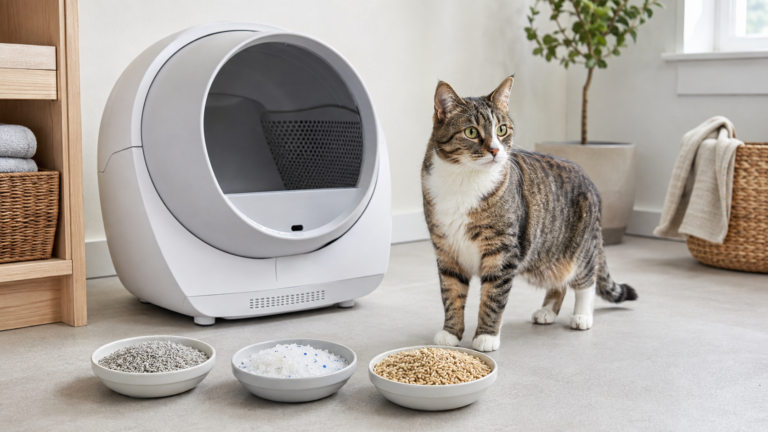
The best self-cleaning litter boxes for cats are not necessarily the models with the longest feature lists. The right choice must fit your cat, available floor space, preferred litter and the amount of routine cleaning you are willing to do.
This guide compares five current automatic litter boxes with clearly documented specifications and distinct use cases. It also explains the limitations that matter before you replace—or supplement—a conventional box.
For background on the technology, read How Do Self-Cleaning Litter Boxes Work?. If you are still deciding whether automation makes sense for your household, see Are Self-Cleaning Litter Boxes Worth It?.
Quick Answer
No single automatic litter box works for every cat. The Litter-Robot 4 offers an established, widely supported all-around design. PETLIBRO Luma and PETKIT Purobot Ultra add camera-based monitoring, while Neakasa M1 Plus and PetSafe ScoopFree SmartSpin suit different needs involving box openness, cat size or entry height.
Which one fits your home:
- Litter-Robot 4: an established all-around option for households that want a wide entry, app monitoring and broad clumping-litter compatibility.
- PETLIBRO Luma: suited to households that value camera-based monitoring and individual recognition for multiple cats in an open-top design.
- Neakasa M1 Plus: an open-top alternative for larger cats or cats that resist enclosed drums.
- PETKIT Purobot Ultra: designed for owners who prioritize automatic waste packing and camera-assisted recognition.
- PetSafe ScoopFree SmartSpin: a comparatively compact, app-connected rotating option with a low entry.
No automatic box is universally best. Check your cat’s weight, mobility, preferred box style and litter before choosing.
Key Takeaways
- Self-cleaning does not mean maintenance-free. You must still empty waste, replenish litter, clean surfaces and inspect sensors and moving parts.
- A machine’s stated waste-bin duration is an estimate, not a guaranteed cleaning interval. Cat count, diet, litter and waste volume affect it.
- Smart usage data can reveal changes in routine, but it cannot diagnose a urinary, digestive or behavioral problem.
- Open and enclosed designs can produce very different acceptance. Cats that dislike covered boxes may prefer an open-top model.
- Keep a familiar conventional box available during the transition. In multi-cat homes, one automated unit may not satisfy every cat.
Best Self-Cleaning Litter Boxes for Cats at a Glance
| Model | Best suited to | Stated cat range | Design | Connectivity | Important limitation |
|---|---|---|---|---|---|
| Litter-Robot 4 | Established all-around automation | 3–25 lb | Enclosed rotating globe | Wi-Fi app | Large footprint and high entry may not suit every cat |
| PETLIBRO Luma | Camera-based multi-cat monitoring | Over 2.2 lb and under 22 lb | Open-top rotating drum | 2.4 and 5 GHz Wi-Fi | Some AI history and analysis require a subscription |
| Neakasa M1 Plus | Large cats and open-box preference | About 2.2–33 lb | Open-top rotating drum | App connected | High entry may challenge cats with limited mobility |
| PETKIT Purobot Ultra | Automated waste packing | 3.3–22 lb | Enclosed rotating drum | 2.4 and 5 GHz Wi-Fi | Proprietary waste-handling supplies add ongoing cost |
| PetSafe ScoopFree SmartSpin | Lower entry and app tracking | Up to 25 lb | Enclosed rotating drum | Wi-Fi app | Confirm litter compatibility and required clearance before buying |
Manufacturer ranges and feature support can change. Recheck the current product page and manual before ordering.
How We Selected These Models
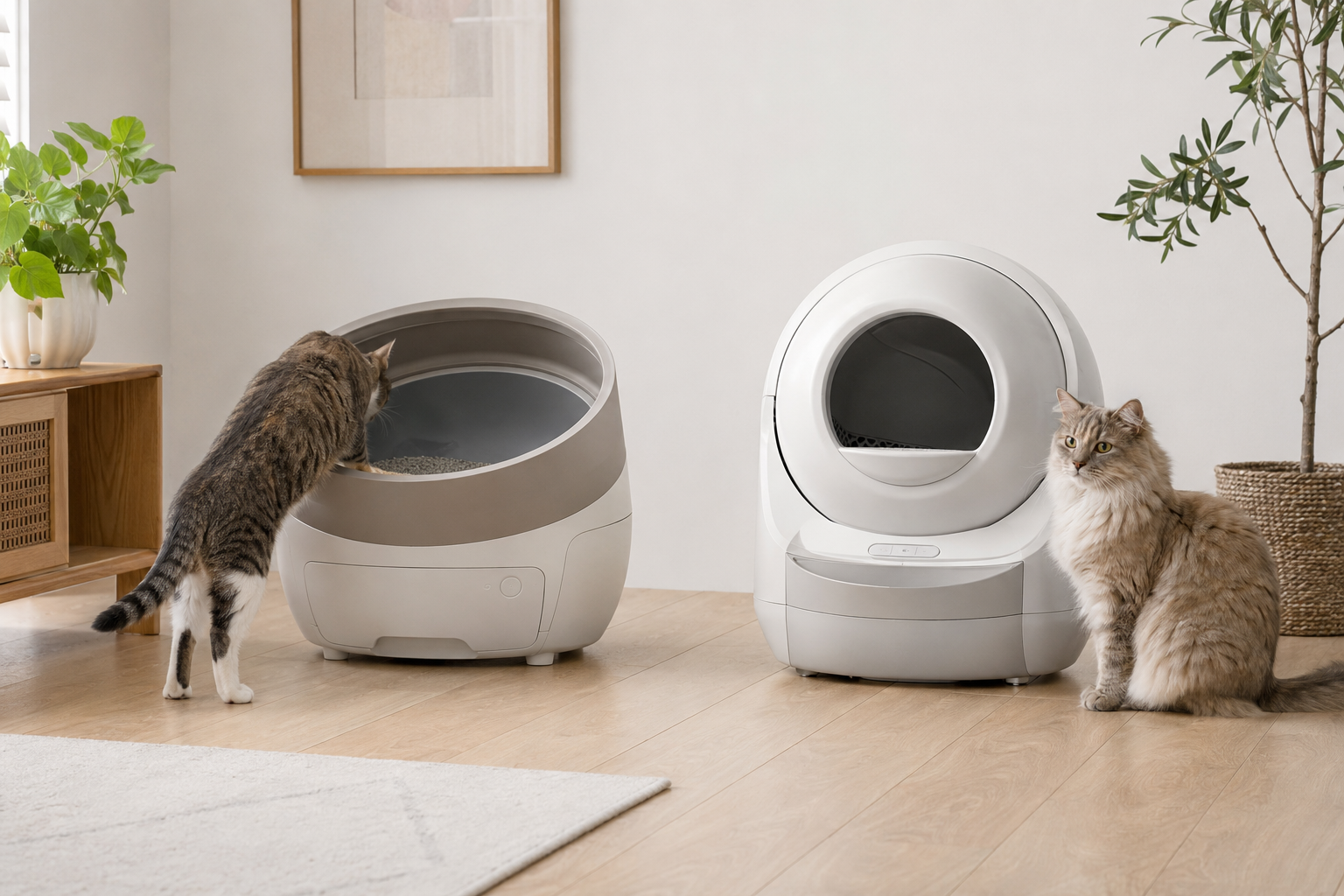
We compared current manufacturer information rather than ranking products by marketplace popularity alone. The shortlist emphasizes:
- documented weight limits and safety detection;
- entry size and open-versus-enclosed design;
- waste-bin capacity and odor-control method;
- supported litter types;
- app, Wi-Fi and subscription requirements;
- cleaning access and ongoing consumables;
- manufacturer documentation and product support.
We removed lightly documented marketplace models from the earlier version of this guide. A lower upfront cost is not compelling when long-term parts, firmware, safety instructions or customer support are unclear.
1. Litter-Robot 4 — Established All-Around Option
Why It Stands Out
The Litter-Robot 4 combines a wide 15.75-inch-square opening with automatic sifting, a sealed waste drawer and app-based usage information. Whisker’s current product page lists it for cats weighing 3–25 lb and says it can support up to four cats per unit.
Its long-established product ecosystem, replacement-part availability and broad support documentation distinguish it from many short-lived marketplace brands. It accepts clumping litter rather than requiring a single proprietary litter formulation.
Key Specifications
| Feature | Manufacturer information |
|---|---|
| Footprint | 22 × 27 inches |
| Height | 29.5 inches |
| Entry | 15.75 × 15.75 inches |
| Empty weight | 24 lb |
| Cat support | Up to four cats; listed cat range of 3–25 lb |
| Litter | Clumping litter; check Whisker’s current compatibility guidance |
| Monitoring | Whisker app, waste-drawer level and usage insights |
| Odor approach | Sealed drawer and carbon filter |
Advantages
- Wide opening compared with many enclosed competitors.
- Extensive documentation and replaceable components.
- Usage and waste-level monitoring through the app.
- Current product information includes a defined 3–25 lb cat range.
Limitations
- It occupies substantial floor space.
- The step and enclosed globe may not suit cats with mobility limitations or a strong preference for uncovered boxes.
- App data and weight readings should be treated as trends, not medical findings.
Verdict
Consider the Litter-Robot 4 when support maturity, a wide entry and a well-documented ecosystem matter more than minimizing size. Measure the complete footprint, not just the globe, and give a cautious cat time to adapt.
View the current Litter-Robot 4 product information on the manufacturer’s website.
2. PETLIBRO Luma — Camera-Based Multi-Cat Monitoring
Why It Stands Out
The PETLIBRO Luma uses an open-top automatic design that combines cleaning with a camera and individual recognition for as many as ten cats. That can help a multi-cat household associate visits and weight trends with the correct pet rather than producing one blended activity log.
PETLIBRO lists weight, visual and infrared sensing plus anti-pinch protection. The unit pauses when it detects a cat. A built-in fan and carbon deodorizer support odor control, while the 11 L waste drawer is rated by the manufacturer for up to seven days with two cats under its test conditions.
Key Specifications
| Feature | Manufacturer information |
|---|---|
| Dimensions | 23.3 × 22.5 × 28.1 inches |
| Empty weight | 33.01 lb |
| Supported cat weight | Over 2.2 lb and under 22 lb |
| Waste drawer | 11 L / 2.9 gal |
| Litter | Clumping clay, tofu and compatible mixed litter |
| Noise | Listed at 35–47 dB |
| Connectivity | 2.4 and 5 GHz Wi-Fi |
| Monitoring | Camera, individual recognition, weight and visit history |
Advantages
- Open-top design and camera-assisted recognition for multi-cat households.
- Works with several clumping-litter types.
- Dual-band Wi-Fi support.
- Multiple detection methods and automatic pausing.
Limitations
- AI analysis and expanded history may require a paid subscription; live view is available without one according to PETLIBRO.
- It must sit on a hard, level floor rather than carpet for reliable weight measurement.
- Non-clumping crystal, pine and some ultra-fine litters are not supported.
Verdict
The Luma is most compelling when distinguishing among several cats is a primary requirement. Confirm the current subscription terms before buying, because the value of its monitoring features depends partly on which history and analysis functions remain available without a plan.
View the current PETLIBRO Luma product information on the manufacturer’s website.
3. Neakasa M1 Plus — Open-Top Option for Large Cats
Why It Stands Out
The Neakasa M1 Plus uses an open-top rotating design instead of a small front opening. That can feel more familiar to cats that avoid covered boxes, and its listed range extends to approximately 33 lb. Neakasa uses six pairs of infrared sensors and four weight sensors to detect a cat and control cleaning.
The 11.23 L waste bin is rated for up to 14 days under the manufacturer’s assumptions. Its Pull & Wrap system is designed to make bag removal more contained, and owners can use fitting bags instead of only one branded refill.
Key Specifications
| Feature | Manufacturer information |
|---|---|
| Design | Open-top rotating drum |
| Supported cat weight | About 2.2–33 lb |
| Entry height | 13.86 inches |
| Waste bin | 11.23 L |
| Litter capacity | 7.17 L |
| Empty weight | 22.81 lb |
| Noise | Listed at 50 dB or less |
| Safety detection | Six infrared-sensor pairs and four weight sensors |
Advantages
- Open top can be easier for cats that dislike enclosed spaces.
- Higher listed maximum weight than most models in this comparison.
- Accepts fitting waste bags.
- Kitten Mode is available for cats below the normal automatic-cleaning threshold.
Limitations
- The 13.86-inch entry remains high for an arthritic or mobility-limited cat.
- Requires fast-clumping, scoopable litter; non-clumping, loosely clumping, newspaper and wood-pellet litter are unsuitable.
- An open design may allow more visible litter tracking than a deeply enclosed unit.
Verdict
The M1 Plus is the clearest option here for a large cat or a cat that strongly prefers an uncovered box. Do not confuse an open top with easy entry: measure your cat’s comfortable step height and consider a stable ramp if the manufacturer permits one.
View the current Neakasa M1 Plus product information on the manufacturer’s website.
4. PETKIT Purobot Ultra — Automated Waste Packing
Why It Stands Out
The PETKIT Purobot Ultra goes beyond automatic sifting by packing and sealing collected waste. Its camera and facial-recognition features are designed to connect litter-box events with individual cats, while a broad sensor system monitors the cleaning area.
PETKIT lists a 10 L waste bin and estimates that it can hold up to 20 days of waste for one cat under its test assumptions. Real emptying frequency will vary and should never override odor, hygiene or waste-level checks.
Key Specifications
| Feature | Manufacturer information |
|---|---|
| Approximate dimensions | 20.94 × 32.20 × 24.09 inches |
| Empty weight | About 32.18 lb |
| Supported cat weight | 3.3–22 lb |
| Waste bin | 10 L |
| Connectivity | 2.4 and 5 GHz Wi-Fi |
| Monitoring | Camera, facial recognition and activity records |
| Waste handling | Automatic packing and sealing |
| Noise | Listed at approximately 35 dB |
Advantages
- Automates both sifting and waste-bag sealing.
- Individual-cat recognition can improve multi-cat records.
- Dual-band Wi-Fi support.
- Extensive sensor-based safety design.
Limitations
- Specialized waste-packing supplies create an ongoing consumables dependency.
- Camera-based observations do not diagnose illness.
- The deep footprint requires careful space planning.
Verdict
Choose the Purobot Ultra primarily for its waste-packing workflow, not simply because it has a camera. Check refill availability and total ownership cost before committing to the system.
View the current PETKIT Purobot Ultra product information on the manufacturer’s website.
5. PetSafe ScoopFree SmartSpin — Compact App-Connected Option
Why It Stands Out
The ScoopFree SmartSpin uses a rotating sifting mechanism, a sealed and deodorized 6 L waste drawer and app-based weight and visit tracking. Its approximately 12-inch entry is lower than several alternatives in this guide, although an individual cat’s mobility and confidence still matter.
PetSafe markets it for multi-cat homes and cats up to 25 lb. The app supports on-demand cleaning and includes controls such as a child lock and weight-change detection.
Key Specifications
| Feature | Manufacturer information |
|---|---|
| Entry height | Approximately 12 inches |
| Supported cat weight | Up to 25 lb |
| Waste drawer | 6 L |
| Litter | PetSafe states broad compatibility; premium clumping litter is recommended for best performance |
| Monitoring | App-based weight, usage and waste information |
| Cleaning | Automatic cycles plus on-demand control |
| Power | Plug-in operation |
Advantages
- Lower entry than several full-size rotating alternatives.
- Sealed, deodorized drawer.
- App tracking and on-demand cleaning.
- Backed by an established pet-product manufacturer.
Limitations
- The 6 L drawer is smaller than the highest-capacity models here.
- A lower entry does not guarantee acceptance by a senior or arthritic cat.
- Litter formulation can still affect sifting performance, even though PetSafe states broad compatibility.
Verdict
The SmartSpin is worth considering when you want app-connected rotating automation without choosing the largest unit in the category. Confirm the assembled dimensions and turning clearance in the latest manual before assigning its location.
View the current PetSafe ScoopFree SmartSpin product information on the manufacturer’s website.
Detailed Comparison
| Model | Open or enclosed | Individual-cat features | Waste approach | Best match |
|---|---|---|---|---|
| Litter-Robot 4 | Enclosed, wide opening | Weight and usage insights | Sealed drawer with carbon filter | Owners prioritizing support maturity and a wide entrance |
| PETLIBRO Luma | Open top | Camera recognition for up to ten cats | 11 L drawer with fan and carbon deodorizer | Multi-cat identification and live viewing |
| Neakasa M1 Plus | Open top | Weight and visit tracking | 11.23 L bin with Pull & Wrap | Large cats and uncovered-box preference |
| PETKIT Purobot Ultra | Enclosed | Camera and facial recognition | Automatic packing and sealing | Reduced contact during waste-bag handling |
| PetSafe SmartSpin | Enclosed | Weight and usage tracking | Sealed, deodorized 6 L drawer | Lower entry and compact connected automation |
How to Choose a Self-Cleaning Litter Box
Start With the Cat, Not the App
Measure your cat’s body length, shoulder height and comfortable step height. A published weight range does not guarantee that the interior is spacious enough. Cornell’s feline guidance notes that larger cats need larger boxes, while kittens, older cats and cats with mobility problems may require low sides. Cornell also notes that many cats prefer uncovered boxes.
See the Cornell Feline Health Center’s house-soiling guidance for broader litter-box placement and preference advice.
Check Litter Compatibility
Rotating sifters usually depend on firm, fast-forming clumps. Pellets, paper, non-clumping crystals and very light litter may pass through the screen incorrectly or coat internal surfaces. Follow the exact current manual; do not assume that every product labeled “cat litter” will work.
Measure the Full Installation Area
Allow room for the power cord, waste-drawer removal, lid or bonnet opening and cleaning access. A unit that technically fits between furniture may be impossible to service. Place weight-sensing models on the hard, level surface specified by the manufacturer.
Examine Safety Behavior
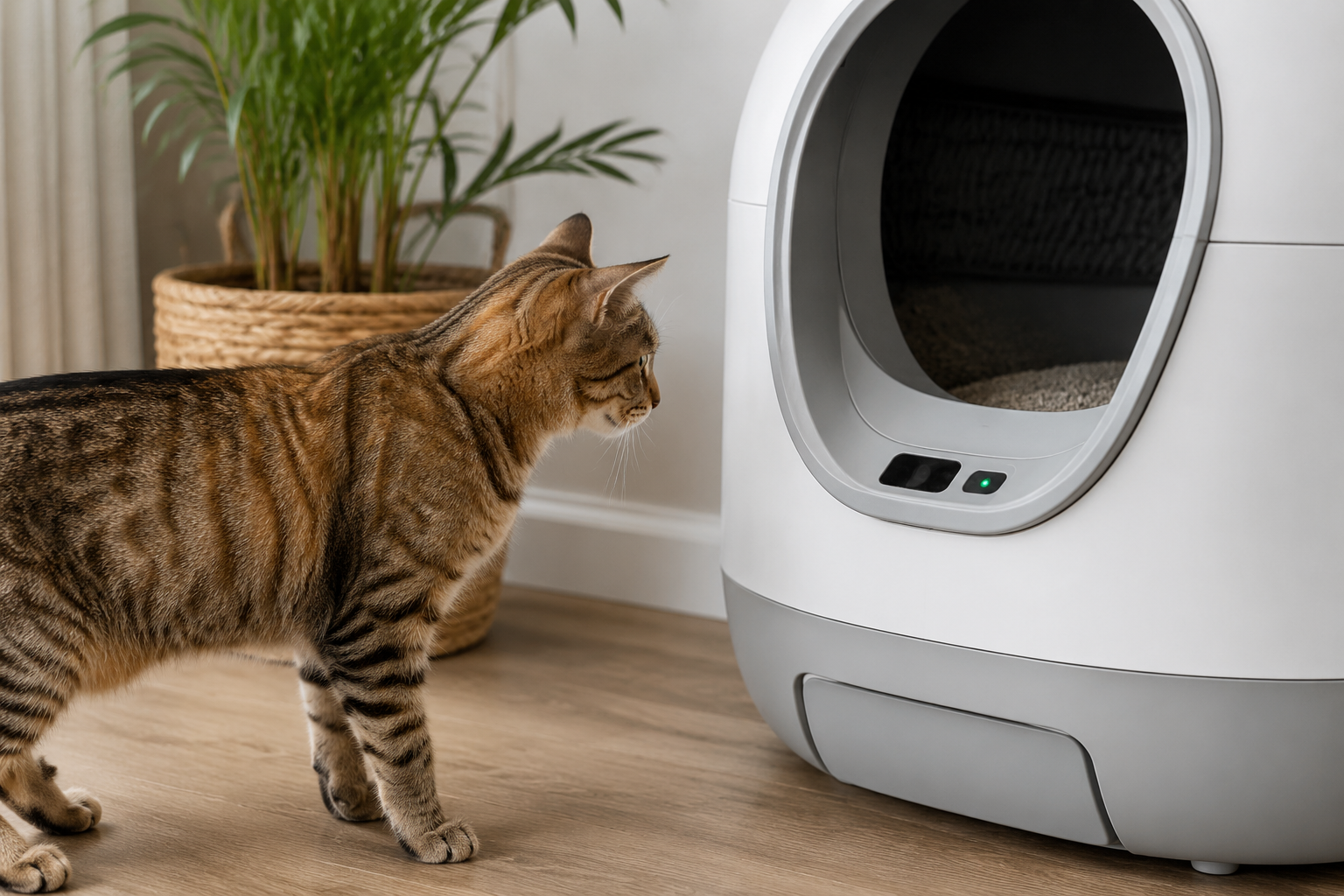
Look for weight, infrared or proximity detection; automatic stopping when a cat approaches; delayed cleaning; manual locks; and a clearly described kitten mode. Never bypass a safety sensor or operate the unit outside its stated cat-weight range.
Calculate Ongoing Requirements
Include replacement bags, filters, deodorizers, cleaners, app subscriptions and proprietary refill systems. Also consider whether replacement parts and technical support are likely to remain available.
Plan a Gradual Transition
Place the automatic unit near the familiar box and initially leave it powered off. Add a small amount of familiar clean litter, allow exploration without forced placement, and activate cycles only after the cat uses it comfortably. Keep the old box available until use is consistent.
Safety and Hygiene Notes
- Remove collected feces regularly even when the drawer is not full. Cornell advises frequent feces removal, plus gloves and handwashing when cleaning a litter box.
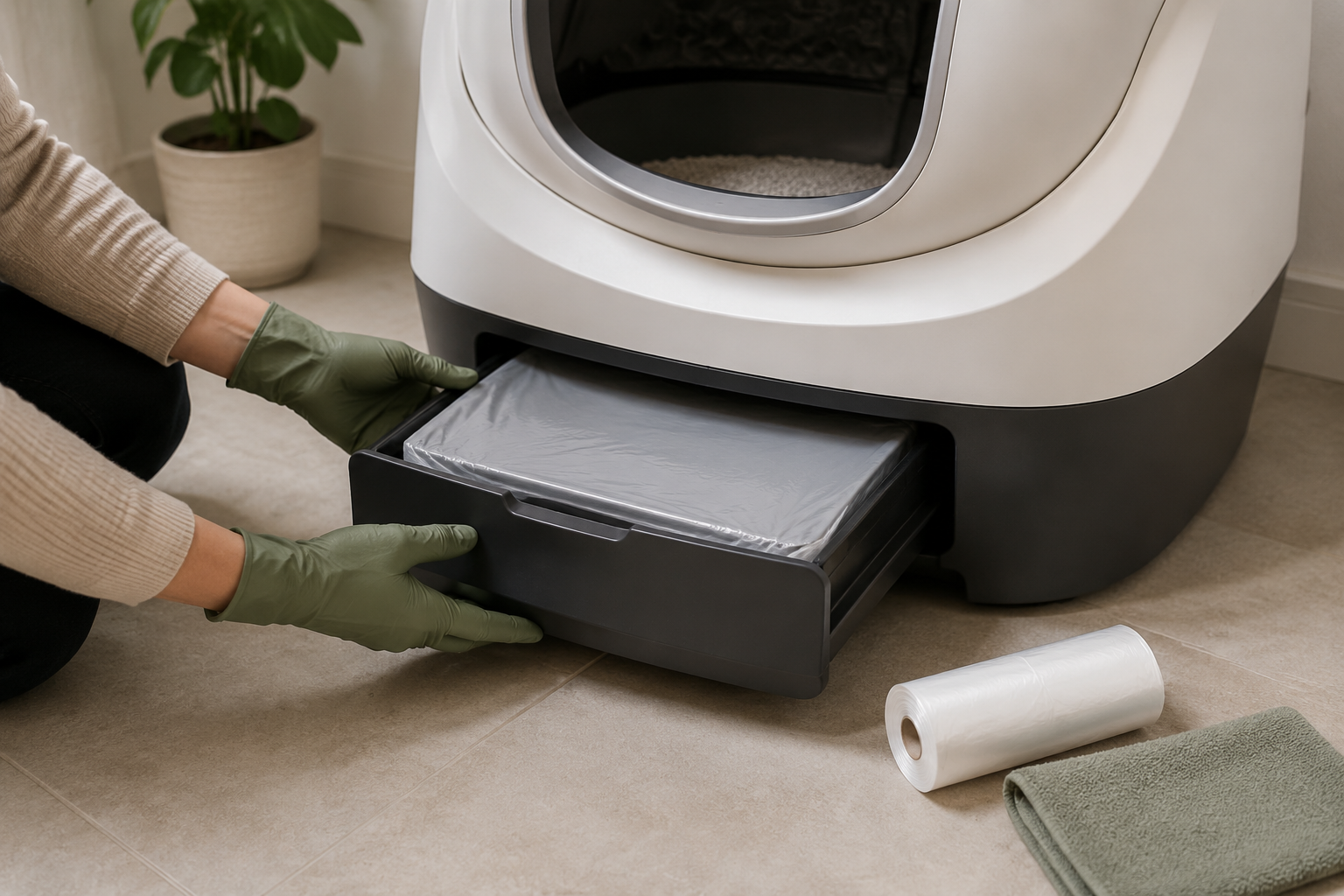
- Disconnect power before deep cleaning unless the manual specifically directs otherwise.
- Do not spray motors, cameras, sensor windows or electrical connections.
- Watch the first several cleaning cycles and verify that the machine stops when your cat approaches.
- Maintain a backup conventional box during outages, faults, travel or transition.
- Sudden changes in urination, defecation, straining, appetite or box avoidance require veterinary attention. Usage alerts are prompts to observe—not diagnoses.
Frequently Asked Questions
Are self-cleaning litter boxes safe for kittens?
Only within the manufacturer’s stated minimum weight and operating instructions. Some products offer a kitten mode that disables automatic cycles, but supervision and a conventional low-sided box remain prudent. Never assume a sensor can reliably detect a kitten below its published threshold.
Can several cats share one automatic litter box?
Some manufacturers support multi-cat use, but capacity is not the only issue. Cats may block or avoid one another, prefer different litter or need separate locations. Cornell’s general recommendation is one litter box per cat plus one extra, placed where each cat can access it. Automation does not automatically remove that behavioral need.
Do automatic litter boxes eliminate odor?
No. Sealed drawers, carbon filters, fans and prompt sifting may reduce exposed waste, but odor still depends on litter, diet, cat count, ventilation and cleaning frequency. A deodorizing claim measured under test conditions may not predict results in your home.
Can I use any litter?
Usually not. Most rotating systems need compatible clumping litter, and each screen has different particle-size limits. Using unsupported litter can cause poor sifting, residue or sensor problems.
How often should I empty and clean the unit?
Empty the drawer when indicated or sooner if odor or soiling appears. Clean the globe, screen, drawer, sensors and surrounding floor according to the manual. Published “up to” durations are capacity estimates rather than hygiene schedules.
Can smart litter-box data detect illness?
It can help reveal a change in visit frequency or weight trend, but it cannot determine the cause. Contact a veterinarian when a change persists or accompanies straining, pain, blood, appetite loss, vomiting, lethargy or box avoidance.
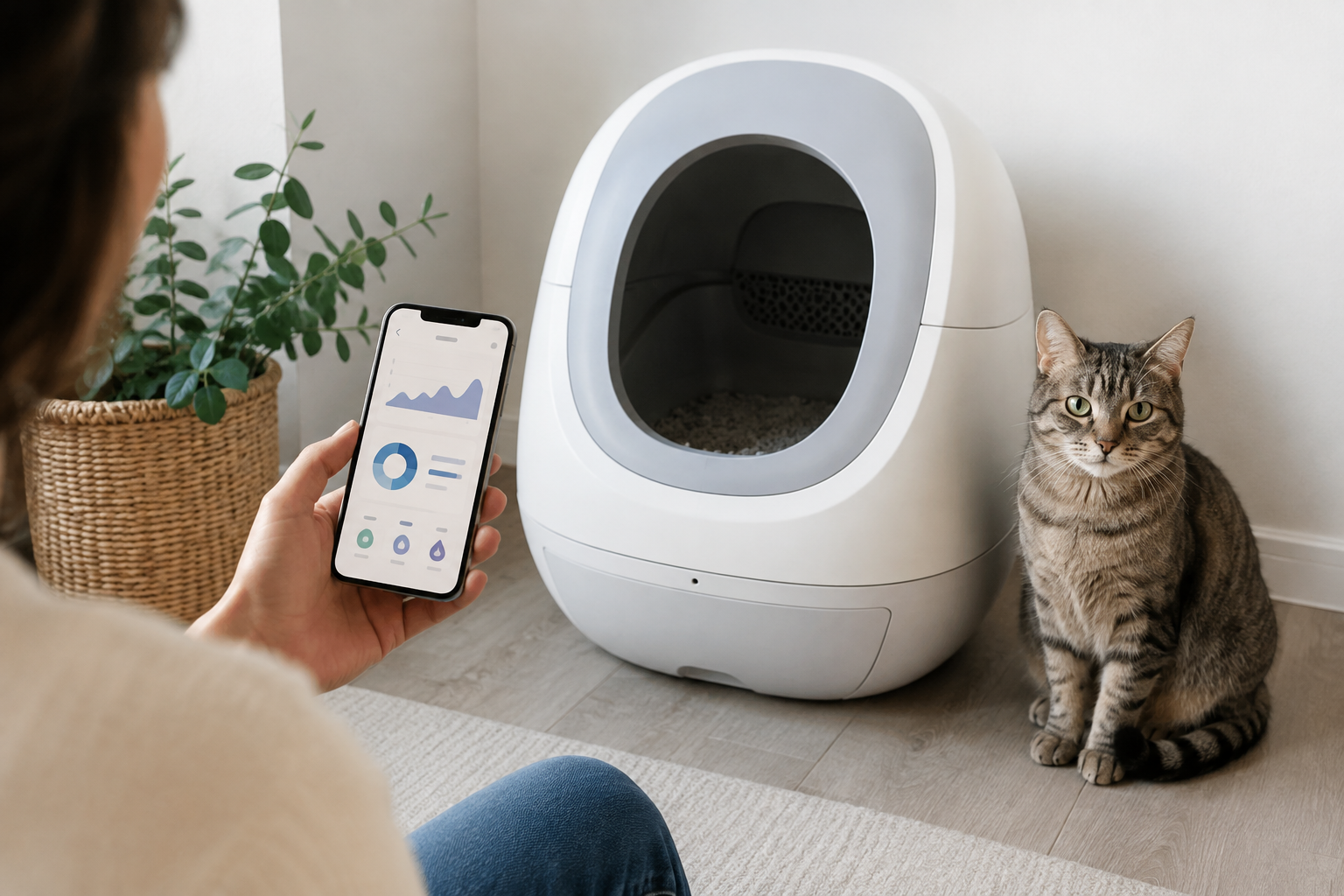
Final Verdict
The best self-cleaning litter boxes for cats serve different needs, so the strongest choice depends on your cat and household:
- Choose Litter-Robot 4 for a wide opening, established support and broad all-around capability.
- Choose PETLIBRO Luma when camera-based identification in a multi-cat home is the central requirement.
- Choose Neakasa M1 Plus for an open top and a higher stated maximum cat weight.
- Choose PETKIT Purobot Ultra when automatic waste packing justifies proprietary consumables.
- Choose PetSafe ScoopFree SmartSpin for a lower entry and a more compact app-connected design.
Whichever model you select, preserve your cat’s choice during the transition and keep checking the box yourself. Automation should reduce repetitive scooping, not replace observation, cleaning or veterinary care.
For a broader connected-care setup, compare the best automatic pet feeders, best smart water fountains and best pet cameras.