Last verified: November 12, 2026 (manufacturer compatibility details for the models named in this guide)
Review basis: Official manufacturer documentation relevant to the models discussed, including product pages, manuals, and support articles. TopPetTech has not conducted hands-on or laboratory testing of the litters or machines discussed.
An automatic litter box separates waste from clean litter with a rotating drum, a screen, a rake, or a purpose-built tray, so the litter has to work with that mechanism. Fast, firm clumps and particles small enough for the machine’s screen matter more than what the bag says. For compatible rotating and sifting models, standard-weight, fast-clumping clay is the usual starting point. Crystal, tofu, and other plant-based litters work only in certain machines, and some machines prohibit them. This guide shows how to choose, test, and introduce a litter that fits your exact model.
Quick Answer
For most rotating and sifting automatic litter boxes, the best choice is a fast-clumping, standard-weight clay litter with small or medium granules. Crystal and plant-based litters work only in some models. Always confirm your machine’s manufacturer guidance before switching, because screen size and sensors differ.
Key Takeaways
- Standard-weight, fast-clumping clay is the most reliable starting point for compatible rotating and sifting machines.
- Crystal and plant-based litters are model-dependent: some machines accept them, some require them, and some prohibit them.
- Pine or wood pellets, paper pellets, and non-clumping litter are unsuitable for most sifting machines.
- Clump strength and particle size affect sifting, and on some models litter weight or color can affect sensor readings.
- Follow your manual’s approved litter list and fill-level requirements.
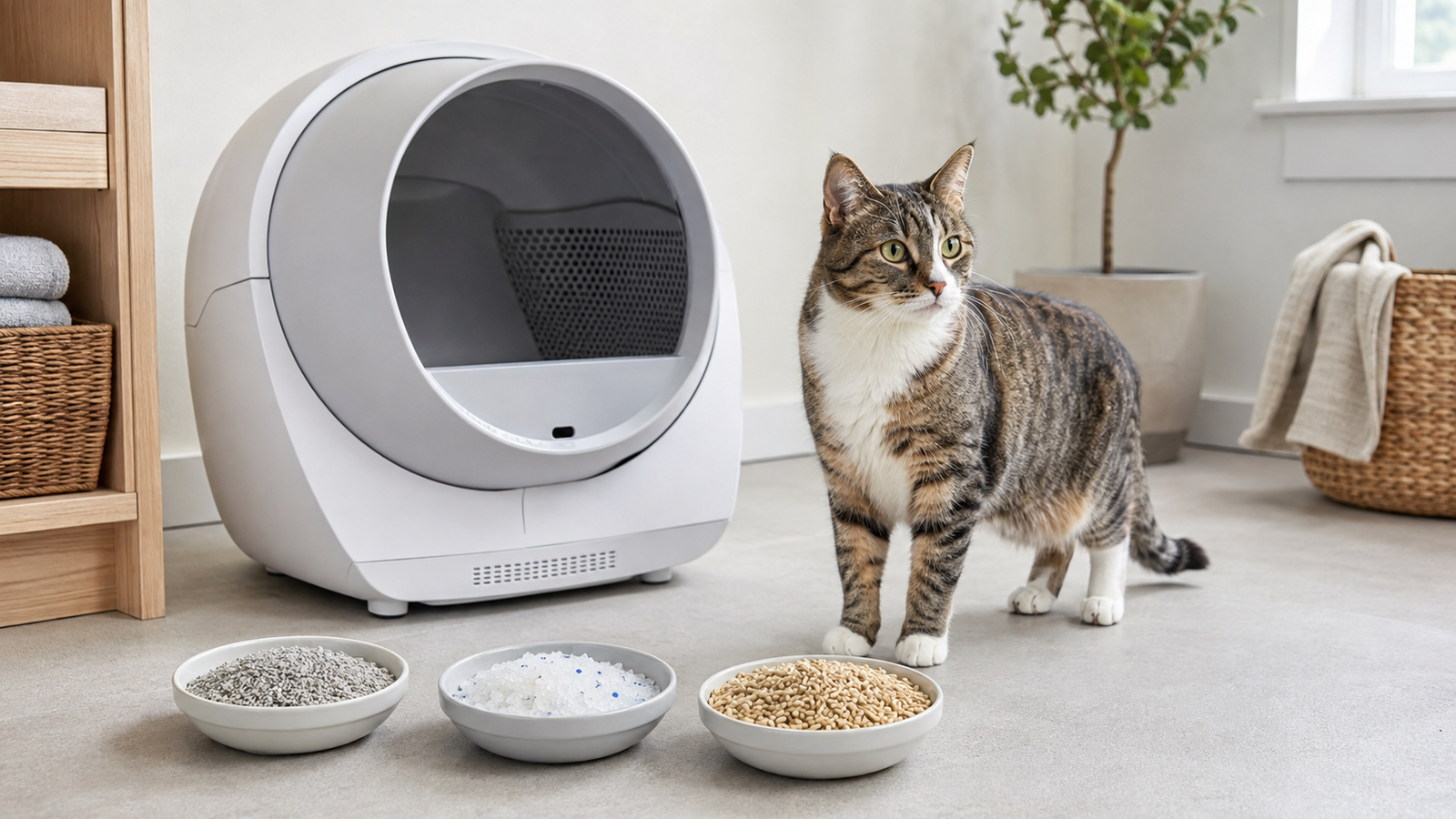
Why Litter Compatibility Depends on the Cleaning Mechanism
The litter is part of the cleaning system. During a cycle, clean granules must separate from soiled litter, so clump strength and particle size decide whether waste is removed cleanly. If clumps crumble or particles do not fit the machine’s openings, clean litter can end up in the waste area, or damp residue can stay behind.
Three common designs handle this differently:
- Rotating or sifting systems: The drum turns so clean granules fall through a screen while clumps stay behind and move to the waste drawer. These need firm clumps and granules small enough to pass through the screen.
- Raking systems: A rake moves through the litter bed to lift out waste. The litter must let the rake move freely, so the manufacturer’s approved litter list matters.
- Crystal-tray systems: A purpose-built tray holds crystal litter, a rake moves waste out of the tray, and the whole tray is replaced when it is used up. These systems expect the designated tray or crystal litter, not ordinary clay.
Machines in the same category can still differ in screen size, sensors, and approved materials. For a fuller explanation of each design, see our guide to how self-cleaning litter boxes work.
What to Look for in Automatic Litter Box Litter
Use these six characteristics to narrow your choices, then confirm them against your model’s manual.
Fast clumping. Litter should absorb urine and form a defined clump before the cleaning cycle starts. If a cycle begins while the litter is still wet, the clump can smear or break apart. Neakasa, for example, recommends fast-clumping litter for its M1.
Firm clump strength. Speed is not enough, because clumps must stay intact when lifted or sifted. Labels such as “hard clumping” are a starting point, not a guarantee. Whisker lists loose-clumping litter among the types that do not work in Litter-Robot.
Compatible particle size. In sifting machines, clean litter must pass through the screen while clumps stay on top. Neakasa states that the M1’s filter handles particles up to about 3 mm in diameter and 10 mm in length. PETKIT advises against litter longer than 12 mm or wider than 3 mm for the Purobot Ultra. These limits vary by model, which is why generic advice cannot replace your manual.
Appropriate weight. Some machines use weight sensors, and Whisker says Litter-Robot 4 uses laser and weight sensors to detect when a cat enters and exits. Whisker recommends standard-weight clay for Litter-Robot. How lightweight litter affects a machine depends on its sensing design, so check the manual instead of assuming either way.
Relatively low dust. Dust can add cleanup work around the unit, but claims such as “low dust” or “99% dust-free” come from the litter maker and are not independent measurements.
Cat acceptance. A litter that works mechanically is no help if your cat avoids it. Changing texture, scent, box type, and location at once is a lot for a cat to accept. Whisker recommends unscented litter for odor control in Litter-Robot, and PETKIT advises keeping the same type of litter your cat already uses when introducing a new box.
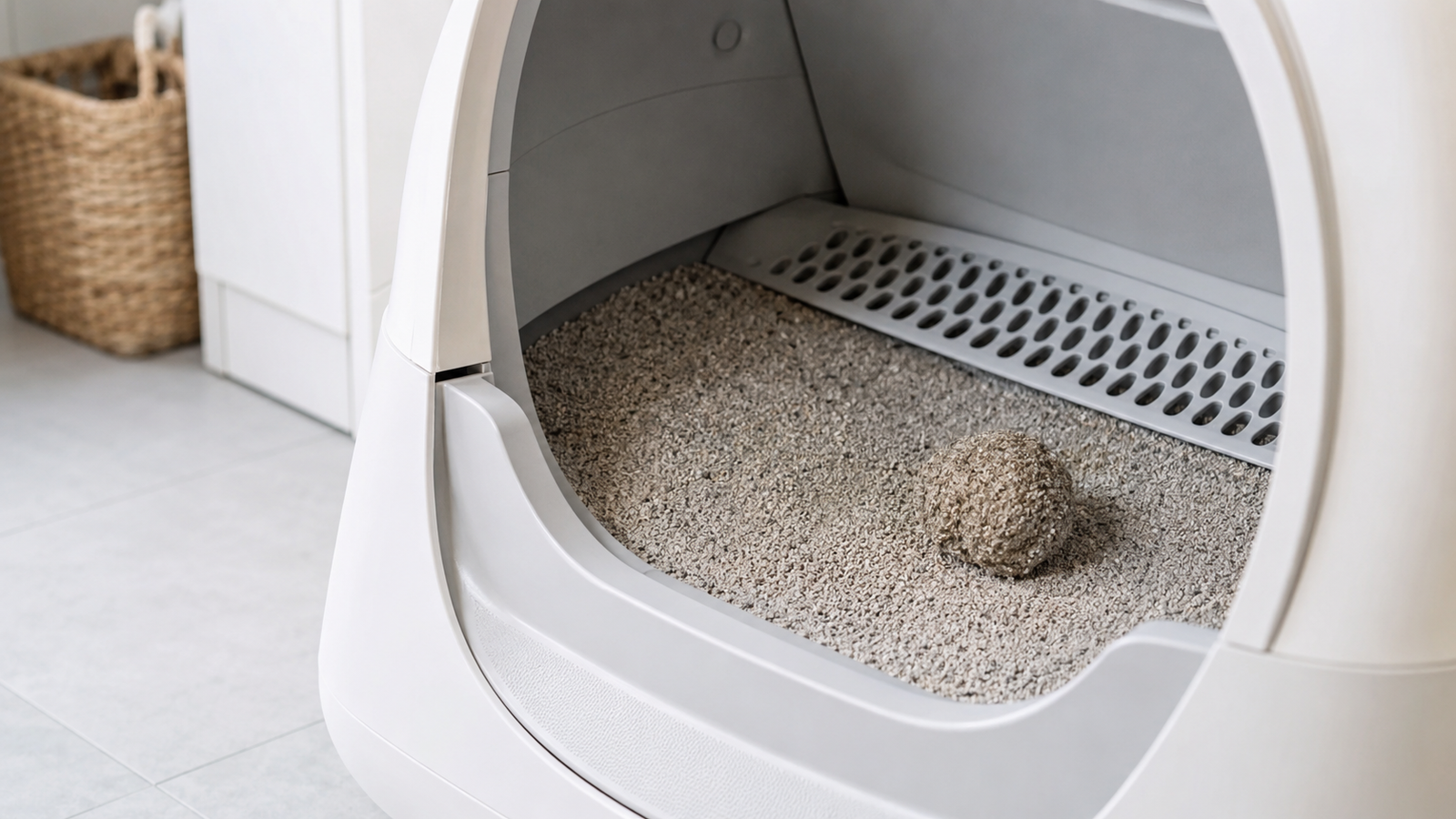
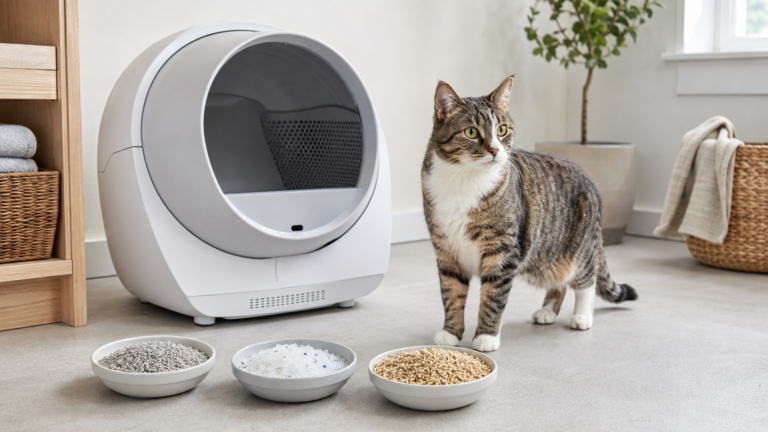
Firm clumps and compatible granule sizes support reliable waste separation.
Comparing Litter Types for Automatic Litter Boxes
These seven categories cover the litters owners most often ask about. Each one’s suitability depends on your machine.
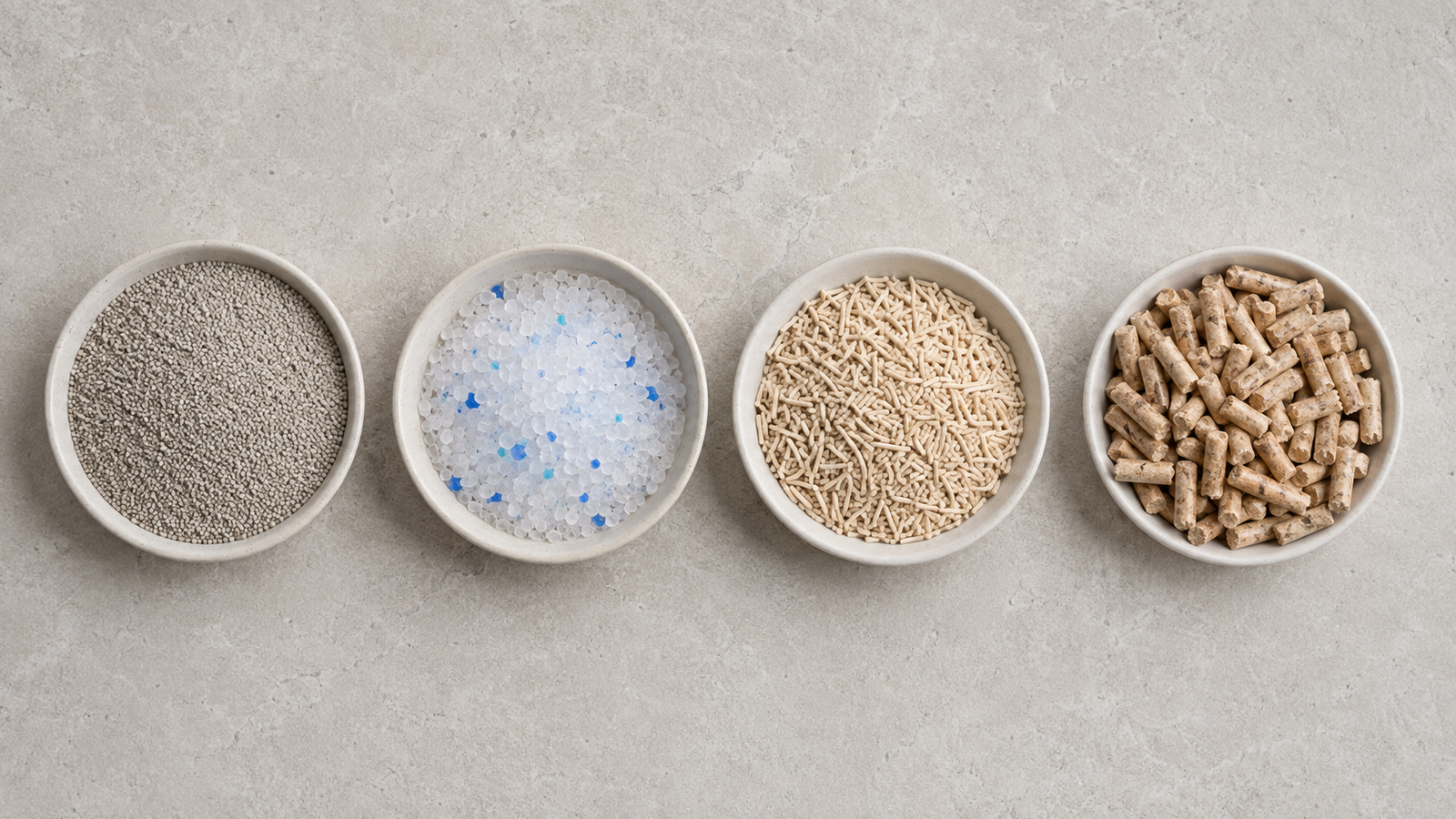
Common litter types differ in particle size, texture, and automatic-box compatibility.
Clumping Clay Litter
For compatible rotating and sifting machines, standard-weight clumping clay is the most dependable starting point. Whisker recommends high-quality, standard-weight, clay-based clumping litter for Litter-Robot, and Neakasa recommends fast-clumping granular bentonite or mineral litter for the M1.
Quality varies between products. Compare clump firmness, granule size, and dust, not just the base material. An unscented or lightly scented formula is a sensible first choice, and you can verify the particle limits in your manual before buying.
Crystal or Silica Gel Litter
“Crystal” covers products that behave differently, so the product type and the machine both matter.
- Absorbent crystal in designated tray systems. These systems are built around crystal litter that absorbs moisture into porous silica rather than forming the removable clumps sifting machines rely on. PetSafe’s ScoopFree crystal trays are designed for ScoopFree crystal litter boxes, where a rake removes waste from the tray, and the tray is then replaced. PETKIT’s Purobot Crystal Duo requires PETKIT’s designated crystal litter and tray and does not support other crystal brands.
- Small silica beads or crystals in some sifting systems. A sifting machine can use silica only if the manufacturer allows it. Whisker says some silica gel beads and crystals can work in Litter-Robot if they pass through the screen, but translucent or white crystals may affect litter-level and Drawer Full Indicator accuracy and are not recommended. Regardless of the silica product, follow the machine manufacturer’s guidance on particle size, clumping requirements, and sensor compatibility.
- Non-clumping crystal in sifting systems. A crystal that only absorbs gives a sifting machine no clump to separate. Whisker and Neakasa both list strictly absorbent or non-clumping litter as incompatible with their machines.
PetSafe describes its crystals as 99% dust-free and low tracking. That is a manufacturer claim. Do not assume one crystal product behaves like another; check the exact product against your model’s manual.
Tofu and Other Plant-Based Clumping Litter
Plant-based litters, including tofu, corn, wheat, and cassava products, appeal to owners who want lighter or renewable alternatives. Compatibility is mixed and depends on the exact machine:
- Neakasa M1: Neakasa’s support article says the M1 does not support tofu litter or mixed litter containing tofu, and recommends fast-clumping, granular litter instead of long strips.
- Litter-Robot 4 and 5: Whisker says plant-based litters typically do not work because they may not filter properly through the sifting system.
- PETKIT Purobot Ultra: PETKIT says the unit includes two sifters that work with most clumping litter within its size limits, and sells separate sifters for tofu-type and finer clay litters.
Because one brand’s restriction does not apply to every machine, check the exact model before buying. Long strips and soft clumps are the most common reasons plant-based litters struggle in a screen-based system.
Pine and Wood Pellet Litter
Wood pellets are designed to absorb moisture and then crumble, rather than form a removable clump. That makes them a poor match for rotating and sifting machines. Whisker lists absorbent wood pellet litter among the types that do not work in Litter-Robot, and Neakasa lists wood pellets as incompatible with the M1.
Pellets suit only a machine the manufacturer specifically designed or approved for them.
Paper Pellet Litter
Paper-based litters are typically absorbent rather than clumping, so they usually cannot produce the firm clumps a sifting screen needs. Whisker and Neakasa both list newspaper-based litter as incompatible with their machines. If you want to use paper litter for any reason, check first whether your model supports it.
Non-Clumping Litter
Conventional non-clumping litter absorbs urine without forming a solid mass. Most rotating and sifting machines rely on removable clumps, and Whisker and Neakasa both list strictly absorbent, non-clumping litter as incompatible. This category includes non-clumping crystal. The exception is a machine designed around it, such as a crystal-tray system.
Lightweight Clumping Litter
Lightweight clumping litter is easier to carry, and some formulas work well. Others may behave differently in a particular machine’s sifting or sensing system. Whisker recommends standard-weight clay for Litter-Robot, while many manuals do not mention weight at all. Rely on your manual’s approved types and particle limits, and test before committing to a large bag.
Automatic Litter Box Compatibility Comparison
Use this table as a starting point. Your machine’s manual takes priority.
| Litter type | Suitable machine type | Main compatibility concern | What to verify |
|---|---|---|---|
| Standard-weight clumping clay | Many rotating and sifting machines | Clump firmness, granule size, dust | Approved litter list and particle limits |
| Small clumping silica crystals | Some rotating or sifting models | Must pass through the screen; translucent or white crystals may affect level readings on some models | Manufacturer’s crystal guidance for your exact model |
| Crystal in purpose-built tray systems | Crystal-tray systems such as ScoopFree crystal and PETKIT Crystal Duo | Use only the designated tray or crystal litter | Required tray or refill type |
| Tofu and other plant-based clumping litter | Model-dependent | Particle shape, soft clumps, and outright prohibitions on some models | Whether your exact model lists it |
| Pine or wood pellets | Usually unsuitable for sifting machines; pellet-specific systems only | Pellets break down instead of clumping | Whether the machine was designed for pellets |
| Paper pellets | Usually unsuitable for sifting machines | Typically absorbent rather than clumping | Manual’s approved types |
| Non-clumping litter, including non-clumping crystal | Usually unsuitable, except machines designed for it | No removable clump | Whether the machine requires clumping |
| Lightweight clumping litter | Model-dependent | Sifting and sensor behavior vary by design | Manual’s litter weight and approved types |
Litter Compatibility by Brand and Model
These are examples of how much compatibility varies, not rankings or recommendations. Even within one brand, models differ. Details below were checked against official US manufacturer pages on November 12, 2026.
Litter-Robot 4 and Litter-Robot 5
Whisker says the best litter for Litter-Robot is clumping clay, and recommends high-quality, standard-weight, clay-based clumping litter. Some silica gel beads and crystals can work if they pass through the screen, but translucent or white crystals may affect litter-level and Drawer Full Indicator accuracy and are not recommended. Whisker adds that plant-based litters typically do not work. It lists strictly absorbent, non-clumping, loose-clumping, newspaper-based, and absorbent wood pellet litters as incompatible.
Whisker’s guidance on the Litter-Robot 4 and 5 pages applies to those models. Do not assume the same list covers other brands or other Litter-Robot models. Official sources: Litter-Robot 4, Litter-Robot 5, and the Litter-Robot 4 FAQ.
Neakasa M1 and M1 Plus
Neakasa documents these two models separately, so they are kept apart here.
M1. Neakasa’s support article says the M1 filter handles litter particles up to 3 mm in diameter and 10 mm in length, and that the M1 supports bentonite and mineral litter. It recommends fast-clumping, granular litter rather than long strips, and says the M1 does not support tofu litter or mixed litter containing tofu.
M1 Plus. Neakasa’s M1 Plus product page gives the same 3 mm by 10 mm filter limit and recommends fast-clumping, granular litter such as bentonite or mineral litter. It lists highly absorbent, non-clumping, loosely clumping, newspaper, and wood pellet litters as incompatible. The page does not address tofu litter, so check the M1 Plus manual before using any tofu product in that model; do not assume the M1’s tofu restriction either applies or does not apply.
Official sources: Neakasa M1 Plus product page and the M1 tofu litter support article.
PetSafe ScoopFree Crystal-Tray Systems
PetSafe’s ScoopFree crystal litter trays are designed for use with ScoopFree crystal litter boxes. Each tray includes pre-portioned crystal litter, and the system’s automatic rake removes waste from the tray, which is then replaced. PetSafe lists ScoopFree crystal litter boxes as the compatible litter box. This guidance does not apply to every PetSafe automatic litter box. Official source: PetSafe ScoopFree crystal litter trays.
PETKIT Purobot Ultra and Crystal Duo
PETKIT’s requirements differ by model, so the details below apply only to the models named. For the Purobot Ultra, PETKIT says the unit includes two sifters that work with most clumping litter, and it advises against litter longer than 12 mm or wider than 3 mm. Those limits are PETKIT’s statement for the Purobot Ultra; do not apply them to other PETKIT models without checking each model’s own page or manual. The Purobot Crystal Duo, by contrast, requires PETKIT’s designated crystal litter and tray, and its manual says not to use other types of litter, including tofu or clay.
Official sources: Purobot Ultra and the Purobot Crystal Duo user manual.
Litter Types and Features to Avoid
Whatever material you prefer, be cautious about these unless your manufacturer approves them:
- Weak or crumbling clumps. Clumps that fall apart when lifted may not survive a cleaning cycle.
- Oversized particles. Long strips, large granules, and full-size pellets may not pass through a screen.
- Excessive dust. Dust can add cleanup work around sensors and moving parts.
- Unsuitable lightweight formulas. Check your manual before assuming a lightweight litter will behave like standard-weight clay.
- Litter that stays damp. Soft, moist clumps can smear or break during a cycle.
- Strong fragrance. Fragrance does not replace proper waste removal. Whisker recommends unscented litter for odor control in Litter-Robot.
Can You Use Regular Litter in an Automatic Litter Box?
Often yes. Whisker says Litter-Robot 4 does not require special litter and works with almost any clumping or scoopable litter, and Neakasa says the M1 is compatible with clumping or scoopable litter. But “regular litter” covers a lot of ground. A standard clumping clay may work very well, while a regular non-clumping or pellet litter may not work at all.
Before buying, check your manual for:
- Whether clumping litter is required
- Any particle-size limits
- Whether crystal, tofu, or other plant-based litters are allowed
- Any litter weight or color cautions
- Whether the machine needs a specific tray or refill
- Any manufacturer warning about unapproved litter
Check guidance for your exact model rather than relying on the brand name alone.
Do You Need the Manufacturer’s Own Litter?
Not always, but it depends on the system.
- Machines that accept compatible third-party litter: Litter-Robot and the Neakasa M1 accept a range of clumping litters within their stated limits.
- Machines that require specific trays, cartridges, or refills: PetSafe’s ScoopFree crystal-tray systems and PETKIT’s Crystal Duo are built around designated crystal trays or litter.
Some manufacturers also recommend their own branded litter. Treat that as a manufacturer recommendation, not independent evidence that it outperforms alternatives. If you are weighing ongoing requirements as part of a purchase, our guide on whether self-cleaning litter boxes are worth it covers the wider ownership picture, and our best self-cleaning litter boxes comparison covers current models.
How Much Litter Should You Add?
Follow the minimum and maximum fill requirements in your machine’s manual. Exact amounts vary by machine, and this guide does not give a universal depth or weight.
- Overfilling can push clean litter into the waste area or interfere with the cleaning cycle.
- Underfilling can leave too little litter to absorb urine and form firm clumps.
- Never run a machine below its stated minimum. Many units mark the fill range on the unit itself, and Neakasa’s M1 materials refer to a scale range you should stay within.
- Replenish as the manufacturer directs, and check the level after the first several cycles with a new litter.
If your machine reports litter level in an app, treat the manufacturer’s range as the target.
How to Test a New Litter Safely
Do not simply fill the machine and hope. Use this sequence:
- Check the manual. Confirm the approved litter types and particle dimensions.
- Examine a dry sample outside the machine. Look at granule size and shape against the manufacturer’s limits.
- Optionally check clumping in a separate tray. Add a little water to a small sample and see whether it forms a cohesive clump. This outside-the-machine test can only show whether a litter clumps at all. It cannot establish machine compatibility, long-term performance, or safety, and water does not reproduce cat urine. Only your manufacturer’s guidance and a supervised test in the machine address compatibility.
- Fill to the permitted level. For an operational test, fill the machine to the level its manual allows.
- Run a supervised manual cycle. If your machine offers a manual cycle, run one with your cat safely outside the machine.
- Inspect the results. Check the waste drawer, screen, clumps, and any error indicators.
- Stop if something is wrong. Stop testing if the machine shows unusual resistance, clogging, or errors.
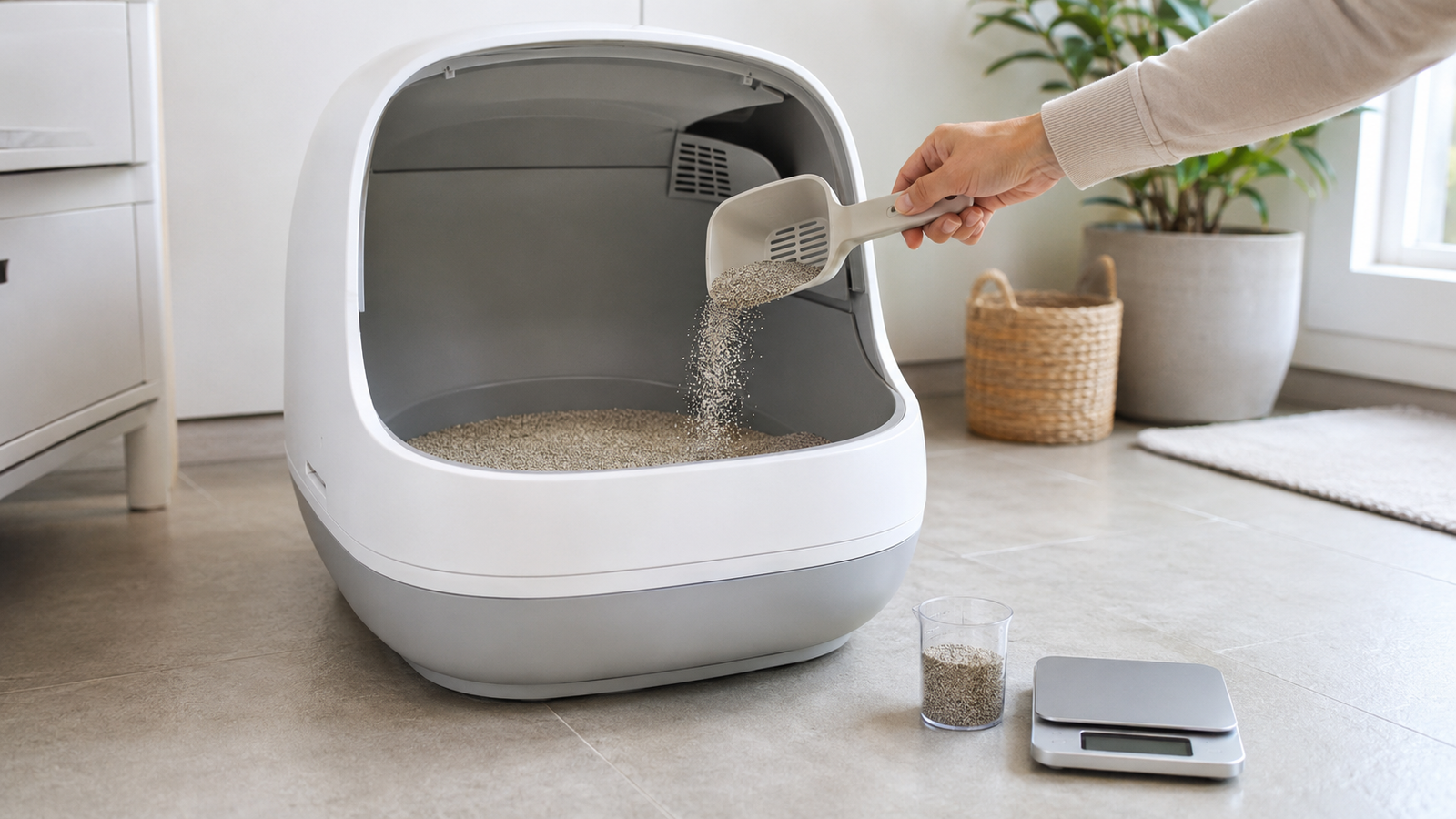
Check a small sample outside the machine before filling an automatic litter box.
How to Transition Your Cat to New Litter
Cats often prefer familiar textures and smells, and a sudden change can lead to litter-box avoidance, especially when the box is new too. Whisker recommends placing the Litter-Robot where the old box was, keeping the old box nearby for a short time, mixing a cup of familiar litter into the clean litter, and leaving the unit off until your cat has used it. Neakasa suggests manual cleaning for the first few days for timid cats.
A gradual process works for most households:
- Place the automatic box in or near the old litter box’s location.
- Fill it with a compatible litter your cat already knows, if your manual allows.
- Keep the old box available during the early transition.
- Leave automatic cleaning off at first only if your manual says that is safe for your model.
- Let your cat investigate without forcing it inside, and reward approaches with praise or treats.
- Run cleaning cycles while your cat is elsewhere.
- Turn on automatic operation once your cat is using the box comfortably.
If you also need to change litters, introduce the new one gradually and avoid changing the box, litter, and location on the same day. Never punish a cat for avoiding the new machine. Persistent avoidance or unusual elimination can have medical causes, so consult a veterinarian if it continues.
Common Litter Mistakes
Three avoidable mistakes often cause litter-related problems:
- Setting the cleaning delay too short. If clumps are smearing or breaking, they may need more time to firm up. Where your model allows it, adjust the delay within the manufacturer’s range. Whisker’s Litter-Robot 4 and 5 pages, for example, list an adjustable delay of 3 to 30 minutes after use.
- Mixing incompatible litters. Combining a suitable granular litter with long pellets or a weak-clumping formula can disrupt sifting. If you mix litters during a transition, confirm that both are permitted for your machine.
- Ignoring the waste drawer. Automatic cleaning does not remove the need for maintenance. Empty the drawer as directed and check for damp residue.
Common Automatic Litter Box Problems Caused by Litter
When a machine wastes clean litter, leaves residue, or breaks clumps, the litter may be part of the cause. These are possible causes, not confirmed diagnoses. Mechanical faults, sensor contamination, and maintenance problems can also be responsible.
| Symptom | Possible litter-related cause | Practical action |
|---|---|---|
| Litter sticks to globe | Weak clumping, short cleaning delay, or shallow litter bed | Check litter, delay setting, and liner |
| Clean litter enters waste drawer | Oversized granules, incorrect fill level, or unsuitable litter | Verify particle size and fill level |
| Clumps crumble | Weak clump strength or premature cleaning | Review litter suitability and permitted delay |
| Excessive dust | Dusty litter formula | Consider a compatible lower-dust product |
| Persistent odor | Incomplete waste separation, damp residue, or overdue maintenance | Inspect litter and waste drawer |
| Sensor or litter-level errors | Possible material, weight, or optical-reading issues | Consult model-specific troubleshooting guidance |
Frequently Asked Questions
What is the best cat litter for an automatic litter box?
For most rotating and sifting machines, a fast-clumping, standard-weight clay litter with small or medium granules is the most reliable starting point. Your manufacturer’s compatibility requirements decide the final choice.
Can I use any clumping litter?
No. Some clumping litters form soft clumps, use oversized particles, or behave differently in a particular machine. Confirm the approved litter types in your manual and test before buying a large bag.
Can I use crystal litter?
Only in compatible machines. Some systems are designed around crystal trays, while some rotating machines accept small crystals that pass through the screen. Whisker warns that translucent or white crystals may affect level readings in Litter-Robot.
Does tofu litter work?
It depends on the machine. PETKIT’s Purobot Ultra has a sifter for tofu-type litters, but Neakasa says the M1 does not support tofu litter, and Whisker says plant-based litters typically do not work in Litter-Robot.
Can I use pine pellets?
Usually not. Wood pellets typically break down instead of forming clumps, and both Whisker and Neakasa list them as incompatible. Use them only in a machine designed or approved for pellets.
Is lightweight litter suitable?
It is model-dependent. Whisker recommends standard-weight clay for Litter-Robot, while other manuals may not mention litter weight. Check your manual.
Why does litter stick to the globe?
Possible litter-related causes include slow or weak clumping, a short cleaning delay, or a shallow litter bed. A dirty liner or other maintenance issue can also be responsible, so check your manual’s troubleshooting section.
How often should I replace the litter?
Manufacturers set their own schedules, and the right interval depends on the machine, number of cats, and litter. Follow your manual and top up as directed. If odor or dampness persists despite normal waste-drawer maintenance, contact the manufacturer about a full change.
Final Verdict
- Rotating and sifting machines that accept it: start with standard-weight, fast-clumping clay within your machine’s particle limits.
- Crystal-tray systems: use the designated crystal tray or litter.
- Tofu and other plant-based litters: use them only if your exact model lists them, because some models prohibit them.
- Always: follow your manufacturer’s instructions and watch whether your cat accepts the litter.
The best litter is the one that works reliably in your machine, suits your cat, and keeps waste separation clean without extra maintenance.
How We Researched This Guide
This guide is based on official manufacturer documentation relevant to the models discussed, including product pages, manuals, and support articles. Manufacturer details were checked on November 12, 2026. TopPetTech has not conducted hands-on or laboratory testing of the products discussed, and the examples above are not rankings. Statements attributed to a manufacturer are the manufacturer’s claims, and the editorial advice on testing and transition reflects those instructions and general practice, not original testing.
Primary sources