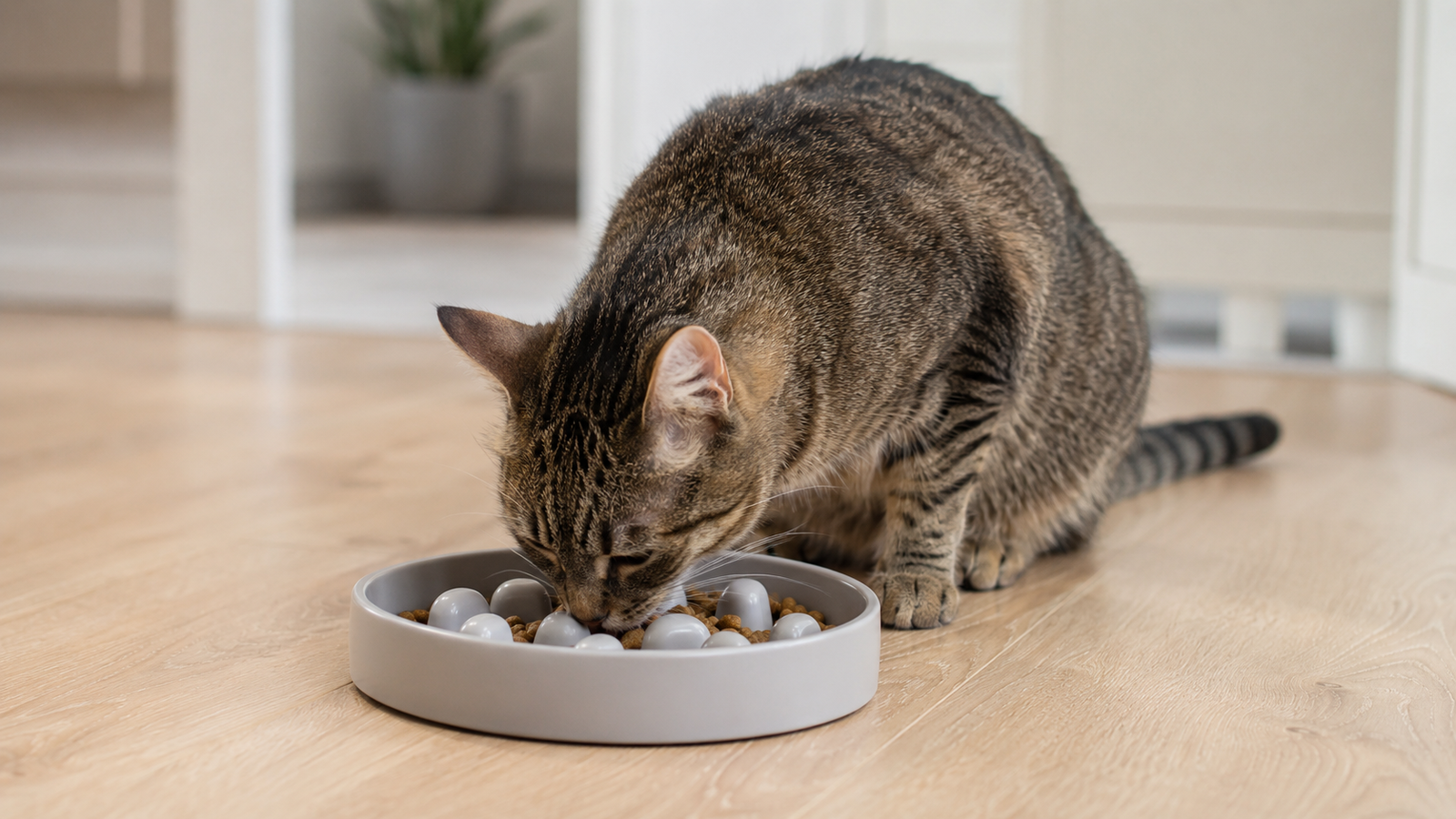
If your cat finishes dinner in seconds, pushes another cat away from its bowl, or brings food back up soon after eating, a cat slow feeder may be worth considering. These bowls use ridges, channels, pockets, or textured surfaces to make food less accessible all at once. The goal is simple: encourage the cat to take smaller mouthfuls and pause during the meal.
A slow feeder is not a treatment for vomiting, a guaranteed weight-loss tool, or a substitute for veterinary care. It also cannot decide how much food your cat needs. However, the right design may help some rapid eaters consume a measured meal more gradually while providing a degree of feeding enrichment.
This guide explains how slow feeders work, which cats might benefit, the differences between bowls, mats, puzzles, and automatic feeders, and how to choose and introduce one without making meals unnecessarily frustrating.
Quick Answer: What Does a Slow Feeder Cat Bowl Do?
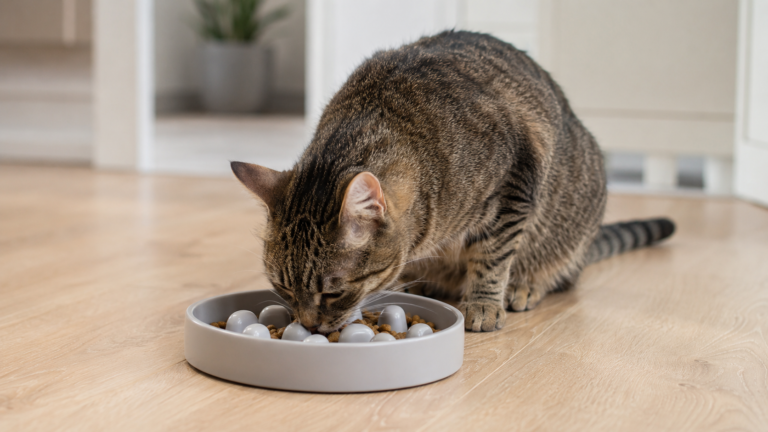
A slow feeder cat bowl spreads food across grooves, ridges, compartments, or other obstacles so a cat cannot take several large mouthfuls in quick succession. Some cats eat around the pattern, while others use a paw to retrieve individual pieces. For wet food, a textured mat or shallow bowl can encourage more licking and smaller bites.
The design may help a cat eat more slowly, but results vary. A bowl that is too easy may make little difference; one that is too difficult may cause frustration or discourage eating. Begin with a simple design, supervise the first meals, and confirm that your cat can comfortably obtain its full measured portion.
Key Takeaways
- Slow feeders restrict access to food rather than reducing the cat’s daily allowance.
- They may help some cats that gulp food, compete at mealtimes, or regurgitate soon after rapid eating.
- Maze bowls, lick mats, puzzle feeders, portion trays, and automatic feeders slow meals in different ways.
- Wet food generally works better with shallow grooves or lickable surfaces; deep puzzles are often better suited to dry food.
- The easiest design that produces a useful slowdown is usually preferable to an unnecessarily difficult puzzle.
- A slow feeder must be stable, appropriately sized, easy to clean, and inspected for damage.
- Vomiting and regurgitation are not the same, and recurring episodes require veterinary assessment.
- Slower eating does not automatically mean fewer calories. The complete daily allowance must still be measured.
What Is a Slow Feeder Cat Bowl?
A conventional bowl places the full meal within easy reach. A slow feeder for cats changes that access by making the full meal less immediately available. Raised patterns divide the food into smaller areas, narrow channels limit how much the cat can reach at once, and textured mats spread wet food over a wider surface.
Some products called slow feeders are closer to food puzzles. The cat may need to move kibble through a channel, scoop it from a cup, rotate a component, or bat a mobile toy. These devices can lengthen mealtime and introduce hunting or foraging behavior, but they demand more problem-solving than an ordinary ridged bowl.
The Feline Veterinary Medical Association’s feeding consensus statement recommends feeding programs that accommodate normal feline behaviors such as hunting, foraging, eating frequent small meals, and eating separately in multi-pet homes. Slow feeders and food puzzles can support parts of that approach, provided they suit the individual cat.
Which Cats Might Benefit From a Slow Feeder?
A slow feeder may be useful when a cat consistently finishes a measured meal extremely quickly or appears to swallow repeated mouthfuls without pausing. It may also be worth discussing with a veterinarian when rapid eating is associated with regurgitation.
Other possible situations include:
- a cat that becomes highly excited when food appears;
- a cat that rushes because another pet is nearby;
- a former stray or food-insecure cat that guards meals;
- an indoor cat that may benefit from more feeding enrichment;
- a cat receiving a measured weight-management diet under veterinary direction; or
- a cat whose daily allowance is being divided into smaller meals.
Not every enthusiastic eater needs a specialized bowl. Some cats slow down when food is spread over a wide plate, meals are served in a quieter location, or competition from other pets is removed. Before buying anything, observe the feeding environment and consider why the cat may be rushing.
Why Does My Cat Eat Too Fast?
Fast eating is a behavior, not a diagnosis. Several factors can contribute, and more than one may be present.
Food competition
A cat may hurry when another animal can approach its bowl. Even when there is no fighting, watching another cat eat nearby can create pressure. Separate, visually divided feeding stations are often more useful than giving only one cat a difficult bowl.
A learned feeding pattern
Cats can learn to anticipate meals and consume them rapidly, particularly when meals are widely spaced or the household routine is unpredictable. Dividing the established daily allowance into smaller scheduled meals may help some cats.
High food motivation
Some cats are naturally enthusiastic about food. Others may have learned to eat whenever food is available because of earlier scarcity. A slow feeder can change access, but calm routines and environmental management may also be needed.
Boredom or limited enrichment
An interactive feeder can make obtaining food more engaging. A peer-reviewed review of food puzzles for cats describes their potential physical and emotional benefits while also noting that the feline evidence base is still developing. We should therefore treat enrichment as a potential benefit, not a guaranteed outcome.
A health-related increase in appetite
A sudden or unexplained increase in appetite should not be managed with a more difficult bowl alone. Medical conditions can change hunger, weight, thirst, and eating behavior. Arrange veterinary advice when rapid eating is new, extreme, or accompanied by weight change, increased thirst, diarrhea, vomiting, weakness, or other concerning signs.
Are Slow Feeders Good for Cats, and Do They Really Work?
They can slow access to food, but effectiveness depends on the cat and the design. VCA Animal Hospitals notes that fast eating can sometimes contribute to regurgitation and suggests interactive toys or feeders as one way to prolong mealtimes and provide mental stimulation.
A useful slow feeder should create pauses without preventing the cat from eating an appropriate meal. It should not rely on sharp corners, unstable pieces, or spaces that trap the cat’s nose, tongue, teeth, or paws.
Results should be judged practically:
- Does the meal take noticeably longer than it did in the ordinary bowl?
- Can the cat reach the complete measured portion?
- Does the cat remain calm rather than walking away frustrated?
- Is less food scattered outside the feeding area?
- Are episodes of bringing food back up becoming less frequent?
- Can the feeder be cleaned thoroughly after every use?
There is no universal number of minutes that defines a successful cat meal. Compare your cat’s own supervised meals before and after introducing the feeder instead of aiming for an arbitrary time.
Slow Feeder Cat Bowl Types Compared
Different products may all be labeled “slow feeders,” even though they ask very different things of the cat.
| Type | How it slows eating | Food suitability | Difficulty | Important limitation |
|---|---|---|---|---|
| Gentle ridge bowl | Separates food with low ridges or waves | Wet or dry, depending on design | Low | May not sufficiently slow a determined cat |
| Deep maze bowl | Requires eating around taller channels | Usually dry; some accept wet food | Moderate | Deep spaces may be difficult to reach and clean |
| Lick mat | Spreads soft food across a textured surface | Wet food or suitable soft food | Low to moderate | Must be washed thoroughly after use |
| Stationary puzzle feeder | Requires pawing, scooping, or moving food through compartments | Usually dry food | Moderate to high | Some cats need gradual training |
| Mobile food toy | Releases individual pieces when moved | Dry food or treats | Moderate to high | Can roll under furniture and scatter food |
| Portion tray | Separates one meal into several small sections | Wet or dry | Low | Does not necessarily slow a cat that empties sections quickly |
| Automatic feeder | Releases measured portions at scheduled times | Depends on feeder type | Not a physical eating obstacle | Smaller portions do not slow eating within each portion |
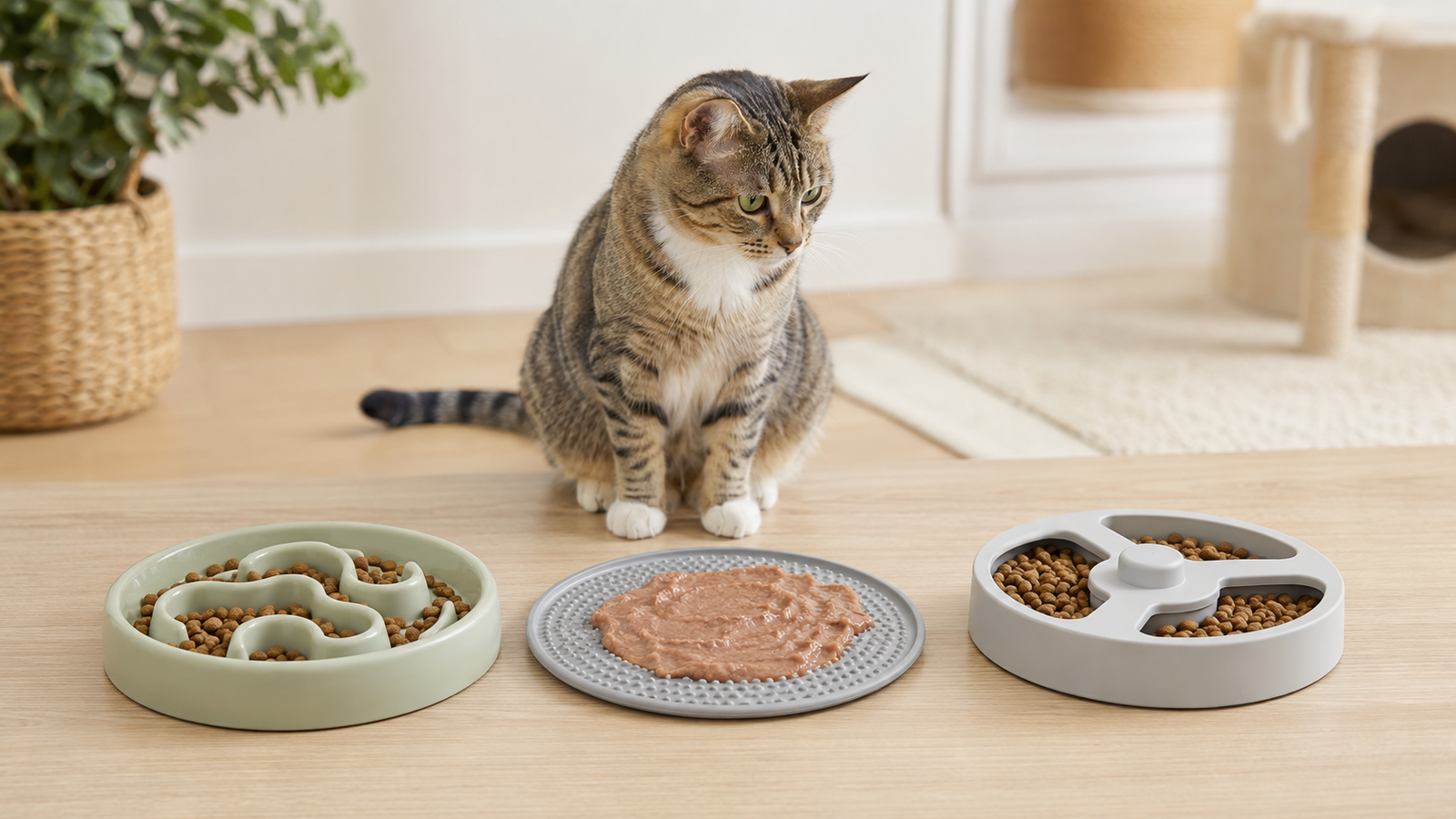
The categories overlap. A stationary puzzle may also function as a slow feeder, and a textured mat can provide both licking activity and slower access.
How to Choose a Slow Feeder Cat Bowl
The most complex-looking bowl is not automatically the best. Match the design to your cat’s food, physical comfort, persistence, and previous experience.
1. Start with suitable difficulty
For a first slow feeder, consider gentle ridges, broad channels, or a shallow textured surface. The cat should be able to see and smell the food and obtain it with modest effort. Difficulty can be increased later if the first design makes no meaningful difference.
Kittens, senior cats, and cats with dental, mobility, or other physical limitations may need a particularly simple and accessible design. Watch whether the cat can reach the entire measured meal comfortably rather than assuming a more difficult pattern is better.
2. Check width and depth
A wide feeding surface gives a cat room to approach food from different angles. Narrow or deep compartments may make access difficult for some cats. Observe facial contact and posture rather than assuming that one shape suits every cat.
Claims about “whisker fatigue” are common, but the concept is not firmly established as a clinical diagnosis. It is still reasonable to respect an individual cat’s preference for a wide, shallow surface when that preference is clearly observable.
3. Match the feeder to the food
Dry kibble can move through channels, cups, and dispensing toys. Wet food is usually easier to spread across shallow grooves or a lick mat. Check the manufacturer’s instructions rather than assuming every design can safely handle both.
4. Choose an appropriate capacity
The feeder must hold the cat’s measured meal without overflowing. Capacity should not determine portion size. Establish the daily allowance first and use the bowl only to change how the food is accessed.
For help dividing that allowance into suitable meals, see our guide to how often you should feed a cat.
5. Look for stability
A non-slip base or sufficiently stable design helps prevent the cat from pushing the feeder across the floor. Stability is particularly important for products that require pawing or licking.
6. Prioritize cleanability
Inspect the grooves, corners, seams, and removable pieces. A bowl that theoretically slows eating but retains food residue is a poor everyday choice. Confirm whether the product can be disassembled and whether the manufacturer permits dishwasher cleaning.
7. Inspect materials and construction
Look for clear manufacturer information about materials and intended food use. Regardless of material, replace a product that becomes cracked, deeply scratched, chipped, warped, or impossible to clean. Avoid loose decorative pieces that a cat could remove.
Slow-feeder selection checklist
| Feature | Why it matters | Warning sign |
| Appropriate difficulty | Produces pauses without blocking the meal | Cat cannot retrieve enough food or gives up |
| Wide, accessible surface | Allows a comfortable approach | Persistent awkward posture or facial rubbing |
| Food compatibility | Keeps wet or dry food usable as intended | Food packs into unreachable spaces |
| Stable base | Reduces sliding and tipping | Bowl moves, flips, or spills repeatedly |
| Simple cleaning | Limits residue in grooves and seams | Odor, trapped food, or inaccessible corners |
| Suitable capacity | Holds the measured meal | Food piles above the slowing pattern |
| Durable construction | Supports safe repeated use | Cracks, chips, detached pieces, or sharp edges |
Slow Feeders for Wet Food vs. Dry Food
Dry food
Kibble works with the widest range of designs, including maze bowls, digging cups, rolling toys, and adjustable puzzles. Kibble size matters: pieces that are too large may jam in narrow channels, while very small pieces may pass through too easily.
Do not assume the bowl is controlling calories. Weigh or measure the complete meal before placing it in the feeder. If an automatic feeder is part of the routine, our automatic feeder portion-accuracy guide explains how to test several dispensing cycles instead of trusting the display alone.
Wet food
Shallow ridge bowls and lick mats generally make it easier to spread wet food in a thin layer. Very deep maze patterns can push food into corners that are difficult for the cat to reach and difficult for the owner to clean.
Serve a measured portion and follow the food manufacturer’s storage guidance. Wash the feeder after the meal rather than continually adding fresh food over residue. If food must be served automatically, use equipment specifically designed for perishable food. Our guide to using wet food in an automatic feeder explains the main feeder types and food-handling considerations.
How to Introduce a Slow Feeder Without Frustrating Your Cat
A sudden switch from an open bowl to a complicated puzzle can make a cat reluctant to eat. Introduce the new feeder gradually.
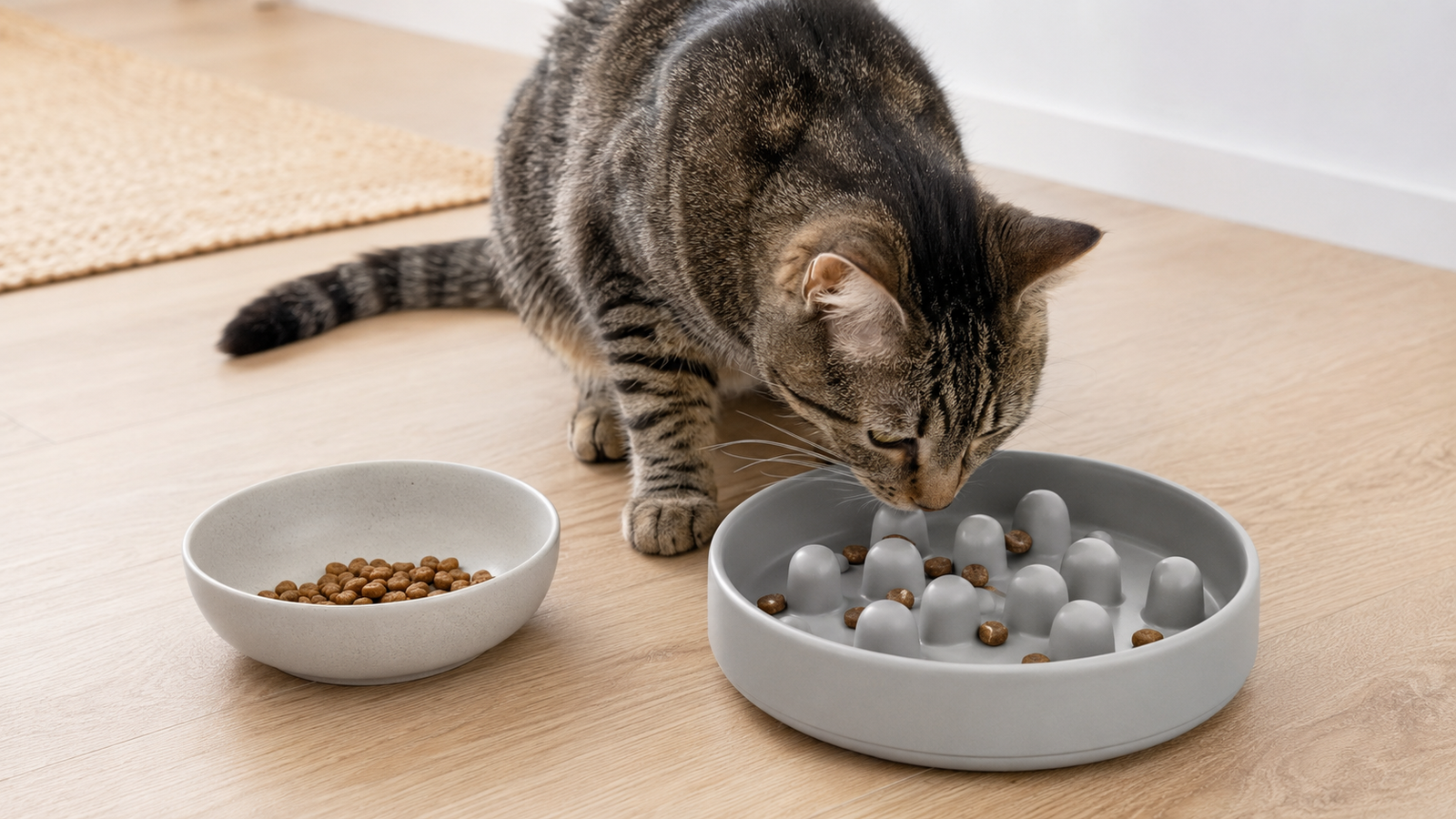
- Wash and inspect it. Remove packaging smells and confirm that no parts are loose or damaged.
- Place it near the normal feeding location. Let the cat investigate it before expecting a complete meal from it.
- Begin with an easy setup. Put food on the most accessible areas rather than packing it into every difficult groove.
- Use familiar food. Avoid changing the food and feeding device simultaneously unless necessary.
- Supervise the first meals. Confirm that the cat understands how to obtain the food and consumes an appropriate amount.
- Increase difficulty gradually. Move food farther into the pattern only after the cat is comfortable.
- Keep an ordinary bowl available if intake becomes uncertain. Never try to force acceptance by allowing a cat to go without needed food.
The aim is not to make the cat “work as hard as possible.” It is to produce a manageable slowdown while preserving reliable intake.
How to Test Whether the Slow Feeder Is Working
Before changing the bowl, observe several ordinary meals while you are present. Record roughly how long the cat takes, whether food is scattered, whether another pet approaches, and whether regurgitation follows.
After introducing the slow feeder, observe the same points across several meals:
- meal duration compared with the previous bowl;
- whether the full measured portion is accessible;
- signs of frustration, avoidance, or excessive pawing;
- food left behind in grooves;
- mess around the station; and
- episodes of regurgitation or vomiting.
Change one major variable at a time. If you simultaneously change food, meal size, location, schedule, and bowl, it becomes difficult to determine what helped or caused a new problem.
Slow Feeder vs. Automatic Feeder
A slow feeder controls how easily food can be accessed during a meal. An automatic feeder controls when food becomes available and, on some models, how much is dispensed.
An automatic feeder can support slower overall consumption by dividing the established daily allowance into several small meals. It does not necessarily slow the cat while eating each individual portion. A physical slow bowl may still be useful beneath or beside a compatible dispenser, but only if the arrangement is stable and does not interfere with dispensing.
If you are deciding whether scheduled portion control is more important than slowing access within each meal, our guide to choosing the right automatic pet feeder explains the main feeder types and selection factors.
If you use timed portions, follow our automatic pet feeder schedule guide and test the complete routine while you are home. A dispensing notification does not prove that the intended cat ate.
Using Slow Feeders in a Multi-Cat Home
Food competition can encourage fast eating. Giving one cat a difficult bowl while another eats nearby from an open bowl may make the problem worse: the fast eater may abandon the slow feeder and steal the easier meal.
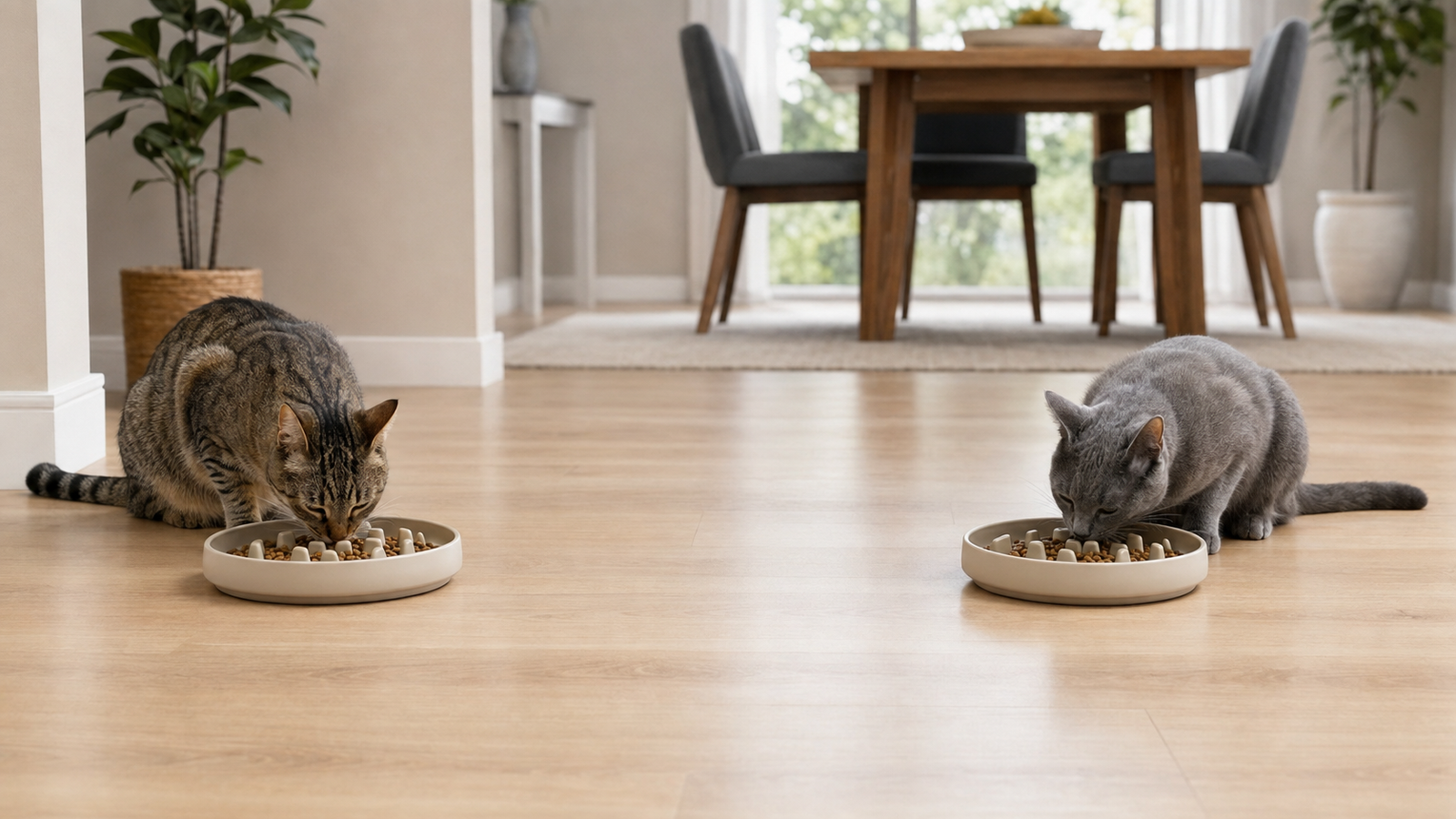
Consider:
- feeding cats in separate rooms;
- placing stations out of sight of one another;
- supervising meals;
- giving each cat an appropriate feeding setup;
- removing bowls after scheduled meals; and
- using selective access when cats require different diets.
Our guide to automatic feeders for multiple cats covers station placement and food stealing. Where one cat must be prevented from accessing another cat’s diet, microchip feeders for cats may offer more reliable separation than a slow bowl alone.
When a Slow Feeder Is Not Enough
Bringing food back up after a meal is often described casually as vomiting, but vomiting and regurgitation are different processes. VCA’s veterinary guide explains that vomiting usually involves effort and abdominal contractions, whereas regurgitation is generally passive and often occurs soon after eating or drinking.
A slow feeder should not be used to self-diagnose the cause. Contact a veterinarian when episodes are recurring, worsening, or accompanied by signs such as:
- weight loss or failure to maintain weight;
- reduced appetite or refusal to eat;
- blood or unusual material in what is brought up;
- diarrhea or persistent constipation;
- lethargy, weakness, pain, or hiding;
- increased thirst or urination;
- difficulty swallowing or breathing;
- repeated unsuccessful retching; or
- inability to keep food or water down.
Seek urgent veterinary advice when a cat appears seriously unwell, has breathing difficulty, collapses, or repeatedly cannot retain food or water.
If an automatic feeder is also part of your cat’s routine and meals are being missed, delayed, or dispensed incorrectly, troubleshoot the feeder separately rather than assuming the slow bowl is responsible.
Common Slow-Feeder Mistakes
Choosing a design that is too difficult
More obstacles do not necessarily produce a better meal. If the cat cannot retrieve enough food, return to an easier design.
Using a dog-sized maze for a cat
A large bowl may have deep or widely spaced obstacles that do not suit a cat’s face, paws, food portion, or eating style. Choose a product intended for cats or verify its dimensions carefully.
Filling food above the ridges
When the meal covers the slowing pattern, the cat can eat from the top as if using an ordinary bowl. Select adequate capacity and distribute food through the accessible sections.
Assuming “anti-vomiting” marketing proves a medical benefit
Marketing terminology does not diagnose why a cat is bringing food back up. Treat the bowl as a feeding tool and seek veterinary advice for persistent symptoms.
Forgetting the total daily allowance
A slow meal can still be oversized. Measure all meals, treats, puzzle food, and automatic-feeder portions as part of the complete daily plan.
Neglecting cleaning
Food residue can collect around ridges, suction cups, seams, and removable components. A complicated feeder may require more attention than a conventional bowl.
Cleaning and Maintaining a Slow Feeder
Follow the manufacturer’s instructions for washing and dishwasher use. As a general routine:
- Remove leftover food after the meal.
- Separate removable components.
- Wash every accessible surface with suitable dishwashing detergent and water.
- Use an appropriate brush to reach grooves without damaging them.
- Rinse away detergent and loosened residue.
- Allow the feeder to dry before refilling.
- Inspect regularly for cracks, chips, warping, deep scratches, loose pieces, and damaged non-slip material.
Wet-food feeders normally need cleaning after each use. Dry-food devices also accumulate crumbs, oils, saliva, and debris and should not simply be topped up indefinitely.
Frequently Asked Questions
Are slow feeder bowls good for cats?
They can be useful for some cats that eat rapidly or benefit from more feeding enrichment. The correct design should slow access without preventing the cat from consuming its complete measured meal. Not every cat needs one.
Can a slow feeder stop my cat from throwing up?
It may help when rapid eating contributes to regurgitation, but it cannot address every cause of vomiting or regurgitation. Recurring episodes require veterinary assessment.
What is the best slow feeder shape for a cat?
There is no universal best shape. A wide, stable bowl with gentle ridges is a sensible starting point for many cats. The appropriate design depends on food type, eating style, comfort, and how easily the cat solves it.
Can cats use dog slow-feeder bowls?
Some may be physically usable, but dog bowls can be too large, deep, or difficult for a cat. Check dimensions, obstacle height, portion capacity, stability, and whether the cat can maintain a comfortable posture.
Can wet cat food go in a slow feeder?
Yes, when the product is intended for wet food. Shallow grooves and lick mats usually distribute wet food more effectively than deep maze bowls. Wash the feeder thoroughly after the meal.
Do slow feeders help cats lose weight?
A slow feeder does not create weight loss by itself. It may support a veterinarian-directed plan by changing meal pace or providing controlled feeding activity, but calorie intake and body condition must still be monitored.
How long should it take a cat to eat?
There is no single evidence-based duration appropriate for every cat and meal. The practical goal is a noticeable, comfortable slowdown compared with that cat’s usual pattern—not an arbitrary number of minutes.
What if my cat refuses to use the slow feeder?
Make the setup easier, place familiar food in accessible areas, and supervise. If intake becomes uncertain, offer food in a familiar bowl and try a simpler design later. Never rely on hunger to force a cat to use an unfamiliar feeder.
Is a puzzle feeder the same as a slow feeder?
Not exactly. Slow bowls use physical patterns to restrict access, while puzzle feeders require problem-solving or manipulation. Both may extend mealtime, but puzzle feeders generally demand more learning and activity.
Can I use a slow feeder with an automatic cat feeder?
Sometimes, if the bowl fits securely and does not block the dispenser. Test several complete cycles and confirm that all food lands in accessible areas. Alternatively, program smaller meals rather than modifying the device.
Final Thoughts
A slow feeder cat bowl can be a useful tool for a cat that rushes through meals, but success depends on choosing the right level of difficulty and continuing to monitor intake. Start with an accessible design, match it to wet or dry food, introduce it gradually, and confirm that it produces pauses without frustration.
The bowl does not determine portion size, replace separate feeding stations, or diagnose why a cat regurgitates or vomits. Measured food, a calm environment, an appropriate schedule, and veterinary guidance when symptoms persist remain essential.
For some cats, a simple ridge bowl is enough. Others may respond better to a lick mat, food puzzle, several smaller scheduled meals, or a combination of feeding strategies. The best choice is the one your cat can use comfortably, safely, and consistently.