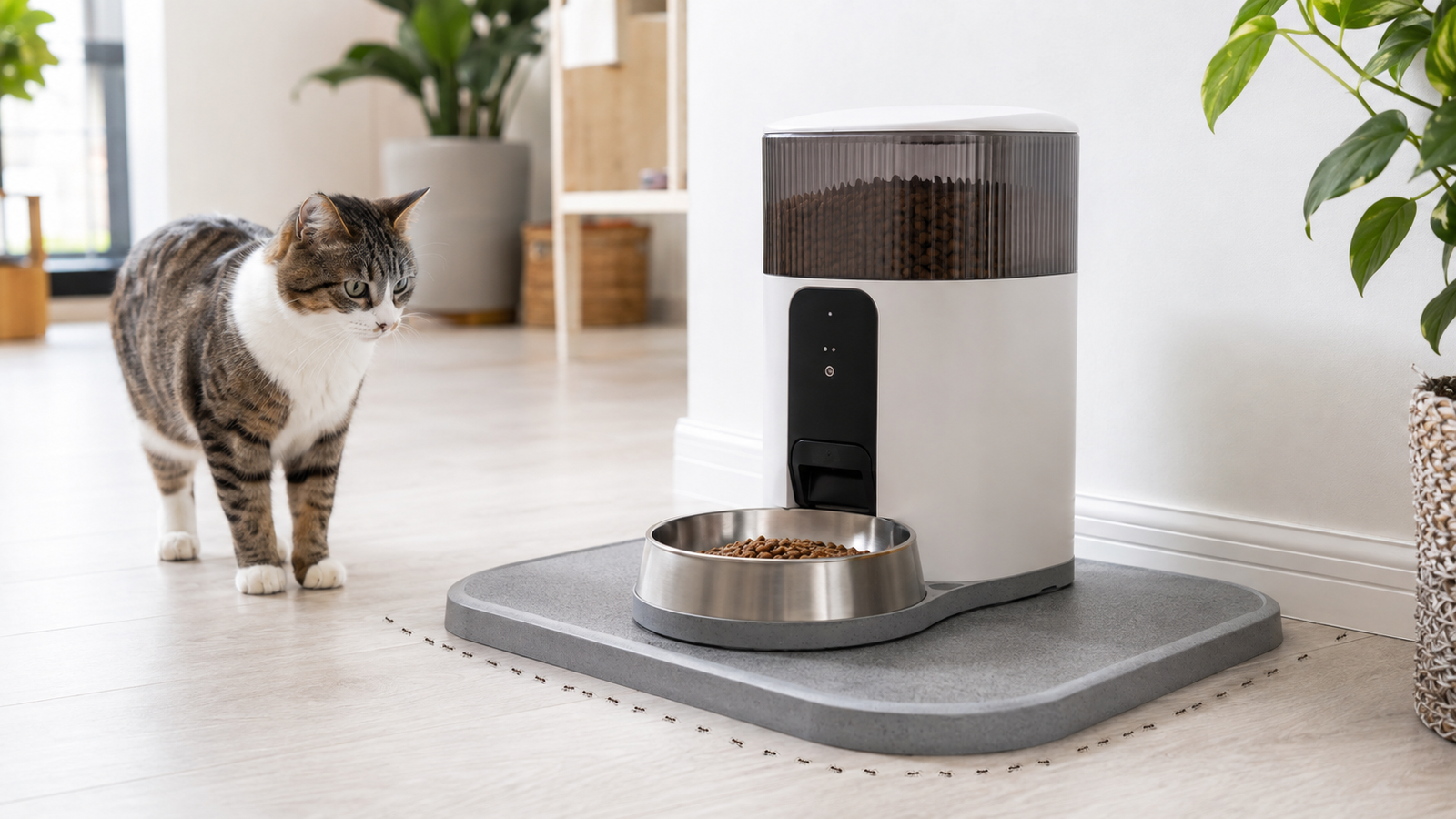
Ants in cat food can quickly become a recurring problem, especially when an automatic pet feeder leaves kibble exposed between meals. Even a few crumbs around the bowl can attract ants, and once they establish a trail, they may eventually reach the feeder base, dispensing chute, or food hopper.
The solution is not simply to spray insecticide around the feeding station. A safer, more effective approach combines prompt food removal, careful cleaning, interruption of ant trails, secure food storage, physical barriers, and treatment of the wider infestation away from your pet’s food.
This guide explains how to keep ants out of an automatic pet feeder without contaminating your pet’s meals or damaging the feeder’s electronics.
Important: Never apply pesticide, essential oil, repellent powder or another chemical directly to a feeder, pet bowl, food-storage compartment or surface that contacts food. Follow the product label for any pesticide and keep pets away from treated areas as instructed.
Quick Answer: How Do You Keep Ants Out of an Automatic Pet Feeder?
Remove and discard ant-contaminated food, unplug the feeder, and clean all food-contact parts according to the manufacturer’s instructions. Vacuum or wipe up spilled crumbs, then wash the ant trail and surrounding floor with soapy water. Reposition the feeder away from walls and entry points, store kibble securely, dispense only the amount your pet will eat, and use a stable physical ant barrier that does not expose the feeder’s electrical components to water. If bait or pesticide is necessary, use it only according to its label and where pets cannot reach it.
Key Takeaways
- Ants are usually attracted by food residue, spilled kibble, grease, moisture, or an established scent trail—not necessarily by poor housekeeping.
- Discard food containing ants rather than returning it to the hopper or storage bag.
- Unplug the feeder before cleaning, and never submerge an electronic feeder base unless the manufacturer explicitly says it is washable.
- Clean the floor, remove ant trails, and clean the feeder itself.
- Reduce the time food remains in the bowl by using measured scheduled meals instead of leaving excess food exposed.
- Avoid essential oils around pet feeding areas; concentrated oils can be dangerous to pets, particularly cats.
- Keep pesticide bait and treated areas inaccessible to pets, and follow every label direction.
- An automatic feeder should be tested after cleaning or repositioning before you depend on it while away.
Why Are Ants Attracted to Automatic Pet Feeders?
Pet food provides fats, proteins, and carbohydrates that different ant species may seek. A few crumbs under the bowl or feeder base can be enough for worker ants to identify a food source.
Automatic feeders may be especially attractive because food can remain available between meals. Several feeder features can also create hidden collection points:
- Kibble dust can accumulate under the hopper or around the dispensing wheel.
- Small pieces may remain inside the chute.
- A pet may push food behind or beneath the bowl while eating.
- Grease from dry food can coat the bowl and nearby surfaces.
- Wet food residue may remain around the edge of a tray compartment.
- The feeder may be placed close to a wall, skirting board, window, or doorway used by ants.
- Continuously topping up the hopper can leave older food and crumbs at the bottom.
Ants communicate through chemical trails. If the visible ants are removed but the trail and food residue remain, other ants may continue following the same route. The National Pesticide Information Center recommends wiping ant trails with soapy water and sealing cracks or crevices ants use to enter a home.
Are Ants in Cat or Pet Food Dangerous?
Finding a few common household ants in kibble does not automatically mean your pet has been poisoned. However, ant-contaminated food should still be discarded. The food may contain dead insects, debris, moisture, or traces of substances the ants contacted elsewhere.
The greater concern may be what was used to control the ants. Food can become unsafe if it has been exposed to pesticide spray, bait, repellent oil, powder, or cleaning chemicals.
Remove your pet from the feeding area and contact a veterinarian or an animal poison-control service such as ASPCA Animal Poison Control promptly if:
- Your pet may have eaten ant bait or pesticide.
- Pesticide was sprayed onto or close to the food or bowl.
- Your pet develops vomiting, drooling, tremors, weakness, breathing difficulty, or unusual behavior.
- You cannot identify the chemical involved.
- The ants bite or sting, and your pet develops swelling, pain, or breathing difficulty.
Do not induce vomiting or give a home remedy unless a veterinary professional specifically instructs you to do so.
How to Keep Ants Out of an Automatic Pet Feeder: 5 Immediate Steps
1. Keep Your Pet Away From the Area
Temporarily move your pet to another room. This prevents them from eating contaminated food, walking through ants, or contacting cleaning products.
2. Unplug and Switch Off the Feeder
Disconnect the power adapter before removing parts. If the feeder contains backup batteries, consult its instructions to determine whether they should also be removed before cleaning.
Do not tip a plugged-in feeder or pour liquid around the base.
3. Discard the Exposed Food
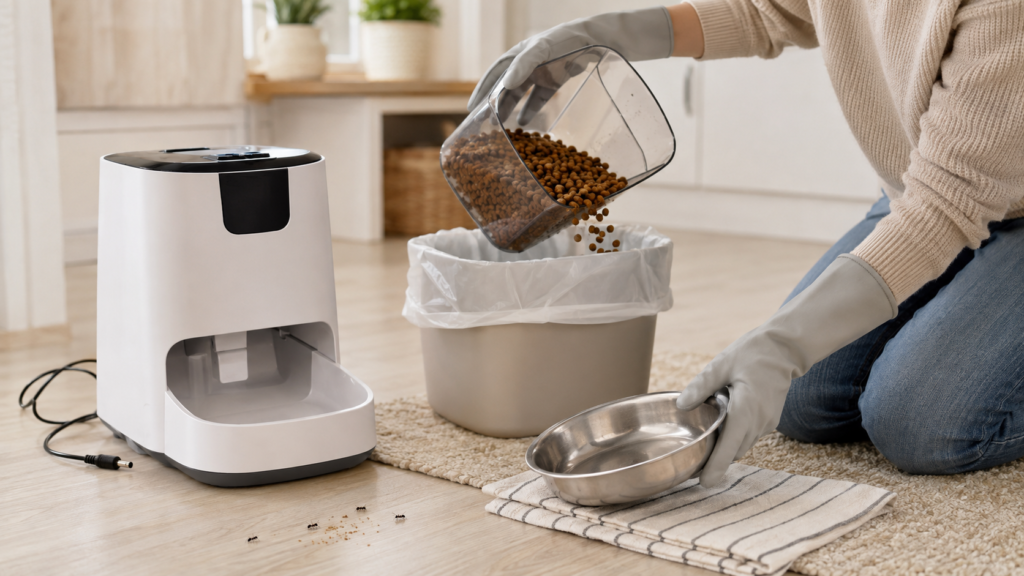
Empty food from the bowl, chute, and affected hopper into a closed waste bag. Do not mix it with clean food or return it to the original storage container.
If ants have entered a large bag of kibble, discard or isolate the affected food rather than repeatedly refilling the feeder from the same source.
4. Separate Removable and Electronic Parts
Remove only the components identified as washable in the feeder manual. These commonly include the bowl, bowl holder, food tray, hopper, and lid, but this varies by model.
The motorized base, control panel, power port, and internal electronics generally require dry or carefully damp-wipe cleaning rather than immersion.
5. Remove Visible Ants and Crumbs
Vacuum ants, kibble fragments, and food dust from the floor and from safe, accessible gaps around the feeding station. Immediately empty the vacuum contents into a sealed waste bag outside the pet area.
Avoid blowing compressed air into the feeder because it can push debris or insects farther into its mechanism.
How to Clean an Ant-Contaminated Automatic Feeder
Wash the Food-Contact Components
Use warm water and mild dishwashing liquid on manufacturer-approved washable parts. Pay attention to corners, bowl edges, tray seams, the hopper outlet, and removable dispensing components where crumbs can collect.
Rinse away soap residue thoroughly. Allow every component to dry completely before reassembly. Moisture left in a dry-food feeder can make kibble clump, spoil, or jam the dispensing mechanism.
For a complete component-by-component routine, follow our step-by-step automatic pet feeder cleaning guide.
Clean the Electronic Base Carefully
Follow the cleaning instructions for your exact feeder model. Remove crumbs and visible debris using a soft, dry cloth or brush. If the manufacturer permits damp wiping, use a lightly dampened cloth and dry the approved surfaces afterward. Never submerge the electronic base or allow moisture to enter the motor, display, buttons, sensors, charging port, or power connector.
Do not spray cleaner directly onto the base. Apply an approved cleaner to the cloth first if the manufacturer permits it.
Inspect the Chute and Dispensing Mechanism
Use a flashlight to check for ants, kibble dust, and fragments around the chute or food outlet. Do not disassemble gears, motors, or internal wiring unless the manufacturer’s instructions specifically allow it.
If ants appear to have entered an inaccessible motor compartment, contact the manufacturer before operating the feeder again. Running it with insects or debris inside could interfere with dispensing.
Clean the Feeding Area and Ant Trail
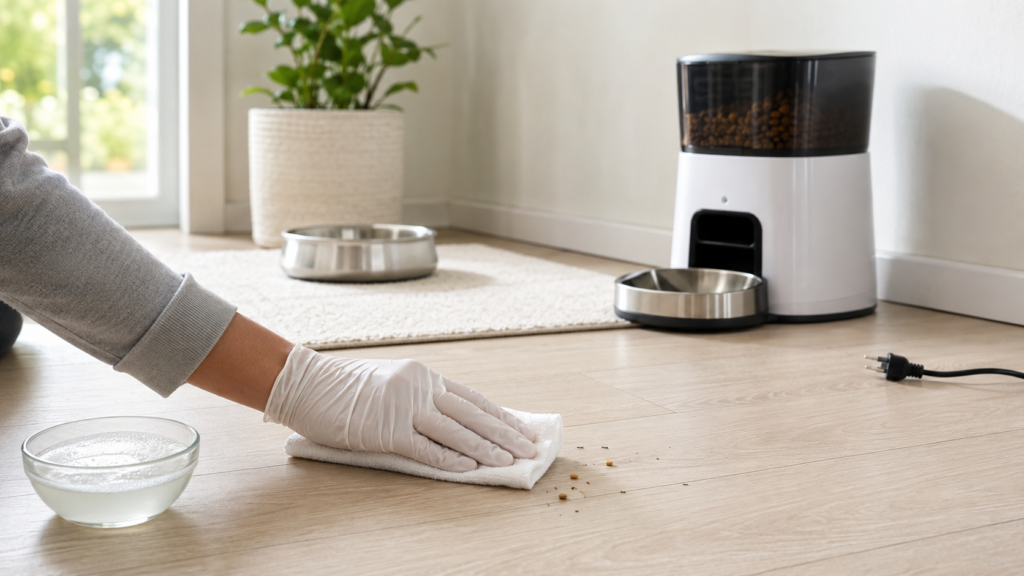
Wash the floor beneath and around the feeder with soapy water, including the route ants were following. Clean along nearby walls, skirting boards, and furniture legs.
The aim is to remove both visible food residue and the trail guiding other ants to the feeder. Dry the floor before replacing electrical equipment.
How to Keep Ants Out of Cat Food and Prevent Them From Returning
Keep the Bowl and Floor Free of Food Residue
Remove uneaten food after an appropriate mealtime instead of allowing excess food to sit all day. Wash the bowl regularly and clean spills as soon as they occur.
Check beneath the feeder, not only around the visible bowl. Lightweight kibble can roll under the base, where it remains unnoticed.
Adjust the Feeding Schedule
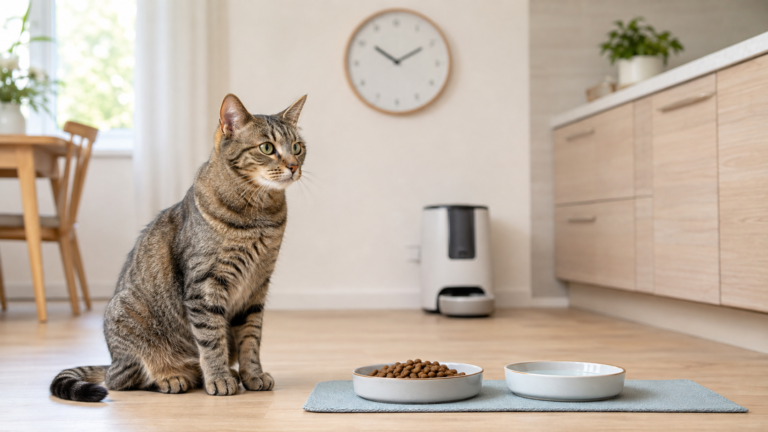
An automatic feeder is most useful when it dispenses measured meals at defined times. Programming a large serving that remains in the bowl for hours can defeat this advantage and continue attracting ants.
If appropriate for your pet, divide the same daily food allowance among smaller scheduled meals. Do not increase the total daily amount merely because you add more feeding times. Our guide to setting up an automatic pet feeder schedule explains how to measure actual feeder portions and test the completed program.
Move the Feeder Away From Ant Routes
Place the feeder on a level, dry surface away from:
- Exterior doors and poorly sealed windows
- Cracks in flooring or walls
- Skirting-board gaps
- Indoor plants with ant activity
- Trash cans and recycling containers
- Other pet bowls with food residue
- Damp areas and leaking water bowls
Avoid positioning the feeder so close to a wall that ants can bypass a floor barrier by traveling along the wall or cable.
Seal Entry Points
Follow the ant trail to identify cracks, gaps, or utility openings. Appropriate sealing can reduce repeated entry, but keep pets away from fresh sealant and follow the product’s curing and ventilation instructions.
Persistent activity from multiple locations may require identification by a qualified pest-management professional.
Store Pet Food Securely
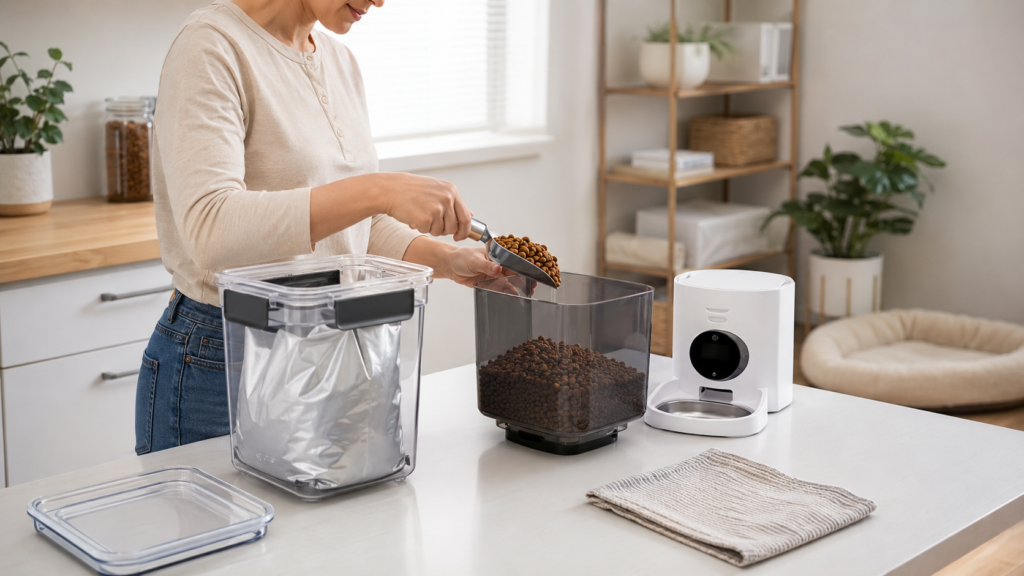
Keep the main food supply in a clean, dry location in its original bag inside a secure container, unless the food manufacturer advises otherwise. Keeping the original packaging preserves the lot number, expiration information, and feeding instructions.
Close the container after every use and wipe up food spilled during refilling. Do not continually pour new kibble on top of old food in the feeder hopper.
Check the Hopper Seal
Make sure the lid, gasket, and locking mechanism are correctly seated. A lid designed to preserve freshness may also make the stored food less accessible, but it cannot make a feeder completely ant-proof.
Remember that hopper protection and bowl protection are different. A well-sealed hopper may make stored kibble harder for ants to reach, but food already dispensed into an open bowl can still attract them. Keep the bowl and surrounding floor clean even when the hopper itself appears well sealed.
Replace damaged seals only with suitable parts recommended for the model. A desiccant pack controls moisture; it is not an ant-control product and must remain inaccessible to pets.
How to Ant-Proof an Automatic Cat Feeder Without a Water Moat
A water moat can block ants from reaching an ordinary food bowl, but it requires special caution with an automatic feeder.
Do not place a powered feeder directly in a tray of water unless the manufacturer explicitly approves that setup. Water can reach the power connector, battery compartment, motor, or ventilation openings. A spilled or overflowing moat can also create an electrical and slipping hazard.
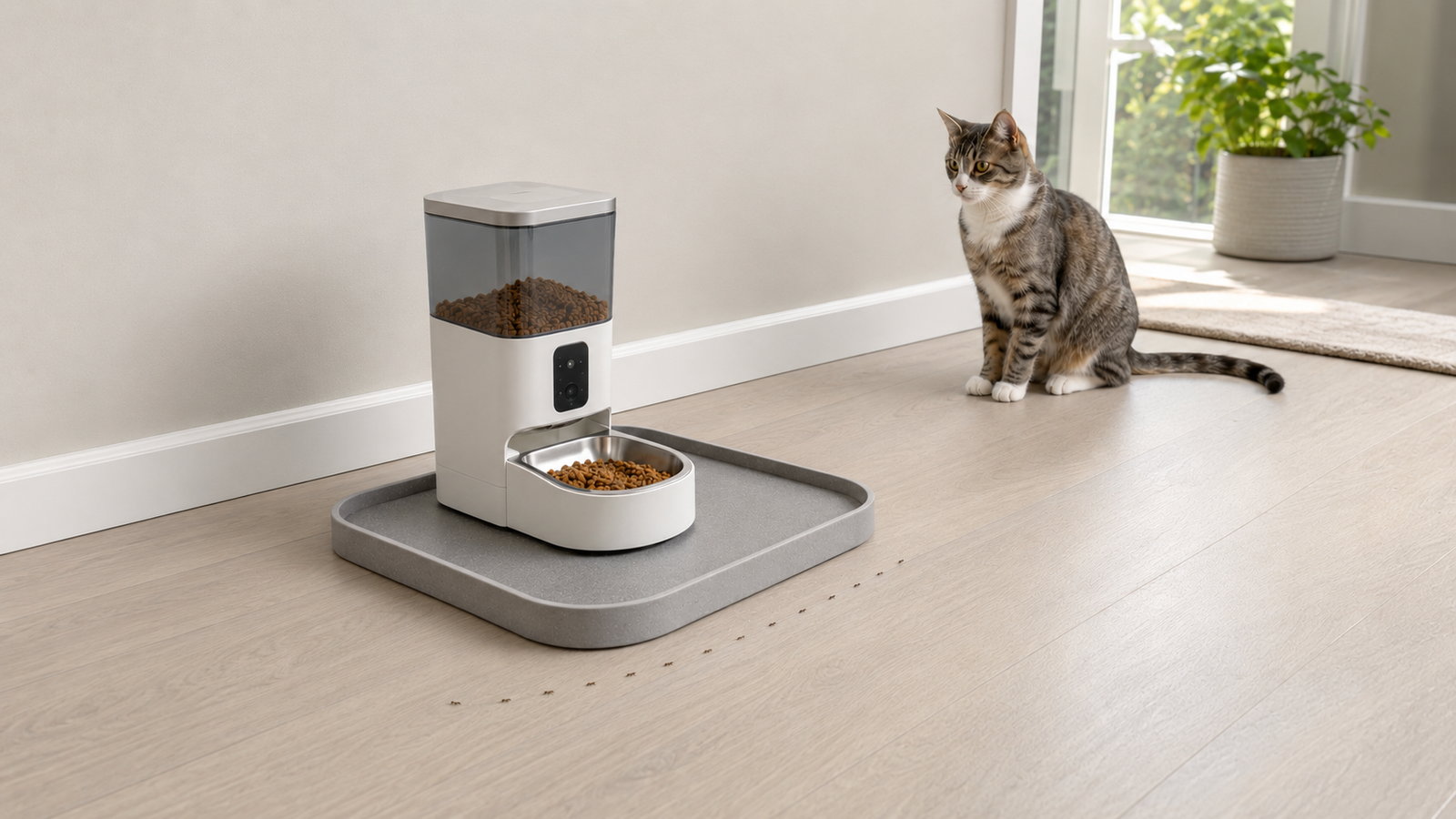
A better option may be a purpose-designed, dry physical barrier or ant-resistant feeding platform large and stable enough for the entire feeder. It should:
- Support the feeder without wobbling or tipping
- Keep ventilation openings unobstructed
- Avoid contact with the power cable and connector
- Remain easy to clean
- Prevent food from accumulating underneath
- Fit the feeder without interfering with the bowl or dispensing chute
Test the feeder on the platform while you are home. Confirm that your pet can eat comfortably and cannot pull, overturn, or push the setup against a wall.
Comparing Common Ant-Control Methods Near a Pet Feeder
| Method | Suitability Near a Feeder | Important Precaution |
|---|---|---|
| Prompt crumb and spill removal | Recommended | Unplug the feeder before moving or cleaning it |
| Soapy-water trail cleanup | Recommended | Dry the area before reconnecting electrical equipment |
| Sealing cracks and entry gaps | Recommended | Keep pets away until the sealant has cured |
| Stable ant-resistant platform | Usually suitable | Confirm stability, ventilation, and cable clearance |
| Water moat | Model-dependent | Keep water completely away from electronics |
| Petroleum jelly or sticky barriers | Limited | Prevent contact with fur, paws, bowl, and feeder openings |
| Essential oils | Avoid around feeding areas | Concentrated oils can be hazardous to pets |
| Loose repellent or insecticidal powders | Generally avoid near food | Risk of inhalation, paw contact, and food contamination |
| Ant bait or pesticide | Restricted use | Follow the label and keep completely inaccessible to pets |
Why Essential Oils Are Not a Safe Default Solution
Online advice sometimes recommends peppermint, tea tree, eucalyptus, citrus, cinnamon, or clove oil to repel ants. These should not be treated as harmless simply because they are described as natural.
The ASPCA warns that concentrated essential oils can be dangerous to pets. Cats are particularly sensitive, and exposure can occur through ingestion, skin or fur contact, or inhalation.
Do not apply essential oil to the feeder, bowl, mat, floor, or wall surrounding your pet’s feeding station. If exposure occurs or your pet develops signs such as drooling, vomiting, weakness, tremors, or breathing difficulty, contact a veterinarian or animal poison-control service promptly.
What About Ant Bait and Insecticide?
Physical prevention and sanitation should come first around a feeding station. If the infestation continues, pesticide treatment may be necessary—but the treatment area should be separated from pet food and water.
The National Pesticide Information Center explains that pets can be exposed by eating pesticide bait or contacting treated areas. Its pet pesticide-safety guidance advises keeping pets away from treated areas for the period stated on the product label and until conditions are safe.
If using an ant-control product:
- Read the complete label before use.
- Confirm that the product is intended for the location and ant problem.
- Never place exposed bait beside the food bowl.
- Use a secured, tamper-resistant station where required.
- Position it where cats, dogs, children, and other animals cannot reach it.
- Prevent contamination of food, bowls, utensils, and food-preparation surfaces.
- Store unused product in its original container and out of reach.
- Do not assume “pet friendly” means harmless if swallowed.
For a severe, recurring, or unidentified infestation, tell a licensed pest-management professional that pets live in the home and show them the feeding area before treatment begins.
How to Prevent Ant Problems While You Are Away
An automatic feeder should not be left untested after cleaning, moving, or adding a barrier platform.
Before relying on it:
- Operate it for several complete meal cycles while you are home.
- Confirm that the feeder remains level and dispenses freely.
- Inspect the bowl and floor after each meal for scattered kibble.
- Make sure the power cable does not create a bridge across an ant barrier.
- Verify that backup batteries and local schedules work as expected.
- Arrange for a responsible person to check your pet, water supply, feeder, and feeding area.
A camera or app notification can provide useful information, but it does not guarantee that your pet ate or that ants did not reach the meal. See our guide to leaving a cat alone with an automatic feeder for a fuller vacation and safety checklist.
If an internet interruption is a concern, our guide explains how automatic feeders work without Wi-Fi and what to test during power outages.
What to Do if Ants Get Inside an Automatic Cat Feeder
Ants in the bowl are mainly a hygiene problem, but insects or debris inside the dispensing path could also contribute to unreliable operation. Stop using the feeder and investigate if it:
- Makes an unfamiliar grinding or clicking sound
- Dispenses incomplete meals
- Shows a jam or obstruction alert
- Contains visible ants behind the control panel or inside the motorized base
- Repeatedly stops after cleaning
- Has moisture near the power connection
Do not apply insecticide inside the mechanism. Contact the manufacturer if the affected area cannot be accessed safely. Our automatic feeder troubleshooting guide covers food jams, power faults, programming errors, and other dispensing problems.
Pet-Safe Ant-Prevention Checklist
Use this short checklist during regular feeder maintenance:
- Remove uneaten food rather than leaving excess in the bowl.
- Wash and dry the bowl regularly.
- Wipe kibble grease and dust from approved surfaces.
- Check under and behind the feeder for crumbs.
- Inspect the hopper lid, seal, and dispensing outlet.
- Store the food bag securely in a closed container.
- Clean visible ant trails with soapy water.
- Seal appropriate cracks and entry points.
- Keep the feeder away from walls and known ant routes.
- Avoid essential oils and loose powders near pet food.
- Keep bait and pesticides inaccessible and follow their labels.
- Test the feeder after cleaning or repositioning it.
Frequently Asked Questions
How Do I Keep Ants Away From My Cat’s Food Bowl?
Keep the bowl and surrounding floor free of crumbs and food residue, remove uneaten food, clean established ant trails with soapy water, and move the feeding station away from walls or entry points where practical. If the bowl is part of an automatic feeder, use only a physical barrier that does not expose the feeder’s electronics, power connection, or ventilation openings to water.
Why Do Ants Keep Returning to My Automatic Feeder?
Food residue or an established scent trail may remain even after the visible ants are removed. Clean the feeder, bowl, floor, wall edge, and the complete trail. Also inspect for hidden crumbs under the base and seal suitable entry gaps.
Should I Throw Away Kibble That Has Ants in It?
Yes. Discard ant-contaminated food in a sealed waste bag. Do not return it to the hopper or mix it with clean food, particularly if pesticide or bait may have been used nearby.
Can Ants Get Inside the Food Hopper?
Yes. Ants may enter through small openings around lids, dispensing paths, or component joints. A correctly fitted lid helps, but most automatic feeders are not guaranteed to be ant-proof.
Can I Spray Vinegar on an Automatic Feeder?
Do not spray vinegar or any liquid directly onto an electronic feeder. Use only cleaning methods approved by the manufacturer. Soapy water can help remove ant trails from a suitable floor surface, but the area must be dried before the feeder is reconnected.
Can I Put Petroleum Jelly Around the Feeder?
Petroleum jelly is sometimes used as a slippery barrier, but it can collect dirt, transfer to fur and paws, and interfere with openings if poorly placed. A stable, purpose-designed physical platform is generally easier to control. Never apply petroleum jelly to food-contact surfaces, vents, electrical ports, or the dispensing mechanism.
Is Diatomaceous Earth Safe Around a Cat Feeder?
Do not assume a loose powder is risk-free merely because it is marketed as natural or food grade. Airborne dust can be inhaled, and powder near the bowl can contaminate food or transfer to paws. Avoid placing it around the immediate feeding area unless a qualified professional and the product label confirm an appropriate method that prevents pet exposure.
Can I Use Peppermint Oil to Repel Ants?
Peppermint and other concentrated essential oils are not appropriate default repellents around pet feeding areas. Cats are especially sensitive to several essential oils. Use sanitation, entry-point control, and physical barriers instead.
Will Smaller Scheduled Meals Help Prevent Ants?
They can reduce the amount of food left exposed, provided the total daily food allowance remains appropriate. Remove leftovers and clean the bowl rather than relying on scheduling alone.
Should I Continue Using a Feeder if Ants Entered the Motor Base?
Switch it off and unplug it. Do not spray pesticide or pour cleaning liquid into the base. Contact the manufacturer for model-specific cleaning, inspection, or replacement guidance before using it again.
Final Recap
Keeping ants out of cat food—especially food served by an automatic pet feeder—starts with removing what attracts them, erasing the trail they follow, and blocking access without contaminating your pet’s food.
Discard affected food, unplug and clean the feeder correctly, remove crumbs from hidden areas, wash ant trails with soapy water, and keep the feeding station dry. Use measured meals, secure food storage, sealed entry points, and an appropriate physical barrier as your first line of prevention.
Avoid spraying chemicals or applying essential oils around the feeder. If pesticide treatment is necessary, follow the complete label, separate it from the feeding area, and ensure pets cannot reach the product or treated surface.
With regular inspection and careful placement, an automatic feeder can continue providing convenient scheduled meals without becoming a permanent food source for ants.