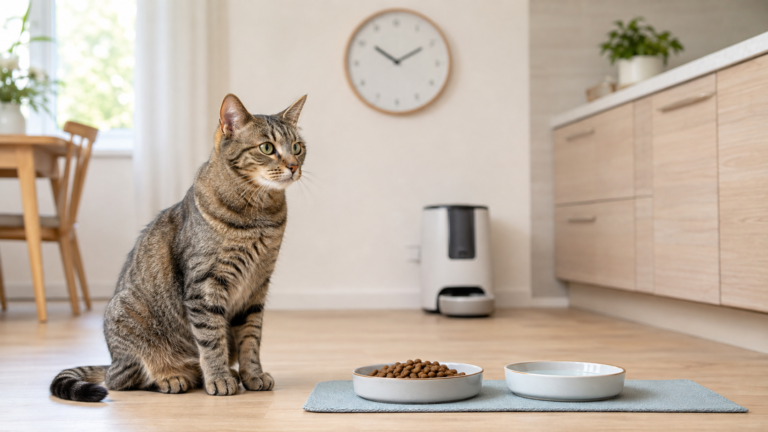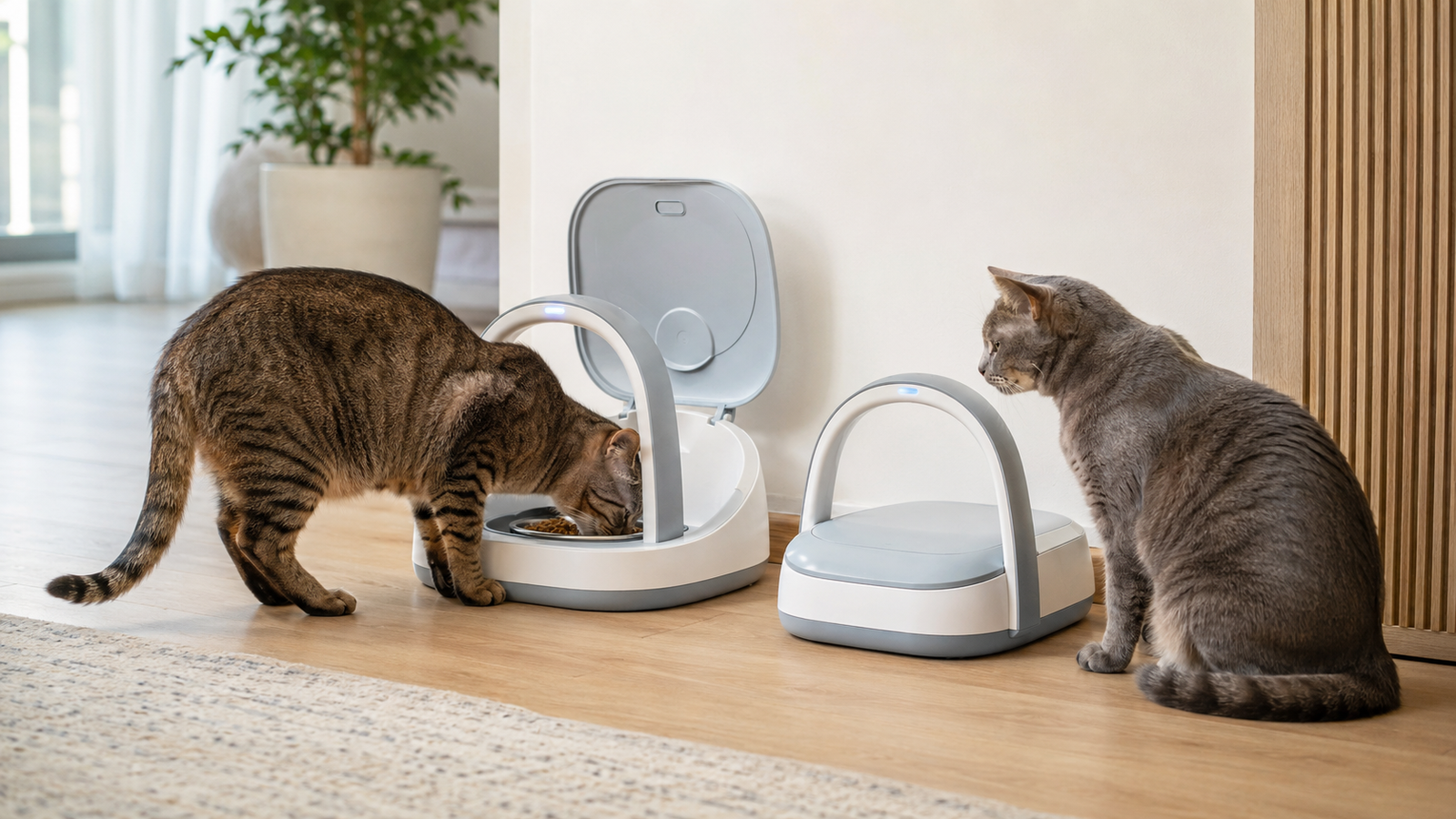
Feeding cats separately can become surprisingly difficult in a multi-cat home. One cat may finish quickly and move to another bowl, while a slower eater returns later to find its food already gone. The challenge grows more serious when cats need different portions, life-stage foods, or veterinary-prescribed diets.
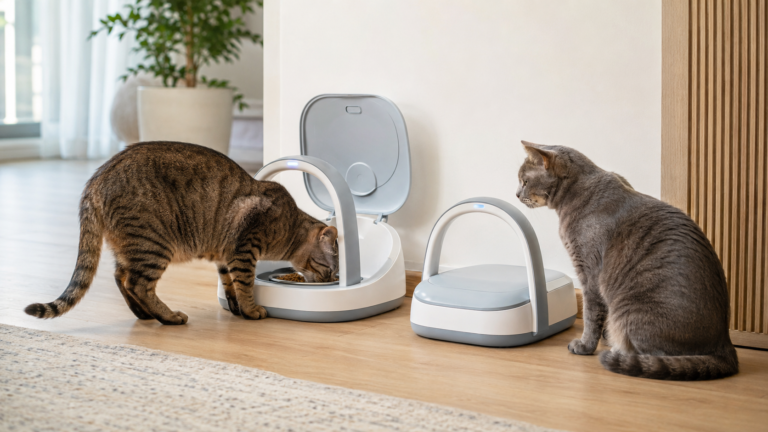
Microchip feeders for cats are designed to address this access problem. Instead of making food available to every pet, they recognize an authorized cat and open the covered bowl only for that animal.
However, the name “microchip feeder” can be misleading. Some products read implanted identification microchips, while others work only with a proprietary RFID collar tag. Many control access to food but do not dispense meals automatically on a schedule. Understanding these differences is essential before choosing one.
Quick Answer: How Do Microchip Feeders for Cats Work?
A microchip cat feeder uses radio-frequency identification technology to recognize an authorized cat’s implanted microchip or compatible RFID collar tag. When the registered cat places its head near the reader, the feeder opens its lid, then closes it after the cat moves away, helping stop other pets from accessing the food. The feeder reads only the identification number transmitted by the chip or tag; it does not access the owner’s personal information, track the cat’s location, or communicate with any pet-microchip registry.
Key Takeaways
- Microchip feeders primarily control which pet can reach a bowl. Most do not control when food is dispensed unless combined with separate scheduling features.
- Two different technologies share the “microchip feeder” name: true implanted-microchip readers and RFID collar-tag systems. Compatibility varies by product, so it should never be assumed.
- These feeders can help reduce food stealing, protect slow or timid eaters, and keep different diets separate, but they cannot guarantee that a determined cat won’t find a way around the lid.
- The feeder identifies a chip or tag number only. It does not calculate a diet, monitor health, or replace guidance from a veterinarian.
- Gradual training, careful placement, and side or rear guards make a meaningful difference in how well a selective feeder performs in practice.
What Is a Microchip Cat Feeder and How Does It Work?
The practical value of microchip feeders for cats becomes clearest when pets sharing a home have different eating habits or dietary requirements.
A microchip cat feeder is more accurately described as a selective-access feeder. Its primary purpose is to control which pet can reach a bowl of food.
A typical unit includes:
- A covered food bowl
- A microchip or RFID reader
- A motorized lid
- A pairing or registration control
- Battery or mains-powered operation
- One or more removable food bowls
- An optional RFID collar tag
- Training settings on some models
When the correct cat approaches, the reader recognizes the registered identification number and activates the lid. When the cat withdraws, the lid closes again. This makes the feeder different from an ordinary programmable feeder that releases portions at predetermined times.
Microchip Feeder vs. Automatic Timed Feeder
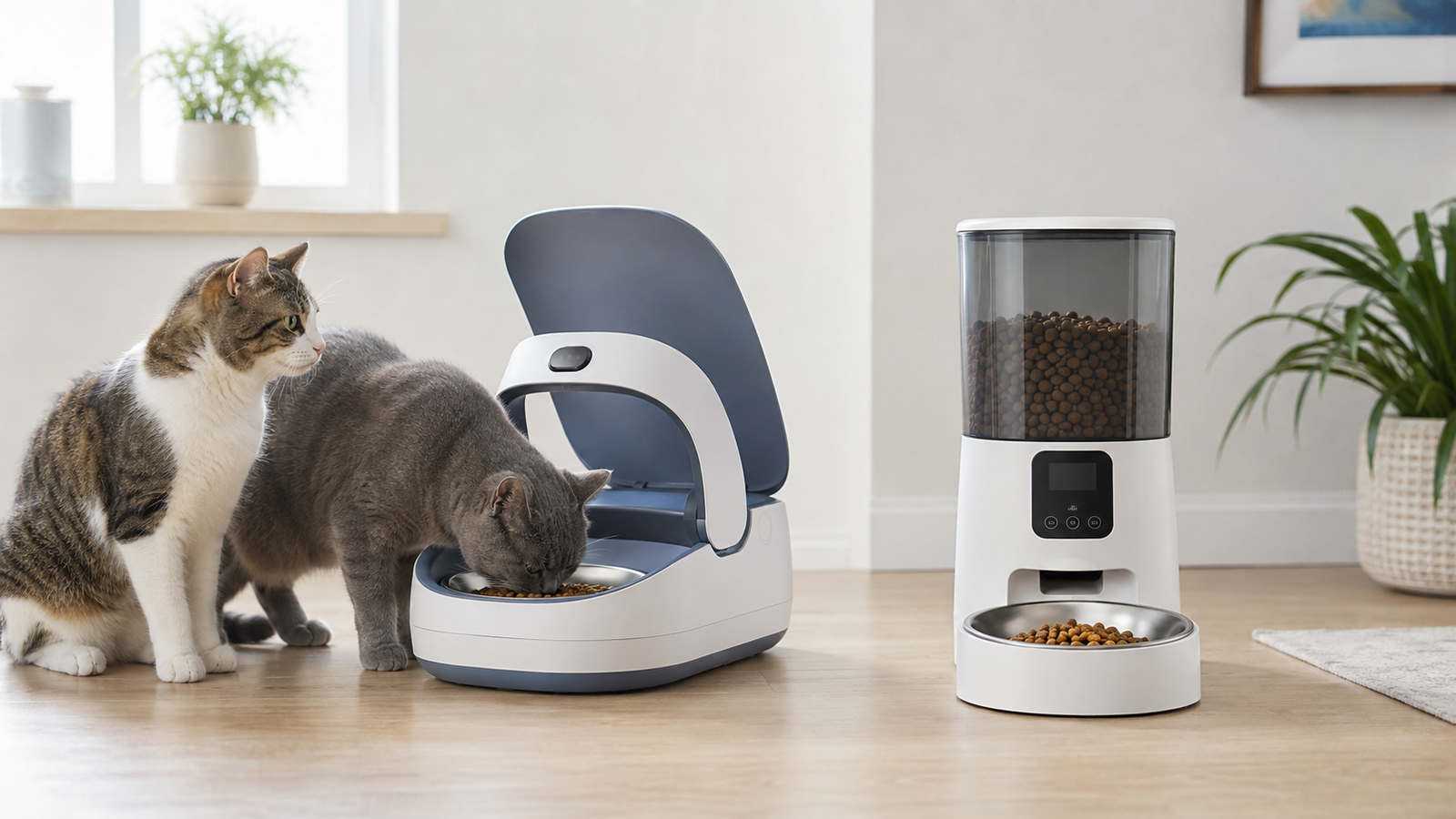
The two terms are sometimes used interchangeably, but they describe different functions.
| Feature | Microchip/selective feeder | Timed automatic feeder |
|---|---|---|
| Main purpose | Controls which pet can access food | Controls when food is dispensed |
| Identification | Microchip or RFID tag | Usually none |
| Food-stealing prevention | Usually the main benefit | Limited if pets share access |
| Scheduled dispensing | Not available on every model | Usually included |
| Portion automation | Often requires manual bowl filling | Usually dispenses measured portions |
| Wet-food compatibility | Available on some covered-bowl models | Only on models designed for wet food |
| Best suited to | Separate diets and multi-pet homes | Consistent meal timing |
Some newer products combine selective access with scheduling, portion control, or app monitoring, but those features must be checked individually rather than assumed. If meal timing is your main concern, see our guide to choosing the right automatic pet feeder.
How Does the Feeder Recognize the Correct Cat?
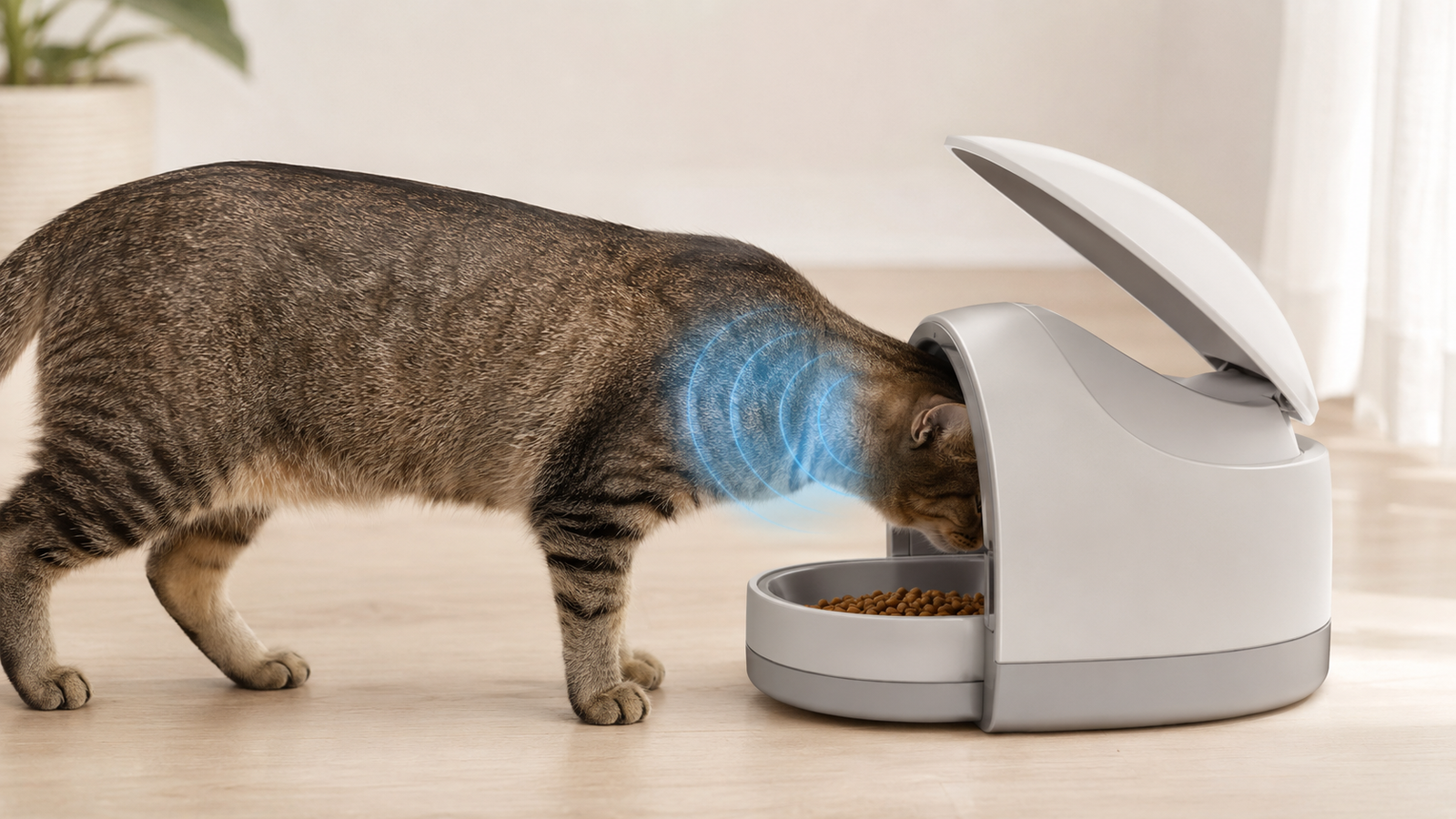
The exact process varies by model, but most compatible microchip feeders follow four general steps.
1. The cat’s identification number is registered. The owner puts the feeder into pairing or learning mode and guides the cat near the reader. The unit detects the identification number and stores it in its internal memory. Some feeders can store several authorized identities; others are designed for only one assigned pet.
2. The registered cat approaches. The reader creates a short-range identification field around the feeding area. When the registered microchip or tag enters that area, the feeder checks the number against its saved list.
3. The lid opens. If the number is authorized, the motorized lid moves away from the bowl. Opening speed and sensitivity may be adjustable on some feeders.
4. The lid closes after the cat leaves. Once the registered cat moves away, the lid closes to restrict access again. Better-protected designs add side or rear barriers to make it harder for another cat to reach the bowl while it’s open.
Microchip Cat Feeder vs. RFID Cat Feeder: What’s the Difference?
It depends entirely on the product. The key difference is what identifies the cat. A true microchip-compatible feeder can recognize a supported identification chip already implanted under the cat’s skin, while an RFID cat feeder may require a compatible collar tag supplied by the manufacturer. Before buying, confirm exactly which identification method the feeder reads rather than relying on the product name alone.
True implanted-microchip compatibility
Some feeders can read compatible identification microchips already implanted under a cat’s skin, so the cat doesn’t need to wear anything additional. The 15-digit ID format is widely recognized as the international standard, but the American Animal Hospital Association (AAHA) notes that multiple chip formats, frequencies, and registration databases remain in use, particularly in the United States. Before purchasing, check the feeder manufacturer’s compatibility list and, if you’re uncertain, ask your veterinarian to confirm your cat’s microchip number and type.
RFID collar-tag systems
Some products advertised as RFID or “microchip” feeders don’t actually read an implanted chip. They require the cat to wear the manufacturer’s supplied collar tag instead. For example, PETLIBRO’s official support documentation confirms that its One RFID Pet Feeder works only with its provided collar tag and does not recognize an implanted pet microchip.
A collar tag can be a useful option for an unchipped cat, but it introduces its own considerations:
- The cat must tolerate wearing a collar.
- The tag must stay attached and correctly positioned.
- A lost or damaged tag may block access entirely.
- Only the manufacturer’s compatible tags typically work.
Always use an appropriately fitted breakaway collar if a cat needs to wear a tag, and follow your veterinarian’s guidance on safe collar use.
What Microchip Feeders Do Not Do
A microchip feeder’s capabilities are often misunderstood. Most basic selective feeders do not:
Access control, portion control, meal scheduling, and feeding monitoring are separate features. A basic microchip cat feeder may control which cat can reach the bowl without measuring portions or serving meals at set times. A timed automatic feeder may schedule portions without identifying which cat eats them, while some connected selective feeders combine several of these functions. Check the exact model rather than assuming that one feature includes the others.
- Track a cat’s location or contain GPS
- Read medical or owner information
- Contact the microchip registry
- Automatically calculate a suitable diet
- Guarantee accurate portion control
- Refill their own bowls
- Refrigerate wet food
- Dispense food on a schedule
- Completely eliminate conflict between cats
According to the American Animal Hospital Association, a pet microchip stores only an identification number, not GPS location, medical records, or private owner information. The feeder simply uses that number locally as an access key.
Benefits of Microchip Feeders for Cats
Can a Microchip Cat Feeder Stop Food Stealing?
A selective lid makes it harder for a fast eater to finish another cat’s meal. This is particularly useful when one cat grazes slowly while another eats immediately.
They help keep different diets separate
A household may include a kitten on growth food, an adult cat on a maintenance diet, a senior cat with different nutritional needs, or a cat on a veterinary-prescribed or weight-management diet. A microchip feeder can help restrict each bowl to the intended pet, though it doesn’t determine what or how much a cat should eat. Those decisions still belong to the owner and veterinarian.
VCA Animal Hospitals lists commercial feeding stations that open only for a recognized microchip as one strategy for managing controlled feeding during a feline weight-reduction plan, used alongside veterinary guidance rather than in place of it.
They may protect slow or timid eaters
A cat that prefers several small visits to its bowl may lose food to a more confident housemate. Selective access can keep the meal available between visits. That said, the protected cat still needs to feel safe approaching the feeder; access technology can’t stop another cat from simply guarding the surrounding area.
Covered bowls may help protect food
Depending on the design, a closed lid can help reduce exposure to flies and slow the drying of food. This doesn’t make wet food safe indefinitely or turn the feeder into a refrigerator, so it’s still important to follow the food manufacturer’s storage directions and the feeder’s own instructions.
Connected models may provide feeding information
Some premium models add scales, apps, or activity records that may show when a cat approached, how frequently it ate, approximate consumption, meal duration, or missed-meal notifications. These records can help an owner notice a change, but they aren’t a veterinary diagnosis. Contact a veterinarian if your cat develops a persistent change in appetite, weight, thirst, energy, or behavior.
Limitations to Consider Before Buying
Compatibility isn’t universal. Never assume a feeder will recognize every implanted microchip. Confirm the chip format, frequency, and number length the exact model supports.
Food can still be stolen while the lid is open. A determined cat may approach from the side or behind while the authorized cat is eating. Look for side guards, a rear cover, adjustable closing behavior, and obstruction protection. Even with these features, no consumer feeder can guarantee that food stealing will never happen.
One feeder may be needed per diet. Registering several cats to one feeder means each authorized cat can access the same food. If cats require different diets, portions, or medications, separate feeders or physically separate feeding areas may be necessary.
Cats may need gradual training. The moving lid, reader arch, and motor sound may worry a cautious cat. A training mode that keeps the lid open initially can ease the introduction. Never force a frightened cat toward the feeder or remove its familiar feeding option abruptly.
Capacity can be limited. Many selective feeders protect a bowl rather than store a large supply of food. They may need daily manual filling and shouldn’t be mistaken for large-hopper dispensers.
Cleaning requirements vary. The bowl and mat may be removable, but the electronic base normally can’t be submerged. Confirm whether bowls are dishwasher-safe and whether food can collect beneath the lid or around the hinges.
Cost increases in larger households. A selective feeder can cost considerably more than an ordinary bowl. If three cats need three different diets, a separate feeder for each cat can add up quickly.
The feeder can’t stop social pressure. A dominant cat may sit near the feeder, block the approach, or intimidate a timid cat without ever reaching the food itself. PetMD notes that even a well-designed automatic feeder can’t necessarily stop a dominant cat from harassing a more timid housemate; separate feeding rooms may be a better solution when conflict is serious.
Microchip Feeders for Multiple Cats: How to Use Them
One microchip feeder can sometimes recognize multiple cats, but that does not mean it can give each cat a different diet. If several cats are authorized to open the same feeder, they normally gain access to the same bowl. Cats that need different foods, portions, or medications may require separate selective feeders or physically separate feeding areas.
Decide which cats truly need restricted access
Ask yourself:
- Are the cats eating different foods?
- Is one cat stealing another’s meals?
- Does one cat graze while another eats quickly?
- Is a veterinarian monitoring a particular diet?
- Does each cat need a separately measured amount?
If every cat eats the same food comfortably, selective access may add unnecessary cost and complexity.
Create separate feeding stations
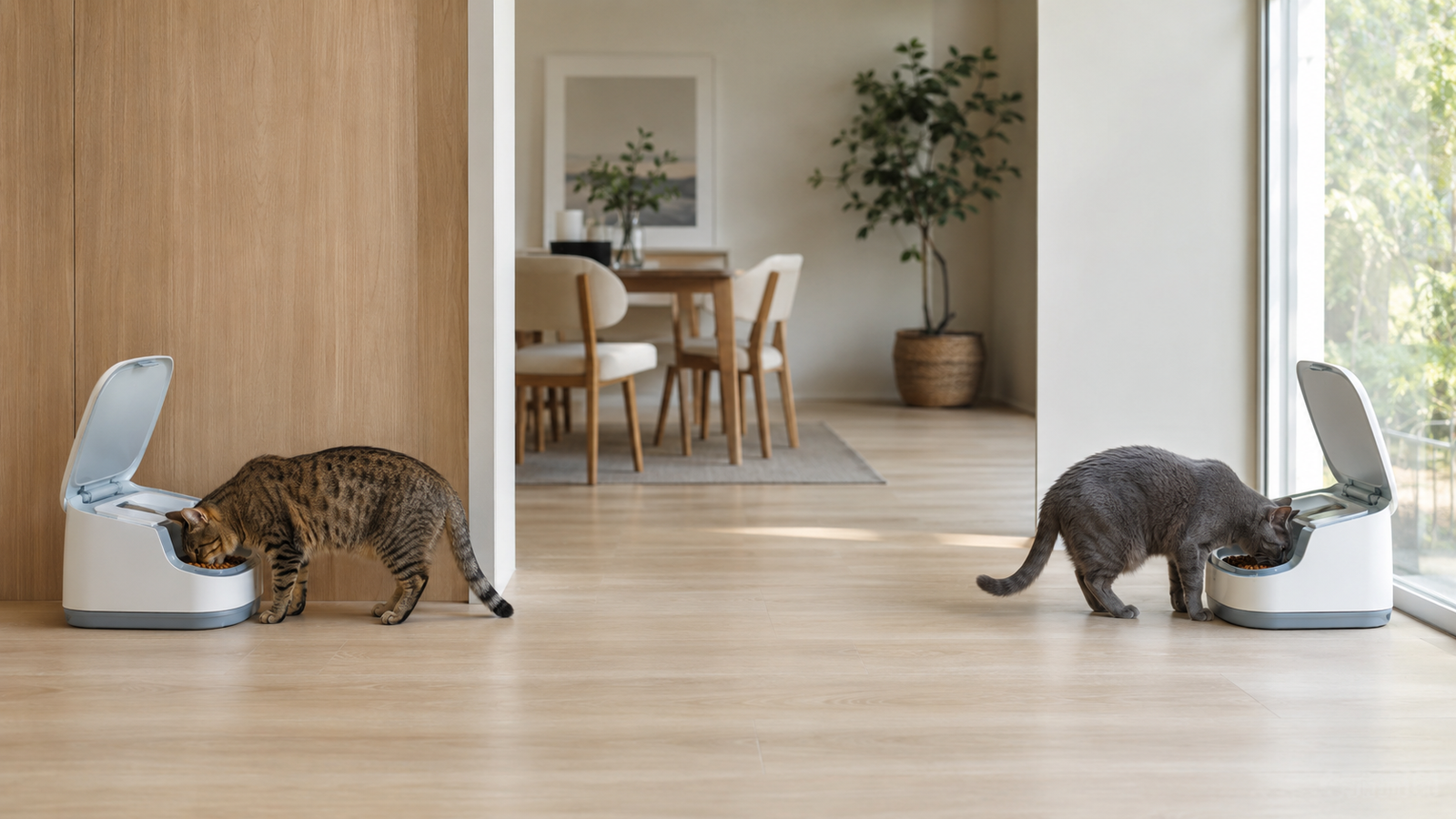
Position feeders apart rather than side by side. Choose quiet locations where each cat can eat without being trapped or watched by another cat, and make sure a timid cat has a clear approach and exit route.
Measure food before filling the bowl
A microchip feeder controls access, not portion size. Measure each cat’s daily allowance according to the food label and your veterinarian’s advice.
Introduce the feeder gradually
A sensible transition might include:
- Placing the switched-off feeder near the familiar bowl.
- Allowing the cat to inspect it voluntarily.
- Serving food with the lid secured fully open at first.
- Using the manufacturer’s training stages, if available.
- Gradually introducing limited lid movement.
- Rewarding calm investigation without forcing the cat.
- Confirming reliable recognition before relying on the feeder day to day.
Observe every cat during the trial period
Check whether the assigned cat is eating enough, the reader recognizes the chip or tag consistently, another pet can reach around the lid, the cat seems frightened by movement or sound, conflict develops near the feeding station, and the bowl stays clean and fresh.
How to Choose a Microchip Cat Feeder
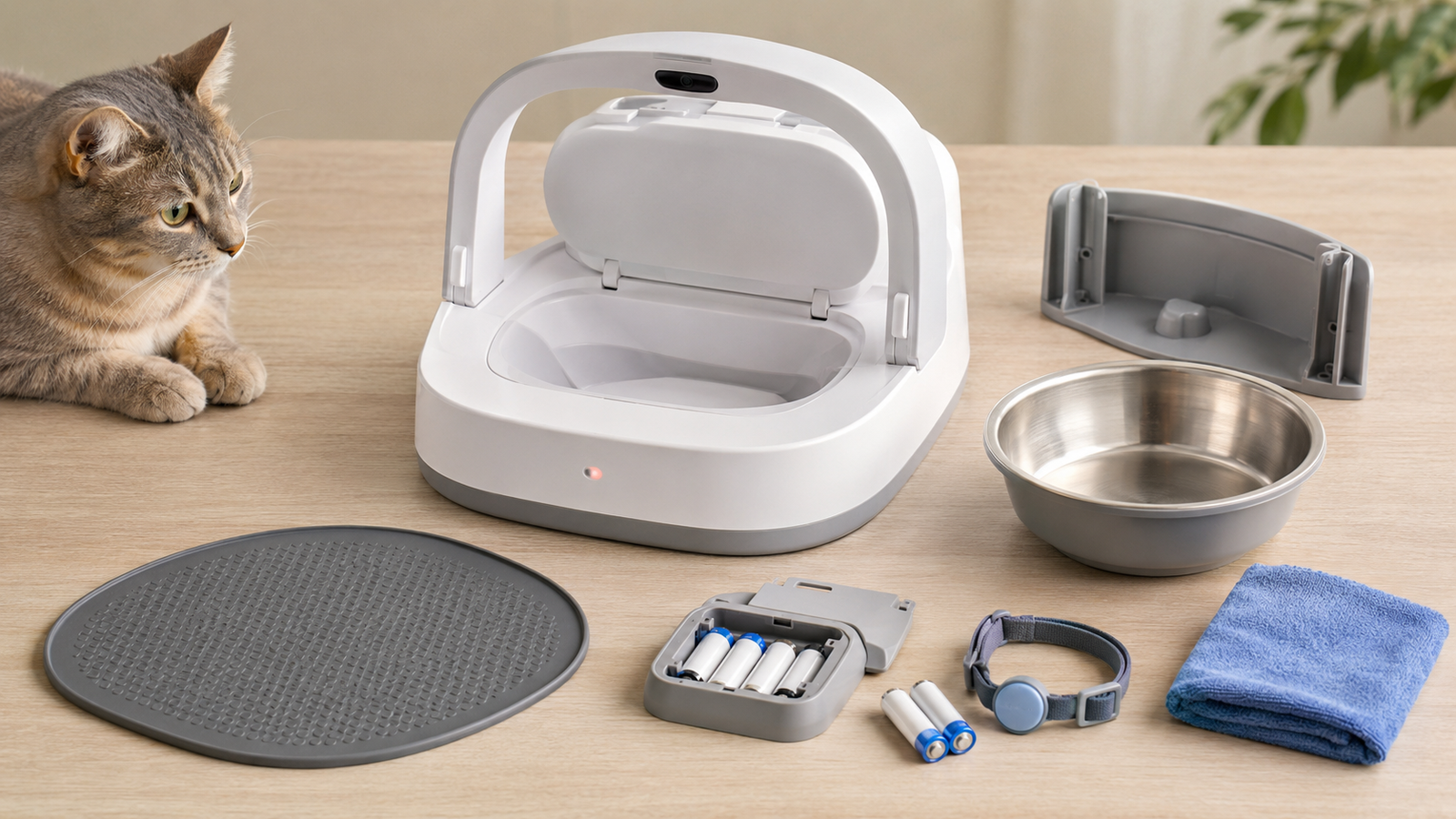
When comparing microchip feeders for cats, confirm the following details before making a decision.
- Reads implanted microchips, RFID tags, or both
- Compatible with your cat’s exact chip type
- Number of pets that can be registered
- Whether authorization is per feeder or per meal
- Wet- and dry-food compatibility
- Bowl material and capacity
- Side and rear theft protection
- Safe lid-obstruction detection
- Adjustable closing speed
- Gradual training mode
- Battery type and low-battery warning
- Removable, easy-to-clean parts
- Availability and cost of replacement bowls or tags
- Scheduling and portion features, if required
- App, hub, or subscription requirements
- Warranty and manufacturer support
Our comparison of the best automatic cat feeders for multiple cats can help you weigh selective access against other multi-cat feeding approaches.
Frequently Asked Questions
Do microchip feeders for cats require a special microchip? Some work with common implanted identification chips, while others support only particular formats. RFID-tag feeders may require a proprietary collar tag instead. Check compatibility before buying.
Can one microchip feeder work for multiple cats? Some feeders can authorize several cats, but every registered cat will normally gain access to the same bowl. Cats requiring separate foods or portions typically need separate feeders.
Can an unmicrochipped cat use one? Often yes, provided the feeder supports a compatible RFID collar tag. Many models include one tag, but replacement or additional tags may cost extra.
Will a microchip feeder stop all food stealing? Not necessarily. It blocks unauthorized access when closed, but a persistent cat may still try to reach the bowl while the authorized cat is eating. Placement, guards, and supervision during setup all matter.
Can microchip feeders hold wet food? Some selective covered-bowl models accept wet and dry food; others, particularly hopper dispensers, are designed only for dry kibble. A lid doesn’t provide refrigeration.
Is a microchip feeder the same as a microchip scanner? It uses related identification technology, but its purpose is different. The feeder simply compares an ID number against its stored authorized list; it doesn’t access registry or owner information.
Do microchip feeders dispense portions automatically? Many don’t. Traditional selective feeders protect food placed manually in a bowl. Some newer models combine access recognition with scheduled dispensing and portion controls.
Are microchip feeders suitable for prescription diets? They can help restrict access to the intended cat, but the diet, amount, and feeding schedule should still follow veterinary instructions, and it’s worth continuing to monitor whether the correct cat is actually eating.
Final Thoughts
Microchip feeders for cats solve a specific but important problem: making the right food accessible to the right pet. They’re particularly useful when one cat steals food, a slow eater needs protection, or cats require different diets. Their real value comes from selective access, not necessarily automatic scheduling, portion dispensing, or remote control.
Before buying, confirm whether the feeder reads your cat’s implanted microchip or requires a collar tag. It’s also worth weighing food compatibility, bowl capacity, theft protection, cleaning, training needs, and how many feeders your household may actually require.
Most importantly, technology can’t resolve every multi-cat feeding conflict on its own. A well-positioned microchip feeder can protect a bowl, but a calm feeding environment, careful observation, and veterinary guidance remain essential alongside it.