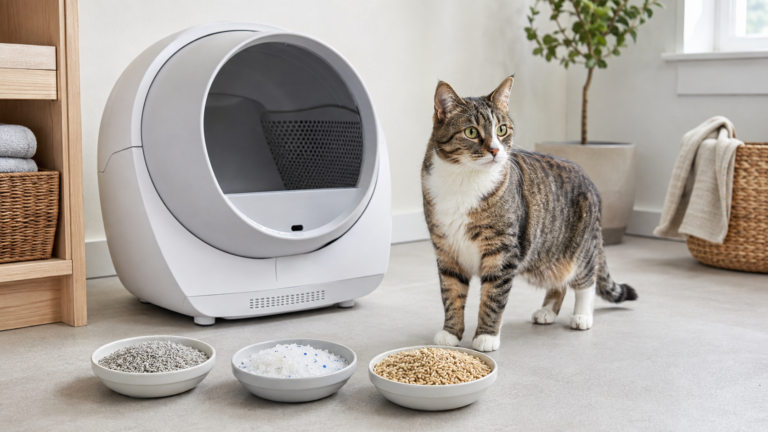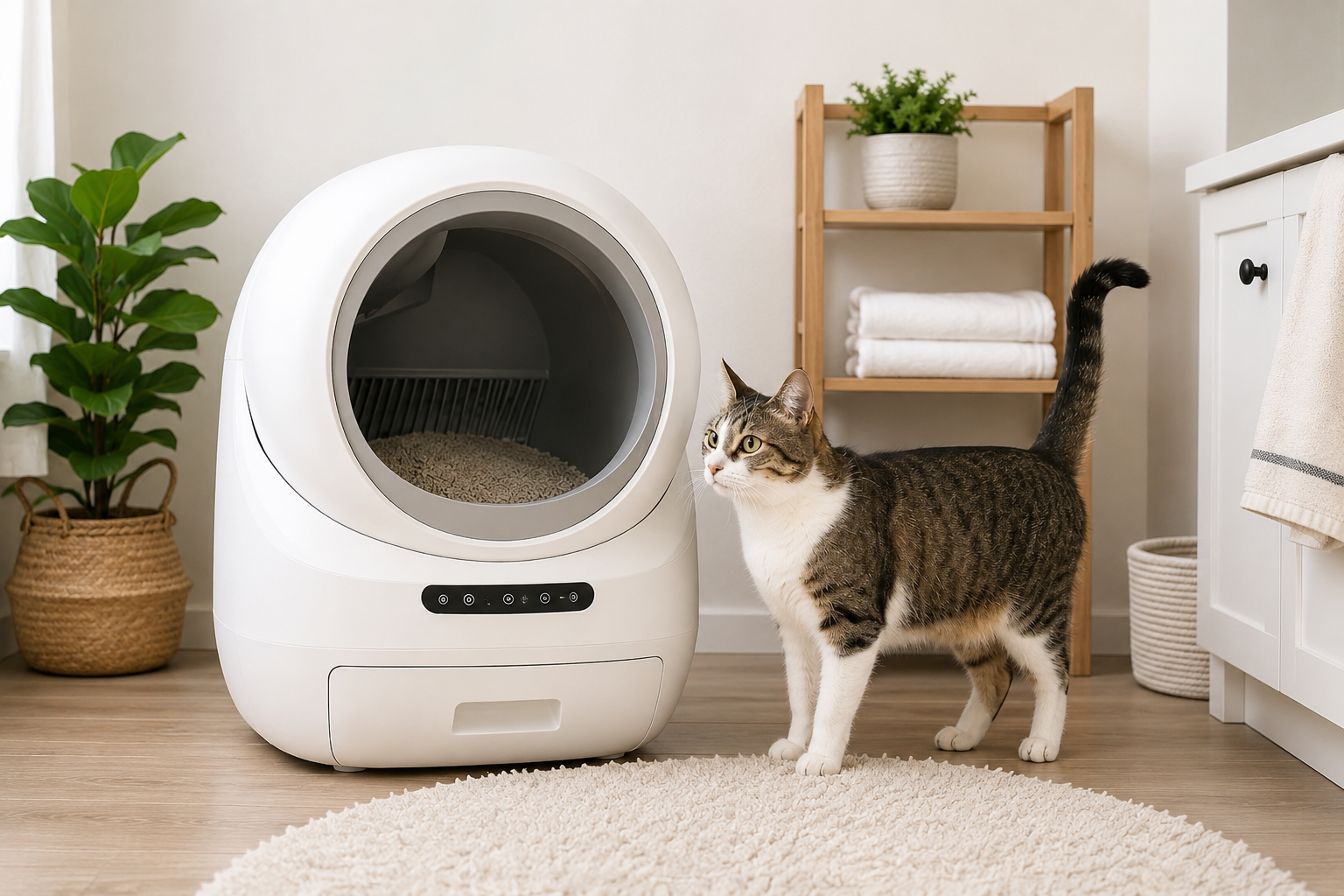
If scooping the litter box every day feels like one chore too many, a self-cleaning litter box can sound like an ideal solution. These automatic systems are designed to detect when a cat has used the box and then separate or remove waste, reducing much of the routine hand-scooping required with a traditional litter box.
But “self-cleaning” does not mean maintenance-free—and convenience alone does not make an automatic litter box the right choice for every cat or household. These systems generally cost more than traditional litter boxes, still require regular cleaning and waste disposal, and may have specific requirements for litter type, cat size, weight, or age. Some cats may also need time to adjust to the unfamiliar shape, sound, enclosure, or movement.
So, are self-cleaning litter boxes actually worth it? This guide looks at their real advantages and disadvantages, safety considerations, ongoing maintenance, suitability for different cats, and the practical factors worth checking before you decide whether an automatic litter box makes sense for your cat and your home.
Quick Answer: Are Self-Cleaning Litter Boxes Worth It?
Self-cleaning litter boxes can be worth it for cat owners who value convenience and want to reduce routine scooping. However, they do not eliminate litter-box maintenance. You will still need to empty collected waste, replenish litter, clean the unit, check sensors and moving parts, and make sure your cat is using the box comfortably.
Whether one is worth the cost ultimately depends on your cat’s needs, the safety and design of the particular model, your budget, and whether you prefer periodic machine maintenance over frequent manual scooping.
Key Takeaways
- Self-cleaning litter boxes can substantially reduce routine hand-scooping, but they are not maintenance-free.
- Their biggest advantage is convenience, while their main drawbacks include higher cost, mechanical complexity, and possible litter restrictions.
- Not every automatic litter box is suitable for every cat, particularly kittens, very small cats, large cats, nervous cats, or cats that struggle with enclosed spaces or high entry points.
- Safety systems and minimum weight or age requirements vary by model and should always be checked before automatic operation.
- Smart usage tracking can help owners notice changes in litter-box habits, but it should never be treated as a veterinary diagnosis.
- Your cat’s comfort and safety should matter more than app features, appearance, or automation.
What Does a Self-Cleaning Litter Box Actually Do?
A self-cleaning litter box automates one particular part of litter-box care: separating or removing waste from the usable litter.
Designs vary. Depending on the model, an automatic litter box may use:
- A rotating drum
- An internal sifting screen
- A motorized rake
- A moving tray
- Another automated waste-separation system
Typically, sensors detect that a cat has entered or used the box. After the cat leaves and any programmed delay has passed, the machine begins a cleaning cycle. Waste is separated from reusable litter and moved into a drawer, bag, or other collection compartment.
You then empty that compartment as required.
Some models also offer app-connected features such as usage history, cleaning-cycle records, waste-drawer notifications, litter-level information, or individual cat tracking.
The exact operation and safety system vary considerably between products, so you should never assume that every automatic litter box works the same way.
What Self-Cleaning Litter Boxes Don’t Do
The name can create unrealistic expectations. Even a sophisticated automatic litter box does not take over every part of litter-box care.
A self-cleaning litter box does not:
- Eliminate the need to empty collected waste.
- Eliminate periodic deep cleaning.
- Automatically prevent all odors.
- Guarantee that your cat will accept or use it.
- Guarantee compatibility with every type of cat litter.
- Replace the need to observe changes in your cat’s bathroom habits.
- Diagnose urinary, digestive, or other medical problems.
- Automatically make one litter box sufficient for every multi-cat household.
- Eliminate the possibility of jams, sensor errors, power interruptions, or other mechanical problems.
It is more accurate to think of these devices as automatic waste-removal systems rather than completely hands-off litter boxes.
The Pros of Self-Cleaning Litter Boxes
Less Routine Scooping
This is the most obvious benefit.
With a traditional litter box, waste normally needs to be found and removed manually. An automatic system handles much of this waste separation after your cat leaves the box.
You still have maintenance responsibilities, but the amount of routine hand-scooping can be substantially reduced.
A Cleaner Litter Surface Between Maintenance Sessions
Because waste can be removed automatically after use, soiled litter may spend less time sitting in the main litter area.
This can help keep the usable litter surface cleaner between your own maintenance sessions, although performance depends on the particular machine, litter type, cleaning-cycle settings, and how frequently the box is used.
Enclosed Waste Storage
Many automatic boxes deposit waste into an enclosed drawer or bag instead of leaving it exposed in the litter bed.
This can help contain some odor between waste-disposal sessions.
However, an enclosed waste compartment does not make odor disappear. Odor control still depends on factors including litter choice, waste capacity, number of cats, cleaning frequency, and how regularly the drawer is emptied.
Convenience for Busy Households
If you cannot scoop immediately after every litter-box visit, automation can keep removing waste between your regular checks.
This can be particularly convenient when a box receives frequent use.
However, automation should supplement owner attention rather than replace it. You should still confirm that the machine is operating normally and that your cat is using it comfortably.
Smart Monitoring on Some Models
Some automatic litter boxes can record information such as box visits, cleaning cycles, or changes in usage patterns.
This information may make maintenance easier and can sometimes help you notice that your cat’s normal litter-box routine has changed.
But these features are monitoring tools—not medical diagnostic systems.
A change in recorded litter-box activity should be treated as information to investigate, not proof that a cat does or does not have a medical condition.
Potential Convenience in Multi-Cat Homes
Automatic waste removal can be useful when a litter box receives frequent use from more than one cat.
But buying one automatic litter box should not automatically be treated as a replacement for an appropriate multi-box setup.
Cats may have different litter preferences, locations they feel comfortable using, or relationships with other cats in the household. Consider the needs of each cat as well as the manufacturer’s stated capacity and recommendations.
The Cons of Self-Cleaning Litter Boxes
Higher Initial Cost
Automatic litter boxes contain motors, sensors, electronics, and, in some cases, Wi-Fi or app-connected technology.
As a result, they generally cost considerably more than a basic traditional litter box.
The purchase price may not be the only expense. Depending on the model, ongoing costs can include:
- Waste liners or bags
- Filters
- Particular litter types
- Cleaning supplies
- Replacement components
- Optional subscriptions or connected services on some products
Consider the total cost of ownership rather than just the price of the machine.
Regular Maintenance Is Still Required
This is one of the biggest misconceptions about automatic litter boxes.
Self-cleaning does not mean maintenance-free.
Depending on the design, you may still need to:
- Empty the waste compartment
- Refill or replace litter
- Wipe sensors
- Clean internal surfaces
- Remove stuck litter or waste
- Check moving parts for debris
- Perform periodic deeper cleaning
A poorly maintained automatic litter box can become unpleasant for the cat and may not operate as intended.
Mechanical and Electronic Problems Are Possible
A traditional litter tray has almost nothing mechanical that can fail.
An automatic litter box may experience sensor errors, jams, waste sticking to internal surfaces, motor problems, connectivity issues, or other faults depending on its design.
This does not mean every automatic box will malfunction. It simply means that additional mechanical and electronic components introduce potential failure points that do not exist in a basic litter tray.
Some Cats May Not Accept Them
Cats have individual preferences.
One cat may investigate a new automatic litter box immediately, while another may be uncomfortable with its entrance, enclosed design, unfamiliar surface, sound, or movement.
A gradual introduction is generally preferable to abruptly removing the familiar litter box.
Where the manufacturer’s instructions permit it, initially leaving the automatic function turned off while the cat investigates the new box can also make the transition less intimidating.
Never force a frightened cat into an automatic litter box.
Not Every Model Is Suitable for Kittens or Very Small Cats
This is an important safety issue.
Automatic litter boxes use different combinations of sensors and safety systems. Some rely partly on the cat’s weight to detect occupancy, and very small kittens may fall below the manufacturer’s minimum requirement for automatic operation.
Minimum weight and age recommendations are model-specific.
Always check the instructions for the exact machine you are considering. Do not assume an automatic litter box is safe for a kitten simply because the kitten can physically enter it.
Large or Mobility-Limited Cats May Need Extra Consideration
External dimensions do not necessarily tell you how much usable space a cat has inside the litter box.
A large cat needs enough room to enter, turn, and position itself comfortably.
Similarly, an older cat or a cat with limited mobility may find a high step, narrow entrance, or enclosed interior more difficult to use.
If accessibility is a concern, prioritize entry height, usable interior space, and ease of movement rather than technology.
They Depend on Electricity
Most fully automatic litter boxes require electricity for their cleaning mechanism.
During a power outage, automatic cleaning may stop. How the machine behaves when power returns varies by product.
Owners should understand what happens if the machine loses power or stops working and be prepared to manage litter-box needs manually if necessary.
Some Require Particular Litter or Consumables
Not every automatic box works with every litter.
Depending on its waste-separation system, a model may require a particular type of clumping litter, crystals, pellets, or other manufacturer-approved material.
Incompatible litter can reduce cleaning effectiveness or interfere with the mechanism.
Litter compatibility should therefore be checked before buying, especially if your cat is strongly attached to its current litter.
Self-Cleaning vs. Traditional Litter Boxes
| Factor | Self-Cleaning Litter Box | Traditional Litter Box |
|---|---|---|
| Routine scooping | Reduced through automation | Usually manual |
| Initial cost | Generally higher | Generally lower |
| Moving parts | Yes | Usually none |
| Electricity | Usually required | Normally not required |
| Regular maintenance | Still required | Required |
| Litter flexibility | May be restricted | Usually more flexible |
| Mechanical failure risk | Possible | Minimal |
| Smart/app features | Available on some models | Generally unavailable |
| Cat adjustment | May require a transition | Often simpler |
| Troubleshooting | May occasionally be required | Usually minimal |
| Space requirements | Often larger | Many sizes available |
Neither type is automatically better.
A traditional litter box offers simplicity, flexibility, and low mechanical complexity. A self-cleaning litter box trades some of that simplicity for automation and convenience.
The better choice is the one that works reliably for both you and your cat.
Who Is Most Likely to Benefit From a Self-Cleaning Litter Box?
An automatic litter box may be particularly appealing if:
- You strongly dislike routine scooping.
- Your schedule makes frequent manual scooping inconvenient.
- You are comfortable maintaining and occasionally troubleshooting a mechanical device.
- Your cat meets the manufacturer’s size, weight, and age requirements.
- Your cat appears comfortable with the box’s entrance and interior.
- You value app-based maintenance reminders or usage information.
- The ongoing cost fits comfortably within your budget.
When Might a Traditional Litter Box Be the Better Choice?
A traditional litter box may remain the more practical option if:
- Your cat is frightened by mechanical sounds or movement.
- Your kitten does not meet the automatic unit’s operating requirements.
- Your cat needs a particularly large or easily accessible litter area.
- You prefer maximum flexibility in litter type.
- You want the lowest initial cost.
- You do not want to troubleshoot sensors, motors, or electronics.
- You are already comfortable with regular manual scooping.
Choosing a traditional litter box is not choosing an inferior solution. A simple litter box that your cat reliably uses and that you keep appropriately maintained can be a perfectly sensible choice.
Are Self-Cleaning Litter Boxes Safe?
Safety deserves more attention than convenience features.
Automatic litter boxes contain powered moving components, and different manufacturers use different systems to determine whether a cat is inside or approaching the machine.
Depending on the design, safety features may include:
- Weight sensors
- Motion or infrared sensors
- Entrance detection
- Multiple occupancy sensors
- Delayed cleaning cycles
- Automatic cycle interruption when a cat is detected
The presence of the word “smart” or “automatic” does not by itself tell you how comprehensive a product’s safety system is.
Safety Features to Check Before Buying
Before using an automatic litter box, verify:
Minimum cat weight and age: Follow the manufacturer’s requirements for automatic operation.
How the cat is detected: Understand which sensors the machine uses and whether they have specific operating limitations.
Cycle interruption: Check whether the cleaning cycle stops if a cat approaches or enters during operation.
Cleaning delay: Understand how long the machine waits after detecting that the cat has left.
Correct litter requirements: Using unsuitable litter may interfere with normal operation on some machines.
Placement requirements: Follow instructions regarding floor surface, wall clearance, power supply, and other installation requirements.
Maintenance requirements: Dirty or obstructed sensors may interfere with reliable operation, so follow the manufacturer’s cleaning instructions.
Safety should carry more weight in your buying decision than app features, appearance, or convenience.
Don’t Let Automation Replace Observation
One potential downside of automatic waste removal is that owners may have fewer reasons to look closely at the litter box.
That makes conscious observation even more important.
Pay attention to changes such as:
- Suddenly visiting the litter box much more frequently
- Straining to urinate or defecate
- Producing unusually small amounts of urine
- Blood in urine or stool
- Crying or appearing uncomfortable while using the box
- Suddenly avoiding the litter box
- Major changes in normal elimination habits
An app may help identify changes in usage frequency on some systems, but it cannot tell you the cause.
If your cat is repeatedly straining to urinate and producing little or no urine, seek veterinary attention immediately. A urethral obstruction is a medical emergency requiring prompt veterinary treatment.
Will an Automatic Litter Box Actually Save You Time?
Potentially, yes—but it changes the type of work rather than eliminating it.
Instead of manually scooping individual clumps every day, you may spend your maintenance time:
- Emptying the waste drawer
- Adding litter
- Cleaning the drum or tray
- Wiping sensors
- Removing stuck debris
- Checking for errors or jams
- Performing periodic deeper cleaning
The more useful question is therefore not:
“Will I ever have to clean it?”
You will.
A better question is:
“Would I rather handle periodic machine maintenance than frequent manual scooping?”
If the answer is yes, an automatic litter box becomes considerably more attractive.
What to Check Before Buying a Self-Cleaning Litter Box
If you’re ready to compare specific options, our guide to the best self-cleaning litter boxes covers different models and the practical features worth comparing. Before choosing any model, consider the following factors.
1. Your Cat’s Size and Weight
Check the manufacturer’s requirements for automatic operation, particularly if you have a kitten or very small cat.
2. Usable Interior Space
Do not judge size only from the machine’s external dimensions.
Consider whether your cat can comfortably enter, turn around, and position itself inside.
3. Entry Height and Accessibility
This is especially important for senior cats, cats with limited mobility, or cats that struggle with high-sided litter boxes.
4. Safety System
Find out how the machine detects a cat and what causes a cleaning cycle to stop.
5. Litter Compatibility
Check whether your preferred litter is approved for the machine.
6. Waste Capacity
A larger waste compartment may require less frequent emptying, but actual capacity depends on usage and the number of cats.
7. Ease of Cleaning
Look beyond automatic waste removal.
Ask how easily you can access and clean the parts that still require manual attention.
8. Ongoing Costs
Consider litter, waste liners, filters, replacement parts, and any optional connected services.
9. Noise
A nervous or easily startled cat may react differently to motor noise than a confident cat.
10. Available Space
Automatic litter boxes can have a much larger footprint than basic trays.
Measure the intended location before buying.
11. Your Cat’s Personality and Existing Preferences
A technically impressive litter box has little value if your cat refuses to use it.
12. What Happens if It Stops Working?
Consider your backup plan for a power outage, sensor fault, or mechanical problem.
This becomes particularly important if the automatic box is heavily relied upon in a multi-cat household.
How to Introduce a Cat to an Automatic Litter Box
Avoid making the change too abruptly.
A sensible transition may include:
- Positioning the new box in an appropriate location near the familiar litter-box area.
- Keeping the old litter box available while your cat investigates the new one.
- Using a familiar, compatible litter where appropriate.
- If the manufacturer permits it, initially leaving automatic cycling turned off while your cat becomes comfortable with the box.
- Allowing the cat to enter voluntarily rather than placing or forcing it inside.
- Observing whether your cat is urinating and defecating normally during the transition.
Once your cat is reliably using the new box and you are following the manufacturer’s operating instructions, you can gradually complete the transition.
If your cat persistently refuses to use the automatic box, the technology may simply not be a good match for that cat.
Common Mistakes to Avoid
Buying for Features Instead of the Cat
An impressive app, sleek design, or long feature list means little if the litter box is uncomfortable or unsuitable for your cat.
Start with safety, size, accessibility, and your cat’s normal preferences.
Assuming “Self-Cleaning” Means No Cleaning
Automatic waste removal does not clean every internal surface.
Plan for regular maintenance from the beginning.
Removing the Old Litter Box Too Quickly
An abrupt change can make adjustment harder for some cats.
Give your cat time to investigate the new box voluntarily.
Ignoring Litter Requirements
Using an incompatible litter can reduce cleaning performance or interfere with the mechanism.
Ignoring Manufacturer Weight or Age Requirements
Never assume that every automatic litter box is safe for every kitten or small cat.
Requirements vary by model.
Relying Too Heavily on App Data
Usage records can be helpful, but they should complement—not replace—your own observation of your cat.
Ignoring Changes in Litter-Box Behavior
A sudden change in frequency, straining, discomfort, or avoidance deserves attention regardless of whether the box is automatic or traditional.
Are Expensive Self-Cleaning Litter Boxes Automatically Better?
Not necessarily.
A higher price may reflect additional sensors, larger capacity, app connectivity, quieter operation, different materials, or additional convenience features.
But price alone cannot tell you whether a litter box is suitable for your cat.
A more useful set of questions is:
- Is it appropriately sized for my cat?
- Is the entrance comfortable and accessible?
- What safety system does it use?
- Does my cat meet the automatic-operation requirements?
- Is compatible litter easy to obtain?
- How difficult is the machine to clean?
- Are replacement parts and consumables readily available?
- What ongoing costs should I expect?
- What happens if the machine malfunctions?
- Is my cat likely to accept its design?
A simpler automatic model that suits your cat and household may offer better practical value than a more expensive model filled with features you do not need.
Frequently Asked Questions
Are self-cleaning litter boxes really worth the money?
They can be. If reducing routine scooping is valuable to you and your cat is comfortable using the machine, the convenience may justify the higher purchase and operating costs. If you do not mind manual scooping, a traditional litter box may provide better value.
Do you ever have to scoop a self-cleaning litter box?
Sometimes. Manual intervention may still be necessary if waste sticks, litter does not separate correctly, or the mechanism requires cleaning. Regular owner maintenance is necessary even when automatic waste removal works normally.
Do self-cleaning litter boxes still smell?
They can. An enclosed waste drawer may help contain some odor, but waste still needs to be removed, and the machine still needs regular cleaning. Litter type, number of cats, waste capacity, and maintenance frequency can all affect odor.
Can multiple cats use one self-cleaning litter box?
Some automatic litter boxes are designed or marketed for multi-cat use, but that does not mean one unit is appropriate for every multi-cat household. Consider the manufacturer’s recommendations as well as the individual needs and litter-box preferences of each cat.
Are automatic litter boxes safe for kittens?
Not every model is suitable for every kitten. Minimum weight, age, and automatic-operation requirements vary by product. Follow the manufacturer’s instructions for the exact model rather than applying a general weight rule to all automatic litter boxes.
Are automatic litter boxes safe?
Safety depends on the product’s design, sensors, setup, maintenance, and correct use. Check how the machine detects a cat, what interrupts a cleaning cycle, and the manufacturer’s requirements for kittens, minimum weight, litter type, and installation.
What happens if my cat refuses to use an automatic litter box?
Do not force your cat into it. Introduce the new box gradually while keeping the familiar litter box available during the transition. If your cat continues to avoid the automatic box, a traditional litter box may simply be a better fit.
How often does a self-cleaning litter box need to be cleaned?
There is no single schedule that applies to every model. Waste compartments need emptying as they fill, while internal surfaces and sensors require periodic cleaning according to the manufacturer’s instructions. Usage by multiple cats may increase maintenance frequency.
Can a self-cleaning litter box tell if my cat is sick?
No. Some smart models can track visits or other usage information, which may help you notice a change in your cat’s routine. However, this information cannot diagnose illness. Concerning changes in urination, defecation, appetite, behavior, or litter-box use should be discussed with a veterinarian.
Final Verdict: Are Self-Cleaning Litter Boxes Worth It?
For the right cat and household, a self-cleaning litter box can be worth it.
Its real value is not that it eliminates litter-box care—it doesn’t. The benefit is that it automates much of the repetitive waste removal that would otherwise require routine hand-scooping.
That can be a meaningful convenience for owners who dislike frequent scooping, have busy schedules, or simply prefer household automation.
But the trade-offs are equally real: higher initial cost, ongoing maintenance, electrical and mechanical components, possible litter restrictions, potential troubleshooting, and an adjustment period for some cats.
Most importantly, the decision should start with your cat rather than the technology.
Consider your cat’s size, age, mobility, temperament, litter preferences, and comfort with the design. Then consider your own budget, available space, maintenance expectations, and willingness to deal with a mechanical device.
If those factors line up, a well-designed automatic litter box can be a genuinely useful addition to your home.
If they don’t, a clean, appropriately sized, and well-maintained traditional litter box remains a perfectly practical choice.