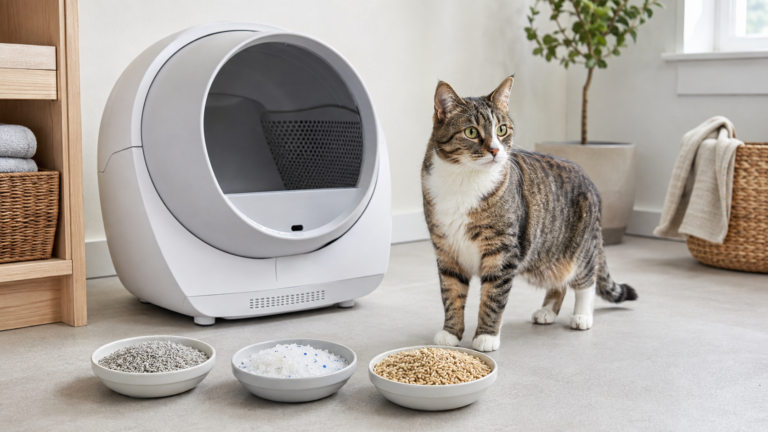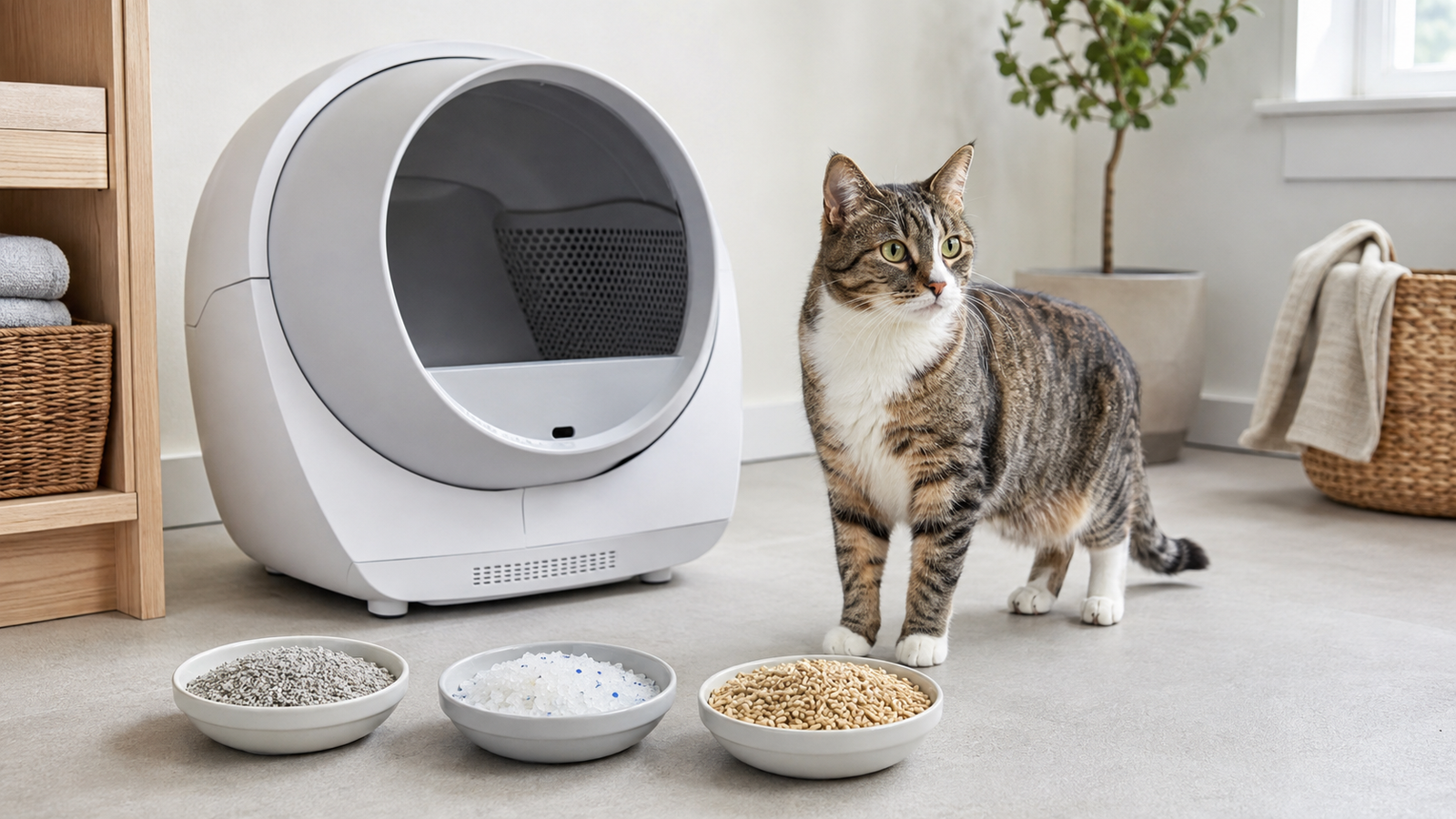
Choosing the right cat litter for automatic litter box use is essential for reliable cleaning, effective waste separation, and easier maintenance.
The wrong litter may produce weak clumps, clog a sifting screen, interfere with sensors, increase waste, or leave damp material inside the waste drawer. Even a technically compatible litter can cause problems if its particles are too large, too light, excessively dusty, or slow to clump.
For most rotating and sifting models, the best cat litter for an automatic litter box is a fast-clumping, standard-weight litter with particles small enough to pass through the machine’s screen. High-quality clumping clay is usually the most reliable option, although certain crystal and plant-based litters can work in compatible models.
The deciding factor is always your automatic litter box’s design and manufacturer guidance.
Quick Answer
For most rotating and sifting models, the best cat litter for automatic litter box use is a fast-clumping, standard-weight formula with compatible particle dimensions.
For most automatic litter boxes, choose a litter that:
- Forms firm clumps quickly
- Does not crumble during the cleaning cycle
- Has small or medium-sized particles
- Is heavy enough for the machine’s sensing system
- Produces relatively little dust
- Controls odour effectively
- Is explicitly permitted by the manufacturer
Standard-weight clumping clay is generally the safest starting point. Crystal litter, tofu litter, and other plant-based alternatives may work in some machines, but their compatibility varies much more between models.
Avoid assuming that any litter labelled “clumping” will automatically work. Particle size, clump strength, and weight matter just as much as the label.
Key Takeaways
- Fast-clumping clay litter is the most broadly compatible choice for rotating and sifting automatic litter boxes.
- Crystal litter works well in machines designed for crystals or compatible disposable trays, but it is not suitable for every system.
- Some tofu and plant-based litters can work, although soft clumps, oversized particles, and moisture retention may reduce performance.
- Wood pellets, paper pellets, and conventional non-clumping litter are unsuitable for most sifting machines.
- Lightweight litter can cause sensor or clump-separation problems in certain models.
- Never overfill the globe or litter tray.
- Check your machine’s manual before switching litter types.
Why Litter Compatibility Matters
An automatic litter box does more than hold litter. Depending on the model, it may rotate a globe, move a rake, sift through a screen, weigh the cat, detect changes in load, monitor litter levels, or calculate when a cleaning cycle should begin.
The litter therefore becomes part of the machine’s operating system.
During a typical cleaning cycle, clean granules must separate from soiled material while urine clumps and solid waste move into the waste drawer. If the litter does not form strong clumps—or if the particles cannot pass through the screen—the separation process becomes unreliable.
That can result in:
- Clean litter being discarded with waste
- Damp material sticking to the globe or rake
- Clumps breaking apart during rotation
- Waste remaining in the clean litter bed
- Increased odour
- More frequent deep cleaning
- Inaccurate litter-level readings
- Unnecessary strain on moving components
If you are unfamiliar with the underlying process, our guide to how self-cleaning litter boxes work explains the main rotating, raking, and sifting mechanisms.
Because these designs operate differently, a litter that performs well in one machine may be unsuitable for another.
What Makes Cat Litter for Automatic Litter Box Use Suitable?
1. Fast Clumping
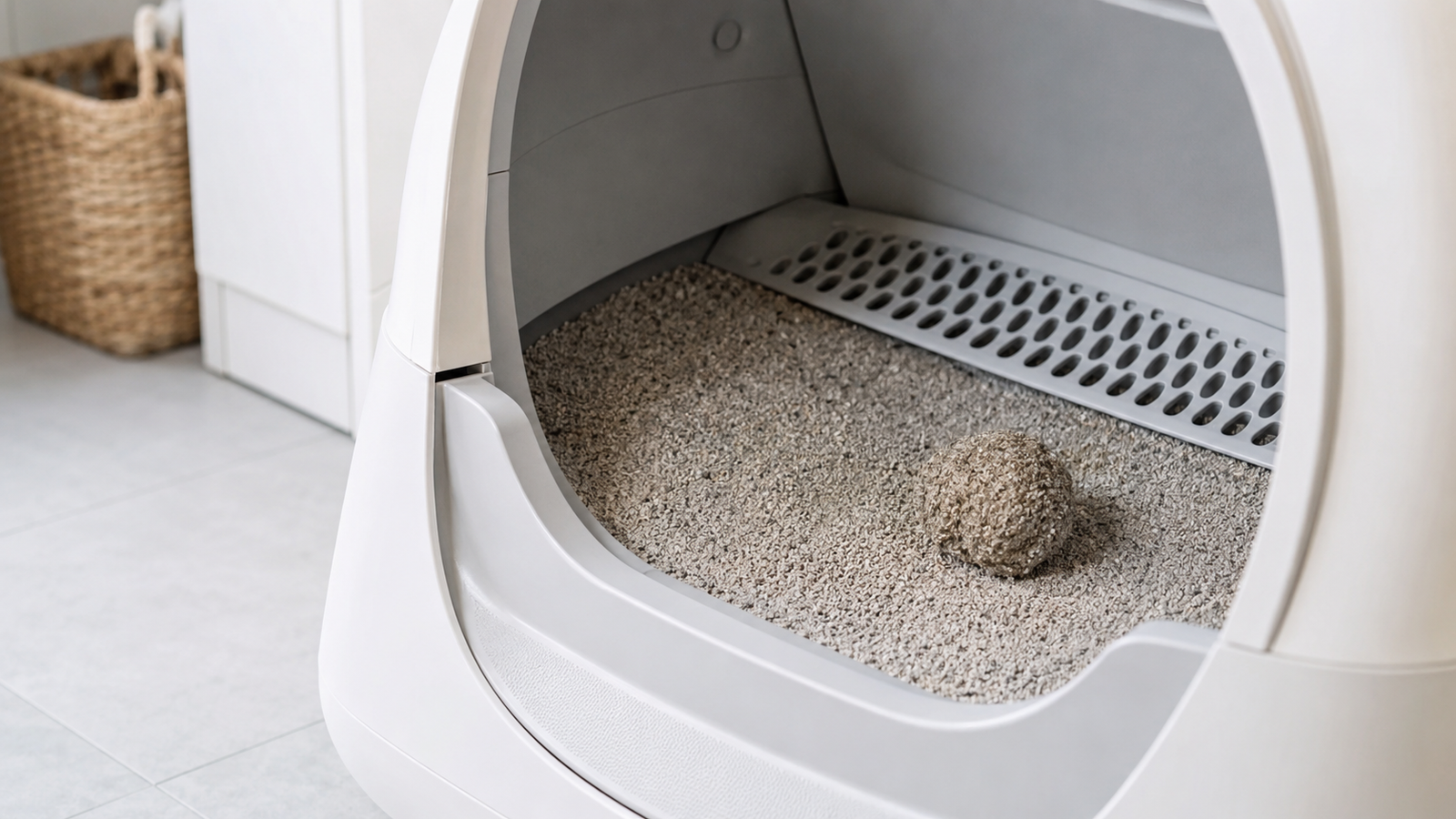
The litter needs to absorb urine and form a defined clump before the cleaning cycle begins.
If a machine starts rotating while the litter is still wet, the clump may smear across the liner or break into smaller contaminated pieces. This can leave residue behind and spread odour through the clean litter.
A longer cleaning delay may help with slower litter, but choosing a faster-clumping formula is usually more dependable.
2. Firm Clump Strength
Speed alone is not enough. Clumps must stay intact when lifted, raked, or sifted.
Weak clumps can crumble into small pieces that fall back through the screen. The litter may then appear clean even though contaminated fragments remain in the bed.
Look for formulas described as:
- Hard clumping
- Firm clumping
- Tight clumping
- Fast clumping
- Suitable for automatic litter boxes
Treat these claims as a starting point, not a guarantee. Actual performance can vary according to litter depth, humidity, urine volume, and the machine’s cleaning delay.
3. Compatible Particle Size
In a sifting system, unused litter must pass through openings while clumps remain above the screen.
Particles that are too large may be carried into the waste drawer along with the clumps. Very fine litter may pass through easily but could track more readily or produce additional dust.
Manufacturer specifications can be quite precise. For example, Neakasa states that the M1’s filter is designed to sift particles measuring up to approximately 3 mm in diameter and 10 mm in length. Its official M1 guidance recommends fast-clumping granular litter such as bentonite or mineral litter.
This is why generic advice cannot replace your model’s instructions.
4. Appropriate Weight
Some automatic litter boxes use changes in weight to recognise that a cat has entered the unit. Extremely lightweight litter may alter how the machine responds or how much material is needed for reliable operation.
Whisker’s Litter-Robot filling guidance notes that lightweight corn- and wheat-based litters may require more weight to activate the Litter-Robot 3’s cat sensor.
That does not mean lightweight litter fails in every automatic box. It means compatibility must be checked for the specific model, especially when the machine relies on weight-sensitive detection.
5. Relatively Low Dust
Dust can collect around seals, screens, sensors, and moving components. It can also create additional cleaning work and may be unpleasant for sensitive cats or people.
A low-dust formula is therefore preferable, but “low dust” is not a standardised measurement. One product advertised as nearly dust-free may behave very differently from another.
Reviews can help, but a small home test is more useful than relying entirely on packaging claims.
6. Cat Acceptance
Mechanical compatibility is only half the decision. Your cat must also be willing to use the litter.
Cats may reject a sudden change in:
- Texture
- Particle size
- Fragrance
- Depth
- Box location
- Sound or movement
- Cleanliness
The best-performing litter is of little value if your cat avoids the box. When possible, introduce a new automatic litter box and a new litter gradually rather than changing everything on the same day.
Comparing Litter Types for Automatic Litter Boxes
Clumping Clay Litter
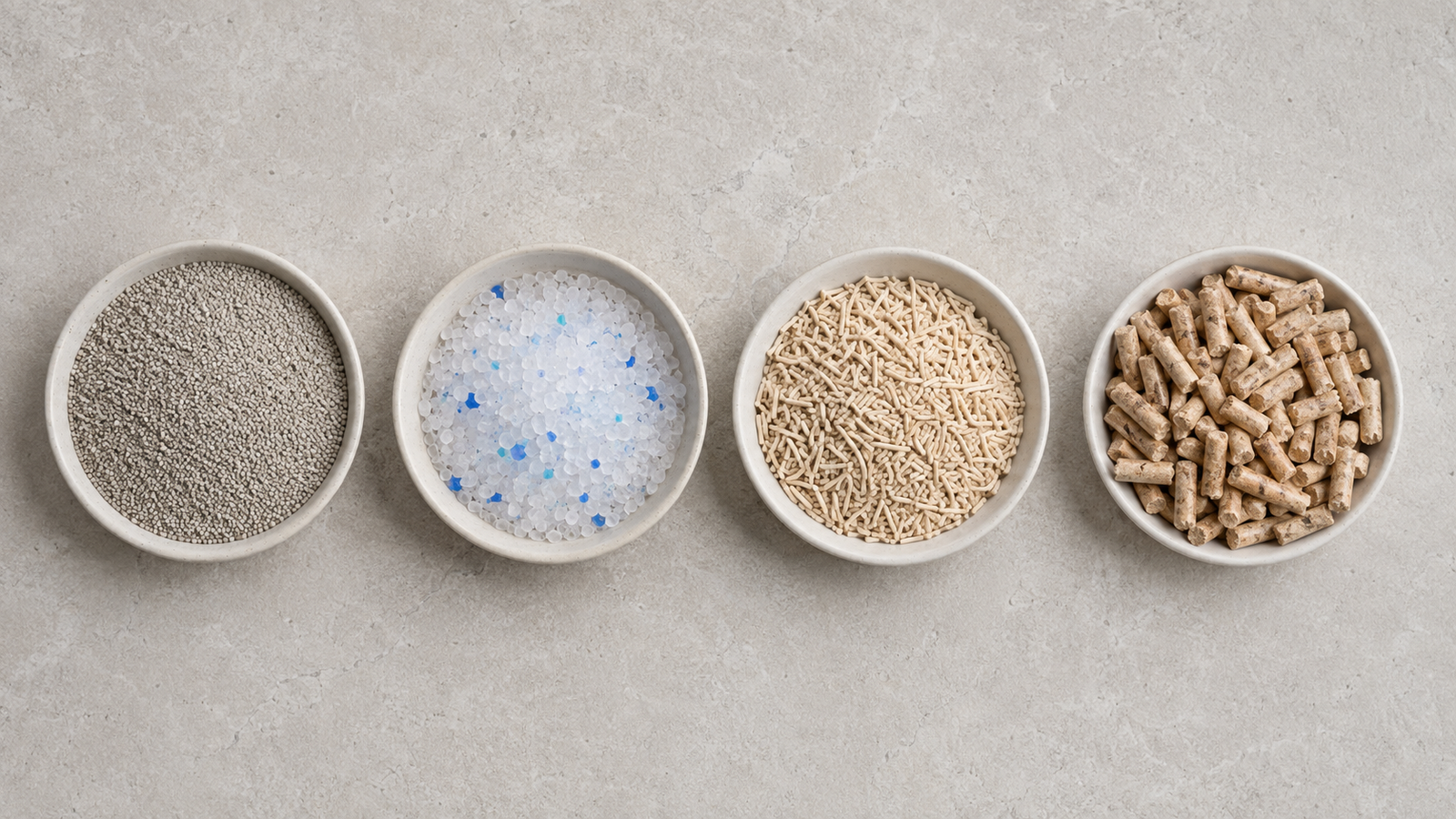
For most rotating and sifting automatic litter boxes, standard-weight clumping clay is the most dependable option.
Bentonite clay absorbs liquid and expands into a firm mass. A suitable formula usually passes through the screen when clean while leaving the larger clump behind for disposal.
Whisker’s official litter compatibility guidance recommends high-quality, standard-weight, clay-based clumping litter for its machines.
Advantages
- Broad compatibility
- Fast absorption
- Strong clump formation
- Effective odour control
- Widely available
- Usually affordable
- Easy to test in small quantities
Possible disadvantages
- Can be dusty
- May track outside the box
- Heavy bags can be difficult to handle
- Some products form softer clumps than others
- Heavily scented versions may discourage sensitive cats
Choose an unscented or lightly scented, fast-clumping formula with relatively low dust. Avoid overfilling the machine, since excess litter can increase waste and interfere with the cleaning cycle.
Crystal or Silica-Gel Litter
Crystal litter absorbs moisture into porous silica particles rather than forming conventional clay clumps. Its performance depends heavily on the machine.
It is a natural fit for certain automatic systems designed around crystal litter or disposable crystal trays. Some rotating machines may also accept small silica crystals that can pass through the sifting screen.
Whisker states that certain silica-gel beads and crystals can work if they pass through the screen. However, its FAQ also warns that translucent or white crystal litter may affect litter-level and Drawer Full Indicator accuracy in the Litter-Robot 4.
Advantages
- Strong moisture absorption
- Generally good odour control
- Often produces less dust than some clay litters
- May require less frequent complete replacement
- Suitable for machines designed specifically for crystals
Possible disadvantages
- Not compatible with every sifting system
- Larger crystals may not pass through the screen
- Non-clumping versions may not separate correctly
- Light or translucent material can affect optical readings in some machines
- Texture may be uncomfortable for certain cats
- Usually costs more than basic clay litter
Use crystal litter only when the manufacturer confirms compatibility. If the machine is designed for clumping litter, do not assume that absorbent non-clumping crystals will work simply because the particles fit through the screen.
Tofu and Other Plant-Based Clumping Litter
Plant-based litter is available in materials such as tofu, corn, wheat, cassava, grass and pea fibre. These products appeal to owners seeking lighter or renewable alternatives to clay.
Compatibility is mixed.
Some plant-based litters form strong clumps and work well in compatible machines. Others produce soft clumps, retain more moisture, or use elongated particles that cannot pass through the screen.
Whisker notes that some alternative plant-based litters may work in its machines, but they tend to form looser clumps and can contribute to condensation inside the waste drawer. More frequent drawer emptying and cleaning may therefore be necessary.
Advantages
- Often lighter than clay
- Frequently made from renewable materials
- Some formulas produce little dust
- Many offer effective clumping
- May track less when the particles are larger
Possible disadvantages
- Clump quality varies considerably
- Long tofu pellets may not pass through narrow screens
- Soft clumps may break during rotation
- Organic material can retain moisture
- Waste-drawer condensation may increase
- Some formulas are more expensive
- Extremely lightweight products may affect weight-sensitive systems
If you want to use plant-based litter, test a small amount first. Short-grain or crushed formulas generally have a better chance of passing through a sifting screen than long pellets, but the manufacturer’s instructions should determine whether they are suitable.
Pine and Wood-Pellet Litter
Traditional wood pellets are usually a poor match for rotating and sifting automatic litter boxes.
The pellets are often too large to pass through the screen. When wet, they may break down into sawdust rather than forming a removable clump. That behaviour is useful in a purpose-built pellet system but not in a machine designed to separate clumps from clean granules.
Advantages
- Renewable material
- Natural wood scent
- Often economical
- Usually produces little airborne dust before breaking down
Disadvantages in most automatic boxes
- Pellets may be too large for the screen
- Wet material turns into sawdust
- Does not create conventional clumps
- Clean pellets may be discarded as waste
- Damp fragments can remain in the litter bed
- May obstruct narrow openings
Whisker specifically excludes absorbent wood-pellet litter from its compatible options. Use it only if your automatic litter box was designed for pellets or its manufacturer explicitly approves the product.
Paper-Pellet Litter
Paper litter is soft and absorbent, which can be helpful for certain cats, but most varieties do not form the firm clumps needed by automatic sifting systems.
Large paper pellets can also be difficult for a screen or rake to separate.
Paper-based litter may be suitable when recommended by a veterinarian for a temporary recovery period, but in that situation a conventional litter tray may be more practical than an automatic box.
Non-Clumping Litter
Conventional non-clumping litter absorbs urine without creating a solid removable mass.
Most rotating and sifting automatic boxes depend on clump formation. Without a firm clump, urine-soaked particles remain mixed with the clean litter or fall back through the screen.
This can cause:
- Persistent odour
- Damp litter
- Increased bacterial contamination
- More frequent full litter replacement
- Poor waste separation
Unless your machine was designed for non-clumping litter, avoid it.
Lightweight Clumping Litter
Lightweight litter is easier to carry and may reduce the physical effort of refilling the box. However, some formulas are too light for reliable sifting or weight-based cat detection.
Possible problems include:
- Clean litter entering the waste drawer
- Clumps breaking during rotation
- Inaccurate weight readings
- Excess litter movement during a cleaning cycle
- Greater tracking around the box
Some lightweight products work perfectly well in specific machines. Confirm compatibility rather than treating “lightweight” as either universally safe or universally unsuitable.
Automatic Litter Box Compatibility Comparison
The following comparison can help you identify suitable cat litter for automatic litter box systems, but your manufacturer’s instructions should always take priority.
| Litter type | General suitability | Main considerations |
|---|---|---|
| Standard-weight clumping clay | Usually the best overall choice | Choose fast, firm clumping litter with relatively low dust |
| Small clumping silica crystals | Model-dependent | Crystals must pass through the screen and may affect optical sensors |
| Non-clumping crystal litter | Usually limited to compatible crystal systems | May not work in machines that require removable urine clumps |
| Short-grain tofu litter | Model-dependent | Check particle size, clump firmness, and moisture retention |
| Other plant-based clumping litter | Model-dependent | Lightweight formulas and soft clumps may reduce performance |
| Pine or wood pellets | Usually unsuitable | Pellets are often too large and may break down into sawdust |
| Paper pellets | Usually unsuitable | Commonly too large and do not form sufficiently firm clumps |
| Conventional non-clumping litter | Usually unsuitable | Urine cannot be separated as a solid clump |
| Lightweight clumping litter | Model-dependent | May affect sensing, sifting and waste separation |
This table is a general comparison. Your machine’s manual takes priority whenever its guidance differs.
Litter Characteristics to Avoid
Whatever material you prefer, avoid litter with the following characteristics unless the manufacturer specifically allows it.
Weak or Crumbling Clumps
Test the litter by allowing a sample clump to set for the same length of time as your machine’s cleaning delay. If it falls apart when gently lifted, it may not survive a cleaning cycle.
Oversized Particles
Large granules, long tofu sticks, and full-sized pellets may not fit through a sifting screen. This causes clean litter to be deposited into the waste drawer.
Excessively Fine or Dusty Material
Very fine particles may pass through screens easily, but they can create dust and tracking. Dust may also collect on sensors and internal surfaces, increasing maintenance.
Very Lightweight Granules
Extremely light litter can move unpredictably during rotation and may not behave correctly in machines that use weight-sensitive detection.
Moisture-Retaining Organic Litter
Plant-based litter that remains damp can soften clumps and increase condensation in the waste drawer. This is especially important in warm or humid conditions.
Heavily Scented Litter
Strong fragrances may be unpleasant for cats, particularly when combined with the unfamiliar sound and movement of a new automatic box.
Fragrance also masks odour rather than correcting poor waste removal. If the machine smells despite regular cycling, check the waste drawer, litter condition, and cleaning schedule.
Can You Use Regular Litter in an Automatic Litter Box?
Yes—many automatic litter boxes use ordinary retail clumping litter rather than a proprietary product.
However, “regular litter” is a broad description. A standard clumping clay litter may work very well, while a regular non-clumping or pellet litter may be completely unsuitable.
Before buying, check:
- Whether the manufacturer requires clumping litter
- Whether there is a permitted particle-size range
- Whether lightweight litter is supported
- Whether crystals or plant-based products are allowed
- Whether the machine requires a specific tray or refill
- Whether using an unsuitable litter could affect the warranty
If the manufacturer provides a compatibility list, use that as your starting point.
Do You Need the Manufacturer’s Own Litter?
Not always.
Some automatic litter boxes are designed around proprietary trays, cartridges, or litter refills. Others accept many third-party clumping litters.
A manufacturer’s own product can reduce uncertainty because it has usually been selected for the machine’s screen, rake, or cleaning cycle. However, it may cost more and may not be your cat’s preferred texture.
A third-party litter may be a sensible choice when:
- The manufacturer permits it
- Its particle size is compatible
- It forms strong clumps within the cleaning delay
- Your cat accepts it
- It does not create excessive dust or waste
Factor ongoing litter and replacement-tray costs into the complete ownership decision. Our analysis of whether self-cleaning litter boxes are worth it covers these long-term considerations in more detail.
How to Test a New Litter Safely
Do not fill the entire machine with an unfamiliar litter immediately. Start with a small, controlled test.
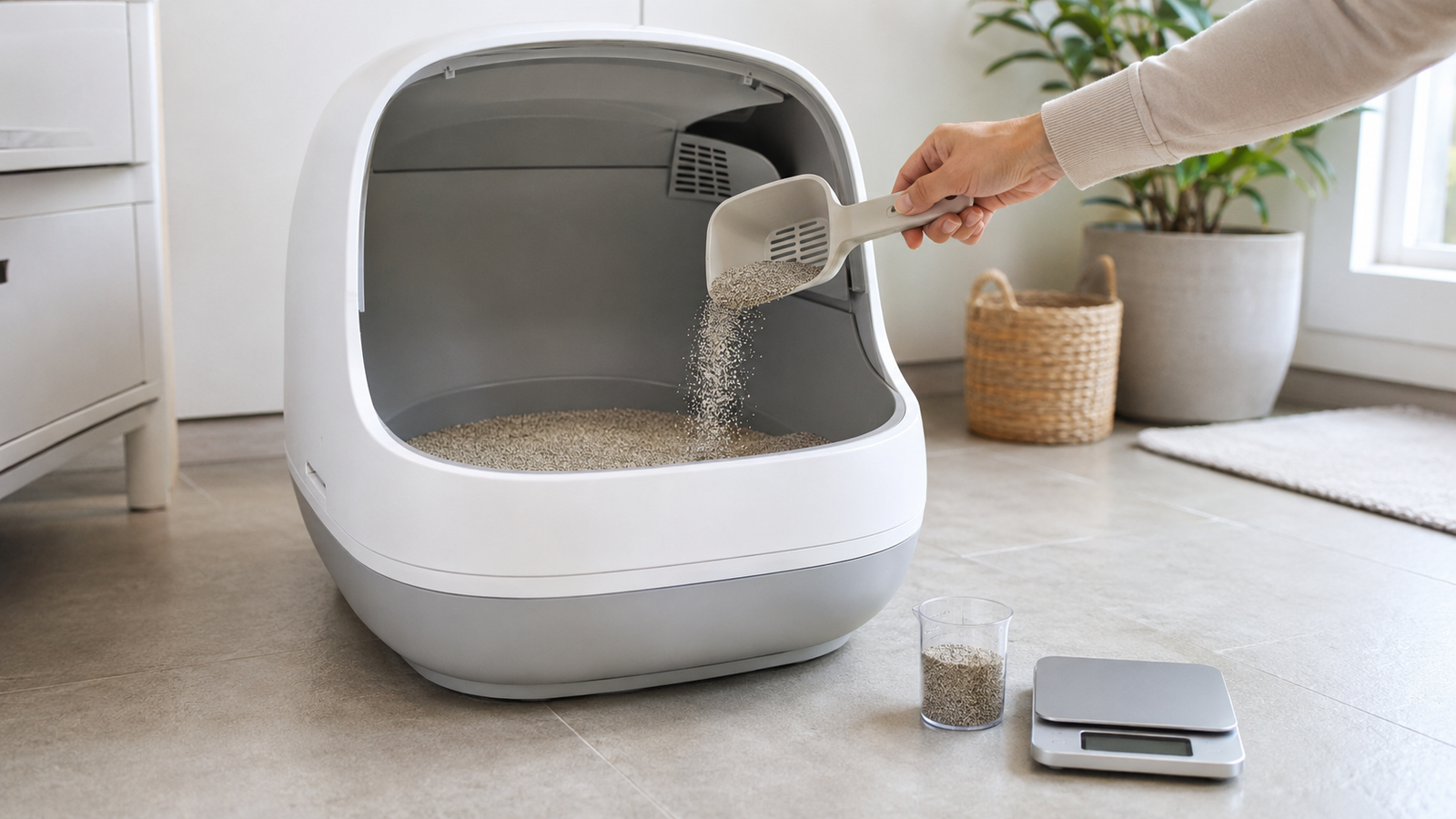
Step 1: Check the Manual
Confirm the permitted litter types, particle dimensions, fill level, and any restrictions concerning crystals, pellets, or lightweight formulas.
Step 2: Test the Particle Size
Pour a small amount into the clean, empty machine and run a manual cycle without your cat present.
Watch for:
- Clean litter entering the waste drawer
- Particles remaining trapped on the screen
- Material collecting around the rake
- Excessive dust
- Unusual resistance or noise
Step 3: Test Clump Formation Separately
Place a small amount of litter in a disposable tray and add a measured quantity of water. Allow it to sit for the same duration as the machine’s cleaning delay.
Then lift or move the clump gently.
A suitable litter should create a cohesive mass that does not immediately smear or crumble.
Water will not perfectly reproduce cat urine, but the test can reveal an obviously weak formula before it creates a mess inside the machine.
Step 4: Add Only a Small Amount
If the dry-cycle and clump tests are successful, add the litter to the machine without exceeding its maximum fill line.
Too much litter can increase resistance, waste clean granules, and interfere with normal rotation.
Step 5: Supervise the First Cycles
Observe the first several cleaning cycles. Check the clean litter bed and waste drawer for:
- Broken clumps
- Damp residue
- Excess clean litter
- Condensation
- Unusual tracking
- Sensor warnings
- Changes in your cat’s behaviour
Stop using the litter if it repeatedly causes errors, clogging, or poor separation.
How to Transition Your Cat to New Litter
Cats often prefer familiar textures and smells. A sudden change can lead to litter-box avoidance, particularly when the box itself is also new.
Whisker’s official acclimation guidance recommends placing the automatic litter box in the same location as the previous box, temporarily keeping the old box nearby, and using familiar litter during the transition.
Use the following gradual transition process:
- Place the automatic box near or in the previous litter-box location.
- Leave the automatic cleaning function off initially if the manufacturer permits it.
- Fill the machine with a compatible litter that is familiar to your cat.
- Keep the old litter box available during the early transition.
- Allow your cat to investigate without being forced inside.
- Use praise or treats when your cat approaches or uses the new box.
- Run initial cleaning cycles while your cat is elsewhere.
- Activate automatic operation only after your cat is comfortable.
If you also need to change the litter, introduce the new formula gradually where practical. Avoid changing the box, litter texture, and location simultaneously.
Never punish a cat for avoiding the new machine. Sudden elimination outside the litter box can also indicate pain, stress, or illness, so consult a veterinarian when the behaviour persists or is accompanied by other symptoms.
Common Litter Mistakes
Choosing by Material Alone
Two clay litters can behave very differently. One may create hard clumps in seconds, while another remains soft for several minutes.
Evaluate performance characteristics, not only the base material.
Ignoring Particle Dimensions
A litter may form excellent clumps but still fail because its clean particles cannot pass through the machine’s screen.
Overfilling the Box
More litter does not necessarily improve odour control. Filling above the marked line can cause clean litter to be discarded and may put additional load on the motor.
Using Too Little Litter
An insufficient litter bed may allow urine to reach the liner before being absorbed. Maintain the level recommended by the manufacturer.
Setting the Cleaning Delay Too Short
If clumps are breaking apart, the litter may need more time to solidify. Where the machine permits it, test a slightly longer delay while continuing to observe hygiene and your cat’s routine.
Mixing Incompatible Litters
Combining a suitable granular litter with long pellets or a weak-clumping formula can disrupt sifting. If you mix products during a transition, confirm that both types are permitted by the manufacturer.
Ignoring the Waste Drawer
Automatic cleaning does not eliminate maintenance. Empty the drawer before it becomes overfilled and check for damp residue or condensation.
Assuming “Natural” Means Compatible
A renewable or biodegradable material may have environmental advantages, but that does not guarantee mechanical compatibility. The litter still needs the correct particle size, weight, and clumping behaviour.
Frequently Asked Questions
What is the best cat litter for an automatic litter box?
For most rotating and sifting machines, a fast-clumping, standard-weight clay litter with small or medium particles is the most reliable choice. The final decision should follow the manufacturer’s compatibility requirements.
Can I use any clumping litter in an automatic litter box?
No. Some clumping litters create soft clumps, use oversized particles or are too lightweight for a particular machine. Confirm the permitted litter type and test a small quantity first.
Can I use crystal litter in an automatic litter box?
Yes, but only in compatible machines. Some systems are designed specifically for crystal litter, while certain rotating boxes accept crystals only when they are small enough to pass through the screen.
Can crystal litter interfere with sensors?
It can in certain models. Whisker warns that translucent or white crystals may affect litter-level and waste-drawer readings in the Litter-Robot 4. Check the guidance for your exact machine.
Does tofu litter work in an automatic litter box?
Some tofu litter works, particularly short-grain or crushed clumping formulas. Long pellets may not pass through the screen, while softer plant-based clumps can break apart or increase moisture in the waste drawer.
Can I use pine pellets?
Usually not in an automatic box designed for granular clumping litter. Pine pellets are often too large and typically turn into sawdust when wet. Use them only in a machine specifically designed or approved for pellets.
Is lightweight litter safe for an automatic litter box?
It is model-dependent. Lightweight litter may work in some machines but can interfere with weight detection or clean-litter separation in others.
Should I use scented or unscented litter?
Unscented or lightly scented litter is generally the safer starting point. Strong perfume can discourage sensitive cats and does not correct problems caused by damp litter or a waste drawer that needs emptying.
Why is clean litter entering the waste drawer?
Common causes include oversized particles, litter filled above the maximum line, unusually lightweight granules, or a screen that is not designed for that litter.
Why are clumps sticking to the globe?
The litter may be slow to absorb, the cleaning delay may be too short, the litter bed may be too shallow, or the liner may need cleaning. A firmer, faster-clumping formula may improve performance.
How often should I replace all the litter?
It depends on the litter, number of cats, machine design, and cleaning routine. Top up the bed as needed, remove any residue that escapes the cleaning cycle, and replace the full contents when odour or dampness persists despite normal maintenance.
Can I mix two types of litter?
Only if both are compatible with the machine. Mixing litter can change particle size, clump strength, and weight, so monitor the first cleaning cycles carefully.
Final Verdict
The best cat litter for automatic litter box use is generally a fast-clumping, standard-weight clay formula with compatible particle dimensions. It usually forms firm clumps, passes through common sifting screens, and separates cleanly during a cleaning cycle.
Crystal litter can be an excellent choice in machines designed for it. Tofu and other plant-based litters may also work, but their particle size, weight, and clump strength require closer attention. Traditional wood pellets, paper pellets, and non-clumping litter should usually be avoided unless the machine was specifically built to handle them.
Before committing to any product:
- Read the instructions for your exact model
- Confirm the approved litter types
- Check the permitted particle size
- Test clump strength
- Run a supervised cleaning cycle
- Monitor the waste drawer for clean litter or damp residue
- Introduce changes gradually for your cat
The best litter is not necessarily the most expensive or heavily advertised option. It is the one that works reliably with the machine, remains acceptable to your cat, and keeps the litter area clean without creating unnecessary waste or maintenance.