Date of last verification: August 27, 2026
Review basis: This research-based comparison was prepared using current manufacturer product pages, official support documentation, and recognized cat-care guidance available in August 2026. TopPetTech has not conducted hands-on testing of these trackers. Specifications, subscriptions, network compatibility, app functions, and availability can change, so confirm the exact model and service coverage before purchasing.
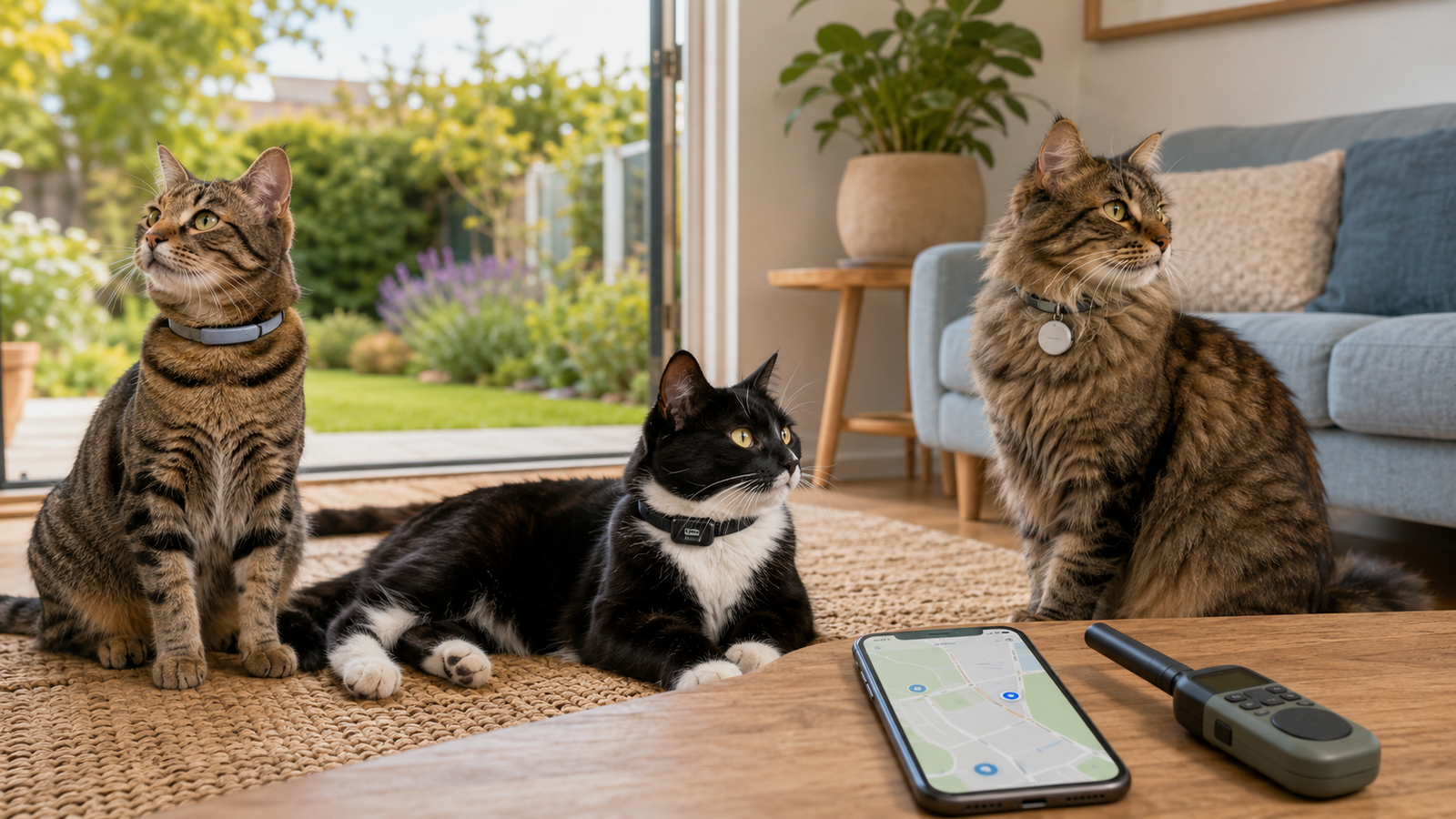
The best cat GPS tracker depends on where your cat may go and how you need to find them. A GPS tracker for cats can report location over longer distances where supported cellular coverage is available. In contrast, a radio-frequency tracker helps you search for a cat nearby without a subscription. An Apple Find My accessory works differently: it relies on compatible devices passing close enough to detect it and is not a true GPS pet tracker.
That distinction matters. A tracker that is useful for finding a cat beneath a porch may not be suitable for following a roaming cat across a neighborhood, while a cellular GPS model may be unnecessary for an indoor cat that occasionally hides in a garage or garden.
This guide compares five current options according to their documented technology, weight, battery arrangement, ongoing cost, coverage needs and practical limitations. If you also have a dog, our separate guide compares GPS trackers for dogs. To check on a pet while you are away from home, see our guide to pet cameras.
Quick Answer
For long-distance location reporting and escape alerts, consider a cat-specific cellular GPS tracker such as the Tractive CAT 6 Mini, Fi Mini or Pawfit Lite. All three require compatible network coverage and an active plan for remote tracking. For close searches around a home or garden without a subscription, Tabcat V2 uses a handheld radio-frequency receiver. AirTag can provide an occasional Find My network location, but Apple expressly designs it for objects rather than pets, so it should not be treated as a substitute for a dedicated GPS tracker.
Key Takeaways
- Cellular GPS and radio-frequency tracking solve different problems. GPS is relevant when a cat may roam farther away; RF is designed for directional searches nearby.
- All three cellular GPS trackers in this comparison require an active plan for remote tracking, so include service fees when comparing long-term cost.
- Tracker weight is only part of the fit. Check the complete collar, holder or case and follow the manufacturer’s minimum cat-weight and neck-size guidance.
- AirTag is not a GPS pet tracker. Apple designs it for objects, so treat any pet use as an additional Find My signal.
- Battery figures are maximum manufacturer estimates. Live tracking, weak reception, temperature and frequent alerts can shorten runtime.
Best Cat GPS Trackers at a Glance
- Suitable for a cat-specific integrated GPS collar: Tractive CAT 6 Mini
- Suitable for longer claimed battery life in a compact GPS attachment: Fi Mini
- Suitable for a lightweight dedicated 4G cat tracker: Pawfit Lite
- Suitable for nearby searches without cellular service or a subscription: Tabcat V2
- Suitable only as a limited Find My comparison: Apple AirTag (2nd generation)
Quick Comparison Table
| Tracker | Technology | Weight | Manufacturer battery claim | Subscription | Main limitation |
|---|---|---|---|---|---|
| Tractive CAT 6 Mini | GPS, LTE/4G, Wi-Fi and Bluetooth | 32 g including collar | Up to 7 days with Power Saving Zones | Required | Requires cellular coverage; integrated collar fits a limited size range |
| Fi Mini | GPS, cellular, Wi-Fi and Bluetooth | 16 g without attachment | Up to 6 weeks; up to 3 months with optional Fi Base | Required for remote tracking | Network and service availability vary by market |
| Pawfit Lite | GPS and 4G cellular | 17.6 g | Up to 3 days | Required | Intended for pets over 2.7 kg and needs mobile coverage |
| Tabcat V2 | Directional radio frequency | 6 g tag; about 7 g with case | 3–12 months | No | Up to 150 m / 500 ft in clear line of sight; not map-based GPS |
| Apple AirTag (2nd generation) | Bluetooth, Ultra Wideband and Find My network | 11.8 g | User-replaceable CR2032 battery; runtime varies by use | No dedicated tracking plan | Designed for objects, not pets; no cellular GPS or continuous live tracking |
Battery life is affected by signal quality, tracking frequency, temperature and use. Range claims are measured under particular conditions and should not be treated as guaranteed recovery distances.
How We Selected and Verified These Trackers
We reviewed the current cat-tracker search landscape and found that many comparison pages still combine GPS, Bluetooth and radio-frequency products under one heading without making their limitations equally visible. Some also retain discontinued devices, unnamed marketplace bundles or products that cannot be traced to a current manufacturer support page.
For this revision, a product had to have a current, identifiable model and sufficient first-party information to verify its basic operation. We considered:
- Tracking technology and whether it provides map-based GPS, directional RF guidance or crowdsourced Bluetooth detection
- Device weight, dimensions and collar arrangement
- Stated battery life and charging method
- Cellular and smartphone requirements
- Subscription or membership requirements
- Water-resistance information
- Escape alerts, live tracking and location history
- Intended cat size or weight
- Regional availability and network dependence
- Important safety and privacy limitations
Products without dependable current first-party documentation were not retained. We also excluded generic accessory bundles and products that did not offer a distinct, verifiable tracking system.
GPS, RF and Find My Tracking Are Not Interchangeable
Cellular GPS Trackers
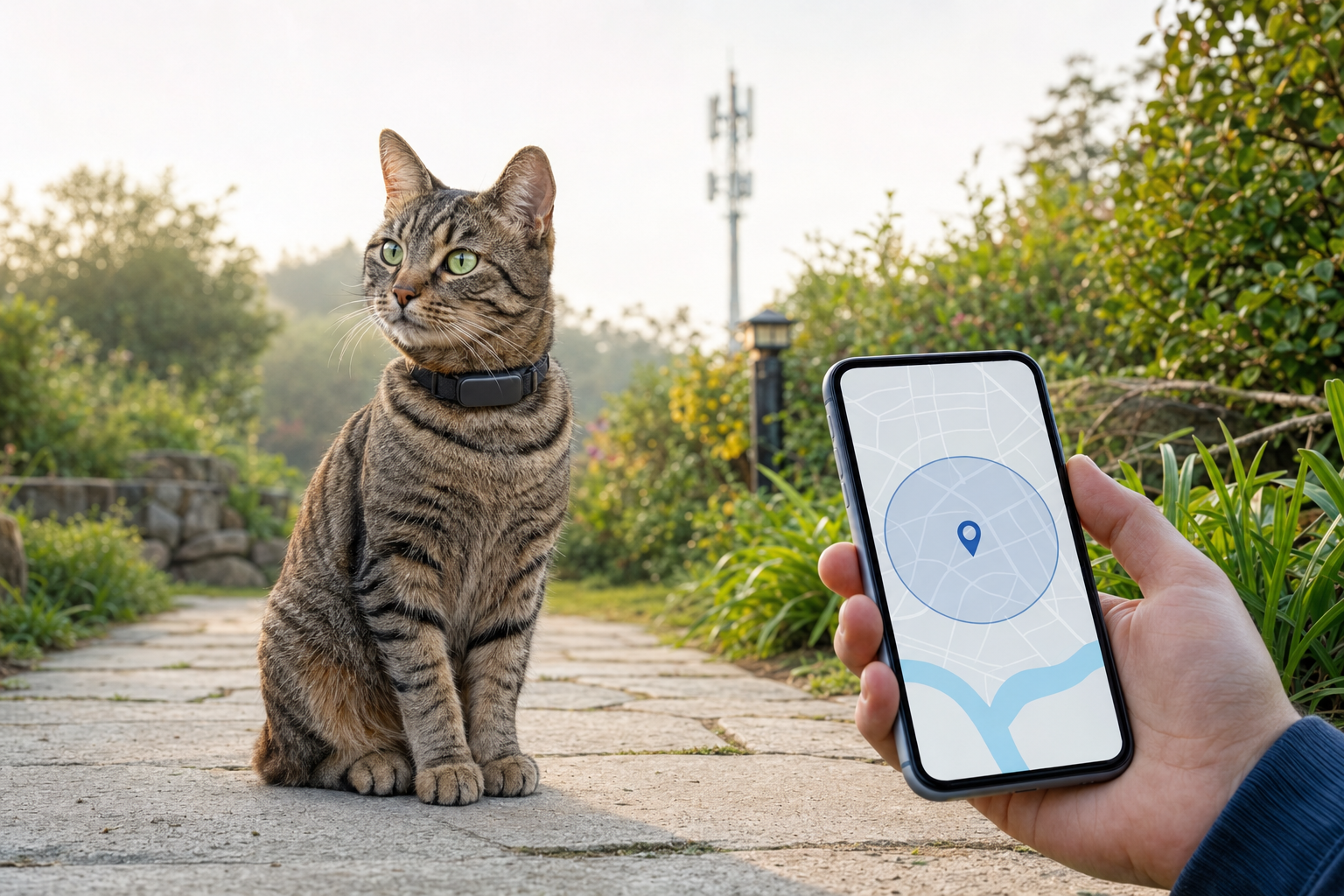
A cellular pet tracker typically uses satellite positioning to determine location and a mobile network to send that location to an app. It can work over a long distance, but “unlimited range” means within supported network and service conditions—not that the tracker works everywhere.
GPS performance can weaken indoors, beneath dense cover or around structures. Live modes also use more battery than ordinary background reporting. Test the exact tracker around your home and usual walking area before relying on it.
Radio-Frequency Trackers
An RF tracker uses a dedicated handheld receiver to guide you toward a tag. It does not display a position on a map and has a limited operating radius, but it can be helpful for close searches indoors or near home and does not need cellular coverage.
Find My Network Accessories
AirTag broadcasts a Bluetooth signal that compatible nearby Apple devices may detect and relay through the Find My network. It is an item finder rather than a cellular GPS tracker. A reported location may be delayed or unavailable if no compatible device passes nearby.
1. Tractive CAT 6 Mini
Why It Stands Out
The Tractive CAT 6 Mini is the current cat-specific model in Tractive’s range. Unlike the older CAT Mini described in the original article, CAT 6 Mini integrates the tracker into its supplied collar.
Tractive lists GPS, GLONASS and Galileo positioning together with LTE/4G, Wi-Fi and Bluetooth connectivity. Live Tracking can provide updates every two to three seconds, while Virtual Fences can alert an owner when the tracker enters or leaves a defined area. The app also records location history, activity and sleep information.
The manufacturer specifies a weight of 32 g including the collar, a neck fit of approximately 19–22.9 cm (7.5–9 inches) and suitability for cats weighing approximately 3.2–8.2 kg (7–18 lb). These limits should be checked carefully because this model is not simply a tag that can be moved to any collar.
Suitable For
Owners who want a cat-specific cellular GPS collar with frequent live updates, virtual-fence alerts and activity information.
Key Specifications
| Specification | Details |
| Model | CAT 6 Mini |
| Positioning | GPS, GLONASS and Galileo |
| Connectivity | LTE/4G Cat 1bis, Bluetooth 5.0 and 2.4 GHz Wi-Fi |
| Live mode | Updates approximately every 2–3 seconds under suitable conditions |
| Battery | Up to 7 days with Power Saving Zones |
| Weight | 32 g / 1.1 oz including collar |
| Size | 95 × 20 × 13 mm / 3.7 × 0.8 × 0.5 in |
| Cat size guidance | Approximately 3.2–8.2 kg / 7–18 lb |
| Neck fit | 19–22.9 cm / 7.5–9 in |
| Water resistance | IP68 |
| Subscription | Required for cellular tracking service |
Advantages
- Integrated cat-collar design
- Frequent updates in Live Tracking mode
- Virtual-fence entry and exit alerts
- Location history, activity and sleep information
- IP68 water-resistance rating
- Uses several positioning systems and multiple connectivity methods
Limitations
- Requires an ongoing subscription
- Needs suitable cellular and satellite reception
- Live Tracking reduces battery life
- Integrated collar has a restricted fit range
- Too large for cats below the manufacturer’s minimum weight
- Wellness trends are not a veterinary diagnosis
Editorial Assessment
CAT 6 Mini is a well-documented option for an outdoor cat that fits its collar and weight limits. Its chief trade-offs are the subscription, regular charging and dependence on cellular coverage. Measure your cat’s neck and check local coverage before ordering.
View the current Tractive CAT 6 Mini product information
2. Fi Mini
Why It Stands Out
The Fi Mini is a 16 g GPS tracker designed for cats and small dogs. It attaches to a compatible collar or harness using the supplied strap or soft case rather than replacing the entire collar.
Fi documents real-time tracking, escape detection, activity and rest information, USB-C charging and IP68 water resistance. Its current comparison information lists a battery claim of up to six weeks, or up to three months when used with an optional Fi Base. Actual battery duration can be much shorter in Lost Mode or when GPS and cellular radios are used frequently.
Fi uses GPS and cellular together: GPS determines the device position and the mobile connection sends it to the app. The company also recommends a home Wi-Fi connection for better coverage, faster escape detection and reduced battery use. A Fi Membership is required for remote tracking and Live Tracking.
Suitable For
Owners who want a lightweight GPS attachment, USB-C charging and less frequent routine charging than shorter-battery models may require.
Key Specifications
| Specification | Details |
| Model | Fi Mini |
| Technology | GPS, cellular, Wi-Fi and Bluetooth |
| Remote functions | Escape alerts, Lost Mode and Live Tracking |
| Size | 42 × 30 × 12.5 mm without attachment |
| Weight | 16 g without attachment |
| Battery | Up to 6 weeks; up to 3 months with optional Fi Base |
| Lost Mode | Manufacturer support notes about 2 days of battery in Lost Mode |
| Charging | USB-C |
| Water resistance | IP68 |
| Collar arrangement | Supplied strap and soft-case attachments |
| Subscription | Fi Membership required for remote tracking features |
Advantages
- Lightweight 16 g device
- Attaches to many compatible collars or harnesses
- USB-C charging
- Escape alerts and real-time Lost Mode
- Activity and rest information for cats
- IP68 water-resistance rating
- Apple Watch integration is documented by Fi
Limitations
- Membership required for remote tracking
- Battery claims depend heavily on connection mode and use
- Lost Mode consumes substantially more power
- Home Wi-Fi is recommended for the intended experience
- Cellular provider and regional availability must be checked before purchase
- Does not include a breakaway cat collar
Editorial Assessment
Fi Mini is relevant for owners prioritizing low tracker weight and longer claimed standby life. However, it is not automatically the right choice in every country or coverage area. Confirm that Fi sells and supports the service in your location, fit the device only to an appropriate cat collar and test escape alerts while your cat is safely at home.
View the current Fi Mini specifications and support information
3. Pawfit Lite for Cats
Why It Stands Out
The Pawfit Lite for Cats weighs 17.6 g and uses GPS with a built-in 4G mobile connection. Pawfit lists real-time and live location tracking, Safety Zones, activity monitoring, family sharing, and 24-hour location history. Its current features also include Find Nearby, which uses Bluetooth to help locate the tracker at closer range, along with light and sound functions that may assist during a nearby search.
Its current product information specifies up to three days of battery life, IP68 protection for immersion up to three meters for 30 minutes, and suitability for pets over 2.7 kg. A quick-release cat collar is included. These details correct the older version of this article, which did not state the present battery and size guidance precisely.
Suitable For
Cats over 2.7 kg whose owners want a lightweight 4G tracker and an included quick-release collar.
Key Specifications
| Specification | Details |
| Model | Pawfit Lite for Cats |
| Technology | GPS with 4G mobile connection |
| Size | 41.5 × 25 × 13.8 mm |
| Weight | 17.6 g / 0.6 oz |
| Cat size guidance | Pets over 2.7 kg |
| Battery | Up to 3 days |
| Water resistance | IP68; manufacturer specifies up to 3 m for 30 minutes |
| Location tools | Live mode, Safety Zones and 24-hour history |
| Sharing | Up to six family members or friends |
| Collar | Quick-release cat collar included |
| Subscription | Required |
Advantages
- Lightweight design intended for cats
- 4G location reporting over supported coverage
- Live location mode and Safety Zones
- Activity information and family sharing
- IP68 water-resistance specification
- Quick-release collar included
Limitations
- Requires a subscription
- Up-to-three-day battery claim means relatively frequent charging
- Not recommended below 2.7 kg
- Remote tracking depends on mobile coverage for both tracker and phone
- Location history is limited to 24 hours.
Editorial Assessment
Pawfit Lite offers a clear combination of low weight, current 4G connectivity and a cat-oriented collar package. The three-day maximum battery claim is its most important practical limitation, so owners should develop a consistent charging routine and test how signal conditions affect runtime.
View the current Pawfit Lite for Cats product information
4. Tabcat V2 Cat Tracker
Why It Stands Out
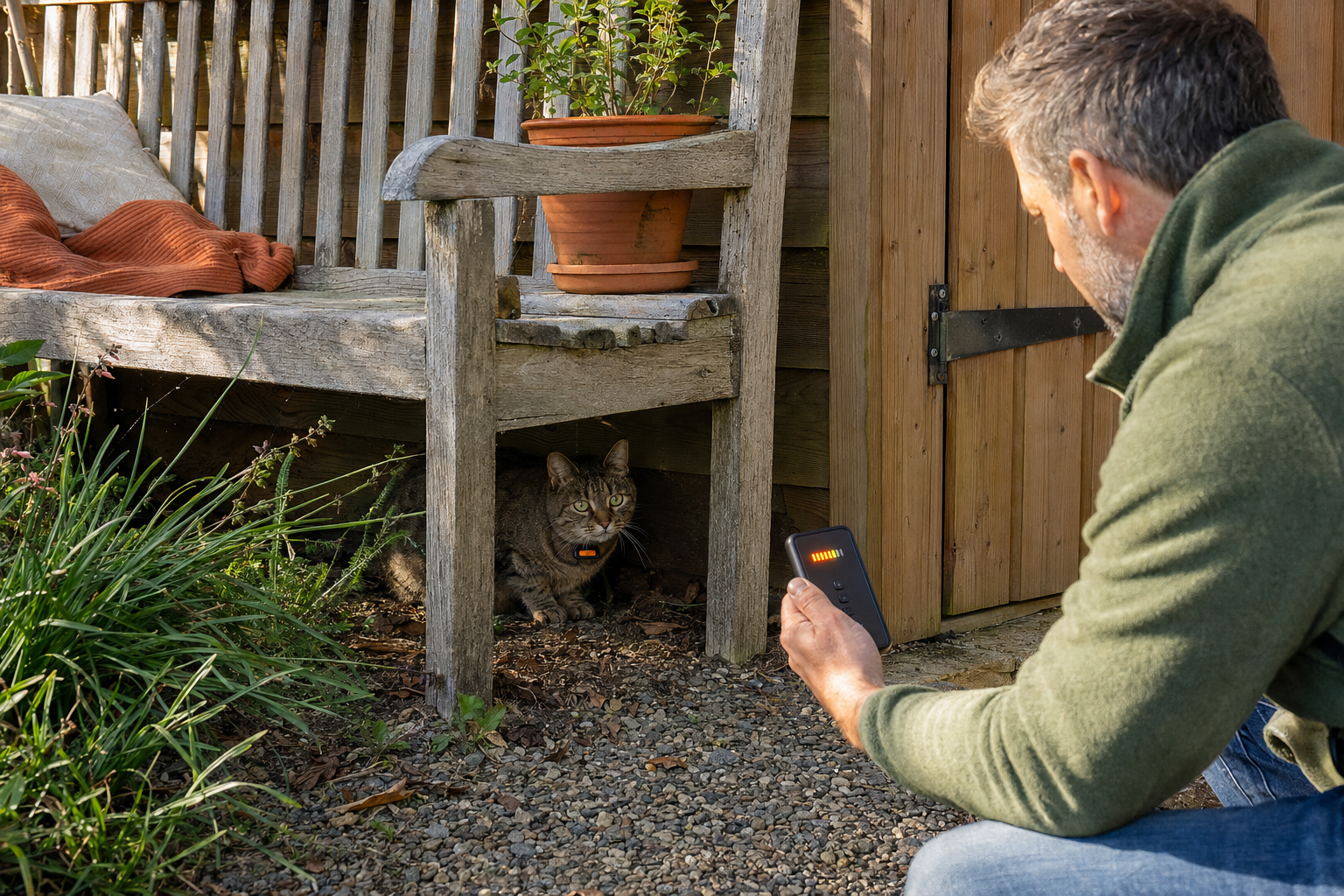
The Tabcat V2 is not a GPS tracker. It uses directional radio-frequency guidance from a handheld receiver to locate a nearby tag. The handset’s audio and visual indicators strengthen as you approach the tag, which Tabcat says can guide a search to within 2.5 cm under suitable conditions.
The manufacturer specifies a maximum range of up to 150 m / 500 ft in clear line of sight. Walls, doors, terrain and other obstacles reduce that range. One handset can pair with up to four V2 tags, and the system doesn’t require cellular coverage, an app, or a subscription.
Suitable For
Indoor cats, close-to-home cats and multi-cat households needing directional nearby searches without monthly fees.
Key Specifications
| Specification | Details |
| Model | Tabcat V2 |
| Technology | 2.45 GHz directional RF |
| Map location | No |
| Maximum stated range | Up to 150 m / 500 ft in clear line of sight |
| Stated close guidance | Within 2.5 cm under suitable conditions |
| Tag weight | 6 g; about 7 g with protective case |
| Tag size | 30 × 20 × 9 mm |
| Battery | Replaceable; stated 3–12 months depending on use |
| Multi-cat support | Up to four V2 tags per handset |
| Subscription | None |
| Compatibility note | V1 and V2 tags and handsets are not cross-compatible |
Advantages
- Very light tag
- No cellular service, smartphone or subscription required
- Useful for nearby indoor and outdoor searches
- Directional audio and visual guidance
- One handset can support up to four cats
- Replaceable batteries rather than frequent charging
Limitations
- Not GPS and does not show a map position
- Limited search radius
- Buildings and other obstacles reduce range
- Owner must walk within reception range with the handset
- Protective case is splash-resistant rather than a basis for assuming full waterproofing
- Only V2 components work together
Editorial Assessment
Tabcat V2 solves a different problem from a cellular GPS tracker. It can be practical when a cat is likely to be hiding nearby, especially indoors, but it cannot report a location from another town or send an escape alert. Its low weight and lack of recurring fees make it a credible alternative when short-range homing is enough.
View the current Tabcat V2 product information
5. Apple AirTag (2nd Generation): A Limited Find My Comparison
Why It Is Included With Caution
Apple’s second-generation AirTag, introduced in 2026, is frequently considered by cat owners because it is compact and uses Apple’s Find My network without a pet-tracking subscription. It is included here to explain the trade-off, not to present it as a GPS pet tracker.
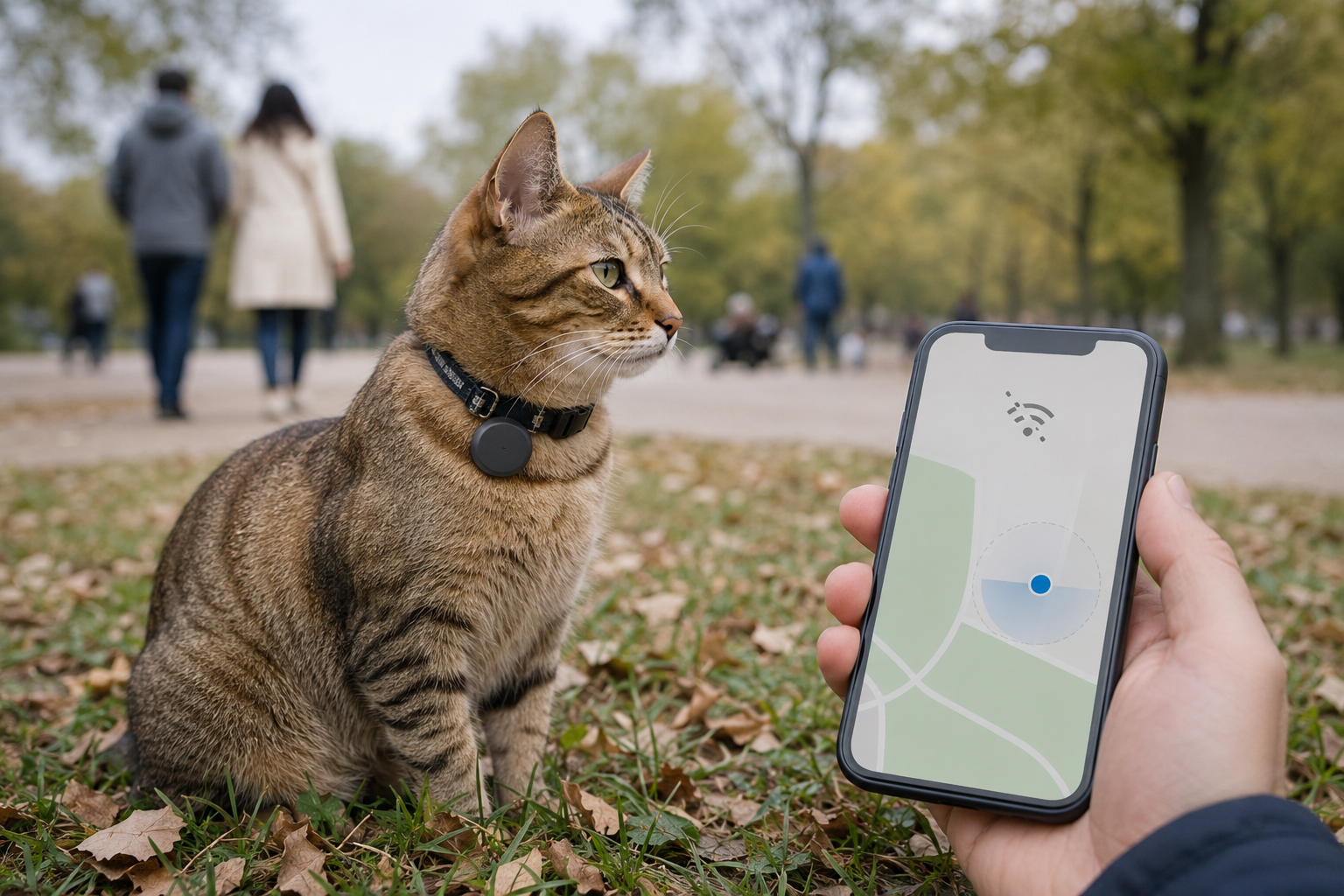
Apple states that AirTag is designed exclusively for tracking objects, not people or pets. It has no cellular GPS connection that continuously sends a cat’s live position. Instead, compatible nearby Apple devices can detect its Bluetooth signal and privately relay an approximate location. That can be useful in a populated area, but the location may be stale or absent in a quiet, rural or obstructed location.
Suitable For
Readers who understand that AirTag is an item finder and want an additional, opportunistic Find My signal—not a primary recovery system.
Key Characteristics
| Characteristic | Details |
| Product | Apple AirTag, 2nd generation (introduced in 2026) |
| Technology | Bluetooth, second-generation Ultra Wideband, NFC and Find My network |
| Cellular GPS | No |
| Continuous live pet tracking | No |
| Size | 31.9 mm diameter × 8 mm thick |
| Weight | 11.8 g / 0.42 oz |
| Water and dust resistance | IP67 under the stated laboratory conditions |
| Battery | User-replaceable CR2032 coin cell; runtime varies with use and conditions |
| Dependency | Nearby compatible Apple devices and the owner’s Apple ecosystem |
| Subscription | No dedicated AirTag tracking subscription |
| Attachment | Pet collar holder is a separate third-party accessory |
| Intended purpose | Apple specifies objects, not pets |
Advantages
- Compact 11.8 g item-finder format
- No dedicated monthly tracking plan
- Find My can report a location when the network detects the tag
- User-replaceable battery rather than routine recharging
- Nearby sound and supported precision-finding functions may assist a close search
Limitations
- Not a GPS pet tracker
- Not designed or marketed by Apple for pets
- No guaranteed update interval or continuous route
- Detection depends on compatible devices passing nearby
- No pet-specific escape alerts, activity records or safety zones
- A separate collar holder changes weight, fit and snag risk
Editorial Assessment
AirTag should not be the main tracking plan for a roaming or escape-prone cat. If an owner uses one as an additional signal, attach it securely to an appropriate quick-release collar and combine it with permanent identification. A dedicated GPS tracker is the more relevant category when remote live location and escape alerts are required.
View Apple’s current AirTag technical specifications
How to Choose the Right Cat GPS Tracker
Start With the Likely Search Area
For an outdoor or roaming cat that may travel beyond your immediate area, cellular GPS is generally the better choice when remote map updates matter. For an indoor cat whose likely escape or hiding area is inside a building, beneath a deck, in a garage, or close to home, RF may be more practical for directional searching. Do not assume a Bluetooth network accessory will provide a current location where few compatible phones pass nearby.
Check Weight, Fit and Collar Safety
Tracker weight alone does not describe the full collar setup. Include the holder, collar, and any case when judging bulk. Follow the manufacturer’s minimum cat-weight and neck-size guidance.
A GPS cat collar may integrate the tracking hardware into the collar itself, while other cat GPS trackers attach to a separate collar or harness, so compare the complete worn setup rather than the tracker alone.
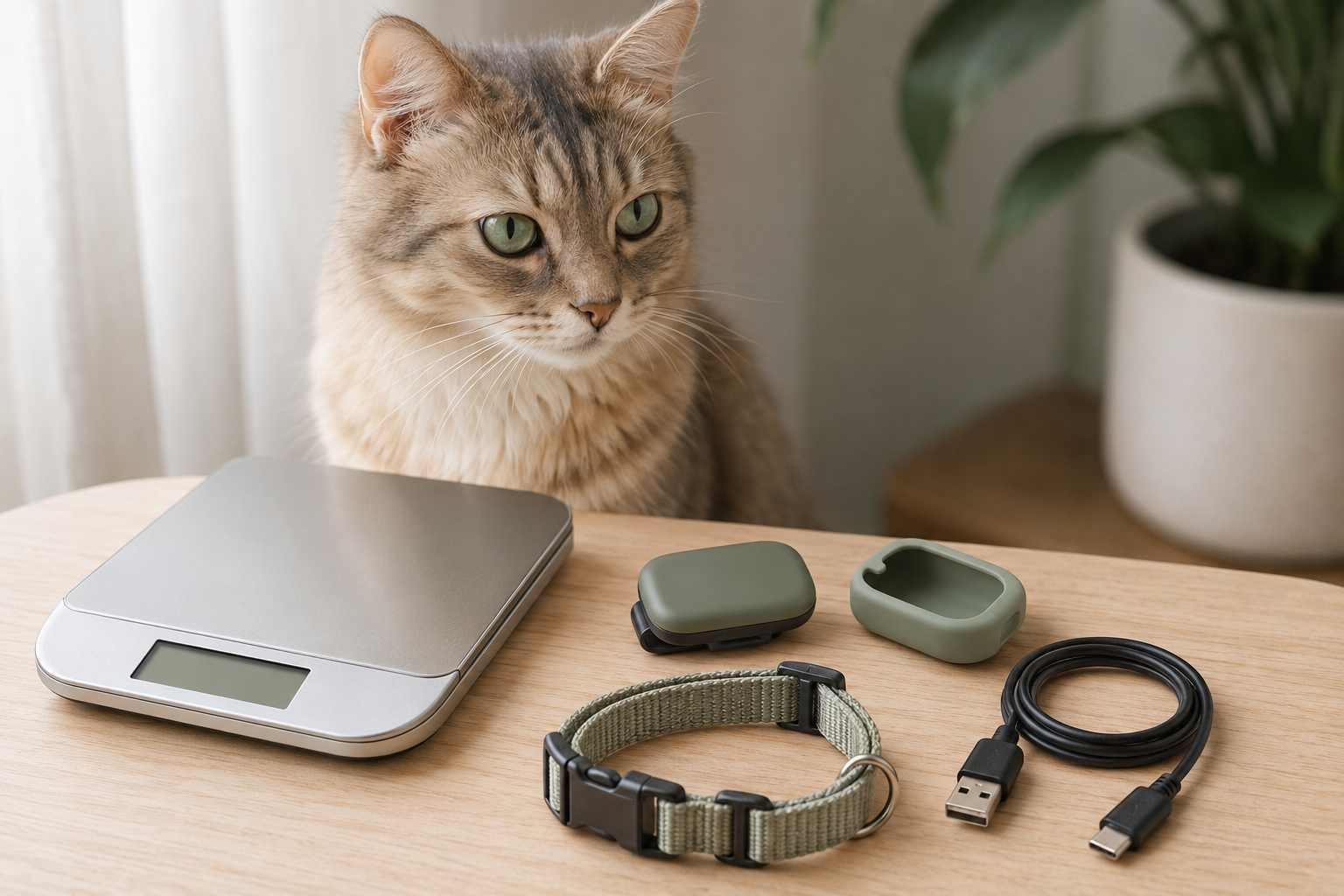
International Cat Care advises that if a cat wears a collar, it should be a good-quality quick-release design that fits correctly. A breakaway collar can release if caught, which reduces entanglement risk but also means the cat and tracker may separate. Read its guidance on collars and cats before fitting a tracker.
Confirm Coverage Before Purchase
Cellular trackers need supported service where the cat travels. A brand being available online does not guarantee that its subscription or mobile partner operates in your country. Review the manufacturer’s coverage information and return policy, then test the tracker locally during the return period.
For rural or low-coverage areas, check the tracking technology rather than relying on a claimed range alone. Cellular GPS may be unable to send a location when mobile service is unavailable, while Find My detection depends on compatible devices passing nearby. RF does not need either network, but its much shorter range means you must already be reasonably close to the cat.
Calculate the Ongoing Cost
Compare the device price with the full subscription term, not only the introductory payment. Check whether live tracking, longer history, family sharing or worldwide service requires a higher plan.
If you want a cat tracker without a subscription, first decide whether you actually need remote cellular GPS. An RF tracker such as Tabcat can provide nearby directional guidance without a monthly plan, while AirTag has no dedicated tracking subscription but is not a GPS pet tracker. The cellular GPS models in this comparison require active service for remote tracking.
Treat Battery Claims as Maximums
Live tracking, weak GPS or cellular reception, cold weather and frequent alerts can shorten runtime. Charge the device before it reaches a critical level and test any low-battery notification.
Test Before Relying on It
Escape-alert speed and live-location update frequency are different measures. The first is how quickly the system tells you that the cat has left a saved area; the second is how often its reported location refreshes after active tracking begins. Test both because a fast escape alert does not necessarily mean equally frequent location updates.
While your cat is safely supervised:
- Confirm that the collar releases appropriately and fits according to professional guidance.
- Walk the tracker outside its home zone and check the alert delay.
- Start live or lost mode and observe the update interval.
- Test locations with trees, walls and weaker mobile coverage.
- Check how quickly the battery falls during active tracking.
- Make sure another household member can access the necessary app or handset.
Safety, Identification and Privacy
A tracker is a recovery aid, not a substitute for responsible supervision or permanent identification. Keep your cat’s microchip registration and contact information current, and use a visible ID tag where appropriate. A microchip identifies an animal when scanned; it does not transmit a live GPS location.
If your cat goes missing, use the tracker according to its technology. For a cellular GPS tracker, check the latest reported location and activate live or lost mode when available. For an RF tracker, move into the likely search area and use the handheld receiver for directional guidance. A Find My accessory may provide a recent detected location, but do not assume that it represents the cat’s current position. Continue a physical search and keep microchip and identification details current in case the tracker or collar becomes separated from the cat.
Do not rely on wellness data from a tracker to diagnose illness. Changes in activity or sleep can have many causes and should be discussed with a veterinarian when they are persistent or concerning.
Review app permissions, account security and location-sharing settings. Give access only to people who need it, use a unique password and remove former household members from shared accounts. For cameras used alongside a tracker, review our pet-camera comparison and apply the same privacy care.
Frequently Asked Questions
What is the difference between a cat GPS tracker and an AirTag?
A cellular GPS tracker determines a position using satellite signals and transmits it through a mobile network to an app. AirTag is an object finder that relies on Bluetooth and nearby devices in Apple’s Find My network. It does not provide continuous cellular GPS tracking.
Do cat GPS trackers work without cellular service?
The tracker may be able to calculate a GPS position, but a cellular model generally needs a supported mobile connection to send that position to your phone. An RF system such as Tabcat works without cellular service but only within its local radio range.
Do all cat GPS trackers require a subscription?
Cellular GPS models normally require a plan because the manufacturer pays for mobile-network data and connected services. RF trackers do not require a mobile plan. AirTag has no dedicated tracking subscription but also lacks cellular GPS pet-tracking functions.
Which tracker is suitable for a small cat?
Follow the exact manufacturer guidance rather than choosing by product weight alone. Pawfit Lite is listed for pets over 2.7 kg, Tractive CAT 6 Mini for cats from 3 to 8 kg, and Fi Mini weighs 16 g but must still be fitted on a suitable collar. Tabcat’s tag is lighter, although it offers only short-range RF guidance.
Can a GPS tracker replace a microchip?
No. A microchip provides permanent identification when scanned by an appropriate organization. A tracker is a removable, battery-powered device that may help report location. Cats should have appropriate permanent identification even when they wear a tracker.
How accurate is a cat GPS tracker?
Accuracy changes with satellite view, buildings, trees, network conditions and tracking mode. Manufacturer update intervals do not guarantee that every point will be exact. Test performance in the places your cat is most likely to go.
Will a tracker prevent my cat from escaping?
No. A tracker may send an alert or help with a search after movement is detected, but it does not create a physical barrier. Secure doors, screens and safe outdoor arrangements remain important.
Can one account track several cats?
Some connected services let one account manage several devices, although each cat usually needs its own tracker and subscription. One Tabcat V2 handset can pair with up to four compatible tags. Check plan and device limits before purchasing.
Final Recap
There is no single tracking technology suitable for every cat:
- Consider Tractive CAT 6 Mini when you want an integrated cat-specific GPS collar, frequent live updates and virtual-fence alerts.
- Consider Fi Mini when low device weight, USB-C charging and longer claimed routine battery life are priorities, and Fi supports your region.
- Consider Pawfit Lite when you want a lightweight dedicated 4G cat tracker with an included quick-release collar and can accommodate more frequent charging.
- Consider Tabcat V2 when the likely search is nearby, and you prefer directional RF guidance without cellular coverage or a subscription.
- Treat Apple AirTag only as a limited Find My item locator, not as a replacement for a dedicated GPS pet tracker.
Whichever device you choose, confirm current service coverage, subscription terms, collar fit and product specifications on the manufacturer’s website. Test the complete setup while your cat is safe, keep permanent identification current and maintain a practical search plan that does not depend on one battery-powered device.
Authoritative and Official Sources
- Tractive CAT 6 Mini official product information
- Tractive CAT 6 Mini setup and Live Tracking information
- Fi Mini official overview and specifications
- Fi product comparison and battery information
- Fi GPS and cellular connectivity explanation
- Pawfit Lite for Cats official product information
- Tabcat V2 official product information
- Tabcat V2 official FAQs
- Apple AirTag (2nd generation) technical specifications
- Apple’s AirTag intended-use statement
- International Cat Care guidance on collars and cats