Date of last verification: August 28, 2026
Review basis: This research-based comparison uses current manufacturer product pages and official support documentation available in August 2026. TopPetTech has not conducted hands-on testing of these trackers. Specifications, network support, subscriptions, app functions, and availability can change, so verify the exact model and service coverage before purchasing.
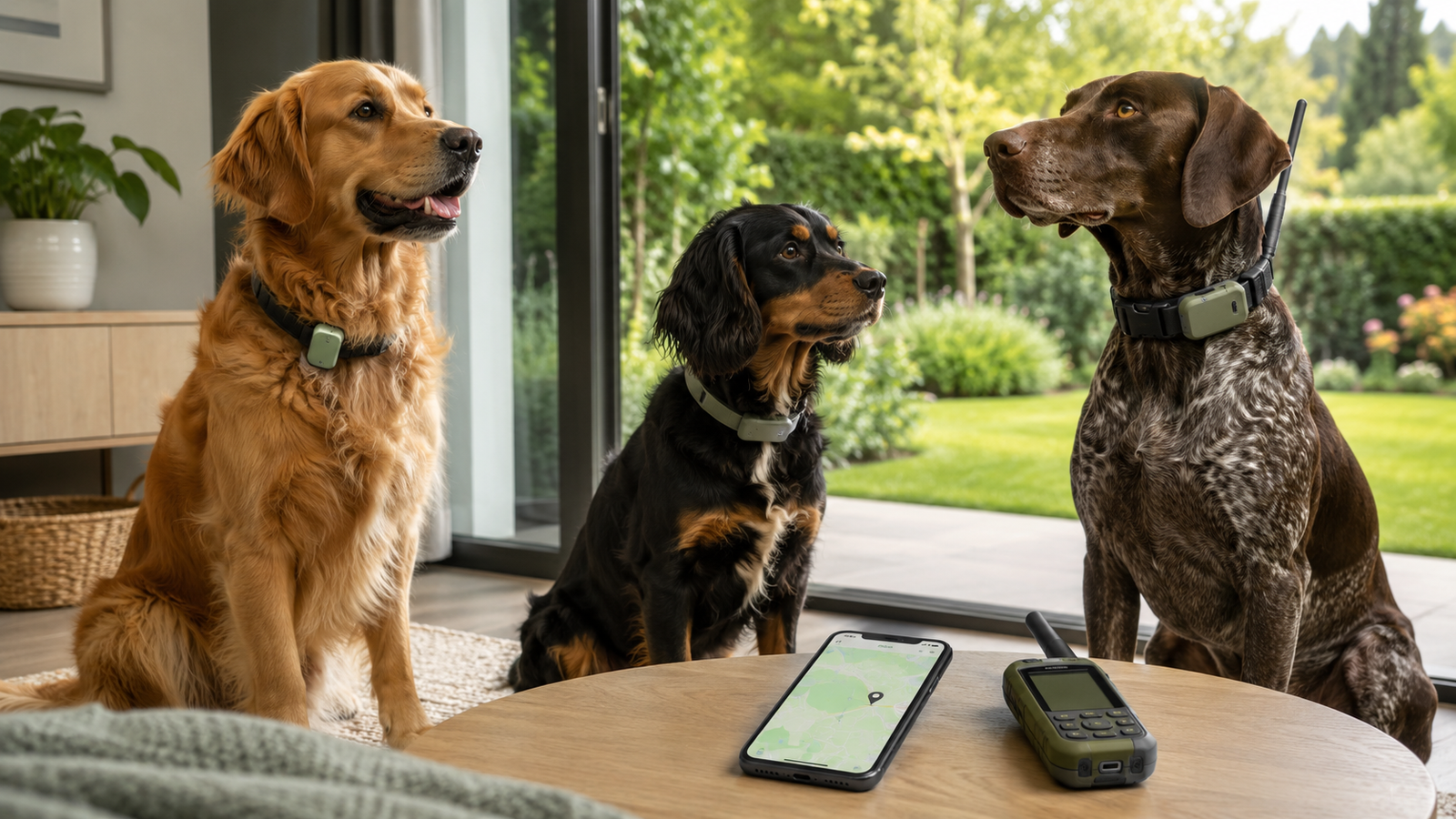
Choosing the right dog GPS tracker depends on where your dog may travel and how you need to find them. A GPS tracker for dogs may use a cellular network to report location through a mobile app, while an off-grid system can send GPS location directly to a handheld receiver by radio. A GPS fence serves a different purpose by focusing primarily on containment and may require training before it can be used safely.
That distinction matters when a gate is left open, a dog follows wildlife, or an off-leash working dog moves beyond sight. A tracker cannot prevent every escape, but the right system can provide an earlier alert, a more useful last-known location, or directional guidance during a search.
This guide compares five current systems according to their documented technology, dog-size guidance, battery arrangement, subscription requirements, coverage limitations, and intended use. If you also have a cat, see our updated guide to GPS trackers for cats.
Quick Answer
For everyday location tracking where mobile service is dependable, Tractive DOG 6/DOG 6 XL and Fi Series 3+ provide app-based escape alerts and live tracking. Aorkuler Dog GPS Tracker 2 uses GPS positioning and a direct radio link to a handheld controller, so it can work away from cellular coverage without a subscription. Garmin Alpha 300/300i with a T 20 or TT 25 collar is a specialized off-grid system for hunting and working dogs. SpotOn Nova is primarily a GPS containment system; remote location tracking requires its optional cellular plan.
Key Takeaways
- Cellular, direct-radio, and GPS-fence systems are different products. Choose according to where the dog may travel and whether tracking or containment is the main goal.
- Tractive and Fi require active subscriptions for their connected tracking functions.
- Aorkuler and Garmin can provide off-grid tracking through direct radio, but their maximum ranges assume favorable terrain and line-of-sight conditions.
- SpotOn can operate its GPS boundaries without a subscription, but its remote tracking and escape-alert features require an optional plan.
- A tracker does not replace secure fencing, recall training, supervision or a registered microchip.
At a Glance
- Suitable for everyday clip-on cellular tracking: Tractive DOG 6 / DOG 6 XL
- Suitable for an integrated smart collar and long claimed battery life: Fi Series 3+
- Suitable for portable off-grid tracking without a subscription: Aorkuler Dog GPS Tracker 2
- Suitable for hunting and professional multi-dog tracking: Garmin Alpha 300/300i with T 20 or TT 25
- Suitable for large-property GPS containment: SpotOn GPS Fence Nova Edition
Quick Comparison Table
| System | Communication method | Subscription | Manufacturer battery claim | Intended use | Main limitation |
|---|---|---|---|---|---|
| Tractive DOG 6 / DOG 6 XL | GPS plus LTE/4G, Wi-Fi and Bluetooth | Required | DOG 6: up to 2 weeks; DOG 6 XL: up to 6 weeks with Power Saving Zones | Everyday app-based tracking and escape alerts | Needs supported cellular coverage |
| Fi Series 3+ | GPS, AT&T cellular, Wi-Fi and Bluetooth | Required | Up to 3 months under low-use conditions | Integrated smart collar, escape alerts and activity information | Current cellular support is market-dependent |
| Aorkuler Dog GPS Tracker 2 | GPS positioning plus direct RF link | None | All-day use; no precise hour figure published | Off-grid directional tracking with a handheld controller | Range falls with hills, trees and buildings |
| Garmin Alpha 300/300i with T 20 or TT 25 | GPS/Galileo plus VHF radio | No tracking subscription; inReach features on 300i require a plan | Handheld: up to 55–60 hours; collar: up to 68 hours | Hunting, working dogs and multi-dog off-grid tracking | Complex, heavier, and less convenient than everyday trackers |
| SpotOn Nova GPS Fence | Multi-constellation GPS; optional cellular tracking | Not required for containment; optional for tracking | At least 33 hours with tracking enabled | Custom GPS boundaries on larger properties | Requires structured training and is not suitable for very small dogs |
Battery life and range are maximum manufacturer estimates. Live tracking, weak signals, terrain, temperature and frequent alerts can reduce performance.
How We Selected and Verified These Systems
We reviewed current search results and comparison pages covering everyday dog trackers, smart collars, off-grid hunting systems and GPS fences. Many pages place all these products in one ranking without explaining that they use different communication methods and cannot be substituted directly for one another.
For this revision, each product required an identifiable current model and sufficient first-party documentation to verify its basic operation. We considered:
- Whether location is transmitted by cellular service or direct radio
- The difference between tracking, geofence alerts, and active containment
- Tracker or collar size and dog-weight guidance
- Manufacturer battery claims and charging method
- Maximum stated range and the conditions attached to that claim
- Subscription and cellular-coverage requirements
- Water-resistance specifications
- App, handheld and map functions
- Regional availability and legal limitations
- Important training and welfare considerations
Garmin Alpha 300/300i with the T 20 or TT 25 was selected as Garmin’s current documented generation for this comparison. We did not use retailer ratings or marketplace availability as substitutes for current manufacturer documentation.
Understanding the Three Main Tracker Types
Cellular GPS Trackers
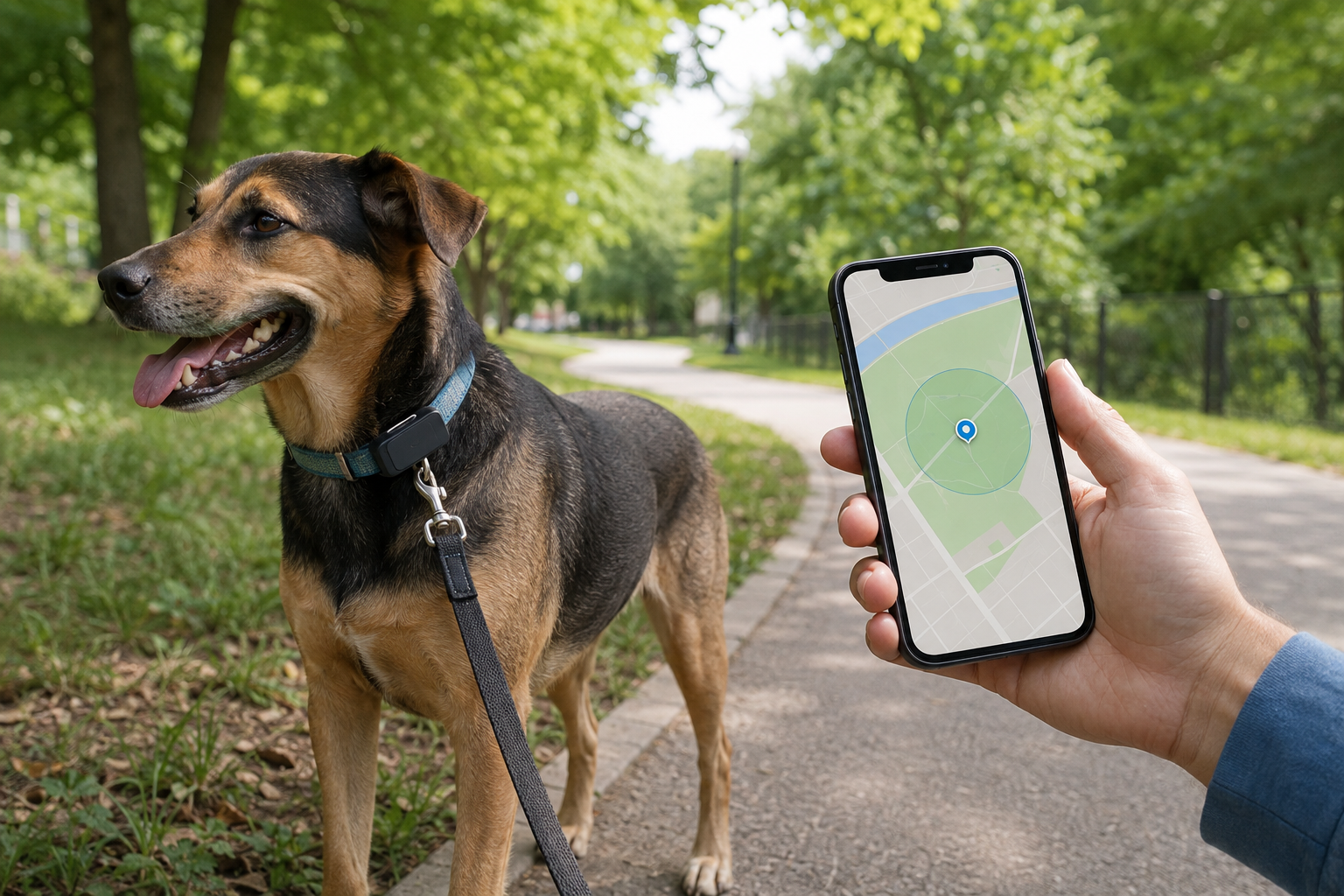
A cellular pet tracker normally uses satellite positioning to calculate location and a mobile network to send that position to an app. This can support remote viewing, escape alerts, location history, and live or near-real-time tracking over a long distance, provided the tracker can receive the required satellite and cellular signals.
An “unlimited range” claim does not mean the tracker operates everywhere. It means there is no fixed radio radius when supported mobile coverage is available. Indoor structures, dense vegetation, deep valleys, and weak mobile reception can delay or interrupt updates.
Direct-Radio GPS Systems
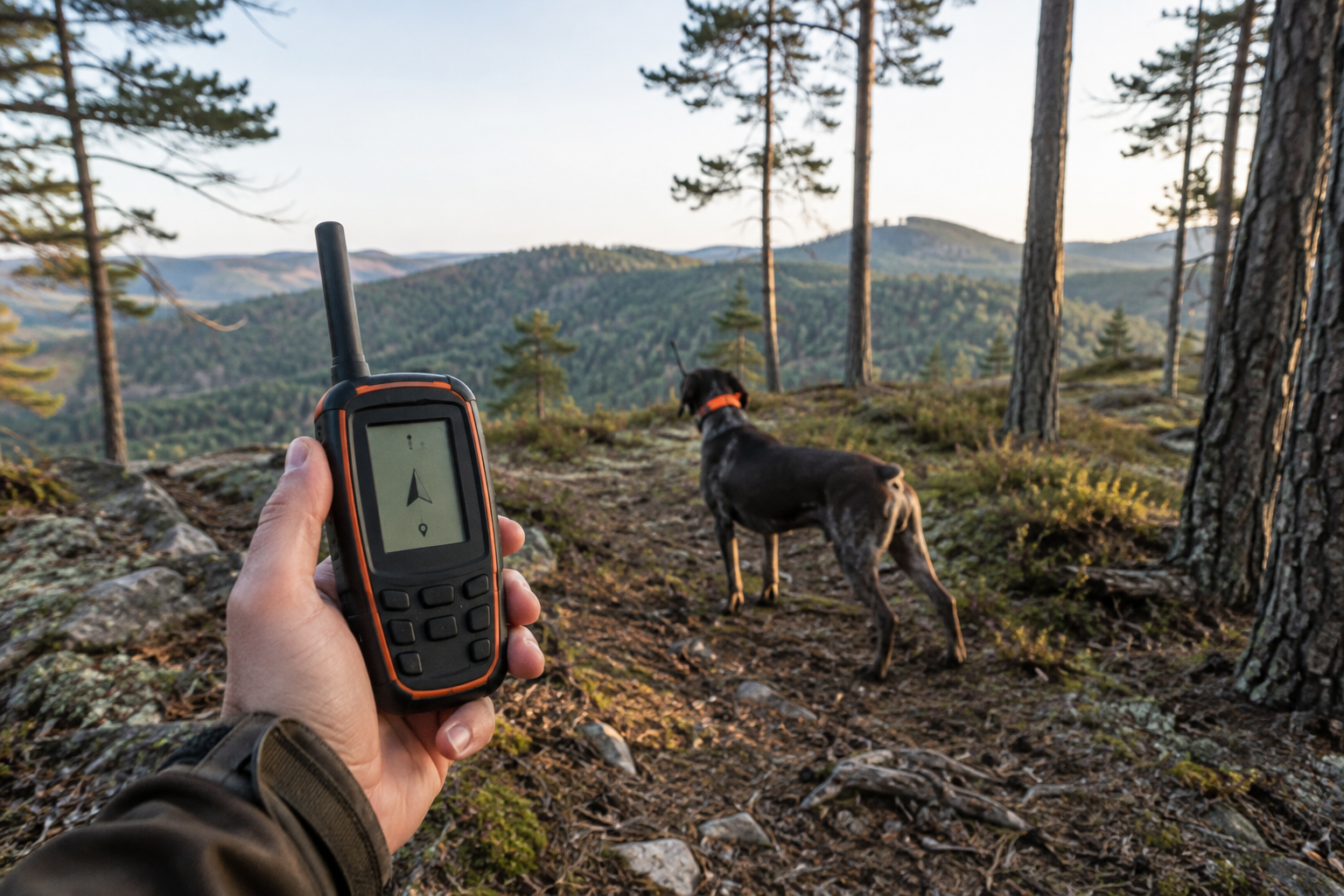
Off-grid systems use satellite positioning at the dog’s collar and transmit the result directly to a dedicated handheld receiver by radio. They don’t need a nearby cellular tower, but they have a finite radio range. Hills, woodland, buildings, and antenna height affect performance.
These systems are useful for rural work, hunting, and backcountry activities. Their trade-offs are additional equipment, greater complexity, and a steeper learning curve.
GPS Containment Systems
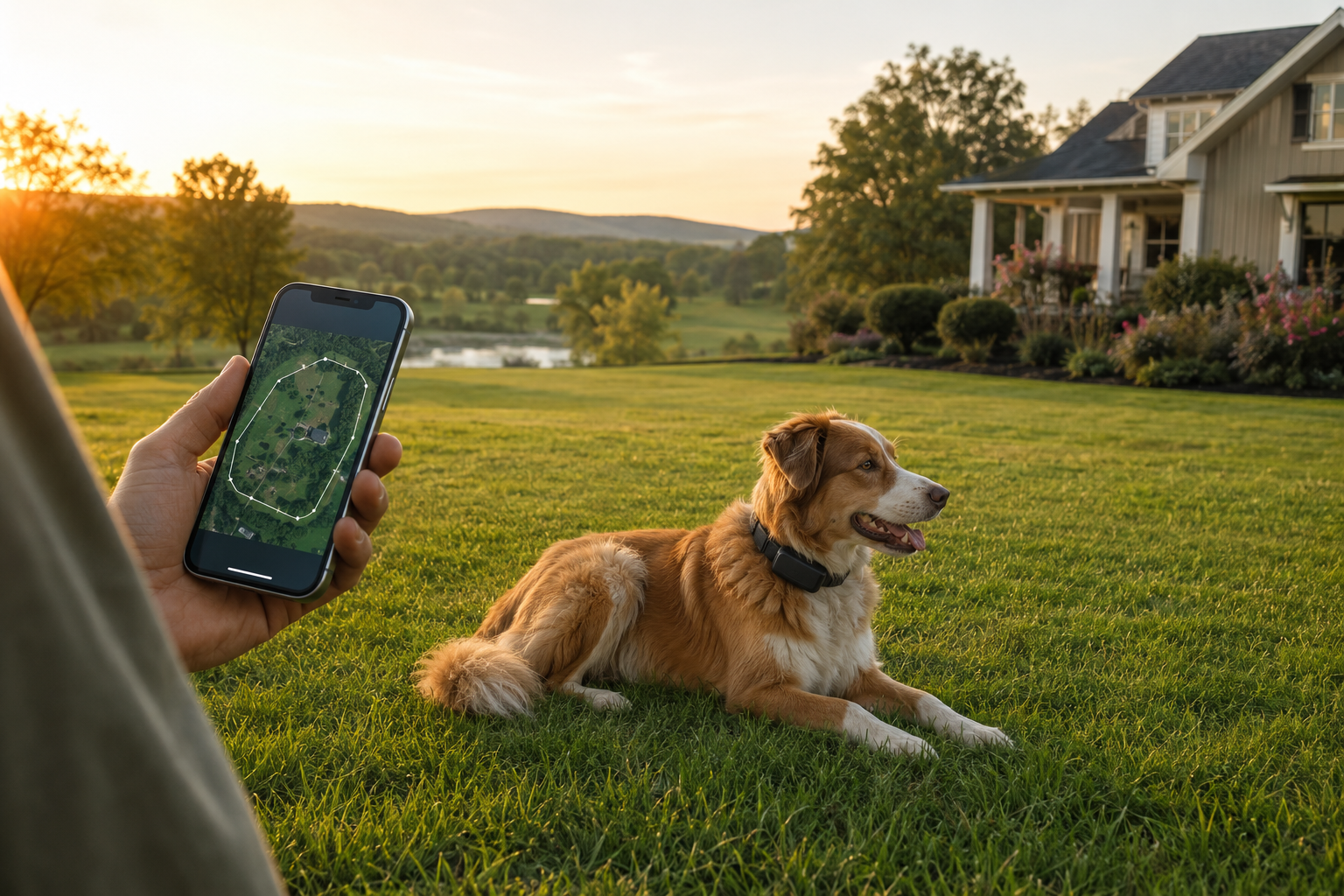
A GPS fence creates virtual boundaries rather than a physical barrier. The collar provides warning feedback as the dog approaches a saved boundary. Some systems also offer remote tracking, but that may require a separate subscription.
Containment collars require careful introduction and structured training. Local rules concerning electronic training or containment aids vary. Owners should review applicable law and consider reward-based professional guidance before enabling aversive feedback.
What About an AirTag for Dogs?
An AirTag is not the same as a dedicated GPS dog tracker. It is an item tracker that can report its location through Apple’s Find My network when compatible Apple devices are nearby. It does not provide the same cellular or direct-radio tracking connection used by the dog-tracking systems in this guide.
An AirTag may help locate an attached item in areas with enough participating devices, but it should not be treated as a substitute for a dedicated dog GPS tracker when timely escape alerts, live tracking, or off-grid recovery are priorities.
1. Tractive GPS Tracker for Dogs — DOG 6 and DOG 6 XL
Why It Stands Out
The Tractive DOG 6 and DOG 6 XL are current clip-on cellular trackers designed for different dog sizes. DOG 6 weighs 39 g and is recommended for dogs above 4 kg (8.8 lb). DOG 6 XL weighs 70 g and is intended for dogs above 20 kg (44.1 lb).
Both use GPS, GLONASS and Galileo positioning together with LTE/4G, Wi-Fi and Bluetooth. The Tractive app provides Live Tracking, Virtual Fences, escape alerts and location history. Current models also document activity, sleep, resting heart rate and respiratory-rate trends, plus dog-specific bark and scratch monitoring on supported models.
Tractive states up to two weeks of battery life for DOG 6 and up to six weeks for DOG 6 XL when Power Saving Zones are used. Active tracking and time away from saved Wi-Fi areas can shorten those figures.
Suitable For
Owners who want app-based everyday location tracking, escape alerts and basic wellness trends in a collar-mounted device.
Key Specifications
| Specification | DOG 6 | DOG 6 XL |
| Size | 71 × 29 × 17 mm | 83 × 47 × 20 mm |
| Weight | 39 g / 1.4 oz | 70 g / 2.5 oz |
| Dog guidance | Above 4 kg / 8.8 lb | Above 20 kg / 44.1 lb |
| Battery | Up to 14 days with Power Saving Zones | Up to 42 days with Power Saving Zones |
| Water resistance | IP68 | IP68 |
| Collar-width compatibility | Up to 2.8 cm / 1.1 in | Up to 4 cm / 1.6 in |
| Connectivity | LTE/4G, Bluetooth 5.0 and 2.4 GHz Wi-Fi | LTE/4G, Bluetooth 5.0 and 2.4 GHz Wi-Fi |
| Positioning | GPS, GLONASS and Galileo | GPS, GLONASS and Galileo |
| Subscription | Required | Required |
Advantages
- Frequent Live Tracking through the mobile app
- Virtual-fence entry and exit alerts
- Several positioning and connectivity methods
- Two sizes for different dogs
- IP68 water-resistance rating
- Activity, sleep, and supported health-trend features
- USB-C charging on the current models
Limitations
- Active subscription required
- Remote reporting needs supported mobile coverage
- Live Tracking reduces battery duration
- DOG 6 XL is too large for small dogs
- Wellness information cannot diagnose a health condition
Editorial Assessment
Tractive offers a practical balance of size, connected tracking and app functions for everyday use. Choose between DOG 6 and DOG 6 XL according to the dog’s weight, collar width, and charging preference rather than assuming the larger model is automatically better.
View the current Tractive DOG 6 and DOG 6 XL product information
2. Fi Series 3+ Smart Dog Collar
Why It Stands Out
The Fi Series 3+ integrates the tracker into a collar rather than attaching a separate device. Fi’s current comparison information lists a device size of 81.5 × 30 × 11.5 mm, a weight of 47 g, IP68/IP66K water resistance, and a battery claim of up to three months.
Battery duration varies substantially with use. Fi’s support guidance estimates four to six weeks for moderate activity and up to two weeks for dogs spending most of the day roaming away from home. GPS and cellular use increase when the collar is away from its Fi Base, Wi-Fi, or the owner’s phone.
An active Fi Membership enables remote tracking, Lost Mode, and escape alerts. Series 3+ currently uses AT&T cellular service in the United States, so readers elsewhere must confirm whether Fi sells and supports the model in their market.
Suitable For
Owners who prefer an integrated smart collar, want longer routine battery life, and have dependable supported cellular coverage.
Key Specifications
| Specification | Details |
| Model | Fi Series 3+ |
| Size | 81.5 × 30 × 11.5 mm |
| Device weight | 47 g |
| Technology | GPS, cellular, Wi-Fi and Bluetooth |
| Cellular provider | AT&T for the current US service |
| Battery | Up to 3 months under low-use conditions; shorter with more GPS/cellular use |
| Water resistance | IP68 and IP66K |
| Charging | Fi Base |
| Location functions | Escape alerts, Lost Mode and Live Tracking |
| Other functions | Activity, rest and supported behavior insights; Apple Watch integration |
| Subscription | Fi Membership required for remote tracking |
Advantages
- Integrated low-profile collar design
- Longer manufacturer battery claim than many clip-on cellular trackers
- Escape alerts and Live Tracking
- Activity and rest information
- IP68/IP66K water-resistance ratings
- Fi Base helps reduce routine GPS and cellular use at home
- Apple Watch integration
Limitations
- Active membership required
- Current cellular network and regional support are limited by market
- Battery duration falls during frequent roaming or Lost Mode
- Collar band and tracker are part of one system rather than a universal clip-on device
- Behavior and activity estimates are not veterinary diagnoses
Editorial Assessment
Fi Series 3+ is most relevant when an integrated collar and longer routine charging interval are priorities. Its regional and single-network dependence is the key limitation, so coverage should be checked before purchase and Lost Mode should be tested while the dog is safely supervised.
View the current Fi Series 3+ specifications and support information
3. Aorkuler Dog GPS Tracker 2
Why It Stands Out
The Aorkuler Dog GPS Tracker 2 does not use a SIM card, mobile app or cellular service. The collar unit determines its position with GPS and sends direction and distance directly to the supplied handheld controller by radio.
Aorkuler states a range of up to 3.5 miles in open terrain, with updates every few seconds. The collar unit weighs approximately 30 g and is rated IP67. A sound-and-light beacon can help during the final stage of a search.
The product page describes “all-day” battery use but does not publish a precise maximum number of hours. Range also falls in dense woods, hills, and built-up areas where the direct radio path is obstructed.
Suitable For
Hiking, farms, rural properties, and other situations where cellular service is unreliable but a portable handheld system is preferred over a professional hunting setup.
Key Specifications
| Specification | Details |
| Model | Dog GPS Tracker 2 |
| Positioning | GPS |
| Communication | Direct RF link to handheld controller |
| Maximum stated range | Up to 3.5 miles in open terrain |
| Update interval | Every few seconds under suitable conditions |
| Collar-unit weight | Approximately 30 g / 1.06 oz |
| Water resistance | IP67 |
| Battery | Rechargeable; manufacturer describes all-day use without a precise hour figure |
| Close-search support | Sound and light beacon |
| Smartphone or app | Not required |
| Subscription | None |
Advantages
- No subscription, SIM card, or mobile app
- Works independently of cellular towers
- Direction and distance shown on the handheld controller
- Relatively light collar unit
- IP67 rating
- Sound-and-light beacon
- Single- and two-dog kits available
Limitations
- Maximum range assumes open terrain
- Trees, hills and buildings reduce radio range
- Requires carrying and charging a separate controller
- No remote cloud location, geofence alerts or phone notifications
- Manufacturer does not publish a precise battery-hour claim
Editorial Assessment
Aorkuler fills the gap between cellular consumer trackers and complex hunting systems. Its lack of recurring fees is useful, but buyers should understand that it is a finite-range radio system and should test it in the actual terrain where it will be used.
View the current Aorkuler Dog GPS Tracker 2 product information
4. Garmin Alpha 300 or 300i With T 20 or TT 25 Collar
Why It Stands Out
Garmin’s current Alpha 300 and Alpha 300i handhelds pair with the T 20 tracking collar or TT 25 tracking-and-training collar. This replaces the older Alpha 200/TT 15X combination covered by the previous version of this guide.
The system uses GPS/Galileo positioning and VHF radio rather than ordinary cellular reporting. Garmin states a range of up to nine miles in favorable conditions and support for tracking up to 20 compatible devices. The Alpha 300i adds inReach satellite communication functions, which require an active satellite subscription and may be regulated in some jurisdictions.
The Alpha 300 handheld has a battery claim of up to 60 hours; the 300i is rated up to 55 hours. Current T 20 and TT 25 documentation lists up to 68 hours for the standard collar battery and up to 136 hours with the optional extended battery pack.
Suitable For
Hunters, handlers and working-dog owners who need multi-dog tracking, detailed maps and long-range direct-radio communication beyond cellular coverage.
Key Specifications
| Specification | Details |
| Handhelds | Alpha 300 or Alpha 300i |
| Compatible current collars | T 20 tracking collar; TT 25 tracking-and-training collar |
| Positioning and link | GPS/Galileo with VHF radio |
| Maximum stated range | Up to 9 miles / 14.5 km under favorable conditions |
| Devices tracked | Up to 20 compatible dog collars or Alpha handhelds |
| Display | 3.5-inch color touchscreen |
| Alpha 300 battery | Up to 60 hours |
| Alpha 300i battery | Up to 55 hours; up to 50 hours with inReach enabled |
| Collar battery | Up to 68 hours; up to 136 hours with optional extended pack |
| Water resistance | Handheld: IPX7; collars: 1 ATM |
| Tracking subscription | Not required for VHF dog tracking |
| Satellite communication | Alpha 300i inReach functions require a plan |
Advantages
- Direct-radio tracking without ordinary cellular service
- Up to nine-mile manufacturer range under optimal conditions
- Tracks multiple dogs and compatible handhelds
- Detailed mapping and directional information
- Replaceable rechargeable batteries
- Long collar and handheld battery claims
- T 20 offers tracking without electronic stimulation
Limitations
- Requires a dedicated handheld and compatible tracking collar
- More equipment and complexity than an everyday pet tracker
- Range falls with terrain and obstruction
- Collar units are substantially heavier than consumer trackers
- inReach features on Alpha 300i require a separate subscription
- Training functions and radio frequencies may be regulated by location
Editorial Assessment
Garmin Alpha is a specialized working and hunting system, not a general replacement for a compact neighborhood tracker. Owners who need location only can pair an Alpha handheld with the T 20 rather than choosing a stimulation-capable TT 25 collar.
View the current Garmin Alpha 300 system information
5. SpotOn GPS Fence Nova Edition
Why It Stands Out
The SpotOn GPS Fence Nova Edition is primarily a containment system. Owners create custom GPS boundaries, and the collar provides progressive warnings as the dog approaches them. Standard fence creation and boundary enforcement do not require Wi-Fi, cellular service, or a subscription.
An optional cellular plan adds remote location viewing, automatic breach alerts, escape reports, activity maps, and other connected controls. Without that plan, SpotOn should not be treated as a remote live tracker.
Nova fits dogs weighing at least 15 lb with necks from 10 to 26 inches. SpotOn states at least 33 hours of battery runtime with tracking enabled, a one-hour charge time, and an IP67 rating.
Suitable For
Owners of suitable dogs on larger or irregularly shaped properties who want portable GPS boundaries and are prepared to complete the required training.
Key Specifications
| Specification | Details |
| Model | SpotOn GPS Fence Nova Edition |
| Primary function | GPS containment |
| Positioning | GPS, GLONASS, Galileo, and BeiDou |
| Fence creation | Unlimited custom fences and Keep Out Zones |
| Cellular or Wi-Fi requirement | Not required for standard containment |
| Remote tracking | Requires optional cellular subscription |
| Dog-size guidance | At least 15 lb; neck 10–26 in |
| Battery | At least 33 hours with tracking enabled; longer in extended mode |
| Charge time | Approximately 1 hour |
| Water resistance | IP67 |
| Feedback | Tone, vibration and optional static levels |
Advantages
- Custom boundaries without buried wires
- Containment works without a mandatory subscription
- Optional remote tracking and breach alerts
- Multiple fences, overlapping fences and Keep Out Zones
- Designed for large or irregular properties
- IP67 rating and rapid charging
- The manufacturer includes individual training support
Limitations
- Designed primarily for property containment rather than everyday clip-on tracking
- Not suitable for dogs below the stated weight or neck size
- Requires careful boundary training before unsupervised use
- Remote location functions require an optional plan
- GPS containment is not a physical barrier
- Electronic-feedback laws and welfare guidance vary by location
Welfare and Training Note
SpotOn provides tone and vibration options as well as optional static feedback. The American Veterinary Society of Animal Behavior recommends reward-based methods and advises against aversive electronic-collar training. Owners should review applicable law, discuss welfare concerns with a veterinarian or appropriately qualified reward-based professional, and use the least aversive setup available.
Editorial Assessment
SpotOn Nova may be relevant when property containment is the primary objective, but it should not be compared directly with a small clip-on tracker. Buyers must consider dog fit, property conditions, training commitment, legal requirements, and whether the optional tracking plan is necessary.
View the current SpotOn Nova GPS Fence product information
How to Choose the Best GPS Trackers for Dogs
Start With the Actual Risk
For a dog escaping from a suburban garden, a cellular tracker with a fast geofence alert may be the most practical option. For hiking or working beyond mobile coverage, direct radio is more relevant. For property containment, a fence system may address the boundary problem, but it does not replace a physical fence in every environment.
Check Fit and Total Weight
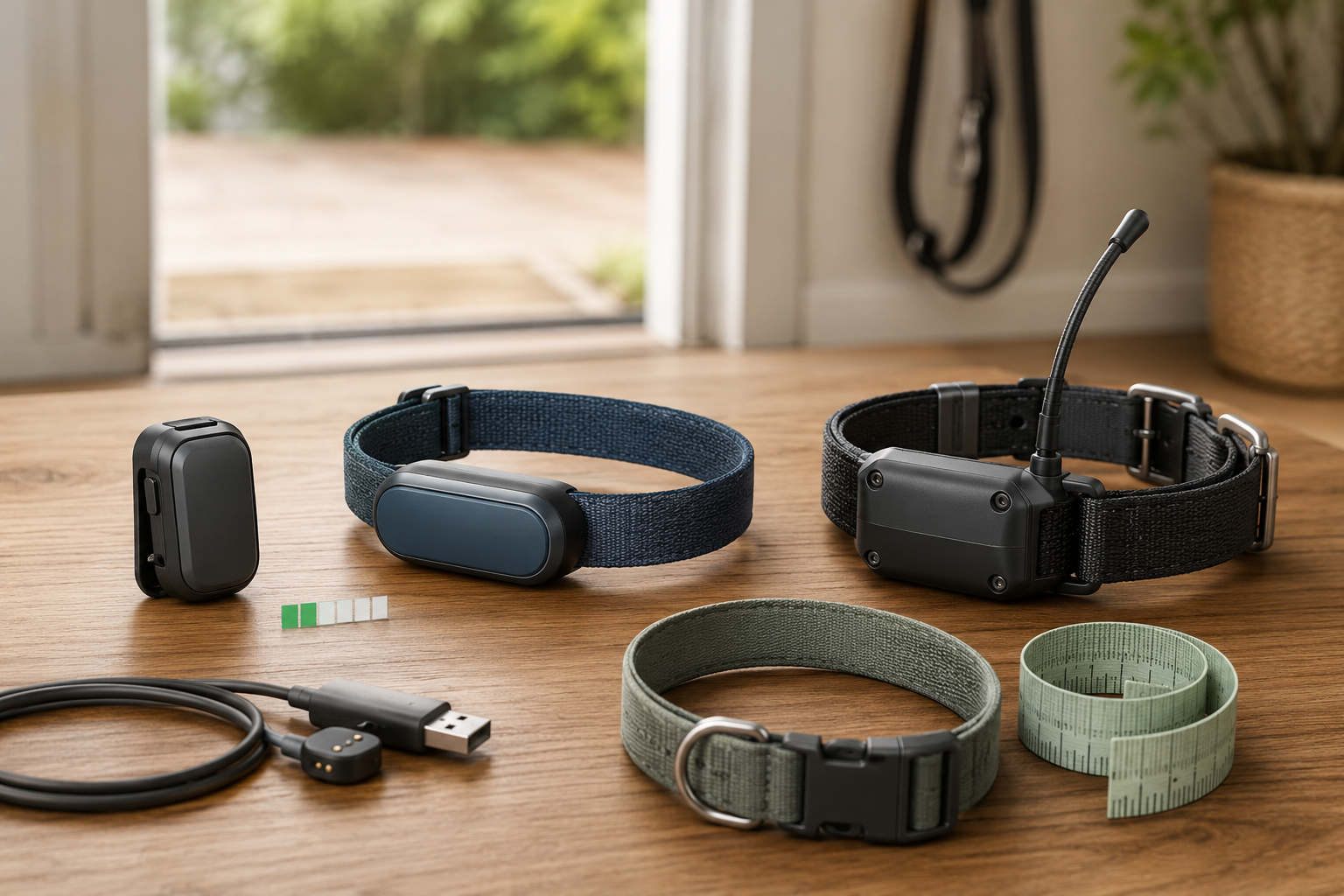
Compare the dog’s weight, neck measurement, and collar width with the manufacturer’s current guidance. Include the collar, antenna, holder, and battery pack when judging total wearable weight. A device suitable for a working retriever may be inappropriate for a toy breed.
Also check how the tracker or collar is secured. A clip-on dog GPS tracker, integrated GPS dog collar, and working-dog tracking collar use different attachment methods and should not be treated as interchangeable designs. Inspect clips, holders, buckles, and collar fit regularly, especially if the dog runs through brush or rough terrain. A tracker that separates from the dog can no longer provide the dog’s location.
Verify Coverage and Regional Support
Check cellular coverage where the dog actually spends time—not only at the home address. Confirm that the manufacturer sells subscriptions and provides support in your country. Direct-radio frequencies, satellite communicators, and electronic-feedback collars may be restricted by local law.
Check Subscription and Equipment Requirements
Confirm which components and subscriptions are required. Some systems need a compatible handheld receiver, collar or optional base, while cellular tracking and connected alerts may depend on an active plan. Review the manufacturer’s current requirements before choosing a system.
Examine Lost-Mode Battery Use
Maximum battery claims often assume time at home, connection to Wi-Fi, or a low update frequency. Live modes use more power. Charge the tracker routinely and test its low-battery alerts.
Decide Whether You Need Tracking or Containment
A virtual fence alert tells you that a dog crossed a saved boundary. A containment collar attempts to influence the dog before or during that crossing. A tracker reports location after the dog moves. These functions overlap on some products but are not equivalent.
Test Before Relying on It
Escape-alert speed and live-location update frequency are different measures. The first is how quickly the system tells you that the dog has crossed a saved boundary; the second is how often the location refreshes once active tracking begins. Test both, because a fast escape alert does not necessarily mean equally frequent location updates.
While the dog is safely supervised:
- Confirm collar fit and comfort.
- Walk the tracker outside its safe zone and measure the alert delay.
- Activate live or lost mode and observe update frequency.
- Test weak-signal areas, trees, slopes, and buildings.
- Check battery use during active tracking.
- Teach another household member how to access the app or handheld.
- Keep a lead, recent photograph, and emergency contact plan available
Safety, Identification and Responsible Use
A GPS device is a recovery aid, not a guarantee. Maintain secure doors and fencing, supervise dogs appropriately, and practice reward-based recall training. If you are also comparing wearable wellness features, read our guide to dog health-monitoring collars.
If an escape alert occurs, open the tracker’s live or lost mode when available and use the latest location, direction, or map information provided by that system. Avoid repeatedly using nonessential app features that may increase battery use during a search. Keep a recent photograph and identification details available, and if the tracker becomes detached or stops reporting, continue the search using the dog’s registered microchip and other identification as recovery safeguards.
Keep the dog’s microchip registration and contact information current. A microchip provides permanent identification when scanned; it is not a GPS transmitter and cannot report live location. Review the AAHA pet-microchipping FAQs for identification guidance.
Health, sleep and activity trends from a collar should not be used to diagnose illness. Discuss persistent or concerning changes with a veterinarian.
For products containing training functions, review the AVSAB position on humane dog training. If your priority is training technology rather than location safety, our separate guide compares remote dog training collars, including their limitations.
Frequently Asked Questions
Do all GPS trackers for dogs require subscriptions?
No. Cellular products such as Tractive and Fi require active service plans. Aorkuler and Garmin use direct radio for standard tracking and do not require a cellular tracking subscription. SpotOn’s containment works without a subscription, but its remote tracking functions require an optional plan.
Can a GPS tracker work without cellular coverage?
A direct-radio system such as Aorkuler or Garmin can work without a cellular tower, provided the dog remains within radio range of the handheld receiver. Cellular trackers need supported mobile coverage to transmit the location to an app.
Can a GPS tracker replace a microchip?
No. A registered microchip permanently identifies the dog when scanned. A GPS tracker is removable, battery-powered and can fail or separate from the collar. Both serve different purposes.
What is the difference between a virtual fence and a GPS fence?
On an ordinary tracker, a virtual fence usually sends a phone alert when the dog enters or leaves a saved area. A GPS containment system provides warnings at the boundary and may include additional feedback intended to keep the dog inside it.
Which option is suitable for a small dog?
Check current manufacturer guidance. Tractive DOG 6 is listed for dogs above 4 kg (8.8 lb). Fi offers several collar sizes, but total fit still needs checking. SpotOn requires at least 15 lb and a 10-inch neck. Garmin collar systems are significantly heavier and are intended for sporting or working contexts.
How far can an off-grid dog tracker work?
Aorkuler states up to 3.5 miles in open terrain. Garmin states up to nine miles under optimal conditions. Trees, hills, buildings, antenna position and interference can reduce both ranges.
Which tracker has the longest battery life?
Fi Series 3+ has a manufacturer claim of up to three months under low-use conditions. Garmin’s optional extended collar battery can reach up to 136 hours. These products serve different purposes, and active tracking can shorten both figures substantially.
Can a tracker prevent a dog from escaping?
No tracker guarantees prevention. A cellular tracker reports location and may send an escape alert. A containment collar attempts to reinforce a boundary but still depends on equipment, positioning, training and the dog’s response. Secure physical measures remain important.
Can several dogs be tracked from one device?
Garmin Alpha handhelds can track up to 20 compatible devices. Aorkuler sells a two-dog kit. Connected-app products can generally manage multiple trackers, but each dog may require separate hardware and service. Confirm current plan limits before purchasing.
Final Recap
There is no single tracking system appropriate for every dog:
- Consider Tractive DOG 6 or DOG 6 XL for everyday app-based tracking, escape alerts and a choice of tracker sizes.
- Consider Fi Series 3+ when an integrated smart collar and longer routine battery claim are priorities and service is supported in your area.
- Consider Aorkuler Dog GPS Tracker 2 for portable off-grid direction and distance without an app or subscription.
- Consider Garmin Alpha 300/300i with T 20 or TT 25 for specialized hunting, working-dog and multi-dog tracking.
- Consider SpotOn Nova when GPS property containment is the main objective and the dog meets its fit requirements.
Before purchasing, verify current specifications, coverage, subscription terms, dog fit and local regulations on the manufacturer’s website. Test the complete system while the dog is safe, keep permanent identification current and maintain a recovery plan that does not depend on one electronic device.
Authoritative and Official Sources
- Tractive DOG 6 and DOG 6 XL official product information
- Tractive model-selection and battery guidance
- Fi current product comparison
- Fi battery-life guidance
- Fi cellular-coverage guidance
- Aorkuler Dog GPS Tracker 2 official information
- Garmin Alpha 300 official information
- Garmin Alpha 300i official information
- Garmin T 20 and TT 25 collar specifications
- SpotOn Nova official product information
- SpotOn subscription-feature information
- AAHA pet-microchipping FAQs
- American Veterinary Society of Animal Behavior position statements