Last verified: September 2, 2026
Review basis: Current manufacturer specifications, official support documentation, access-control functions, installation requirements and suitability for different cats and households. TopPetTech has not tested every product in this guide hands-on.
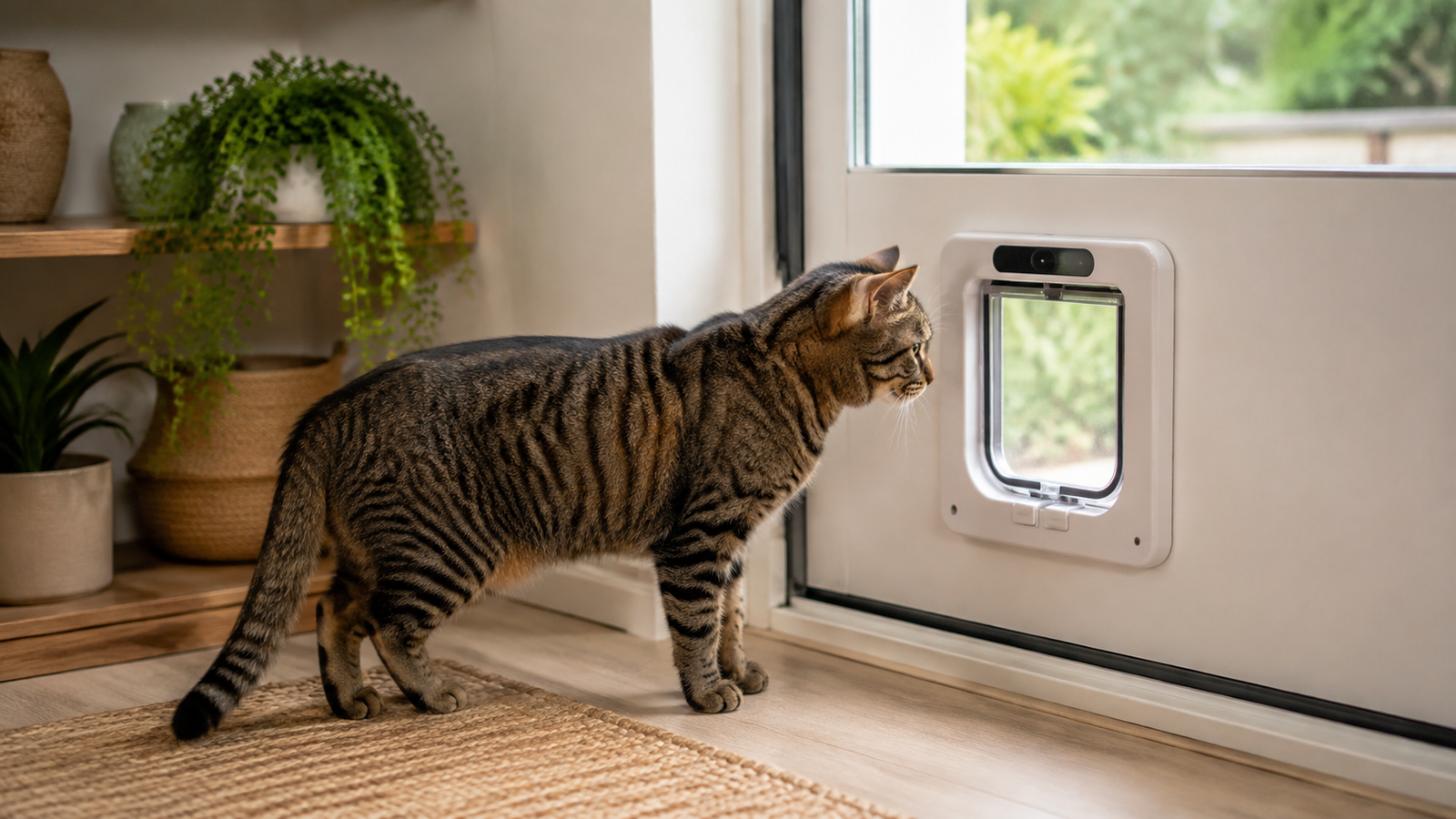
The best microchip cat doors are not all designed to solve the same problem. A basic selective-entry model can keep unregistered animals outside, while a dual-scan door can apply different exit permissions to individual cats. Connected models add remote controls, schedules and activity notifications, but they also introduce apps, hubs, Wi-Fi requirements or additional setup.
This guide compares five current microchip and smart cat doors according to what they actually control, how they identify a pet, their opening size, power arrangement and installation requirements. It does not assume that more connectivity is automatically better.
For cats with outdoor access, a door is only one part of a broader safety plan. A cat GPS tracker may provide location information outside the home, while a pet camera positioned near the entrance can help you observe arrivals and departures. Neither replaces supervision, identification or appropriate outdoor precautions.
Quick Answer
Choose a microchip cat door according to the access rule you need, not the amount of connectivity. SureFlap’s Microchip Pet Door and DualScan operate without an app; SureFlap Cat Flap Connect and PetSafe SmartDoor Connected add remote controls and notifications; Ferplast provides a larger local-control option without Wi-Fi.
Which one fits your household:
- SureFlap Microchip Pet Door: suitable for straightforward selective entry and a larger opening without app dependence.
- SureFlap DualScan Microchip Cat Flap: suitable for multi-cat homes where different cats need different outdoor permissions.
- SureFlap Microchip Cat Flap Connect: suitable for app-based monitoring, remote locking and individual exit permissions.
- PetSafe SmartDoor Connected: suitable for owners who want app schedules and notifications in a larger connected door.
- Ferplast SWING MICROCHIP LARGE: suitable for larger cats when app connectivity is unnecessary.
Regional availability varies, and installation can be a larger commitment than the electronics themselves. Confirm the current manual, compatible accessories and flap dimensions before cutting a door, wall or glass panel.
Key Takeaways
- A microchip door reads an identification code; it does not track your cat’s location.
- Selective entry and selective exit are different features. Many doors identify a pet coming in but allow any pet to leave.
- Connected features may depend on Wi-Fi, an app, a hub or cloud services. The mechanical or programmed door behavior during an outage matters.
- Measure your cat and the proposed installation area before buying. Product labels such as “large” are not substitutes for dimensions.
- Glass, metal and wall installations may need adapters, tunnel extenders or professional installation.
- Introduce the flap gradually and never force a hesitant cat through it.
Best Microchip Cat Doors at a Glance
| Model | Suitable use | Identification | Connected features | Main limitation |
|---|---|---|---|---|
| SureFlap Microchip Pet Door | Larger opening and straightforward selective entry | Implanted microchip or SureFlap RFID collar tag | None | Normal exit is not individually controlled |
| SureFlap DualScan Microchip Cat Flap | Different outdoor rules for multiple cats | Implanted microchip or compatible RFID collar tag | None | Smaller opening and no remote monitoring |
| SureFlap Microchip Cat Flap Connect | Remote control and activity monitoring | Implanted microchip or compatible RFID collar tag | Sure Petcare app through Hub | Hub and network setup required |
| PetSafe SmartDoor Connected | App schedules in a larger connected door | Pet Door Key; compatible cat microchips on Medium model | My PetSafe app over 2.4 GHz Wi-Fi | Cat microchip support is limited to the Medium model and listed chip types |
| Ferplast SWING MICROCHIP LARGE | Large cats without app requirements | Compatible implanted microchip or supplied collar device | None | No individual app-based permissions or monitoring |
Manufacturer features and regional stock can change. Treat this table as a comparison starting point and recheck the current product page before purchase.
How We Selected These Products
We reviewed current manufacturer pages, support material and installation information rather than relying on marketplace rankings. Selection emphasized:
- whether the door reads an implanted microchip, a collar key or both;
- selective-entry and selective-exit behavior;
- pet capacity and individual permissions;
- flap-opening dimensions and suitability for larger cats;
- app, hub, Wi-Fi and power requirements;
- door, wall, metal and glass installation considerations;
- manufacturer documentation, replacement parts and support;
- meaningful differences between products rather than minor feature duplication.
SureFlap DualScan is included because it addresses a common multi-cat concern: how to let one cat outside while keeping another indoors. Lightly documented marketplace doors and products with unclear long-term support were not promoted into the main shortlist.
How Microchip and Smart Cat Doors Differ
Selective Entry
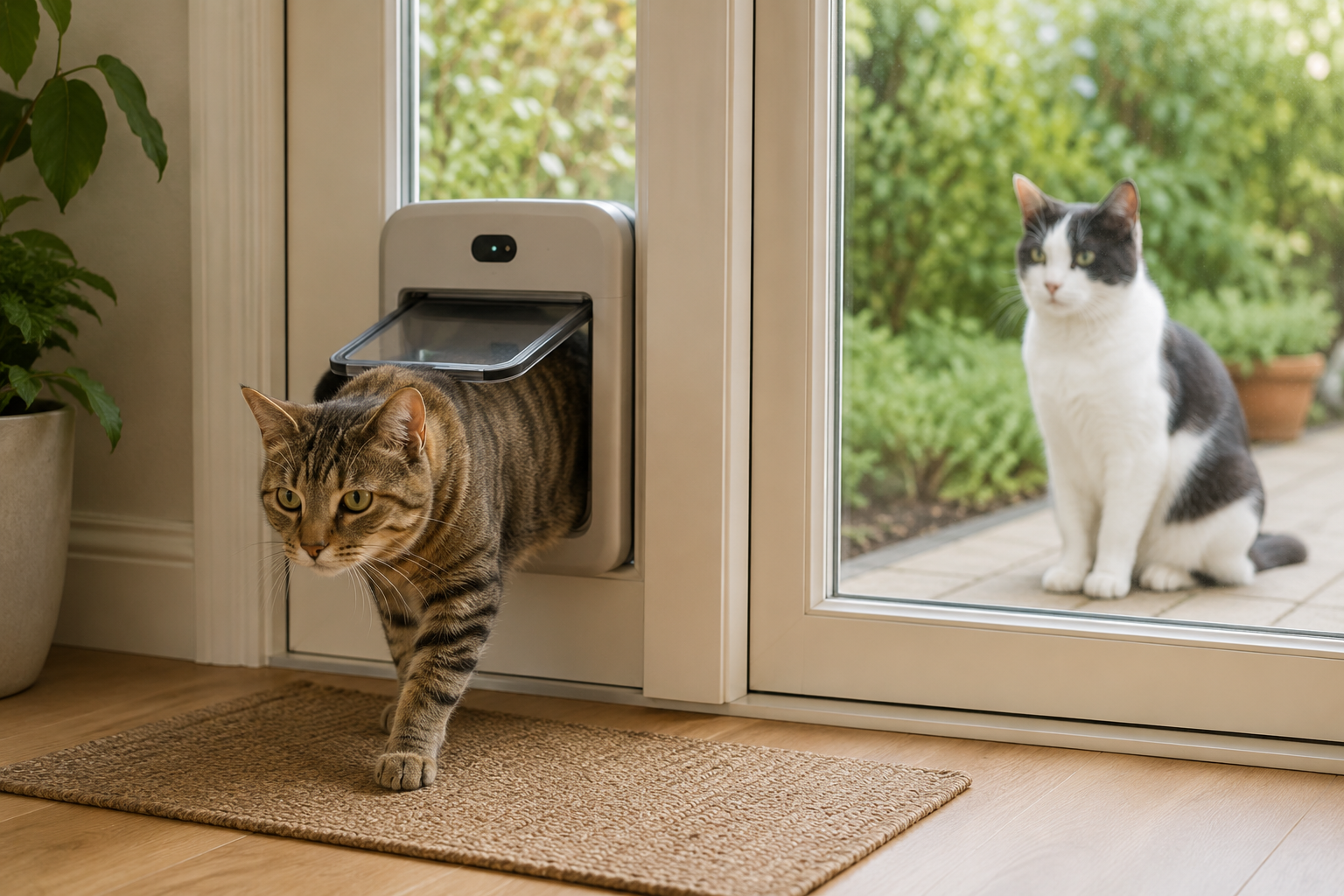
A selective-entry door remains locked to an unregistered animal approaching from outside. When it reads an authorized microchip or collar tag, it releases the entry lock. This can help prevent neighborhood cats from entering the home, which Cats Protection identifies as a useful role for microchip cat flaps.
Selective entry does not necessarily mean selective exit. Some doors allow any pet on the inside to leave normally.
Selective Exit
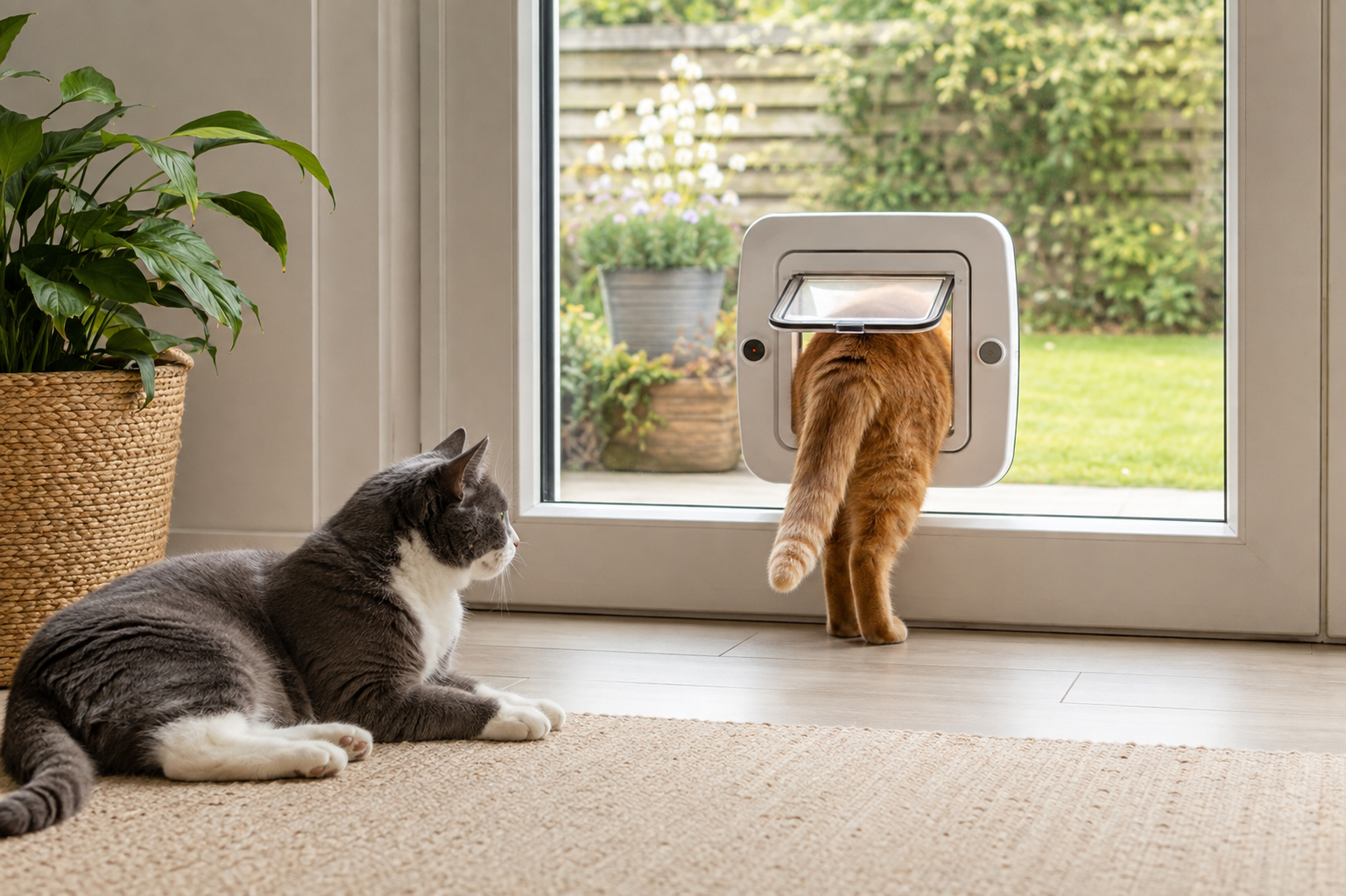
A dual-scan or two-way identification system can apply an exit rule to an individual registered cat. This is relevant when one cat is allowed outside, but another must remain indoors. Check whether the rule is stored locally, controlled manually or changed through an app.
Connected Control
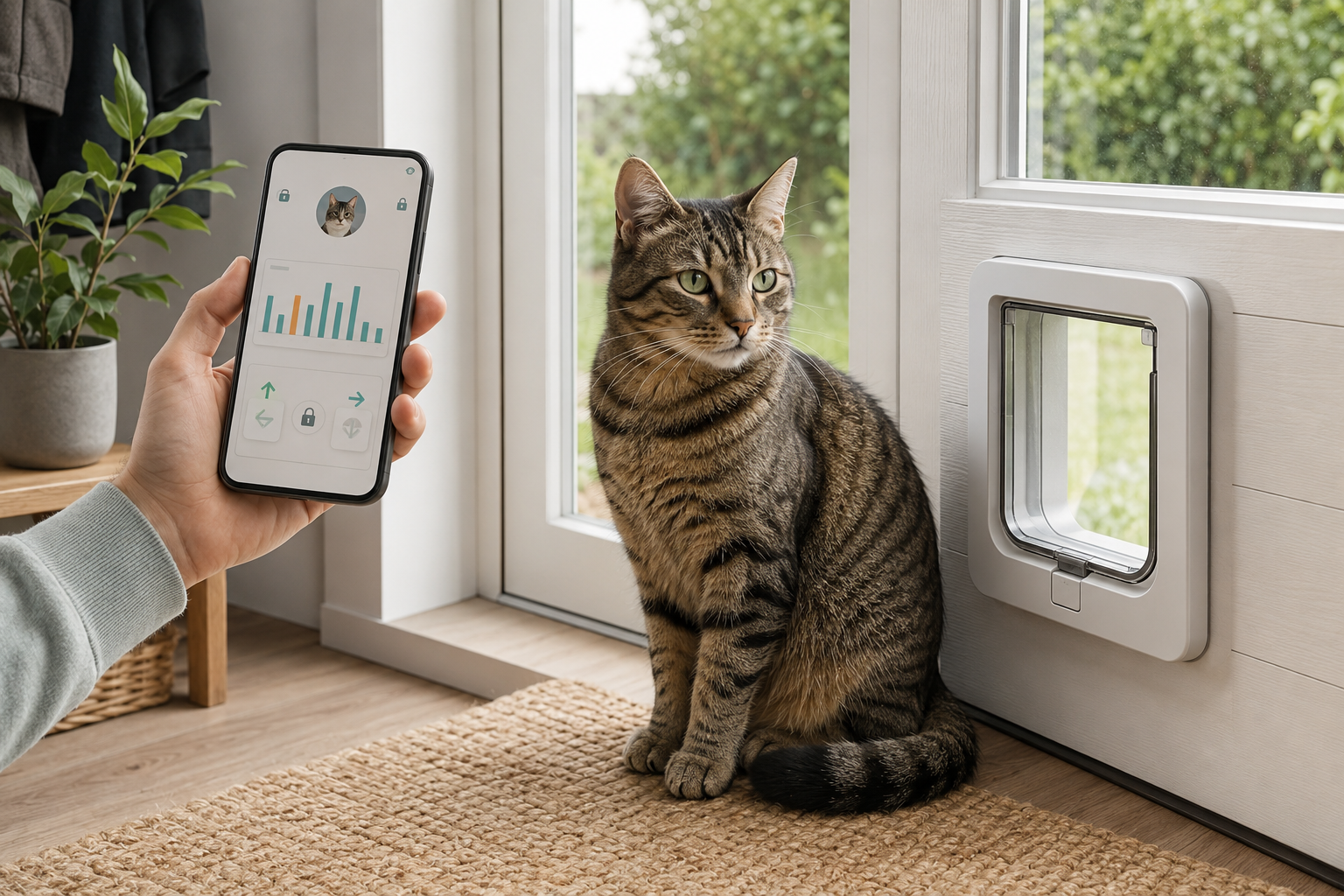
A connected door may add remote locking, schedules, notifications and activity history. These features can be convenient, but they do not make the door physically larger, easier to install or more compatible with a particular microchip. Establish the required access rule first, then decide whether remote control is worth the additional hardware and account dependence.
1. SureFlap Microchip Pet Door — Larger Selective-Entry Option
Why It Stands Out
The SureFlap Microchip Pet Door offers a 178 × 170 mm opening, making it roomier than SureFlap’s cat-flap-sized models. It reads common implanted identification microchips and also supports SureFlap RFID collar tags. Up to 32 pet identities can be stored.
Its primary purpose is simple: allow registered pets to enter while helping keep unregistered animals outside. A curfew mode can lock and unlock the door at programmed times, and a manual control can provide locked, unlocked or directional behavior. It does not require an app or household internet connection.
Best For
Larger cats, small dogs and multi-pet households that need collar-free selective entry without remote monitoring.
Key Specifications
| Specification | Manufacturer information |
|---|---|
| Access method | Most common implanted microchips or SureFlap RFID collar tag; check compatibility |
| Stored pet identities | Up to 32 |
| Flap opening | 178 × 170 mm / about 7.0 × 6.7 inches |
| Main electronic control | Selective entry |
| Curfew function | Programmable lock and unlock time |
| Power | Four C-cell batteries |
| Claimed battery life | Up to 12 months; usage affects runtime |
| Installation | Doors, walls and glass with appropriate accessories |
| Warranty | Three years according to Sure Petcare |
Advantages
- Larger opening than standard cat-flap-sized SureFlap models.
- Stores multiple pet identities.
- Uses a compatible implanted microchip without requiring a collar.
- No app, Hub or Wi-Fi dependence.
- Curfew setting and low-battery indication.
Limitations
- Individual microchip recognition is primarily used for entry; normal exit is not individually restricted.
- Requires four C-cell batteries.
- Wall and glass installation can require accessories and professional work.
- No activity notifications or remote changes.
Our Verdict
The SureFlap Microchip Pet Door is a practical choice when a larger opening and uncomplicated selective entry matter more than app features. It is particularly relevant for a large cat or a mixed cat-and-small-dog household. Choose a DualScan or connected model if individual exit permissions are essential.
View the current SureFlap Microchip Pet Door product information on the manufacturer’s website
2. SureFlap DualScan Microchip Cat Flap — Individual Exit Permissions
Why It Stands Out
The SureFlap DualScan reads a registered pet on both sides of the flap. That allows the household to assign different exit permissions: one cat can come and go, while another can be kept indoors. The door also blocks entry by unregistered animals.
This is a more specialized function than a basic selective-entry door, but it can be the decisive feature in a multi-cat home. It stores up to 32 pet identities and does not require an app or Hub to apply the programmed rules.
Best For
Multi-cat households in which individual cats have different outdoor-access rules.
Key Specifications
| Specification | Manufacturer information |
|---|---|
| Access method | Most common implanted microchips or SureFlap RFID collar tag; AVID encrypted, and Trovan excluded |
| Stored pet identities | Up to 32 |
| Flap opening | 142 × 120 mm / about 5.6 × 4.7 inches |
| Entry control | Blocks unregistered animals |
| Exit control | Individual permissions through DualScan identification |
| Power | Four AA batteries |
| Connectivity | None required |
| Installation | Doors, walls and glass with relevant accessories |
Advantages
- Applies different exit permissions to registered cats.
- Prevents unregistered animals from entering.
- Safety mode allows a registered indoor-only cat to return if it escapes through another opening.
- No cloud account, Wi-Fi or Hub required.
- Stores rules for multi-cat households.
- Supports implanted microchips and compatible collar tags.
Limitations
- The 142 × 120 mm opening may not suit a very large cat.
- Rules must be managed at the device rather than remotely.
- Four AA batteries are required.
- Sure Petcare excludes AVID encrypted and Trovan chips from the listed DualScan compatibility; check the exact chip before purchase.
- Installation accessories may add cost and complexity.
Our Verdict
The DualScan is the most relevant option here when the actual problem is not simply unwanted entry, but different outdoor rules for different cats. Measure the smallest opening carefully; its specialized permissions are not useful if a larger cat cannot pass comfortably.
3. SureFlap Microchip Cat Flap Connect — App Monitoring and Remote Control
Why It Stands Out
The Microchip Cat Flap Connect combines individual microchip permissions with the Sure Petcare app. Through a compatible Hub, owners can receive entry and exit notifications, review activity, change permissions, set a curfew and lock the flap remotely.
It retains the smaller 142 × 120 mm cat-flap opening, so its advantage is connected management rather than size. The Hub links the flap to the account and internet service; without that connection, buyers should understand which locally stored access rules remain available by checking the current manual.
Best For
Cat owners who will actively use remote locking, notifications and individual access management.
Key Specifications
| Specification | Manufacturer information |
|---|---|
| Access method | Compatible implanted microchip or SureFlap RFID collar tag |
| Stored pet identities | Up to 32 |
| Flap opening | 142 × 120 mm / about 5.6 × 4.7 inches |
| Connected hardware | Sure Petcare Hub |
| App functions | Notifications, activity, permissions, curfew and remote lock control |
| Power | Four AA batteries |
| Claimed battery life | Up to 12 months; usage and connectivity affect runtime |
| Installation | Doors, walls and glass with suitable accessories |
Advantages
- Remote lock control and curfew changes.
- Individual entry and exit permissions.
- Entry and exit notifications plus activity information.
- Uses a compatible implanted microchip.
- Useful when household access rules change regularly.
Limitations
- Hub, network and account setup are required for connected functions.
- Smaller opening may not fit a very large cat.
- Cloud-connected features introduce more points of dependency than a local-only door.
- Regional bundle and Hub availability can vary.
Our Verdict
The Connect model is most useful when remote control and activity notifications will change how you manage access. If the household follows stable rules and does not need monitoring, DualScan can provide individual exit permissions with less connected complexity.
4. PetSafe SmartDoor Connected — Larger App-Controlled Alternative
Why It Stands Out
The PetSafe SmartDoor Connected offers remote lock control, individual schedules and door-use notifications through the My PetSafe app. The Medium model has a 7.1 × 7.8-inch opening and supports listed compatible cat microchips as well as Pet Door Keys.
That qualification matters: PetSafe states that implanted-microchip pairing is limited to the Medium SmartDoor and specified cat microchip types. The Large model relies on compatible Pet Door Keys rather than cat microchip recognition. Buyers should verify the exact chip type before cutting an installation opening.
Best For
Connected households that need a larger app-controlled opening and can confirm compatibility with the Medium model.
Key Specifications
| Specification | Manufacturer information |
|---|---|
| Access method | Pet Door Key; compatible cat microchips on Medium model |
| App | My PetSafe app |
| Wi-Fi | 2.4 GHz required for connected features |
| Remote functions | Lock/unlock, individual schedules and notifications |
| Medium opening | 7.1 × 7.8 inches |
| Medium pet guidance | Pets up to 25 lb |
| Medium power | Four C-cell batteries or optional power adapter |
| Locking/weather design | Multi-point lock and dynamic weather sealing |
Advantages
- App-based schedules and remote lock control.
- Door-use and status notifications.
- Medium opening is larger than a standard cat flap.
- The compatible Medium model can use specified implanted cat microchips.
- An optional adapter can provide mains power, while installed batteries offer backup.
Limitations
- Microchip pairing is not supported across every size and chip type.
- Connected functions require 2.4 GHz Wi-Fi.
- Power adapter and some installation accessories are separate.
- Metal, glass and wall installation requirements need careful review; PetSafe states only the Medium model can be installed in glass with the appropriate adapter and professional help.
Our Verdict
The SmartDoor Connected is relevant when a larger opening and app schedules are both priorities. For a cat, select the Medium model only after confirming the implanted chip standard. Households that want simpler microchip entry without Wi-Fi should consider a local-only SureFlap or Ferplast model.
View the current PetSafe SmartDoor Connected product information on the manufacturer’s website
5. Ferplast SWING MICROCHIP LARGE — Large Non-App Microchip Flap
Why It Stands Out
The Ferplast SWING MICROCHIP LARGE combines microchip-controlled entry with a 17 × 20 cm opening for larger cats and small dogs. It stores up to 30 microchip codes and includes a collar device for a pet that does not have a compatible implanted chip.
A four-way control supports entry only, exit only, entry and exit, or fully locked operation. These are general flap settings rather than app-based permissions for individual animals. The Wind Stopper system is intended to reduce draughts around the flap.
Best For
Large cats whose owners want selective microchip entry without smartphone connectivity.
Key Specifications
| Specification | Manufacturer information |
|---|---|
| Access method | Compatible implanted microchip or supplied collar device |
| Stored microchip codes | Up to 30 |
| Opening | 17 × 20 cm / about 6.7 × 7.9 inches |
| Overall dimensions | 26.5 × 16.2 × 31.5 cm |
| Direction settings | Entry only, exit only, both directions, or locked |
| Draught feature | Wind Stopper system |
| Intended pets | Large cats and small dogs |
| App/Wi-Fi | None |
Advantages
- Larger opening for bigger cats.
- Stores multiple microchip identities.
- Four-way manual access settings.
- No app or Wi-Fi dependence.
- Supplied collar device offers an alternative to an implanted chip.
Limitations
- No remote monitoring, notifications or schedules.
- Electronic identification is used for authorized entry rather than individualized app-based exit control.
- Larger overall frame requires more installation space.
- Compatibility and regional accessory availability should be confirmed before installation.
Our Verdict
The Ferplast model is a reasonable alternative when physical opening size and local operation matter more than connected features. Compare the complete frame and cut-out requirements—not only the 17 × 20 cm passage—with the intended installation location.
View the current Ferplast SWING MICROCHIP LARGE product information on the manufacturer’s website
Detailed Comparison
| Model | Selective entry | Individual exit rules | App control | Opening | Power/dependency |
|---|---|---|---|---|---|
| SureFlap Microchip Pet Door | Yes | No | No | 178 × 170 mm | Four C batteries |
| SureFlap DualScan | Yes | Yes | No | 142 × 120 mm | Four AA batteries |
| SureFlap Cat Flap Connect | Yes | Yes | Yes | 142 × 120 mm | Four AA batteries plus Hub/network for connected features |
| PetSafe SmartDoor Connected Medium | Yes, with compatible chip or key | App permissions and schedules | Yes | 7.1 × 7.8 inches | Four C batteries or adapter; 2.4 GHz Wi-Fi for app |
| Ferplast SWING MICROCHIP LARGE | Yes | General four-way mode, not individual app rules | No | 17 × 20 cm | Battery-powered local operation; confirm current manual |
How to Choose the Right Cat Door
Define the Access Rule
Write down the exact problem before comparing features:
- Do you only need to stop unfamiliar animals from entering?
- Must one cat remain indoors while another may leave?
- Do you want the door to lock at night?
- Must you change permissions while away from home?
- Are notifications useful, or would they become ignored noise?
A basic selective-entry door is often enough for the first problem. Individual exit rules require DualScan or an equivalent two-way system. Remote changes require a connected product.
Confirm Microchip Compatibility
A pet microchip stores an identification number; it is not a GPS tracker. Door readers support specified chip frequencies and formats. Use the manufacturer’s compatibility checker or ask support to confirm the exact microchip number before installation.
If a collar tag is required, use an appropriate breakaway collar and review collar safety. An implanted compatible microchip avoids dependence on a collar that may be lost.
Measure the Cat and Opening
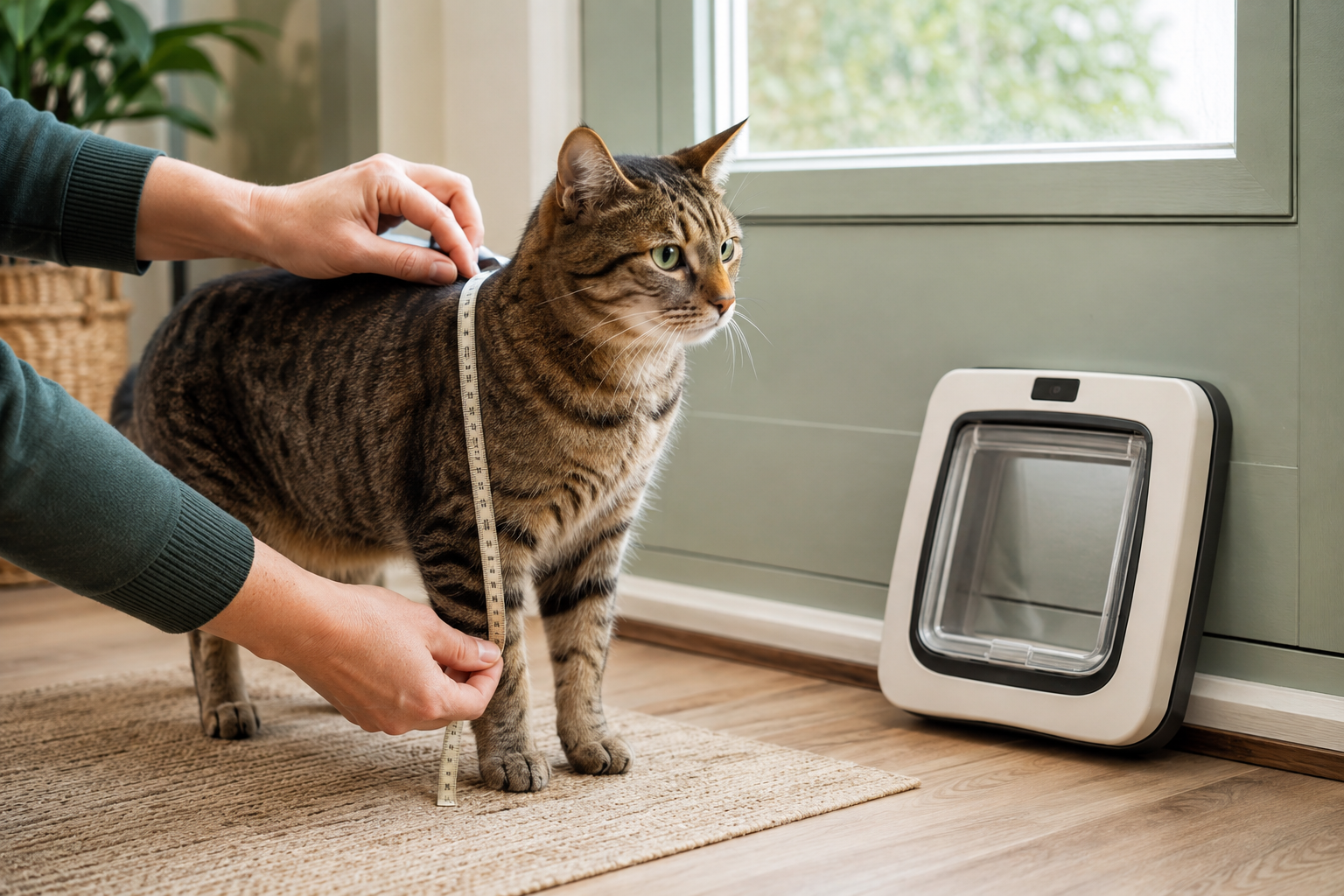
Measure the widest part of the cat’s body and the height needed for a comfortable step-through. Compare those measurements with the smallest clear opening—not the outside frame. A heavy cat is not always broad, and a light long-haired cat may need more physical clearance than expected.
Plan the Installation Before Purchase
Identify the construction material and thickness. Wooden and uPVC-style doors, metal panels, double glazing and masonry walls can require different cut-outs, adapters and tunnel pieces. Never cut tempered or double-glazed glass yourself; consult an appropriate professional and order a panel prepared for the specified installation.
Check where the battery compartment, controls, and Hub will remain accessible after fitting. Also consider rain exposure, sealing, drafts and whether the flap may obstruct another door or screen.
Check Offline and Low-Battery Behavior
For a battery model, confirm the low-battery warning and whether registered identities remain stored during replacement. For a connected model, determine which access rules continue locally when Wi-Fi, internet service or the Hub is unavailable. Maintain a practical way to let the cat in or keep it safely indoors during a fault.
Introduce the Door Gradually
Allow the cat to investigate the installed flap without pressure. Depending on the manufacturer’s training instructions, begin with the flap secured open or the locking sound demonstrated at a distance. Use calm rewards and short sessions. Do not push or pull a cat through the opening.
Safety and Responsible Outdoor Access
International Cat Care notes that a microchip cat flap can allow selective access while helping keep unfamiliar cats outside. It also recommends microchipping before outdoor access. Read its guidance on letting a cat outside for the first time.
Keep these limitations in mind:
- A microchip door does not prevent traffic, wildlife, toxins, theft, fights or becoming lost after the cat leaves.
- Keep the cat’s microchip registration and contact details current.
- Neutering, vaccination and appropriate parasite prevention should be discussed with a veterinarian before outdoor access.
- Provide an indoor litter tray even when a cat normally toilets outside.
- Consider keeping cats indoors at higher-risk times according to local conditions and veterinary or welfare guidance.
- Test manual locks and battery warnings regularly.
- Inspect the flap and frame for sharp edges, damage, obstruction or weather-related wear.
For broader welfare advice, see Cats Protection’s guidance on keeping cats safe outside.
Frequently Asked Questions
What is a microchip cat door?
A microchip cat door reads the identification number from a compatible implanted microchip and unlocks for a registered pet. The chip supplies an identity; it does not provide location tracking or power the door.
Can a microchip cat door keep other animals out?
It can remain locked to animals whose microchips or collar tags have not been registered. That can discourage neighborhood cats and some other unwanted visitors, but correct installation and locking are still essential. No consumer pet flap should be described as completely wildlife-proof, burglar-proof or escape-proof.
What is the difference between selective entry and selective exit?
Selective entry identifies an animal approaching from outside and unlocks for registered pets. Selective exit identifies or applies a rule to a pet leaving from inside. A door may offer one without the other, so verify both directions separately.
Can one cat go outside while another stays indoors?
Yes, if the door supports individual exit permissions and both cats are correctly registered. SureFlap DualScan and Cat Flap Connect are designed for this type of rule. A basic selective-entry-only door generally cannot distinguish which indoor cat is leaving.
Do smart cat doors work without Wi-Fi?
Local microchip doors do not require Wi-Fi. Connected products need their stated network or Hub arrangement for remote controls and notifications. Some programmed access behavior may continue locally during an outage, but confirm the current manual for the exact model.
Can several cats use the same microchip door?
Yes, if the opening fits every cat and the memory supports all identities. This guide includes models listing capacity for 30 or 32 pets. Capacity does not guarantee that every cat will accept the flap or that all cats should receive the same access rules.
Will my cat’s microchip work with every door?
Not necessarily. Chip standards and reader support vary. Confirm the exact chip number with the manufacturer’s compatibility tool before buying, especially for PetSafe SmartDoor Connected, where implanted-chip support is specific to the Medium model and listed cat chip types.
Is an app-connected cat door worth it?
It can be worthwhile when you will use remote permission changes, curfews or entry and exit notifications. If the household has stable rules and only needs to block unfamiliar animals, a non-connected microchip door may be simpler to own.
Final Verdict
The best microchip cat doors serve different access needs, so the right choice must apply the correct rule while fitting both your cat and the installation:
- Consider SureFlap Microchip Pet Door for a larger opening and simple selective entry.
- Consider SureFlap DualScan when individual cats need different exit permissions without app dependence.
- Consider SureFlap Microchip Cat Flap Connect for app monitoring and remote rule changes.
- Consider PetSafe SmartDoor Connected Medium for a larger app-connected door after confirming cat microchip compatibility.
- Consider Ferplast SWING MICROCHIP LARGE for larger cats and local four-way control without an app.
Do not choose from the feature list alone. Verify the microchip, opening size, installation material, offline behavior and regional product support before making an irreversible cut.
For another part of a connected cat-care setup, compare smart water fountains for pets and pet cameras for home monitoring.