Last Verified: August 7, 2026
Review Basis: This informational guide is based on research into automatic pet feeder features, feeding considerations, manufacturer guidance, and generally accepted pet-care practices. TopPetTech has not personally tested every type of automatic feeder discussed in this guide. Features and capabilities can vary by model, so readers should confirm current specifications with the manufacturer before purchasing.
Introduction
Feeding your pet on a consistent schedule is an important part of maintaining a predictable daily routine, but consistency isn’t always easy. Work commitments, changing schedules, unexpected delays, and busy mornings can all make it difficult to serve meals at the same time every day.
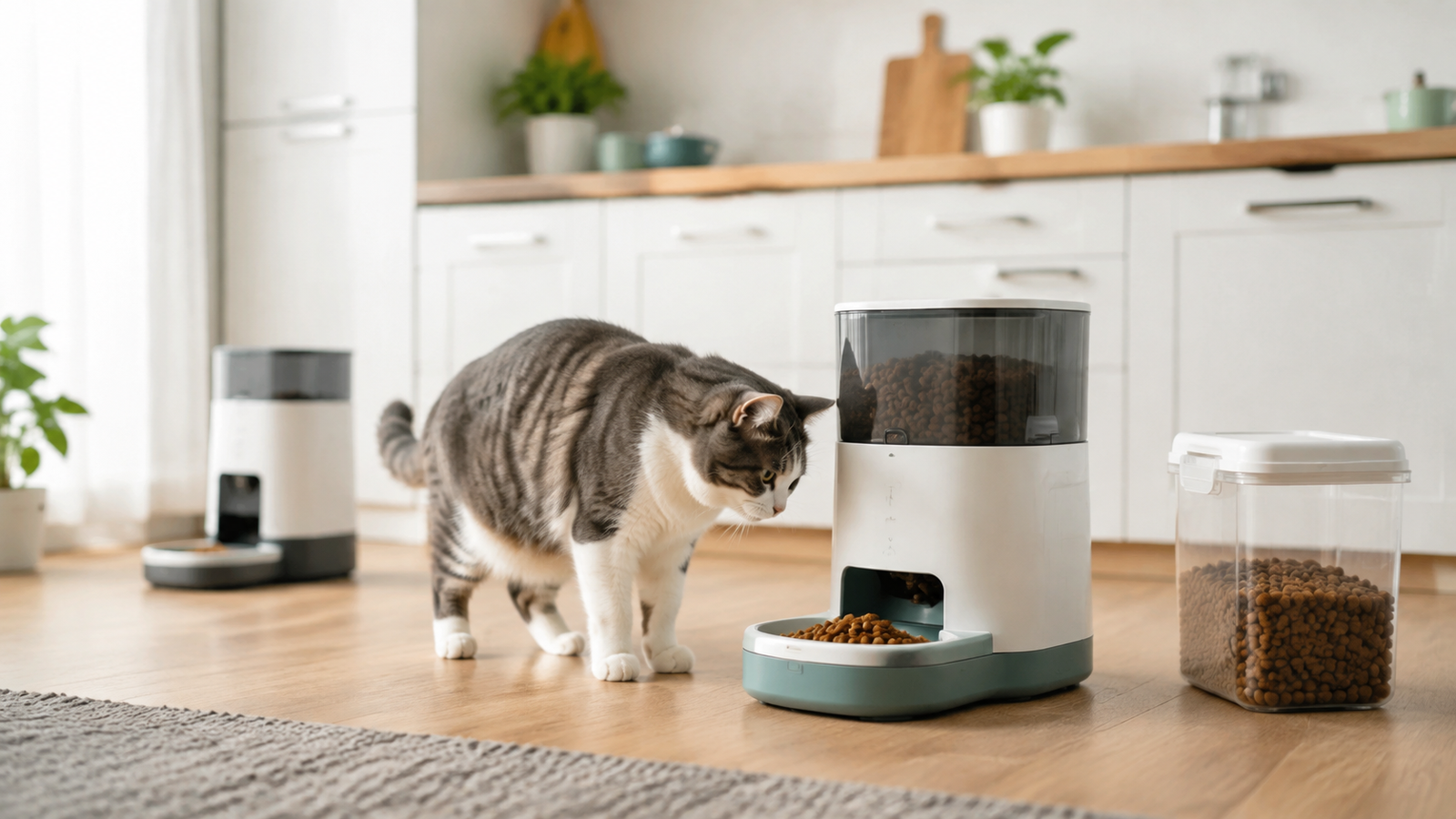
An automatic pet feeder can help by dispensing measured meals on a set schedule, whether you’re home or away. Depending on the type of feeder, it may also help with portion control, multiple daily meals, and managing feeding routines in busy or multi-pet households.
However, knowing how to choose an automatic pet feeder isn’t simply about buying the newest model or the one with the longest list of features. Your pet’s size, eating habits, food type, feeding schedule, and your household setup all matter.
In this guide, we’ll explain the features that deserve the most attention, the practical factors to consider before buying, and the common mistakes to avoid—so you can choose a feeder that fits your pet’s needs and your daily routine.
Quick Answer: How to Choose an Automatic Pet Feeder
Choose an automatic pet feeder based on your pet’s size, food type, eating habits, and feeding schedule. Prioritize accurate portion control, reliable dispensing, easy programming, and simple cleaning over unnecessary smart features. The right feeder should fit your pet’s existing routine while making scheduled feeding more consistent and convenient.
Key Takeaways
- Match the feeder to your pet’s size, appetite, and usual portion needs.
- Check that the feeder is compatible with your pet’s food, whether that’s dry kibble, wet food, or another supported type.
- Prioritize reliable dispensing and accurate portion control before considering extras such as apps, cameras, or voice features.
- Consider battery backup if power interruptions are a concern in your area.
- Remember that an automatic feeder supports your pet’s feeding routine—it doesn’t replace fresh water, daily care, interaction, or veterinary guidance when needed.
Table of Contents
- Why Owners Use Automatic Feeders
- TopPetTech Expert Insight
- What Features Should You Look for in an Automatic Pet Feeder?
- Key Buying Factors to Consider
- Who Can Benefit from an Automatic Pet Feeder?
- Common Buying Mistakes to Avoid
- Safety Tips for Using an Automatic Pet Feeder
- Frequently Asked Questions
- Final Recap
Why Owners Use Automatic Feeders
Consistent Feeding Supports a Predictable Routine
Automatic feeders aren’t only useful for people who travel. They can also help pet owners maintain more consistent mealtimes when work, appointments, or other daily responsibilities make manual feeding less predictable.
Dogs and cats often become accustomed to regular household and feeding routines. A programmable feeder can dispense meals at scheduled times each day, even when your own routine changes.
This can be especially practical in households where feeding times sometimes vary or where more than one person shares feeding responsibilities.
An automatic feeder should support an appropriate feeding routine rather than determine one. If your pet has a medical condition or specific dietary requirements, follow your veterinarian’s guidance on meal timing, portions, and feeding frequency.
Consistent Portion Control Can Help Manage Servings
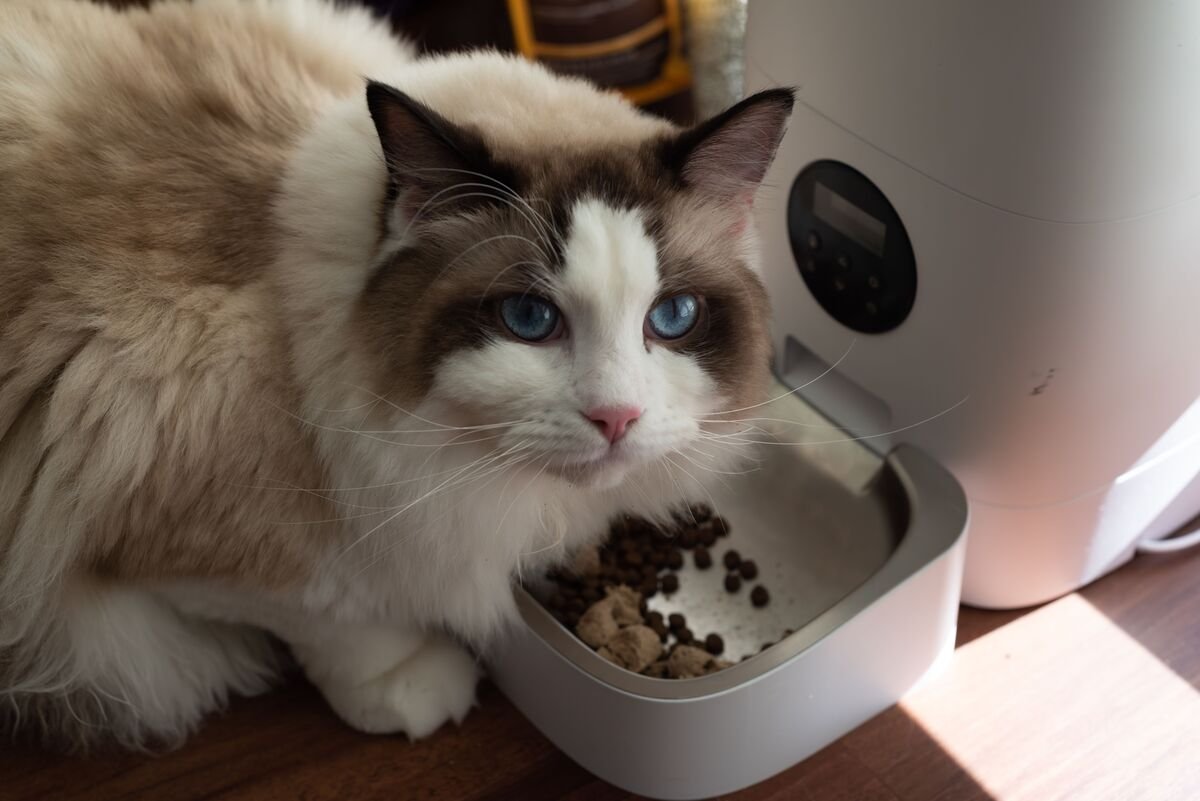
One of the most practical benefits of an automatic pet feeder is the ability to dispense consistent, measured portions.
When food is served manually, portion sizes can gradually vary—especially when several people share feeding responsibilities. A programmable feeder can reduce that inconsistency by dispensing the amount set by the owner at each scheduled meal.
This can be particularly useful for pets that eat several smaller meals throughout the day or for households that want more consistency in how much food is served at each feeding.
However, portion control is only useful when the programmed amount is appropriate for your pet. An automatic feeder doesn’t determine how much your pet should eat. Follow the feeding guidance appropriate for your pet’s food, age, size, activity level, and individual needs, and consult your veterinarian when specific dietary or weight-management guidance is required.
Before choosing a model, it is also worth checking how consistently automatic feeders dispense their programmed portions.
For additional guidance on feeding amounts and feeding schedules, see the American Animal Hospital Association’s feeding recommendations for healthy dogs and cats.
Convenience Without Replacing Daily Care
An automatic pet feeder can make everyday feeding more convenient when work, appointments, travel, or unexpected delays interfere with your normal schedule. Instead of replacing your involvement, it helps keep scheduled meals more consistent when you can’t serve them manually.
That convenience has limits. An automatic feeder doesn’t replace fresh water, daily interaction, exercise, enrichment, or regular attention to changes in your pet’s appetite and behavior.
Think of it as a routine-support tool: it can automate meal delivery, but your pet still depends on you for the rest of their daily care.
Helpful for Specific Feeding Schedules
Not every pet follows the same feeding schedule. Some may eat two meals a day, while others may be better suited to several smaller meals based on their individual needs or a feeding plan recommended by their veterinarian.
A programmable automatic feeder can make these schedules easier to maintain by dispensing meals at preset times throughout the day. This can be particularly useful when an owner isn’t always available at every scheduled mealtime.
The feeder itself, however, shouldn’t determine how often a pet needs to eat. If your pet has a medical condition, specific dietary requirements, or a veterinarian-recommended feeding schedule, follow that professional guidance when programming the feeder.
Fewer Missed or Double-Served Meals
In households where more than one person shares feeding responsibilities, it isn’t always obvious whether a pet has already been fed. This can occasionally result in a missed meal or an unintended extra serving.
A programmed automatic feeder can make the routine easier to manage by dispensing scheduled meals without relying on someone remembering each feeding time.
It can also be useful when you’re unexpectedly delayed away from home, since a correctly programmed and functioning feeder can still dispense the scheduled meal. However, it’s important to check the feeder regularly and make sure it has enough food, adequate power, and is dispensing properly.
TopPetTech Expert Insight
Based on our research into automatic pet feeder features and the factors that matter most in everyday use, one principle stands out:
Reliability is more valuable than complexity.
A feeder’s core job is to dispense the intended amount of food at the scheduled time. Features such as app control, cameras, voice recording, and notifications can be useful, but they shouldn’t come at the expense of dependable dispensing, practical portion control, or easy cleaning.
When comparing feeders, start with the basics: food compatibility, dispensing reliability, portion settings, scheduling flexibility, and ease of cleaning. Consider smart features afterward, based on which ones would genuinely make your feeding routine easier.
A simple rule: Choose app control, cameras, or notifications only when they solve a specific problem—such as checking whether a meal was dispensed while you’re away. Otherwise, prioritize dispensing reliability, portion accuracy, food compatibility, and easy cleaning.
What Features Should You Look for in an Automatic Pet Feeder?
Before comparing brands or smart features, focus on the basics that affect everyday usability and reliability:
- Accurate portion control: Look for adjustable portion settings that suit your pet’s usual serving size.
- Flexible meal scheduling: Make sure the feeder can accommodate the number and timing of meals your pet normally receives.
- Simple programming: Controls should be straightforward enough to adjust without unnecessary difficulty.
- Food-safe construction: Food-contact components should be made from materials intended for food use and maintained according to the manufacturer’s instructions.
- Suitable hopper capacity: Choose a capacity appropriate for your pet’s food intake without making the feeder unnecessarily large.
- Easy cleaning: Removable bowls and accessible food-contact components make routine cleaning more practical.
- Reliable dispensing: The feeder should dispense compatible food consistently without frequent jams or incomplete servings.
- Battery backup: This can be particularly useful where power interruptions occur or when you want scheduled feeding to continue during a temporary outage.
- Food compatibility: Check the manufacturer’s guidance for supported food types and, where applicable, recommended kibble sizes.
These core features generally matter more in everyday use than extras such as cameras, voice recording, or app-based controls. Smart features can still be worthwhile, but only when they solve a genuine need in your household.
Choose the Feeder Type Before Comparing Features
Different automatic feeders solve different feeding problems. Before comparing individual models, first identify which type best matches your pet’s routine:
- Programmable hopper feeder: Best suited to dry food when scheduled portions and multiple daily meals are the main priorities.
- Timed tray or wet-food feeder: Designed for pets that eat wet food or meals that cannot be dispensed through a standard dry-food hopper.
- Smart or Wi-Fi feeder: Useful when remote scheduling, app controls, notifications, or feeding records solve a specific need.
- Microchip or RFID-controlled feeder: More appropriate when individual food access matters, such as food stealing, different diets, or certain multi-pet households.
- Gravity feeder: Provides continuous food availability rather than scheduled portion control, so it serves a different purpose from a programmable automatic feeder.
Once you know which feeder type fits the feeding problem, compare models based on portion accuracy, food compatibility, scheduling, reliability, cleaning, capacity, and backup power.
Key Buying Factors to Consider
Every pet and household is different, so the right feeder depends on more than a feature list. Start with your pet’s food type and feeding behavior, then consider portion requirements, feeding frequency, household or multi-pet needs, and the level of reliability and connectivity you actually need. Use the following factors to narrow your options before comparing individual models.
1. Your Pet’s Size and Appetite
Your pet’s size can help narrow down the type of feeder you need, but daily food intake and usual portion size are just as important.
A small cat or toy-breed dog may benefit from a compact feeder that can dispense appropriately small portions. Medium and larger dogs may require greater hopper capacity and dispensing settings that accommodate their usual meal sizes.
Don’t choose capacity based on body size alone. Consider how much food your pet actually eats each day, how often you want to refill the feeder, and whether the model can dispense portions that match your pet’s normal feeding plan.
The goal is to choose a feeder that’s practical to refill while still offering suitable control over individual meal portions.
Don’t assume that a labeled “portion” represents the same amount of food across different feeders. Dispensed amounts can vary with the feeder’s mechanism and the size, shape, and density of the food. Before relying on a new feeder, measure several test servings using your pet’s usual food and adjust the programmed setting as needed.
2. Your Pet’s Eating Habits
Before choosing a feeder, consider how your pet normally eats. Some pets finish their food immediately, while others eat gradually throughout the day. Feeding behavior can influence which feeder features are actually useful.
Ask yourself:
- Does your pet eat their meal immediately or return to it gradually?
- Do they receive several smaller meals throughout the day?
- Do they tend to eat very quickly?
- Do they try to access extra food between scheduled meals?
- In a multi-pet household, does another pet try to steal their food?
These habits can help you identify practical features to look for. For example, flexible scheduling may be useful for dividing a daily food allowance into several scheduled meals, while multi-pet households may need a feeder designed to control which pet can access the food.
Choose a feeder that works with your pet’s established feeding routine rather than expecting your pet to adapt to an inconvenient setup.
3. Food Type Compatibility
Not every automatic feeder works with every type of pet food. Before buying, check the manufacturer’s instructions to confirm that the feeder is compatible with the food your pet normally eats.
Depending on the feeder’s design, supported foods may include:
- Dry kibble: The most common food type used with hopper-style automatic feeders.
- Wet food: Requires a feeder specifically designed to store and serve wet meals appropriately.
- Semi-moist food: Use only when the manufacturer specifically lists it as compatible.
- Freeze-dried food: Compatibility depends on the feeder and the size, shape, and texture of the pieces.
For dry-food feeders, also check the manufacturer’s recommended kibble dimensions. Pieces that are too large, irregularly shaped, or otherwise unsuitable for the dispensing mechanism may not dispense reliably.
If your pet eats wet food, don’t assume a standard dry-food hopper is suitable. Choose a feeder specifically designed for wet food and follow the manufacturer’s instructions for food storage, temperature control, cleaning, and how long food can safely remain in the device.
For more detail on this decision, see our guide to using wet food in an automatic pet feeder.
4. Feeding Frequency
Consider how many meals your pet normally receives each day and whether those meals need to be served at specific times.
For a simple once- or twice-daily routine, basic scheduling may be sufficient. If your pet receives several smaller meals throughout the day, look for a feeder that supports enough scheduled feedings and provides suitable portion settings for each meal.
Also check how the feeder handles scheduling. Some models offer flexible individual meal times and portions, while others provide more limited programming options.
Choose scheduling features that match your pet’s established feeding plan rather than changing an appropriate routine simply to fit the feeder. If your pet follows a veterinarian-recommended feeding schedule, make sure the feeder can accommodate that plan before relying on it.
If you need help translating that routine into programmed meal times and portions, see our automatic pet feeder schedule guide.
5. Household Environment
The right feeder should suit your home as well as your pet. Before choosing one, think about where it will be placed, who will have access to it, and whether anything in your household could interfere with normal operation.
Consider these questions:
- Do you have multiple pets that may compete for food?
- Could another pet eat from the feeder when it isn’t their scheduled meal?
- Does your pet tend to push, tip, chew, or try to open food containers?
- Is there a stable, dry location where the feeder can be placed safely?
- Are power interruptions common enough that battery backup would be useful?
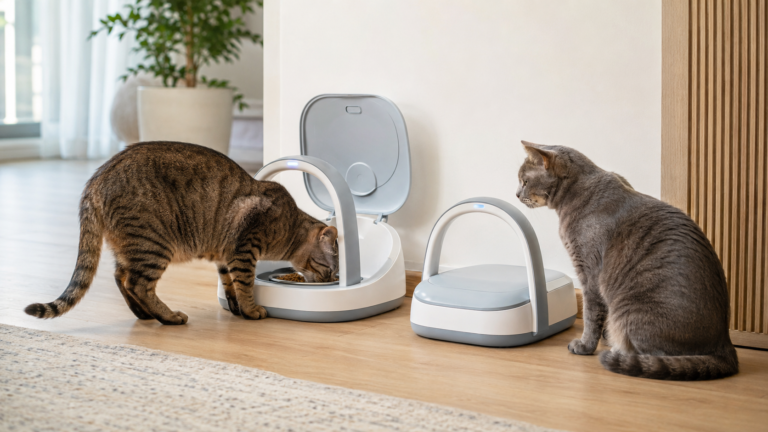
In multi-pet homes, a standard open feeder may not prevent one pet from eating another’s food. If individual access matters, look for a feeder specifically designed to control access for particular pets.
For households with two or more cats, our guide to automatic pet feeders for multiple cats explains when dual-bowl, separate, microchip, or RFID-controlled setups are more appropriate.
Also consider stability and power reliability. A secure lid, sturdy construction, appropriate placement, and a suitable backup-power option can be more valuable in some households than additional smart features.
If connectivity is also a concern, check how the feeder behaves offline before buying; our guide explains how automatic pet feeders work without Wi-Fi.
6. Ease of Cleaning
Automatic feeders come into regular contact with pet food, so ease of cleaning should be an important part of your decision.
Look for removable bowls and accessible food-contact components that can be cleaned without complicated disassembly. If a manufacturer describes certain parts as dishwasher-safe, check exactly which components that guidance applies to.
Pay particular attention to areas where crumbs, food residue, or moisture can collect, including the bowl, dispensing outlet, and food-storage components.
Always follow the manufacturer’s cleaning instructions, especially for electronic parts that shouldn’t be immersed in water. A feeder that’s straightforward to clean is generally easier to maintain as part of your pet’s regular feeding routine.
Before choosing a feeder, consider how easily its bowl, hopper, dispensing outlet, and other food-contact parts can be maintained; our automatic pet feeder cleaning guide explains what routine cleaning typically involves.
7. Long-Term Reliability
Price matters, but the least expensive feeder isn’t necessarily the best value. A feeder is only useful if it continues to dispense food consistently and remains practical to operate and clean.
When comparing options, look beyond the feature list. For smart feeders, also check what happens if Wi-Fi, internet access, or the manufacturer’s online service becomes unavailable. A useful reliability feature is the ability to keep previously programmed meal schedules stored on the feeder itself, although offline behavior varies by model and should be confirmed with the manufacturer. Check the manufacturer’s warranty and support information, and read recent customer feedback for recurring reports about dispensing problems, jams, programming issues, difficult cleaning, or component failures.
If app-based features matter to you, also consider the manufacturer’s ongoing software support. Check whether important functions require an account, internet connection, subscription, or continued access to the manufacturer’s online service, and confirm which core feeding functions remain available without them.
Pay particular attention to feedback from owners who have used the feeder for several months rather than relying only on first impressions. Patterns across multiple reviews can be more informative than a single unusually positive or negative experience.
When reading reviews, look specifically for evidence about portion consistency, missed meals, recurring jams, offline behavior, ease of cleaning, and performance after several months of use. These practical details are usually more useful than ratings based mainly on setup or first impressions.
Before buying, it can also help to understand the common causes of feeder failures and which problems can usually be corrected through setup, cleaning, or maintenance.
No automatic feeder is completely maintenance-free, so regular cleaning, checking the food supply, inspecting the dispensing mechanism, and following the manufacturer’s care instructions remain important after purchase.
Who Can Benefit from an Automatic Pet Feeder?
An automatic feeder can be useful in many households, particularly when maintaining consistent mealtimes manually is difficult. It may be worth considering for:
- People with busy or changing schedules: Scheduled dispensing can help keep mealtimes consistent when work, appointments, or other commitments interfere with normal feeding times.
- Households where several people share feeding duties: Automation can reduce uncertainty about whether a scheduled meal has already been served.
- Pet owners managing several daily meals: Programmable scheduling can make multiple smaller feedings easier to maintain.
- Owners following a veterinarian-recommended feeding schedule: A suitable feeder may help automate the timing of meals once the appropriate schedule and portions have been established.
- Multi-pet households: Certain feeders can help manage different feeding routines, although individual access requires a model specifically designed for access control.
- Anyone who values a more predictable feeding routine: Even owners who are usually home may find scheduled meal dispensing convenient.
An automatic feeder isn’t necessary for every household. If you’re consistently available at mealtimes and manual feeding works well for you and your pet, automation may offer relatively little benefit. The decision should be based on whether a feeder solves a genuine feeding-routine problem rather than simply adding another connected device to your home.
An automatic feeder may also be the wrong solution when a pet’s feeding needs require close supervision, when changes in appetite need to be monitored carefully, or when the available feeder cannot safely accommodate the pet’s prescribed food or feeding plan. In these situations, convenience should not take priority over appropriate care or veterinary guidance.
Common Buying Mistakes to Avoid
Even a well-reviewed automatic feeder may be a poor fit if it doesn’t match your pet’s food, portions, or feeding routine. Before buying, avoid these common mistakes:
- Choosing based on price alone: A lower price isn’t necessarily better value if the feeder lacks the scheduling, portion, capacity, or reliability you need.
- Ignoring food compatibility: Check the supported food type and, for dry-food models, the manufacturer’s recommended kibble dimensions.
- Assuming a dry-food feeder can handle wet food: Wet food requires a feeder specifically designed for that purpose and should be stored and handled according to the manufacturer’s instructions.
- Choosing the wrong capacity: Consider your pet’s actual food intake and how frequently you’re comfortable refilling the feeder.
- Overlooking cleaning requirements: A feeder with difficult-to-access food-contact areas may be inconvenient to maintain properly.
- Focusing too heavily on smart features: App control, cameras, notifications, and voice features can be useful, but they don’t compensate for unreliable dispensing or poor usability.
- Forgetting about backup power: If power interruptions are a concern, check whether the feeder supports battery backup and what functions remain available when operating on batteries.
Taking a few minutes to check these practical details can help you choose a feeder that fits your pet’s routine rather than one that simply looks impressive on a feature list.
Safety Tips for Using an Automatic Pet Feeder
An automatic feeder can make scheduled feeding more convenient, but it still needs regular checking and proper maintenance. Keep these basic precautions in mind:
- Test a new feeder before relying on it: Observe several scheduled dispensing cycles to make sure the programming, portion settings, and dispensing mechanism work as expected.
- Check food and power regularly: Don’t assume the feeder is operating simply because it has been programmed. Make sure it contains enough food and has a reliable power source or functioning backup batteries, where applicable.
- Keep electrical components dry: Position power cords, adapters, and other electrical parts away from water bowls and other sources of moisture, and follow the manufacturer’s placement instructions.
- Place the feeder on a stable surface: Choose a location where it is less likely to be tipped, pushed, chewed, or otherwise interfered with by pets.
- Clean food-contact parts regularly: Follow the manufacturer’s cleaning instructions and don’t immerse electronic components unless they are specifically designed for it.
- Check stored food: Refill and store food according to the food manufacturer’s and feeder manufacturer’s guidance rather than continually topping up old food without checking its condition. The FDA also recommends storing dry pet food in a cool, dry place and keeping it in its original bag when possible.
- Don’t treat automation as supervision: Continue checking your pet’s appetite, water intake, behavior, and general condition even when meals are dispensed automatically.
- Follow veterinary guidance when needed: If your pet has a medical condition, specific dietary requirements, or a prescribed feeding schedule, discuss automated feeding with your veterinarian before relying on it.
Frequently Asked Questions
How do I choose an automatic feeder for my pet?
Start with your pet’s food type, usual portion size, feeding schedule, eating behavior, and whether other pets can access the food. Then choose the appropriate feeder type and compare models for reliable dispensing, portion accuracy, food compatibility, easy cleaning, suitable capacity, and backup power. Consider Wi-Fi, app control, cameras, or other smart features only when they solve a specific need.
Can automatic pet feeders be used with wet food?
Yes, but only feeders specifically designed to handle wet food should be used for that purpose. Many hopper-style automatic feeders are intended primarily for dry kibble. If your pet eats wet food, check the manufacturer’s instructions for food compatibility, storage, cooling where applicable, cleaning, and safe use.
How many meals can an automatic pet feeder schedule per day?
It depends on the model. Different feeders support different numbers of scheduled meals, portion settings, and programming options. Before buying, check that the feeder can accommodate your pet’s existing feeding schedule, particularly if your pet receives several smaller meals throughout the day.
Will an automatic pet feeder work during a power outage?
Some models can continue scheduled dispensing using backup batteries, while others depend on their main power source. If power interruptions are a concern, check whether the feeder supports battery backup and which functions remain available while it is operating on backup power.
Can I leave my pet alone because I have an automatic feeder?
An automatic feeder can dispense scheduled meals when you’re away, but it shouldn’t be treated as a substitute for appropriate supervision and daily care. Your pet still needs access to fresh water, a safe environment, interaction and care appropriate to the length of your absence, as well as someone who can respond if the feeder fails or your pet becomes unwell.
Can an automatic feeder help with portion control?
Yes. A suitable feeder can help dispense more consistent portions than estimating each serving manually. However, the feeder doesn’t determine how much food your pet should receive. The programmed portions still need to match an appropriate feeding plan for your pet, with veterinary guidance where needed.
Final Recap
The right automatic pet feeder starts with your pet’s needs, not the longest feature list. Identify the food type, feeding behavior, portion requirements, schedule, and multi-pet access needs first. Then choose the appropriate feeder type and compare models for dispensing reliability, food compatibility, cleaning, backup power, and offline behavior. Smart features should come afterward, when they solve a specific problem.
Smart features such as app control, notifications, cameras, or voice functions can add convenience, but they’re most valuable when they solve a genuine need rather than distract from the feeder’s core job.
An automatic feeder can make scheduled meals easier to manage, but it still requires regular cleaning, refilling, checking, and appropriate daily care. For pets with medical conditions or specific dietary requirements, feeding decisions should continue to follow veterinary guidance.
Once you know which features matter for your pet, you can compare suitable models in our Best Automatic Pet Feeders guide to see how different options match those priorities.