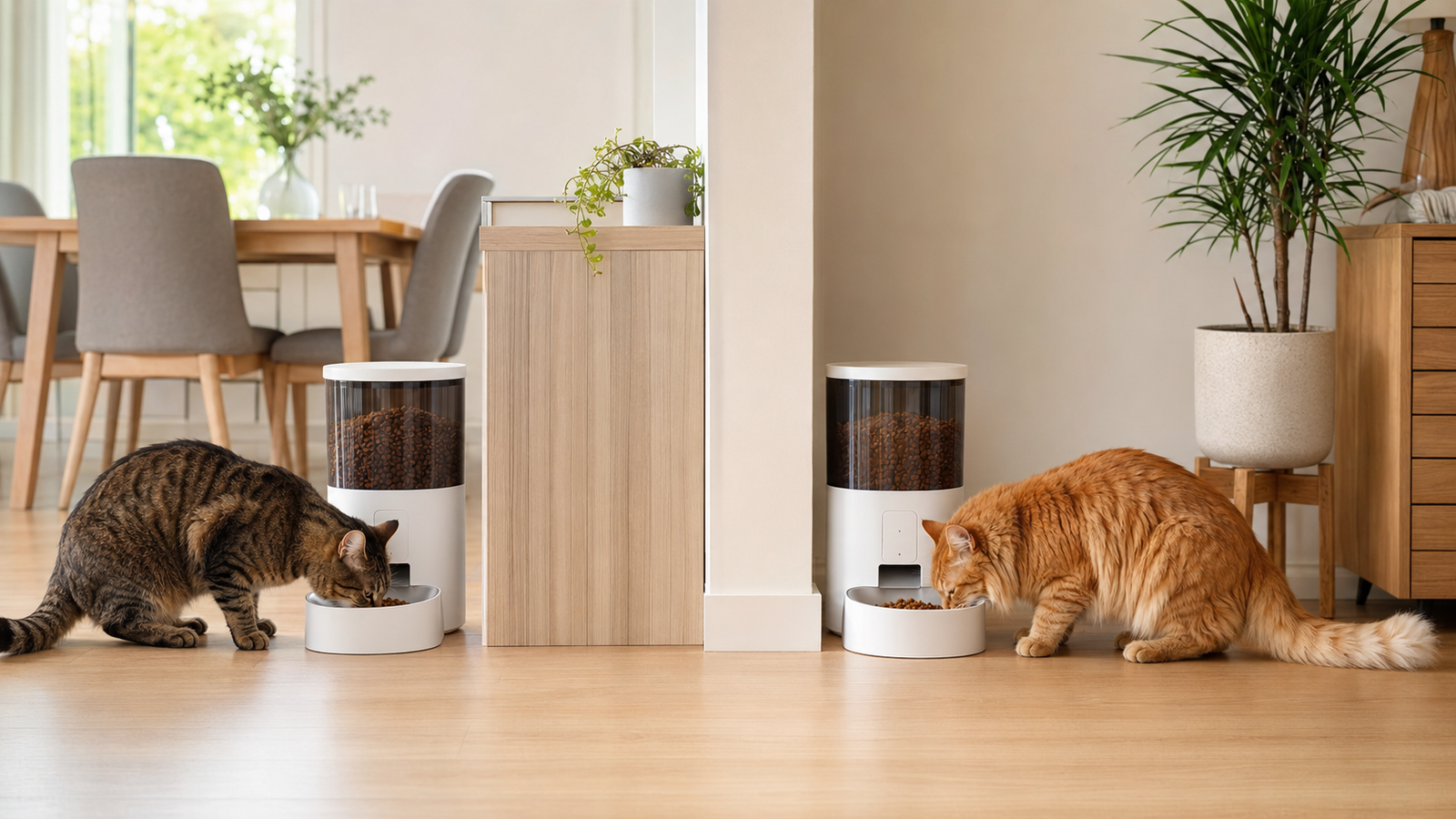
Choosing between automatic pet feeders for multiple cats becomes easier when you compare portion control, individual access, and food-stealing prevention separately. Feeding two or more cats can become surprisingly complicated. One cat may finish every meal in seconds, another may prefer to graze, and a third may need a different food or portion. When the bowls are left unprotected, the fastest or most confident cat can eat more than intended while a quieter cat receives too little.
An automatic feeder can help, but choosing a model with two bowls does not automatically solve food stealing. Some feeders divide food between bowls, while others control which cat is allowed to reach a meal. Understanding that difference is the key to creating a calmer, safer feeding routine.
This guide explains how to use automatic pet feeders for multiple cats, when separate feeders are necessary, and how to prevent one cat from eating another cat’s food.
Important: An automatic feeder can support a feeding plan, but it cannot diagnose appetite changes or determine the correct diet for an individual cat. Ask your veterinarian for guidance if a cat needs a prescription diet, weight-loss plan or medically controlled portion.
Quick Answer: How Do Automatic Pet Feeders for Multiple Cats Work Best?
The best automatic-feeder setup for multiple cats depends on whether the cats can safely share food. One dual-bowl feeder may work for cats eating the same diet and similar portions without competition. Use separate timed feeders when individual portions or schedules differ, and use physical separation or microchip- or RFID-controlled access when one cat steals food or needs a protected diet.
- A dual-bowl automatic feeder may work when both cats eat the same food, need similar portions, and reliably stay at their own bowls.
- Separate timed feeders offer better portion control, but they will not stop food stealing if every cat can reach every bowl.
- Microchip or RFID feeders are usually more suitable when cats need different diets or one cat repeatedly steals food.
- Separate rooms or feeding zones can be an effective low-technology solution when cats finish scheduled meals within a reasonable time.
A simple rule is: match the feeder to the problem. If two cats eat the same food and share peacefully, a dual-bowl feeder may be enough. If they need different portions, use separate programmable feeders. If one cat steals food, grazes slowly, or needs a protected diet, use individual access control or physical separation.
In many multi-cat homes, one feeder per cat—or one access-controlled bowl per cat—is the most dependable arrangement. However, some compatible cats can share a simpler setup successfully.
Key Takeaways
- A dual-bowl feeder divides food but usually cannot control which cat eats it.
- Separate timed feeders manage portions, but physical separation may still be necessary.
- Microchip and RFID feeders use different identification methods; check the model before buying.
- Feeder placement, visual separation, and a safe exit route can reduce mealtime pressure.
- Measure real feeder output and confirm which cat actually eats each meal.
Why Feeding Multiple Cats Can Be Difficult
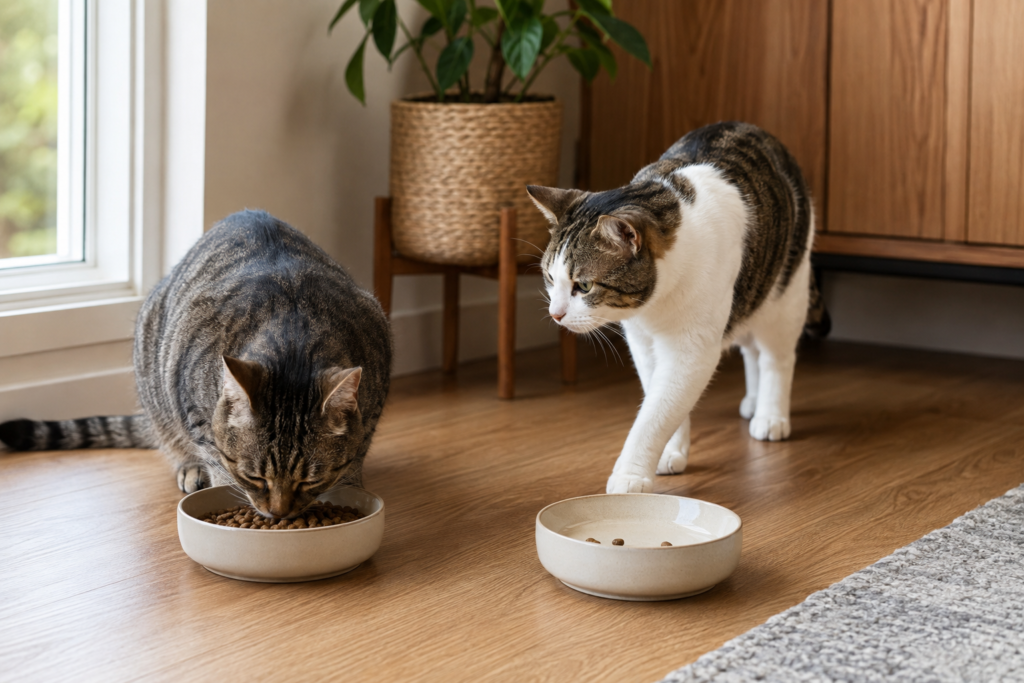
Cats living together do not necessarily have the same eating style. Even cats of a similar age and size may differ in appetite, confidence, activity level, and preferred meal pattern.
Common multi-cat feeding problems include:
- One cat finishing quickly and moving to another bowl
- A timid cat leaving when another cat approaches
- One cat grazing while another eats everything immediately
- Cats requiring different foods or portion sizes
- A kitten reaching an adult or senior cat’s food
- A dog stealing food from the cats
- Uncertainty about which cat ate a dispensed meal
- Competition or tension around a shared feeding station
Food stealing is not always obvious. A more assertive cat may simply stand nearby, stare, or approach while the other cat quietly moves away. Owners may see an empty bowl and assume the intended cat ate the meal.
The Feline Veterinary Medical Association’s feeding guidance supports feeding programs that account for cats’ behavioral needs, including multiple feeding stations and, in some situations, automatic feeders. The organization, formerly known as the American Association of Feline Practitioners, also emphasizes separate resources and territories in its environmental-needs guidance to help reduce tension in multi-cat households.
Can Two Cats Share One Automatic Cat Feeder?
An automatic cat feeder for two cats can work well when both cats eat the same food, need compatible portions, and share without competition. However, two bowls do not guarantee separate feeding: if either cat steals food, grazes slowly, or needs a different portion or diet, separate feeders or individual access control are usually more reliable.
Sharing is more likely to work when:
- Both cats eat the same food
- Their daily portions are similar
- They comfortably eat near each other
- Neither cat guards the feeder
- Both finish their scheduled meals at a similar pace
- You can regularly confirm how much each cat actually eats
Sharing is less suitable when:
- One cat routinely eats from both bowls
- One cat is overweight or underweight
- A cat needs prescription or age-specific food
- One cat grazes over several hours
- A timid cat avoids the feeding area
- There is hissing, blocking, chasing, or food guarding
- You cannot tell which cat consumed the meal
If one cat is consistently gaining weight while another is losing weight or leaving food behind, the shared arrangement is not providing reliable individual feeding—even if the feeder itself dispenses accurately.
For three or more cats, do not assume that a larger hopper or additional bowls will solve the problem. Consider whether each cat needs its own portion, diet, feeding location, or access control, and use multiple feeding stations when one shared station cannot provide reliable individual access.
As the number of cats increases, plan the feeding system around individual access rather than feeder capacity: multiple stations, adequate spacing, protected diets where needed, and a practical way to confirm each cat’s intake become more important than simply choosing a feeder with more bowls.
Dual-Bowl Feeders Do Not Automatically Prevent Food Stealing
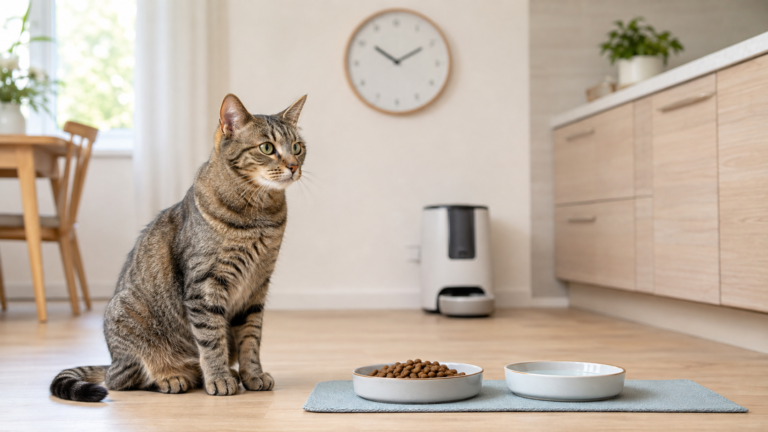
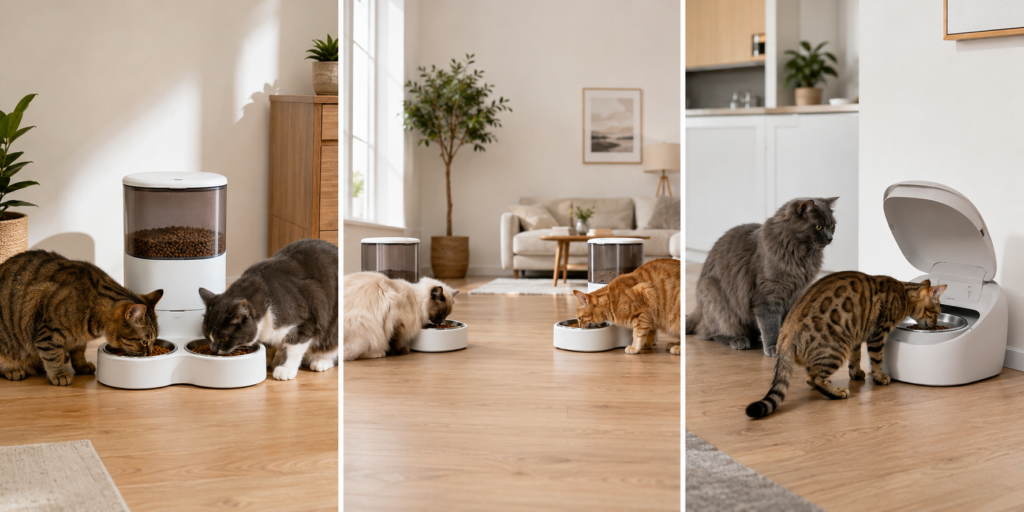
A dual-bowl automatic feeder generally uses one food container and a splitter that directs kibble into two bowls. This can make simultaneous feeding more convenient, but both bowls usually remain open to both cats.
The device may divide the dispensed food, yet it cannot ensure that each cat eats exactly half. Equal food in two bowls is not the same as equal food consumed by two cats; one cat may finish its own portion and then eat from the second bowl. Kibble may also fall unevenly, particularly if the splitter or feeder is not level. More importantly, a fast eater can finish one bowl and move directly to the other.
A dual-bowl feeder is therefore a convenience tool—not an individual access-control system.
It may be reasonable for cats that already share peacefully, but it should not be relied upon for prescription diets, strict weight management, or established food stealing.
Comparing Multi-Cat Automatic-Feeding Arrangements
| Feeding arrangement | Individual portions | Stops food stealing? | Best suited to | Main limitation |
|---|---|---|---|---|
| One feeder with two bowls | Food may be divided, but individual intake is not guaranteed | Usually no | Compatible cats eating the same food | Either cat can reach both bowls |
| Separate timed feeders | Yes | Not without separation | Cats following different schedules or portions | A cat may visit another feeder |
| Microchip-controlled bowl | Depends on the model and how food is loaded | Yes, when correctly configured | Different diets, grazing, and food theft | May not dispense food on a schedule |
| RFID collar-tag feeder | Usually | Yes, while the correct tag is worn | Scheduled, controlled access | Requires the assigned collar tag |
| Recognition-based smart feeder | Depends on the model | Potentially | Households wanting individual records | Recognition performance and features vary |
| Separate-room scheduled feeding | Yes | Yes, while access is controlled | Cats that finish meals at set times | Requires space and routine management |
Once you know whether your cats need a shared feeder, separate timed feeders, or selective access, compare specific models in our guide to the best automatic cat feeders for multiple cats. It explains which feeders support scheduled meals, microchip/RFID access, wet food, and camera monitoring—and which features do not prevent food stealing.
Microchip, RFID and Recognition-Based Feeders: What Is the Difference?
These terms are sometimes used as though they mean the same thing, but the access methods differ.
Microchip-controlled feeders
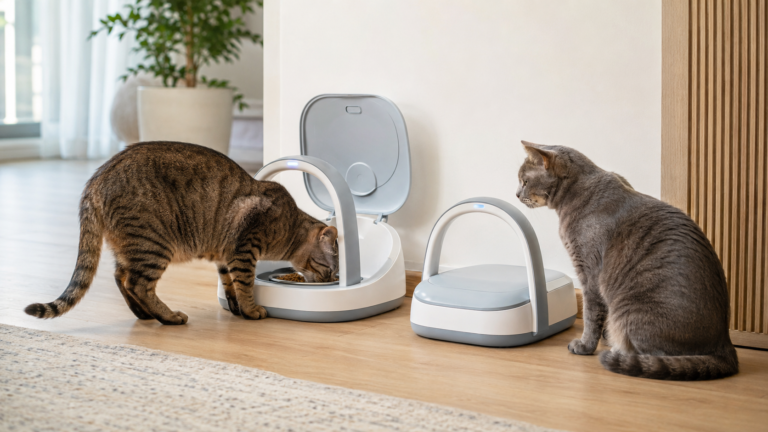
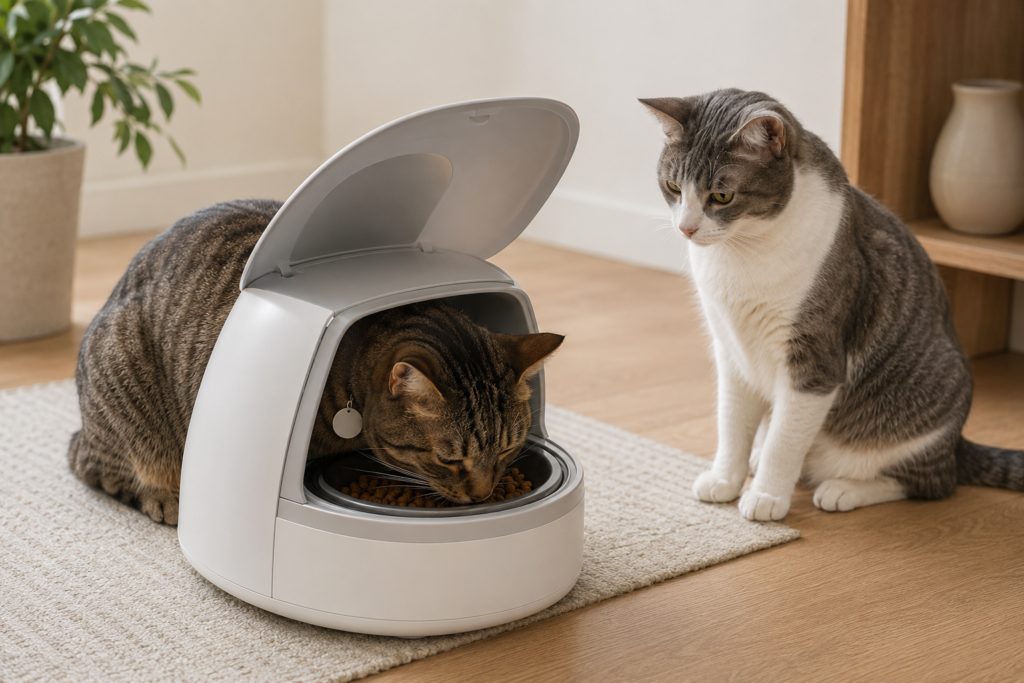
A microchip feeder reads a compatible identification microchip already implanted in the cat, or sometimes a manufacturer-supplied collar tag. The lid opens for a registered cat and closes when that cat moves away.
For example, the official SureFeed Microchip Pet Feeder information describes a covered bowl that opens for a programmed microchip or compatible collar tag. This type of feeder can protect wet or dry food from other pets, but a basic microchip bowl may not automatically dispense measured meals from a hopper.
A microchip feeder for multiple cats is particularly useful when one cat needs protected access to food, although households where several cats need individually protected meals may require a separate access-controlled feeder for each cat.
For a deeper explanation of access control, see our guide to how microchip feeders for cats work.
RFID collar-tag feeders
An RFID feeder recognizes a tag worn on the cat’s collar. Some models combine access control with scheduled dispensing and app-based feeding records. The PETLIBRO One RFID Smart Feeder, for example, uses an assigned collar tag rather than reading an implanted microchip.
This distinction matters. A product described as an “RFID feeder” should not automatically be assumed to read the cat’s implanted microchip.
Recognition-based smart feeders
Some newer feeders use cameras or other sensing technology to identify an approaching pet. These systems may offer individual feeding records or restrict bowl access, but recognition methods and reliability differ between models.
Before purchasing any access-controlled feeder, verify:
- Whether it reads implanted microchips, a proprietary collar tag, or camera-based recognition
- How many pets can be registered
- Whether food is dispensed automatically or only protected after manual filling
- Whether another cat can approach from the side or rear while the lid is open
- What happens during a power, battery, Wi-Fi, or recognition failure
- Whether feeding records show food dispensed, food remaining, or food actually eaten
How to Set Up Automatic Feeders for Multiple Cats
Setting up automatic feeders for multiple cats requires more than programming meal times; each cat also needs dependable access to its assigned food.
1. Identify each cat’s feeding needs
Write down the food type, daily quantity, normal eating speed, and usual meal times for each cat. Note whether the cat finishes meals immediately or returns to the bowl throughout the day.
Do not assume equal-sized cats need identical portions. Age, activity, health, body condition, and the energy density of the food can all affect feeding needs. Follow veterinary advice and the feeding plan established for each cat.
2. Choose the appropriate level of control
Use the least complicated arrangement that reliably protects every cat’s meal.
- Peaceful cats eating the same diet may manage with a dual-bowl feeder.
- Cats needing different portions or feeding schedules usually need separate timed feeders, because a shared dual-bowl feeder cannot guarantee how much each cat actually consumes.
- Persistent food stealing or grazing often calls for individual access control.
- Cats eating prescription or medically restricted diets may need a microchip, RFID, or physically separated setup.
If you are uncertain, begin with separate feeding stations and supervise the cats before investing in a more complex system.
3. Create separate feeding locations
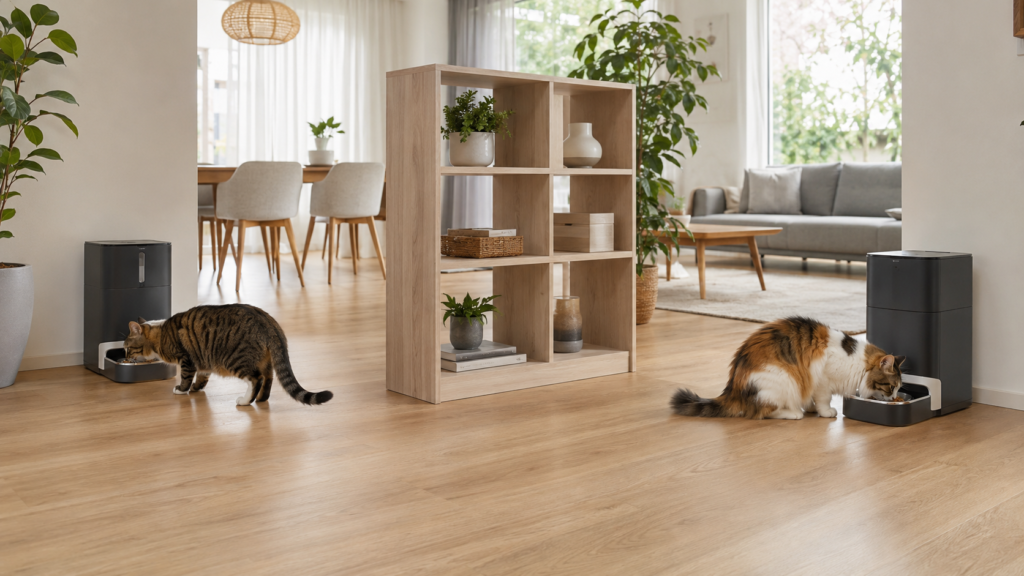
Do not automatically place several feeders side by side. Physical distance and visual separation can reduce staring, crowding, and pressure around meals.
Depending on your home and your cats’ relationships, suitable locations may include different sides of a room, separate rooms, different levels, or stations divided by furniture. Every cat should be able to approach, eat, and leave without passing a cat that regularly blocks or chases it.
Keep feeders away from litter boxes and busy areas. Position them on stable, level surfaces so portions fall consistently and the units cannot easily be pushed over.
4. Introduce one change at a time
Cats may hesitate around a new feeder because of its sound, moving lid, or unfamiliar shape. Allow each cat to investigate its own feeder while it is inactive. Place familiar food in the bowl, reward calm approaches, and gradually introduce movement or dispensing.
Do not force a nervous cat’s head toward an access-controlled lid. A gradual transition is safer and more likely to create a lasting routine. Our guide on how to train your cat to use an automatic feeder explains the introduction process in more detail.
5. Test recognition and physical access
For a microchip or RFID system, confirm that the intended cat can open the feeder from a normal eating position. Then observe what happens when another cat approaches.
Check whether:
- The lid closes at an appropriate speed
- A second cat can reach the food from behind or beside the registered cat
- The feeder moves when a cat paws at it
- The collar tag stays in the correct position
- The access settings remain stored after a battery change or power interruption
Some determined cats learn to follow closely or reach around another cat. Accessories, wall positioning, or a different station layout may be needed, but any enclosure must allow the authorized cat to enter and leave comfortably.
6. Program and measure portions carefully
Do not rely solely on a feeder’s numbered “portion” setting because that number may not represent a standard tablespoon, cup, or weight. Kibble size and shape can change how much the mechanism releases.
Run several test dispensings into an empty bowl and weigh the output on a kitchen scale. Calculate the total dispensed across the day, then compare it with the cat’s feeding plan. Our automatic-feeder schedule guide provides a practical method for checking meal timing and output.
For more precise portion testing, see our guide to how accurate automatic pet feeders are and how to measure their actual output.
Recheck the amount when changing food because a different kibble may dispense differently.
7. Supervise the complete routine
Observe several meals rather than watching only the first successful opening. Cats may behave differently when you leave the room or after becoming familiar with the device.
Confirm that:
- Each cat approaches its assigned station willingly
- The intended cat receives the meal
- No cat waits nearby to intimidate another
- A slow eater has enough time to finish
- Food is not being pulled or knocked from the protected bowl
- The feeder operates at every programmed time
- If several cats depend on one shared feeder, have a backup feeding plan in case that single unit jams, loses power, or fails to dispense.
A small home camera may help reveal food stealing, but direct checks of the cats’ bowls and feeder remain important.
8. Monitor appetite, weight, and behavior
Automatic feeding should make individual monitoring easier—not replace it. Check bowls daily, clean the food-contact parts as directed, and weigh cats at suitable intervals recommended by your veterinarian.
In a multi-cat home, individual feeding can also make appetite changes easier to detect because you can see which cat is eating less, rather than finding an empty shared bowl without knowing who consumed the food.
Pay attention to changes such as:
- A cat suddenly eating much more or less
- Unexplained weight loss or gain
- Vomiting or repeated regurgitation
- Increased thirst
- Difficulty chewing
- Reluctance to approach the feeder
- New guarding, chasing, or hiding
An empty feeder bowl does not prove that the assigned cat ate the meal. If appetite or weight changes unexpectedly, seek veterinary advice rather than only adjusting the feeder.
Managing Common Multi-Cat Feeding Situations
One cat eats quickly while another grazes
This is one of the strongest reasons to use individual access control. A timed meal may limit when food appears, but it does not protect the slow cat’s leftovers after the fast cat finishes.
A microchip-controlled bowl can allow the grazing cat to return while keeping the other cat out. Alternatively, feed the fast eater in a separate room and remove bowls after a supervised meal if both cats can adapt to scheduled feeding.
Cats need different foods
Kittens, adults, and senior cats may have different diets. Cats may also require weight-management, allergy-related, or prescription food. A shared open bowl cannot reliably ensure that the right cat eats the right food.
Use individual protected bowls or separate rooms, and follow the veterinarian’s instructions. Avoid making sudden dietary or portion changes simply to make the automatic-feeder setup more convenient.
One cat needs to lose weight
Automatic portioning can support a veterinarian-directed weight-management plan, but only if the cat cannot obtain calories from other bowls. Individual-access systems can be useful in this situation. A published feline study found that an individualized automatic-feeder system supported controlled food access and automated portioning within a structured weight-loss program.
Weight loss in cats must be gradual and professionally guided. Do not sharply restrict food or allow a dieting cat to go without eating.
A timid cat is being displaced
Do not focus only on protecting the food. The timid cat also needs a route to the feeding station where it does not feel watched or trapped. Increase the distance between stations, add a visual barrier, and avoid narrow corners with only one exit.
If the other cat still follows, blocks, or intimidates the timid cat, move to stronger separation—such as feeding in different rooms with the door closed or using individual access-controlled feeders.
If tension continues outside mealtimes, seek advice from a veterinarian or qualified feline behavior professional.
A dog steals the cat food
An access-controlled bowl may keep a dog from reaching the cat’s meal. Another option is a cat-only feeding area that the dog cannot enter, provided it remains comfortable and accessible for the cat.
Elevating food may work for some agile adult cats, but it is unsuitable for cats with mobility limitations and does not provide dependable individual access when several cats can reach the same location.
Cats eat wet and dry food
Check whether the feeder is designed for the relevant food type. Hopper-style dispensers generally handle compatible dry kibble, whereas wet food requires a suitable compartment or protected-bowl design and careful temperature management.
Our guide on using wet food in an automatic pet feeder covers food safety, storage, and setup considerations in detail.
Common Mistakes to Avoid
Assuming two bowls guarantee equal feeding
A splitter may distribute kibble into two bowls, but it cannot control which cat consumes it. Observe the cats instead of judging success by the number of bowls.
Placing every feeder together
Close placement may recreate the competition you were trying to solve. Separate feeding locations can be as important as the feeder technology.
Changing the feeder, food, and schedule at the same time
Too many simultaneous changes make it difficult to identify why a cat stops eating. Introduce equipment gradually and keep the familiar food and routine where possible.
Trusting app notifications without checking
A “meal dispensed” notice normally confirms a device action, not that the intended cat ate the food. Inspect the bowl and monitor each cat.
Ignoring power and battery behavior
Test backup power where provided and learn what the feeder does if Wi-Fi fails. Some schedules run locally, while other functions may depend on connectivity. Model-specific behavior should be confirmed in the official manual.
For outage planning, see our guide to how automatic pet feeders work without Wi-Fi.
Using automation to manage a medical problem without guidance
Technology may support a veterinary plan, but it should not replace diagnosis, appropriate food selection, or follow-up weight checks.
When Should You Contact a Veterinarian?
Contact your veterinarian if a cat:
- Stops eating or eats substantially less than normal
- Loses or gains weight unexpectedly
- Requires a prescription or therapeutic diet
- Regularly vomits, regurgitates, or has diarrhea
- Shows difficulty chewing or swallowing
- Drinks or urinates noticeably more
- Becomes unusually aggressive, withdrawn, or fearful around food
These changes may indicate more than a feeder-setting problem. Cats should not be placed on an aggressive weight-loss plan or left without adequate food while owners experiment with a new arrangement.
Frequently Asked Questions
Do I need one automatic feeder for each cat?
Not always—the deciding factor is whether each cat can reliably receive its own food and portion without another cat interfering. Use separate feeders when cats need different portions or schedules, and consider microchip or RFID access when one cat steals food, grazes slowly, or needs a protected diet. If both cats require individually protected meals, one access-controlled feeder per cat may be necessary.
Can two cats use the same automatic feeder?
Yes, but sharing works only when both cats receive enough food without competition. Supervise several meals and monitor each cat’s weight. If one cat takes more than its share, use separate feeding stations or access-controlled feeders.
How Do Automatic Pet Feeders Stop One Cat From Eating Another Cat’s Food?
Feed the cats in separate rooms, use supervised scheduled meals, or protect each meal with a microchip or RFID feeder. Increasing the distance between feeding stations may reduce pressure, but distance alone will not stop a determined cat that can still reach the other bowl.
What type of automatic cat feeder is best for two cats?
For two cats that eat the same food and share peacefully, a dual-bowl automatic feeder may be sufficient. If they need different portions or schedules, separate timed feeders provide better control. If one cat steals food or needs a protected diet, a microchip- or RFID-controlled feeder is usually more appropriate than an open dual-bowl model.
Is an RFID feeder the same as a microchip feeder?
Not necessarily. Some feeders recognize an implanted identification microchip, while others require a proprietary RFID collar tag. Check the manufacturer’s specifications instead of relying only on the product name.
Can automatic feeders give different portions to different cats?
Separate programmable feeders can dispense different quantities. Some access-controlled smart systems also combine individual recognition with scheduled portions. A shared, open dual-bowl feeder generally cannot guarantee how much each cat consumes.
Where should I place automatic feeders in a multi-cat home?
Use quiet, stable locations where cats can approach and leave without being blocked. Avoid placing all feeders directly beside one another if the cats show tension. Different rooms, opposite sides of a room, or visually separated stations may work better.
What if one cat is afraid of the automatic feeder?
Turn off automatic movement initially and let the cat eat familiar food from the inactive bowl. Introduce sounds and moving parts gradually, using calm encouragement and positive reinforcement. Never withhold food to force a frightened cat to approach the device.
Final Thoughts
Automatic pet feeders for multiple cats work best when the technology matches the actual household problem. A dual-bowl feeder may simplify meals for cats that already share well, but it does not provide individual access. Separate timed feeders improve portion control, while microchip or RFID systems can protect meals from food stealing.
Whatever arrangement you choose, create separate and comfortable feeding locations, measure the real output, introduce the equipment gradually, and observe which cat actually eats each meal. The goal is not merely to automate food delivery—it is to ensure every cat receives the correct food in a calm, dependable routine.