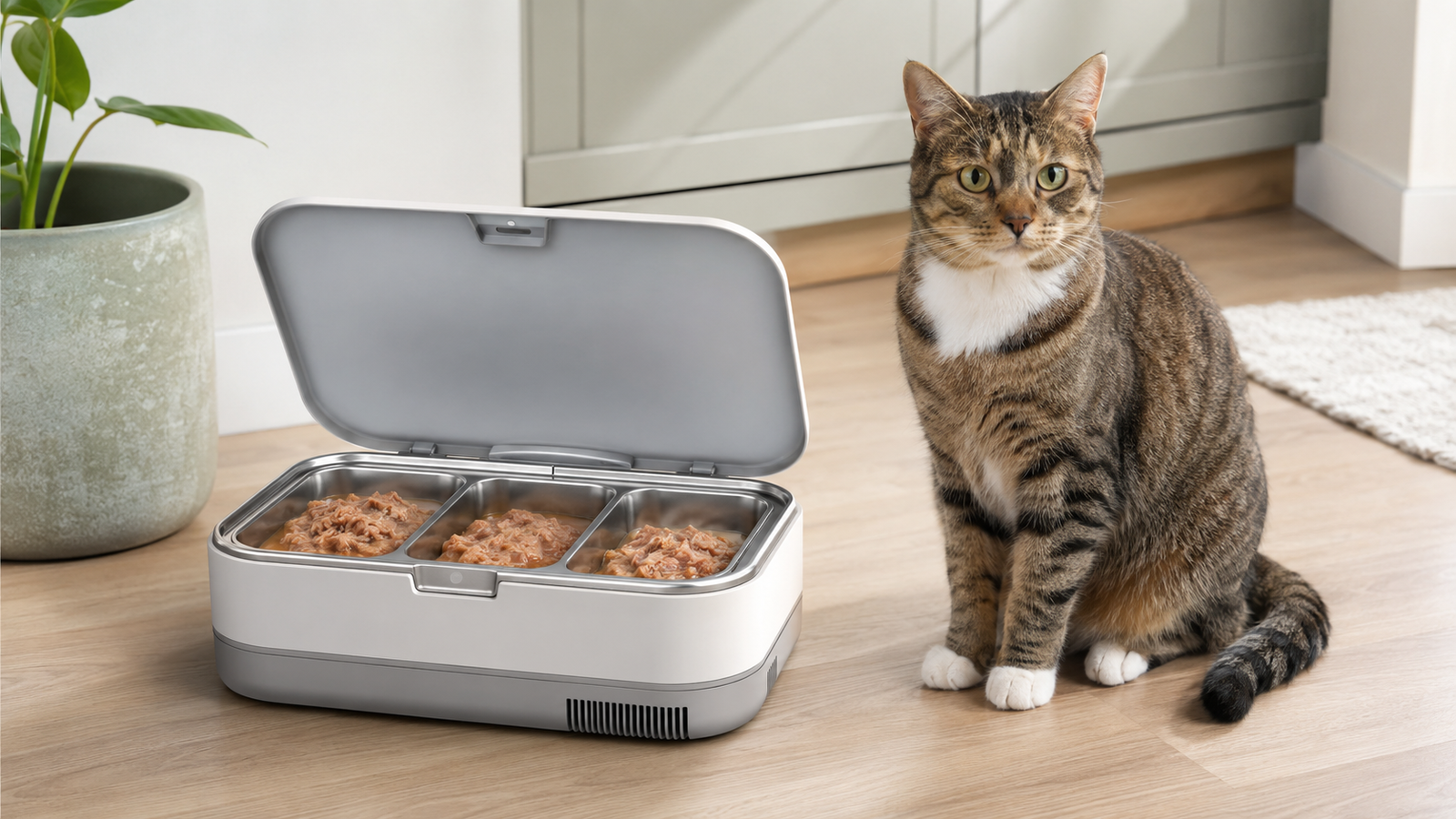
Can you put wet food in an automatic feeder? Yes—but only if the feeder is specifically designed for wet or moist food and you follow its cooling, storage, and cleaning instructions.
Standard hopper-style automatic feeders are usually made for dry kibble. Wet food can stick inside their dispensing mechanisms, block the chute, and spoil when it is not kept at a suitable temperature. An automatic wet food feeder designed for moist meals avoids these problems by using covered meal compartments, frozen ice packs, or powered cooling instead of a dry-food hopper.
The correct setup depends on the feeder design, room temperature, meal schedule, and manufacturer instructions. Even with an automatic feeder, you should continue checking whether your cat ate normally and whether leftovers remained safe.
Quick Answer
You can put wet cat food in an automatic feeder only when the manufacturer identifies the model as wet-food compatible. Covered timed trays can limit exposure, ice-pack feeders provide temporary cooling, and refrigerated feeders use powered cooling for longer storage under specified conditions.
Do not place canned, fresh, raw, or rehydrated food in an ordinary dry-food hopper. Do not assume that a lid alone refrigerates food, and do not apply one model’s advertised storage time to a different feeder.
Key Takeaways
- Use wet food only in a feeder specifically designed for it.
- A covered tray is not the same as a refrigerated feeder.
- Ice-pack performance changes with room temperature and how fully the packs were frozen.
- Powered cooling may permit longer storage, but its limits are model-specific.
- There is no single safe holding time for every feeder and environment.
- Test the feeder and its cooling system while you are home.
- Wash and fully dry food-contact parts after moist meals.
- Check leftovers because appetite changes can be easy to miss with automated feeding.
- An automatic wet-food feeder cannot replace a responsible caregiver during a longer absence.
Can You Put Wet Food in an Automatic Feeder?
Yes, but the right automatic cat feeder for wet food depends on how the feeder stores, cools, and presents each meal.
Wet food can be used in automatic feeders with individual meal compartments designed for canned or moist food. Depending on the product, the compartments may remain covered until a timer opens them, sit above frozen ice packs, or be held inside a powered cooling chamber.
Most upright hopper feeders are different. They store loose kibble above a motorized wheel or conveyor, which releases food through a narrow chute. Moist food is not free-flowing, so it can coat or obstruct the mechanism. A standard hopper also lacks the temperature control needed for perishable meals.
Check the manual or official product page for the exact model. Product appearance is not enough: a feeder may have a lid or sealed-looking tray without providing active cooling.
If you are still comparing feeder designs, our guide on how to choose the right automatic pet feeder explains the broader features worth checking before purchase.
Why Ordinary Dry-Food Feeders Cannot Handle Wet Food
Putting wet food into a dry-food hopper can cause several problems.
The Food May Not Dispense
Dry-feeder mechanisms depend on kibble falling and moving through an outlet. Pâté, shredded food, gravy, and rehydrated meals can stick to the hopper, rotor, or chute instead of dropping into the bowl.
Residue Can Collect Inside the Mechanism
Moist food can enter gaps that are difficult or unsafe to wash. Residue left near a motor, sensor, or non-removable chute creates a hygiene problem and may damage the feeder.
The Feeder Does Not Control Temperature
A dry-food hopper is intended to keep kibble enclosed, not chilled. A sealed lid may reduce air exposure, but it does not turn the storage compartment into a refrigerator.
Moisture Can Affect Electronics
Liquids and condensation may reach parts that were never designed for wet food. This can interfere with sensors, motors, or electronic controls.
If you accidentally load an incompatible feeder, unplug it, remove the food, and follow the manufacturer’s cleaning instructions. Do not immerse the electronic base or restart the feeder until approved components are clean and completely dry.
Three Types of Automatic Wet-Food Feeders
1. Covered Timed Trays
A covered timed feeder stores food in one or more compartments. At the programmed time, a lid opens or a rotating tray moves the selected meal into an accessible position.
This design protects unopened portions from pets and reduces exposure to the room, but the cover alone does not actively cool the food. Its appropriate holding time depends on starting temperature, room conditions, and manufacturer instructions.
2. Ice-Pack Feeders
An ice-pack feeder places one or more frozen packs beneath or around the meal tray. The packs absorb heat and help keep the food cooler for a limited period.
The official Closer Pets Cat Mate C500 is an example of a compartment feeder supplied with twin ice packs and identified by the manufacturer as suitable for wet food.
Ice packs are a passive cooling system, not continuous refrigeration. Their performance depends on:
- How long they were frozen
- Their size and condition
- Room temperature
- Direct sunlight
- Feeder placement
- Quantity and starting temperature of the food
- How often the feeder is opened
An ice-pack feeder can be useful for delayed meals, but it should be tested in the room where it will operate.
3. Refrigerated Feeders
A refrigerated wet-food feeder uses powered cooling rather than frozen packs. It may hold several prepared meals and warm or uncover one compartment shortly before serving.
For example, Petlibro states that its Polar wet-food feeder can preserve wet food for up to 72 hours under the product’s specified operating conditions. The company also advises against using raw food in that model. These are manufacturer claims for the Polar—not universal limits for every refrigerated feeder.
Do not assume that every product marketed as a refrigerated or actively cooled feeder maintains the same temperature as a household refrigerator. Check the manufacturer’s stated operating temperatures and storage conditions for the exact model rather than relying on the word “refrigerated” alone.
Powered cooling may provide more consistent temperature management, but it introduces other considerations:
- Dependence on electricity
- Cooling time after loading
- Operating-temperature limits
- App or schedule settings
- Power-failure response
- Condensation and cleaning
- Maximum storage period specified by the manufacturer
In simple terms, choose a covered timed tray when you mainly need scheduled access, an ice-pack feeder when temporary passive cooling suits your meal schedule, and a refrigerated feeder when you need powered cooling within the manufacturer’s specified storage conditions.
Covered, Ice-Pack and Refrigerated Feeders Compared
No category is automatically appropriate for every household. Choose according to your cat’s diet, the delay before each meal, local room conditions, and how reliably you can monitor the feeder.
How Long Can Wet Food Stay in an Automatic Feeder?
There is no universal answer that applies to every feeder. When people ask, “Can you put wet food in an automatic feeder?” safe holding time is usually their main concern.
The FDA’s pet-food storage guidance advises owners to promptly refrigerate or discard unused canned or pouched pet food and to keep refrigerators at 40°F/4°C or below. It also recommends washing and drying pet food bowls and utensils after use.
The practical takeaway is simple: unless a feeder provides a manufacturer-approved cooling method that keeps wet food within its specified storage conditions, don’t treat the feeder as refrigerated storage.
Distinguish storage time from serving time. A feeder may keep an unopened meal compartment within its specified cooling conditions before mealtime, but those conditions can change once the compartment opens and the food becomes accessible. After serving, follow the feeder manufacturer’s instructions and appropriate food-storage guidance rather than assuming the model’s maximum storage claim also applies to an opened, partially eaten meal.
VCA guidance on feeding kittens notes that canned food should not generally be left out for more than approximately one to two hours. That guidance concerns food exposed without dependable temperature control; it is not a guaranteed storage limit for every cooled feeder.
The appropriate holding period depends on:
- Whether the feeder provides active cooling
- Actual temperature around the food
- Starting temperature of the meal
- Room temperature and humidity
- Exposure to sunlight or heat-producing appliances
- Feeder construction
- Manufacturer instructions
Do not rely on appearance or smell alone to decide that wet food is safe. When cooling performance is uncertain, discard the food rather than taking a risk.
How Room Temperature Affects Wet-Food Safety
A feeder placed in a cool, shaded room may behave differently from the same feeder near a sunny window, radiator, or warm kitchen appliance.
Higher ambient temperatures cause ice packs to warm more quickly and make powered cooling systems work harder. Direct sunlight can heat the feeder even when the surrounding room feels comfortable.
Place a wet-food feeder:
- Indoors in a stable environment
- Away from direct sunlight
- Away from radiators, ovens, and heating vents
- On a level, dry surface
- Where air can circulate according to the manual
- Away from water bowls if splashing could reach electrical parts
Never cover ventilation openings on a refrigerated feeder. Follow any minimum clearance or operating-temperature requirements supplied by the manufacturer.
How to Set Up an Automatic Wet-Food Feeder Safely
Step 1: Confirm Food Compatibility
Read the manual and product label. Confirm whether the model accepts canned, moist, fresh, rehydrated, or raw food. These terms are not interchangeable, and approval for wet food does not automatically mean approval for raw food.
Step 2: Wash Approved Components
Before first use, wash the removable tray, bowl, lid insert, or other approved food-contact parts. Do not immerse the electronic base. Rinse and dry all components completely before reassembly.
Step 3: Prepare the Cooling System
For an ice pack feeder, freeze the packs for the period stated by the manufacturer. Check for cracks or leaks before placing them beneath the tray.
For a refrigerated feeder, allow any required pre-cooling period. Do not assume the chamber reaches its operating temperature immediately after it is switched on.
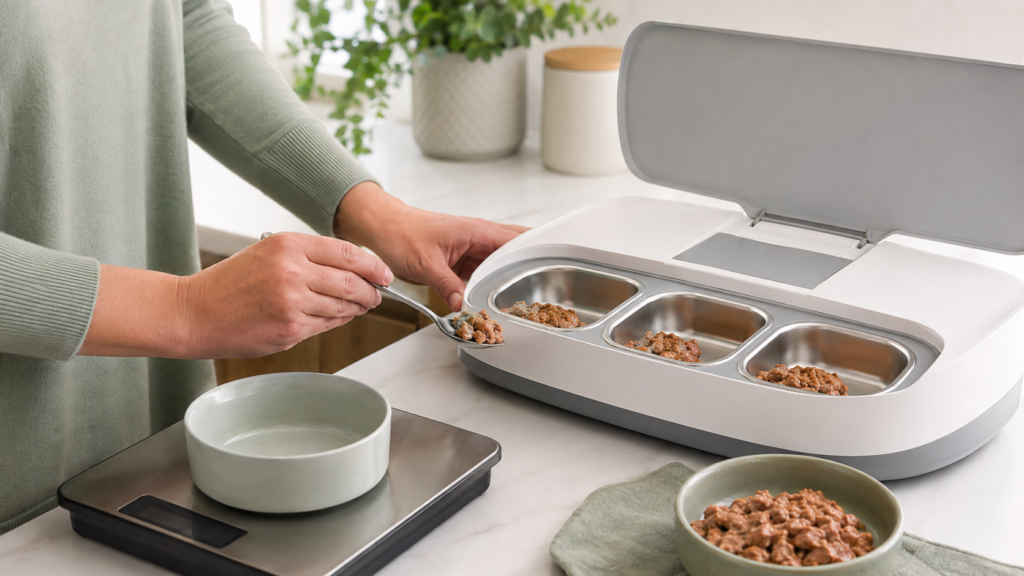
Step 4: Measure Each Meal
Use the daily amount recommended for your cat and divide it among the scheduled compartments. The feeder organizes meal timing; it does not calculate your cat’s nutritional requirements.
Cats with diabetes, kidney disease, obesity, food allergies, or prescribed diets should follow a veterinarian-approved feeding plan.
Step 5: Load Food at an Appropriate Starting Temperature
Follow the feeder manual. Some products may recommend chilled food, while others specify different preparation instructions. Avoid loading warm food unless the manufacturer expressly permits it.
Step 6: Program and Verify the Schedule
Set the current time, meal times, and any lid-open duration. Watch each compartment open during a test cycle so you know the tray aligns correctly and your cat can reach the food.
Our automatic pet feeder schedule guide provides a complete process for planning meal times and portions.
Step 7: Introduce Your Cat Gradually
Some cats hesitate when a tray rotates, a lid moves, or a cooling fan makes noise. Start with supervised meals and allow your cat to investigate the feeder without pressure.
Step 8: Check Leftovers
Inspect the feeder after each scheduled meal. Record whether the compartment opened and whether your cat ate the expected amount.
Do not automatically save an exposed or partially eaten portion for the feeder’s next scheduled meal. Once the compartment has opened and your cat has accessed the food, handle the leftovers according to appropriate food-storage guidance and the feeder manufacturer’s instructions. When the food’s time or temperature history is uncertain, discard it.
VCA’s feeding-time guidance explains that food left at a regular meal can be an important sign of an appetite change. Contact your veterinarian if reduced eating is unexplained or persists.
How to Test Cooling Before Depending on the Feeder
A practical home test can show how the feeder performs under your normal conditions. It does not replace official instructions or food-safety guidance.
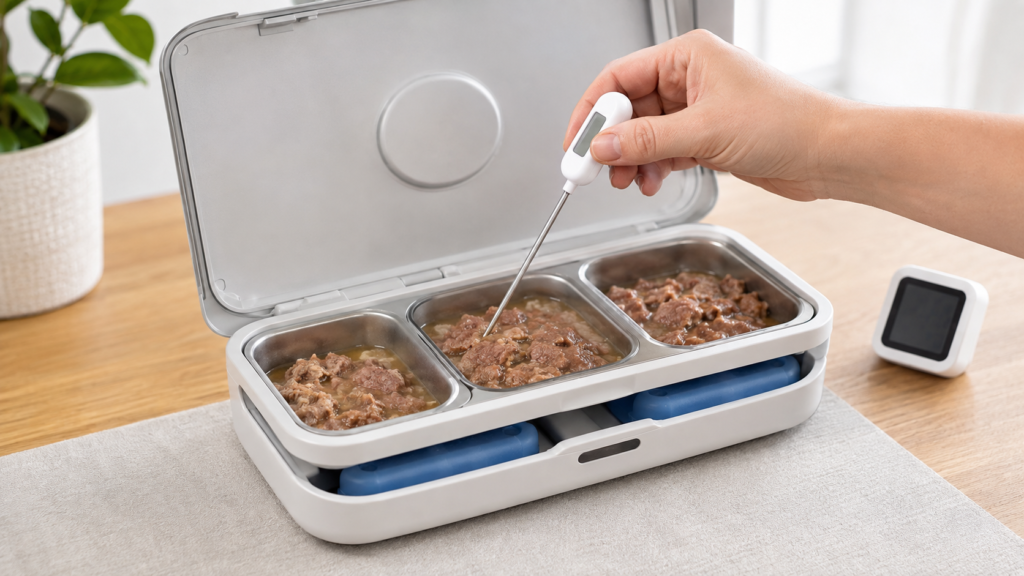
- Place the feeder in its intended location.
- Prepare its ice packs or powered cooling system exactly as instructed.
- Load test portions at the recommended starting temperature.
- Set the same schedule you plan to use.
- Keep your cat away from the test food.
- Check the system at each planned mealtime.
- Note room temperature, cooling performance, and whether the tray opened correctly.
- Discard the test food after the experiment.
A food-safe probe thermometer may help you observe temperature change, but do not treat one reading as proof of universal safety. Temperature can vary between compartments and across the food.
Repeat the test when seasons change, the feeder is moved, or the cooling packs are replaced.
Portioning and Scheduling Wet Meals
Automatic feeders can support several smaller meals, but the total daily amount remains the most important figure.
When preparing meals:
- Measure the full daily allowance first.
- Divide it among the number of scheduled meals.
- Account for treats and any dry food provided separately.
- Avoid filling compartments beyond their stated capacity.
- Record uneaten portions rather than automatically adding extra food later.
Wet and dry foods can have very different calorie densities. Do not substitute equal volumes without checking the food labels and your veterinarian’s advice.
If portion consistency is also important, see our guide to automatic pet feeder portion accuracy for practical ways to check whether a feeder delivers the amount you expect.
Cleaning an Automatic Wet-Food Feeder
Moist food leaves more residue than dry kibble and requires prompt cleaning.
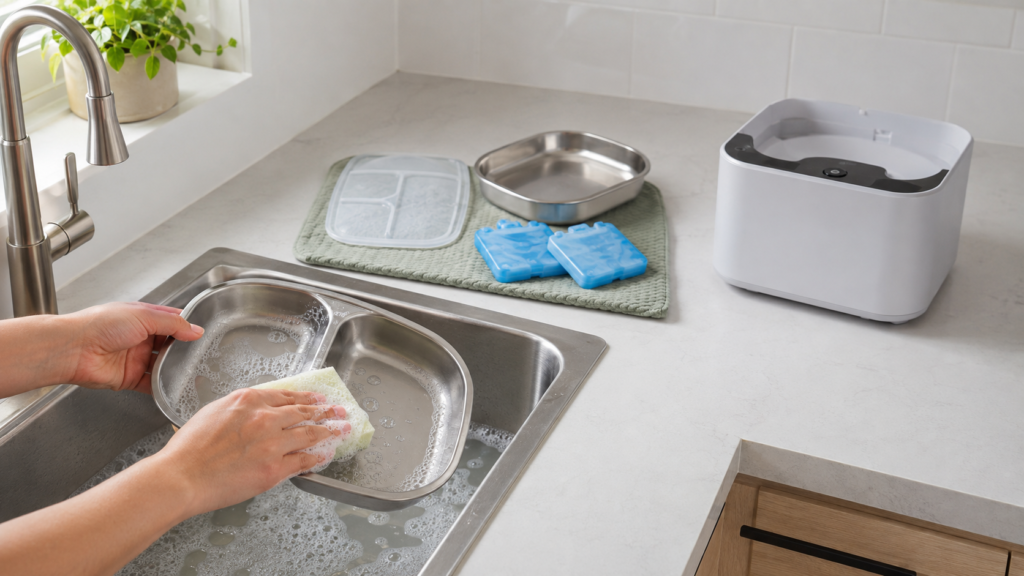
After use:
- Disconnect power if required by the manual.
- Remove leftover food.
- Detach manufacturer-approved washable parts.
- Wash the tray, bowl, and removable inserts with warm water and mild dish soap.
- Clean crevices where gravy or crumbs collect.
- Rinse thoroughly.
- Dry every part completely before reassembly.
- Wipe the electronic base as instructed without submerging it.
- Check the cooling area for condensation or residue.
Do not close damp components inside the feeder. Trapped moisture can encourage odor, residue buildup, and malfunction.
For a fuller maintenance routine, see How to Clean an Automatic Pet Feeder.
What to Do During a Power Failure
A power interruption matters most for a refrigerated feeder because cooling may stop even if the meal schedule remains stored.
If power fails:
- Note when the outage began, if known.
- Keep the feeder closed while assessing the situation.
- Check whether the manufacturer provides a power-failure procedure.
- Do not assume an app notification proves that cooling continued.
- Discard food when its temperature history or safety is uncertain.
- Clean and restart the feeder according to the manual.
Battery backup may operate a clock, lid, or dispensing motor without powering refrigeration. Confirm exactly which functions receive backup power on your model.
If the tray fails to rotate or open, use our troubleshooting guide for an automatic feeder not dispensing food, while also following the wet-food safety precautions above.
Wet-Food Feeders in Multi-Cat Homes
A standard timed feeder controls when food becomes available, not which cat eats it. In a multi-cat home, one cat may consume another’s meal before you notice.
Consider:
- Separate feeders in different rooms
- Supervised meal periods
- Physical separation during feeding
- Microchip- or RFID-access feeders for individual diets
- A combination of timed meals and controlled access where compatible
Pay particular attention when one cat receives medication, a prescription diet, or a different calorie allowance. The feeder must support the individual feeding plan rather than simply make food available to the group.
For households where food stealing or individual access is a concern, our guide to automatic pet feeders for multiple cats explains when separate, microchip, or RFID-controlled feeding setups may be more appropriate.
Can You Use Raw or Rehydrated Food?
Do not assume that wet-food compatibility includes raw meat or rehydrated freeze-dried food.
Raw pet food requires additional handling precautions. The FDA’s raw pet-food guidance advises keeping raw products frozen until use, thawing them safely, preventing cross-contamination, and promptly refrigerating or discarding leftovers.
Only use raw or rehydrated food if the feeder manufacturer expressly permits it and you can follow both the food maker’s and feeder maker’s storage requirements. For example, Petlibro specifically advises against raw food in its Polar model. Ask your veterinarian whether the diet is appropriate for your cat.
Can a Wet-Food Feeder Replace a Pet Sitter?
No. An automatic wet-food feeder can support a meal schedule, but it does not provide complete care during a longer absence.
A responsible caregiver still needs to check:
- Whether your cat ate normally
- Whether the feeder opened and cooled correctly
- Food and water availability
- Litter-box condition
- Signs of illness, injury, or distress
- Power, battery, and app status
A feeder can malfunction, and a cat can become unwell even when food is available. Arrange appropriate human care rather than relying on the device alone.
For a broader assessment of this limitation, see Are Automatic Pet Feeders Worth It?.
Common Mistakes to Avoid
Putting Wet Food in a Dry-Food Hopper
This can block the mechanism, contaminate non-washable components, and leave food without cooling.
Treating a Covered Tray as a Refrigerator
A lid reduces access and exposure but does not actively remove heat.
Copying Another Feeder’s Storage Claim
Storage limits are based on a particular design and test conditions. Use the instructions for your exact model.
Loading Warm Food
Unless the manual directs otherwise, begin with food at the recommended temperature so the cooling system is not forced to remove unnecessary heat.
Placing the Feeder in Sunlight
Direct sun or nearby heat can reduce the effectiveness of ice packs and powered cooling.
Skipping the Home Test
Run the full schedule under supervision before leaving the feeder responsible for a delayed meal.
Ignoring Uneaten Food
Leftovers can indicate that the meal was unappealing, the feeder opened incorrectly, or your cat’s appetite changed.
Assuming Battery Backup Powers Cooling
Some batteries operate only the timer or tray. Verify which functions remain active during an outage.
What to Check Before Choosing a Wet-Food Feeder
Before choosing an automatic feeder for wet food, confirm the following:
- Which food types the manufacturer permits
- Whether the system uses a cover, ice packs, or powered cooling
- Its tested ambient-temperature range
- The maximum model-specific storage period
- How quickly it cools after loading
- What happens during a power failure
- Whether meal trays are removable and dishwasher-safe
- How many meals and portions it holds
- Whether your cat can comfortably reach the bowl
- Whether replacement trays, packs, or parts are available
- Whether the schedule operates without internet access
- Whether alerts confirm cooling, opening, or only app connectivity
Prioritize food compatibility, cooling performance, cleaning, and dependable operation over cameras, voice recordings, or other optional features.
Frequently Asked Questions
Can You Put Canned Cat Food in an Automatic Feeder?
Yes, but only in a feeder specifically designed for wet or canned food. Standard dry-food hoppers are not suitable because canned food can block the mechanism and requires different storage conditions.
How Long Can Wet Cat Food Stay in an Automatic Feeder?
There is no universally safe duration. It depends on the cooling method, food temperature, room conditions, and manufacturer instructions. Food left without dependable cooling should be refrigerated or discarded promptly according to authoritative food-storage guidance.
Are Automatic Feeders With Ice Packs Safe?
They can help keep meals cooler for a limited period when used as instructed. Their performance varies with pack temperature, room conditions, and feeder design, so test the exact setup at home before relying on it.
Is a Refrigerated Feeder Better Than an Ice-Pack Feeder?
A refrigerated feeder may provide more consistent powered cooling, while an ice-pack feeder offers a simpler passive-cooling approach without relying on powered refrigeration. Neither is automatically better for every situation. Compare storage needs, room conditions, cleaning, power dependence, and manufacturer limits.
Can Wet Food Be Left in a Covered Feeder Overnight?
A cover alone does not refrigerate wet food. Do not leave wet food overnight unless the feeder provides a manufacturer-approved cooling system capable of maintaining it for the planned period under your conditions.
Should I Freeze Wet Food Before Loading the Feeder?
Only if the food and feeder manufacturers permit it. Freezing can affect texture, and different cooling systems are designed for different starting temperatures.
Can an Automatic Wet-Food Feeder Work Without Wi-Fi?
Some models store schedules locally, while others require connectivity for certain controls. Wi-Fi operation and cooling are separate questions, so confirm both in the product manual.
How Often Should I Clean a Wet-Food Feeder?
Food-contact trays and bowls should be cleaned promptly after use. Follow the manufacturer’s instructions for the cooling chamber, lid, seals, and electronic base.
Can I Use a Wet-Food Feeder for a Cat With Diabetes?
It may help to follow a veterinarian-approved meal schedule, but it should not be used to create the schedule independently. Discuss meal timing, portions, medication coordination, and backup plans with the veterinarian managing your cat.
Final Recap
The answer to “Can you put wet food in an automatic feeder?” is yes—but only when the model is specifically designed for moist meals.
Covered trays, ice-pack feeders, and refrigerated feeders are not equivalent. A cover limits access, ice packs provide temporary passive cooling, and refrigerated models use powered systems with model-specific temperature and storage requirements.
Choose the feeder according to your cat’s diet and meal schedule, then test it under normal home conditions. Follow authoritative food-storage guidance, check uneaten meals, and clean food-contact components promptly.
An automatic wet-food feeder can make scheduled meals more practical, but it cannot guarantee that food remains safe, prove that your cat ate, or replace attentive daily care.