Last verified: September 2, 2026
Review basis: This research-based comparison uses current manufacturer product pages, manuals and support information. TopPetTech has not conducted hands-on testing of every product in this guide. Availability and specifications can change, so confirm the exact model before purchasing.
The best dog training collars are not necessarily the models with the longest claimed range or the greatest number of stimulation levels. A suitable system must fit the dog, provide controls the handler can operate consistently and support a humane training plan.
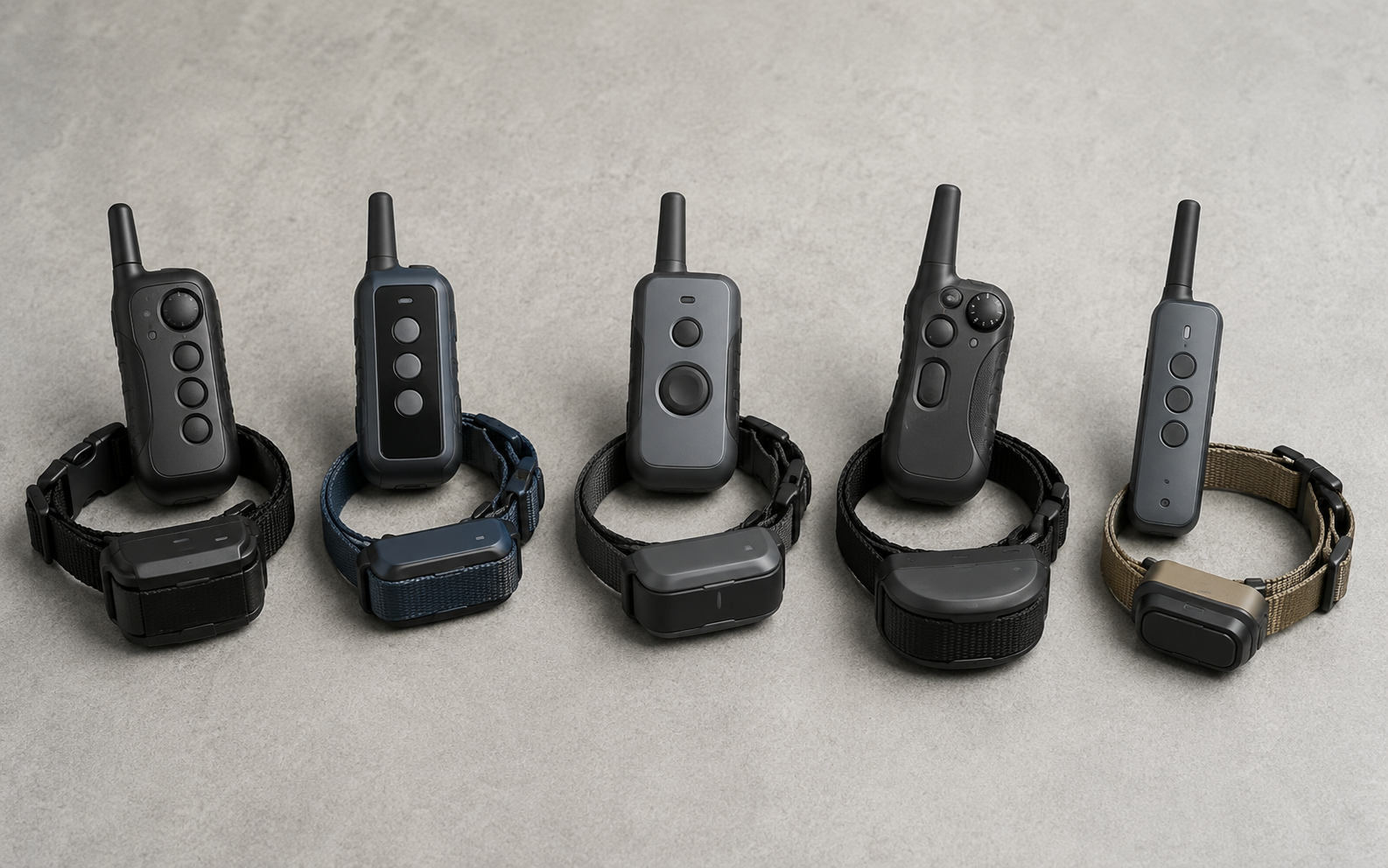
This guide compares five current remote dog training collars with traceable manufacturer documentation. All five use a dedicated handheld transmitter rather than a smartphone app. Some provide tone and vibration as well as adjustable static stimulation, but those features should not be interpreted as a recommendation to use aversive methods.
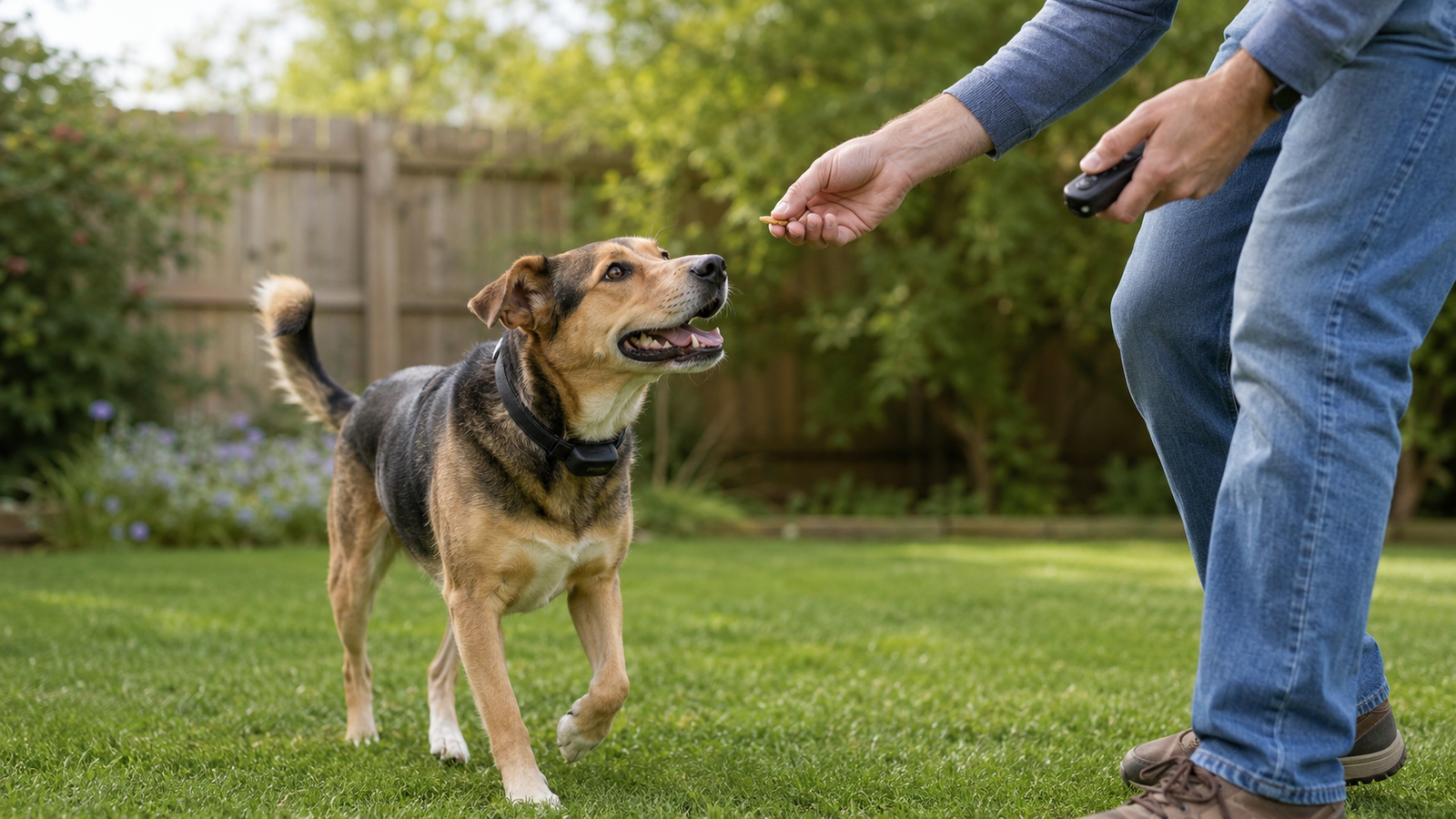
The American Veterinary Society of Animal Behavior recommends reward-based methods for dog training and advises against aversive tools, including electronic shock collars. Begin with management, clear cues and rewards. If a dog has fear, anxiety, aggression, reactivity or another serious behavior concern, consult a veterinarian or appropriately qualified reward-based behavior professional rather than attempting to solve it with a collar.
If your main goal is location tracking or escape alerts rather than cue-based training, see our separate comparison of GPS trackers for dogs. GPS fences, bark collars and ordinary remote trainers solve different problems and should not be treated as interchangeable.
Quick Answer
PetSafe Basic and Core provide straightforward handheld controls, while SportDOG FieldTrainer 425X suits structured field use and multi-dog handling. Dogtra 200iQ offers a compact receiver with fine adjustment, and Educator ET-300 Mini is documented for dogs from 5 lb. None provides app control or GPS tracking.
Key Takeaways
- Reward-based training should be the starting point; a collar does not replace teaching, management or professional guidance.
- “Remote,” “smart,” “GPS,” “bark control,” and “app-connected” describe different functions; none of these five collars provides app or GPS features.
- Manufacturer range figures usually assume favorable line-of-sight conditions, and actual range can decrease around buildings, terrain and interference.
- More stimulation levels do not make a collar more humane or more appropriate for a particular dog.
- Check minimum dog size, neck fit, receiver dimensions, contact-point guidance and wear-time instructions. Never attach a leash to an electronic receiver-collar strap unless the manufacturer explicitly designs it for that purpose.
Best Dog Training Collars at a Glance
| Model | Suitable use | Manufacturer-stated range | Multi-dog capacity | Important limitation |
|---|---|---|---|---|
| PetSafe Basic Dog Trainer | Simple close-range remote cues | Up to 300 ft | One dog | Shortest stated range in this comparison |
| PetSafe Core Dog Trainer | Everyday training with more range and adjustment | Up to 1,000 ft | Up to two dogs with an additional collar | Connected app control is not included |
| SportDOG FieldTrainer 425X | Close-working sporting or field dogs | Up to 500 yd | Up to three dogs with additional collars | Field-oriented controls may be unnecessary for routine home training |
| Dogtra 200iQ | Compact receiver and fine remote adjustment | Up to 1/2 mile | Expandable to two dogs | No app, GPS or virtual-fence features |
| Educator ET-300 Mini | Compact system documented for smaller dogs | Up to 1/2 mile | Expandable to two dogs | Complex control options require careful setup and instruction |
Stated range is not a promise of real-world performance. Buildings, trees, terrain, weather, interference, how the transmitter is held, and battery condition can reduce usable distance.
How We Selected and Verified These Products
The previous version mixed remote trainers, automatic bark collars, GPS fences and marketplace products under one heading. For this evergreen update, a product needed:
- a current official manufacturer product or support page;
- a clearly documented control method and training modes;
- stated fit, range, waterproofing and charging information;
- replacement or additional-receiver support where relevant;
- a distinct role in the comparison;
- enough documentation to explain meaningful limitations.
We did not rank products by retailer popularity, star rating or promotional claims. We also excluded lightly documented marketplace models from the main shortlist and separated GPS containment from ordinary remote training.
Important Welfare Context Before Comparing Collars

Electronic collars can deliver tone, vibration or static stimulation, but any of those signals can become aversive if they cause fear, pain or distress. The veterinary behavior position is important: the AVSAB humane dog-training statement recommends reward-based methods and states that aversive methods should not be used for training or behavior modification.
Research summarized by AVSAB has also found that positive reinforcement can be more effective than electronic-collar training while avoiding the same welfare risks.
Accordingly, TopPetTech does not advise choosing a collar solely because it offers stronger output, greater range or more levels. A device comparison cannot determine whether an electronic collar is appropriate for an individual dog. Discuss persistent or serious behavior with a veterinarian and seek a qualified reward-based trainer or veterinary behaviorist.
1. PetSafe Basic Dog Trainer — Simple Short-Range Controls
Why It Stands Out
The PetSafe Basic Dog Trainer is the least complicated system in this comparison. Its handheld remote provides tone, vibration and eight adjustable static levels, while the receiver collar is rechargeable and waterproof.
PetSafe states a range of up to 300 ft. That is substantially shorter than the other products here, but it may be sufficient for structured work around a home or enclosed yard. A shorter published range should not be treated as permission to train off-leash in an unsecured area.
Suitable For
Owners who want a straightforward single-dog remote system from an established manufacturer and do not need field-scale range or multi-dog expansion.
Key Specifications
| Specification | Manufacturer information |
|---|---|
| Model | PDT00-18034 |
| Control method | Handheld remote |
| Modes | Tone, vibration and eight static levels |
| Stated range | Up to 300 ft / 100 yd |
| Neck fit | 10–22 inches |
| Receiver | Waterproof and rechargeable |
| Charging | Magnetic charger; approximately two hours |
| Claimed operating time | Up to 20 hours |
| App connectivity | None |
Advantages
- Straightforward handheld layout.
- Tone and vibration are available separately from static stimulation.
- Waterproof rechargeable receiver.
- Magnetic charging connection.
- Current manufacturer product and support information.
Limitations
- Shorter stated range than the other systems compared.
- Only eight static adjustment levels.
- Not designed for app control, GPS tracking or virtual fencing.
- No multi-dog expansion is documented for the 100-yard Basic series.
- Manufacturer battery and range claims vary with use and conditions.
Our Verdict
The PetSafe Basic Dog Trainer is the clearest fit when uncomplicated controls matter more than range or expansion. It should not be confused with an app-controlled product. Reward-based teaching and a secure training environment remain more important than the remote’s feature list.
View the current PetSafe Basic Dog Trainer information on the manufacturer’s website
2. PetSafe Core Dog Trainer — More Range and Adjustment
Why It Stands Out
The PetSafe Core Dog Trainer expands the company’s basic format to a stated 1,000-ft range and 15 static levels. It retains separate tone and vibration modes, a waterproof rechargeable receiver and magnetic charging.
PetSafe also documents Add-A-Dog support, allowing one Core remote to work with a second compatible collar purchased separately. The built-in LED can improve the dog’s visibility in lower light, but it is not a location tracker.
Suitable For
Owners who want a current PetSafe remote trainer with more adjustment and distance than the Basic model, plus optional two-dog expansion.
Key Specifications
| Specification | Manufacturer information |
|---|---|
| Model | PDT00-18036 |
| Control method | Handheld remote |
| Modes | Tone, vibration and 15 static levels |
| Stated range | Up to 1,000 ft / 333 yd |
| Neck fit | 10–22 inches |
| Multi-dog support | Up to two dogs with an additional compatible collar |
| Receiver | Waterproof and rechargeable |
| Charging | Magnetic charger; approximately two hours |
| Claimed operating time | Up to 20 hours |
| Additional feature | Collar LED light |
| App connectivity | None |
Advantages
- Greater stated range than PetSafe Basic.
- More adjustment levels than the Basic model.
- Separate tone and vibration controls.
- Expandable to a second dog with compatible equipment.
- Waterproof receiver and built-in LED.
Limitations
- No smartphone app, GPS or location reporting.
- Additional receiver is a separate purchase.
- Stated range assumes favorable conditions.
- The receiver still requires careful fit and regular skin checks.
Our Verdict
The Core is the more flexible PetSafe option for owners who genuinely need added range or two-dog compatibility. Those who only need simple, close-range operation may find the Basic model easier and less costly. Neither model replaces reward-based instruction.
View the current PetSafe Core Dog Trainer information on the manufacturer’s website
3. SportDOG FieldTrainer 425X — Field-Oriented Multi-Dog System
Why It Stands Out
The SportDOG FieldTrainer 425X is designed for sporting dogs working relatively close to the handler. Its transmitter can be operated without continually looking at the controls, and the system provides tone, vibration and up to 21 static levels.
SportDOG states a 500-yard range and support for as many as three dogs when compatible Add-A-Dog receivers are purchased. The remote and receiver are waterproof and submersible to 25 ft under the manufacturer’s DryTek specification.
Suitable For
Experienced handlers who need weather-resistant equipment and multi-dog control for structured field work—not owners seeking a smartphone app or GPS tracker.
Key Specifications
| Specification | Manufacturer information |
|---|---|
| Model | SD-425X |
| Control method | Handheld remote |
| Modes | Tone, vibration and up to 21 static levels |
| Stated range | Up to 500 yd |
| Minimum dog weight and neck fit | 8 lb and above; approximately 5–22-inch neck |
| Multi-dog support | Up to three dogs with additional compatible receivers |
| Water protection | Remote and receiver submersible to 25 ft using DryTek |
| Battery | Rechargeable lithium-ion |
| Charging | Approximately two hours |
| Claimed operating time | Approximately 50–70 hours per charge |
| App connectivity | None |
Advantages
- Controls designed for operation without repeatedly viewing the remote.
- Expandable to three dogs.
- Tone and vibration options.
- Strong documented water protection.
- Manufacturer support, manuals and replacement components.
Limitations
- Field-oriented design may be excessive for ordinary home training.
- Additional dog receivers cost extra.
- It is not a GPS, app-connected or activity-monitoring collar.
- Long stated range should not encourage unsafe or unsupervised off-leash use.
Our Verdict
The FieldTrainer 425X has the clearest role for structured field use and experienced multi-dog handling. Its durability and tactile remote distinguish it from simpler household systems, but those capabilities do not make it automatically appropriate for a companion dog or an inexperienced handler.
View the current SportDOG FieldTrainer 425X information on the manufacturer’s website
4. Dogtra 200iQ — Compact Receiver With Fine Adjustment
Why It Stands Out
Dogtra’s 200iQ uses a compact 2.4-oz receiver and a one-handed transmitter with 100 medium-output levels. The documented controls include nick, continuous stimulation, XPP vibration and audible tone, plus an LED locate light.
The system has a manufacturer-stated half-mile range, an IPX9K waterproof rating and optional two-dog expansion. Dogtra states a minimum dog weight of 10 lb, while also advising buyers that fit varies with breed, coat, neck shape and build.
Suitable For
Owners comparing a compact, waterproof remote system with fine adjustment and optional two-dog expansion, after professional guidance on whether such a device is appropriate.
Key Specifications
| Specification | Manufacturer information |
|---|---|
| Model | Dogtra 200iQ |
| Control method | Handheld remote |
| Modes | Audible tone, XPP vibration, nick and continuous stimulation |
| Adjustment | 100 medium-output levels |
| Stated range | Up to 1/2 mile |
| Minimum dog weight | 10 lb; fit varies by build and coat |
| Receiver size and weight | 2 × 1.5 × 1.2 inches; 2.4 oz |
| Multi-dog support | Expandable to two dogs |
| Water protection | IPX9K |
| Additional feature | LED locate light |
| App connectivity | None |
Advantages
- Compact receiver with documented dimensions and weight.
- Fine adjustment through 100 levels.
- Audible tone and vibration controls.
- IPX9K water-protection claim.
- Expandable to two dogs.
- Official manuals and replacement receiver support.
Limitations
- More adjustment choices require careful, consistent handling.
- Half-mile claim assumes favorable conditions.
- No app, GPS or virtual-fence features.
- Additional receiver and certain accessories are separate purchases.
- Fit cannot be determined from body weight alone.
Our Verdict
The Dogtra 200iQ offers a compact receiver and more granular control than the simpler PetSafe models. That precision should not be mistaken for evidence that static stimulation is necessary. Owners should prioritize reward-based methods and professional behavioral guidance.
View the current Dogtra 200iQ information on the manufacturer’s website
5. Educator ET-300 Mini — Compact Half-Mile System
Why It Stands Out
The Educator ET-300 Mini is documented for dogs from 5 lb with soft-to-normal temperaments. The manufacturer lists a half-mile line-of-sight range, 100 stimulation levels, tone and vibration functions, a lock-and-set control and a waterproof floating transmitter.
Both the receiver and transmitter use rechargeable batteries. The system can expand to two dogs with compatible equipment. The word “Mini” refers primarily to the compact transmitter and receiver format; it does not remove the need to evaluate fit, behavior and training method for the individual dog.
Suitable For
Owners researching a compact remote system for a smaller dog and who have appropriate professional guidance, rather than shoppers seeking app connectivity.
Key Specifications
| Specification | Manufacturer information |
|---|---|
| Model | Educator ET-300 Mini |
| Control method | Handheld floating transmitter |
| Modes | Tone, vibration and adjustable static stimulation |
| Adjustment | 100 levels plus manufacturer-documented boost settings |
| Stated range | Up to 1/2 mile line of sight |
| Minimum dog weight | 5 lb according to manufacturer guidance |
| Receiver | Approximately 2.4 oz; waterproof |
| Multi-dog support | Expandable to two dogs |
| Charging | Approximately two hours |
| Claimed standby time | Approximately 24–48 hours |
| App connectivity | None |
Advantages
- Compact format and low published minimum dog weight.
- Tone and vibration functions.
- Fine adjustment and setting lock.
- Waterproof receiver and floating transmitter.
- Expandable to two dogs.
- User-replaceable rechargeable batteries documented by the manufacturer.
Limitations
- Numerous settings and control combinations increase setup complexity.
- Manufacturer terminology should not override independent welfare guidance.
- Range is a favorable-condition maximum.
- No smartphone app, GPS tracking or virtual fencing.
- Minimum weight does not guarantee a comfortable fit for every small dog.
Our Verdict
The ET-300 Mini is the most clearly documented option here for a smaller dog, but suitability cannot be decided from the 5-lb minimum alone. Receiver fit, temperament and humane training method require equal attention, and owners should not rely solely on manufacturer marketing when assessing welfare.
View the current Educator ET-300 Mini information on the manufacturer’s website
Detailed Comparison
| Model | Remote range | Tone | Vibration | Multi-dog support | App or GPS |
|---|---|---|---|---|---|
| PetSafe Basic | Up to 300 ft | Yes | Yes | One dog | No |
| PetSafe Core | Up to 1,000 ft | Yes | Yes | Up to two | No |
| SportDOG FieldTrainer 425X | Up to 500 yd | Yes | Yes | Up to three | No |
| Dogtra 200iQ | Up to 1/2 mile | Yes | Yes | Up to two | No |
| Educator ET-300 Mini | Up to 1/2 mile line of sight | Yes | Yes | Up to two | No |
Every product in this comparison also offers static stimulation. The table does not rank products by intensity or number of levels because more output is not evidence of better training or better welfare.
How to Choose a Training Approach and Device
Define the Behavior Before Buying
Write down the behavior, its context and what you want the dog to do instead. Barking, pulling, poor recall, separation-related distress, fear and aggression have different causes. A collar cannot diagnose those causes.
Start With Reward-Based Training
Use management to prevent repeated unwanted behavior, teach an alternative response and reinforce it consistently. A veterinarian can check whether pain, illness or medication effects contribute to a sudden behavior change. For complex cases, seek a credentialed reward-based trainer, certified applied animal behaviorist or veterinary behaviorist.
Do Not Confuse Training With Tracking or Containment
A remote trainer sends a handler-initiated cue over a radio link. A GPS tracker calculates location and usually reports through an app or handheld. A virtual fence delivers automatic boundary feedback. If escape recovery is the priority, compare dog GPS tracking systems rather than buying a training collar for a job it cannot perform.
Check Fit and Contact Guidance
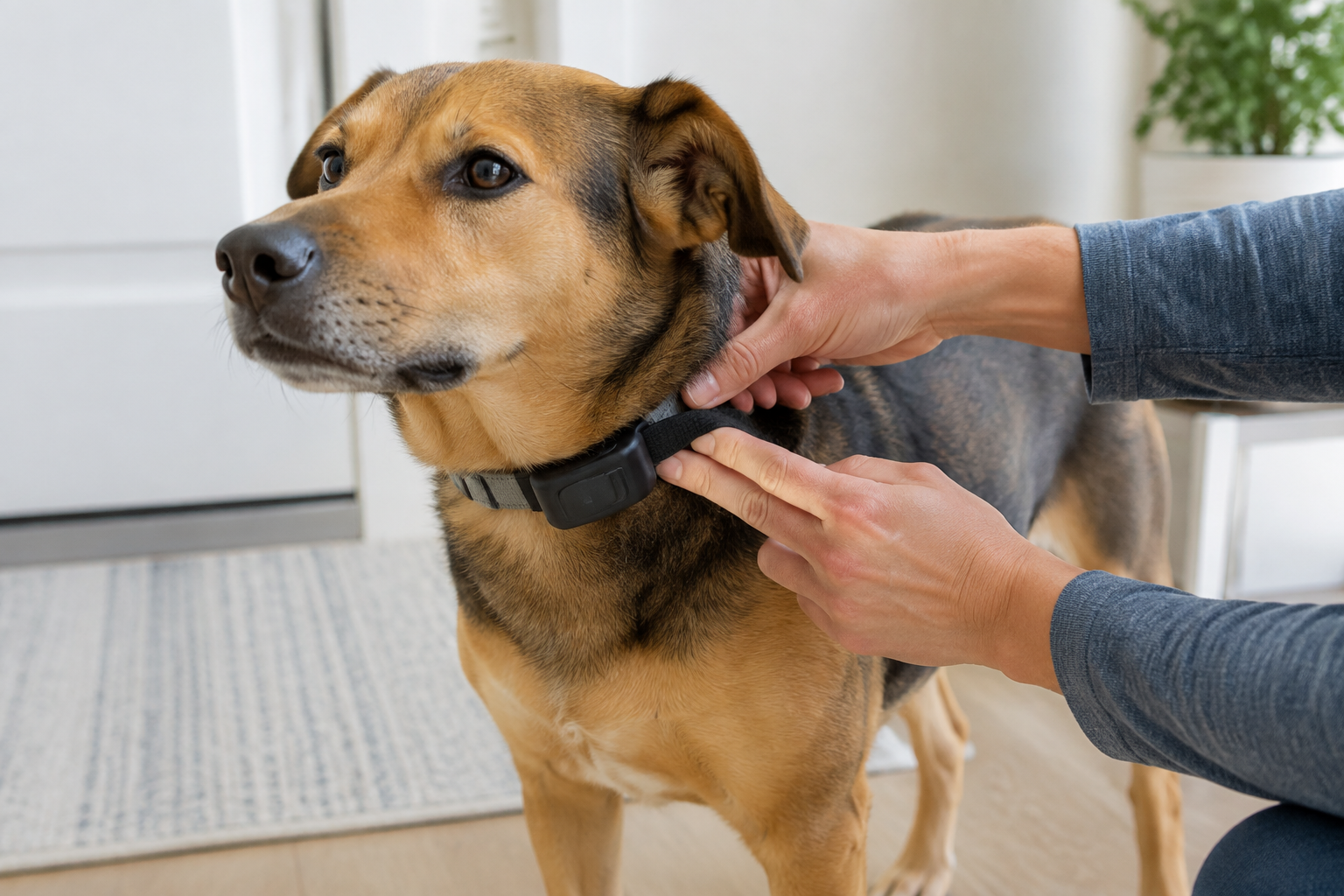
Follow the exact manufacturer manual. Inspect the skin frequently, keep the receiver clean and dry, and follow wear-time limits. Do not tighten the collar excessively or position it over damaged skin. Never use a product outside its stated age, weight or size guidance.
Treat Range as a Maximum Claim
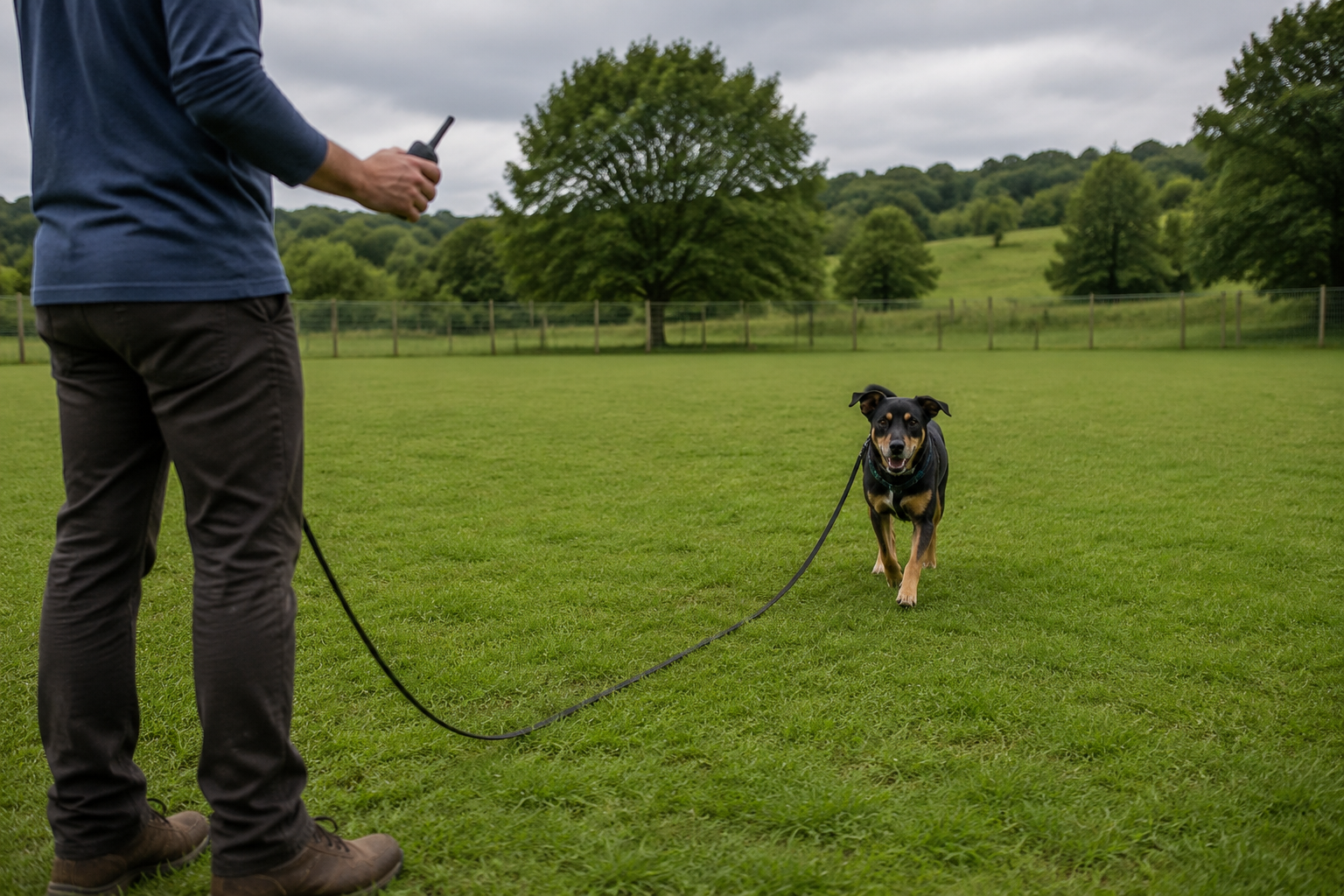
Actual range may decrease around hills, trees and structures, or because of interference and poor transmitter orientation. Maintain supervision and a safe physical environment. A long-range remote is not a substitute for a secure fence, leash or trained recall.
Confirm What Happens After Purchase
Check the warranty, regional support, charger type, battery replacement options and availability of compatible extra receivers. A low-cost device with no manual or replacement parts is difficult to recommend as an evergreen choice.
Frequently Asked Questions
Are electronic dog training collars recommended by veterinary behaviorists?
AVSAB recommends reward-based training and advises against aversive methods, including electronic shock collars. Consult a veterinarian or qualified reward-based behavior professional for an individual plan, especially when fear, anxiety, aggression or reactivity is involved.
Do all dog training collars use static stimulation?
No. Training equipment also includes ordinary flat collars, harnesses, head halters, long lines, treat pouches and clickers. The five electronic remote systems compared here offer tone and vibration as well as static stimulation. A signal can still become aversive if it frightens or distresses the dog.
Are app-controlled dog training collars common?
Genuine app-controlled remote trainers are less common than product marketing may imply. Many “smart” listings still use a handheld radio remote. Smartphone connectivity is more prevalent in GPS trackers, activity monitors and virtual-fence systems.
Can a training collar track a lost dog?
Not unless it contains a separate GPS or other location system. The five collars in this comparison do not provide app-based lost-dog tracking. See our dog GPS tracker comparison if location is the main requirement.
Does a longer range make a collar better?
No. Range only describes the maximum communication distance under stated conditions. Control layout, fit, durability, training method and the dog’s welfare are more important. Most companion-dog training should occur close enough to observe body language and reinforce the desired response.
Can one remote control several dogs?
Some systems can. PetSafe Core and Dogtra 200iQ can expand to two dogs, Educator ET-300 can expand to two, and SportDOG FieldTrainer 425X can support up to three with compatible additional receivers. PetSafe Basic is a single-dog system.
Can an electronic collar solve barking, fear or aggression?
A collar does not identify why a behavior occurs. Punishing warning behavior can worsen fear or suppress signals without resolving the cause. Seek veterinary and qualified reward-based behavioral help for fear, aggression, separation-related distress or persistent barking.
Final Verdict
The best dog training collars are not automatically the models with the greatest range or the most settings. In many households, reward-based instruction, management equipment and professional guidance are more appropriate than an electronic collar.
For readers comparing documented remote systems:
- PetSafe Basic is the simplest short-range option.
- PetSafe Core adds range, adjustment and two-dog expansion.
- SportDOG FieldTrainer 425X is designed for weather-resistant field use and up to three dogs.
- Dogtra 200iQ combines a compact receiver with fine adjustment.
- Educator ET-300 Mini has the lowest manufacturer-listed minimum dog weight in this comparison.
None provides smartphone control or GPS tracking. Choose the category that matches the real problem, verify the current manual and prioritize the dog’s physical and emotional welfare over feature count.
For related technology, compare dog health-monitoring collars and smart pet technology under $100.