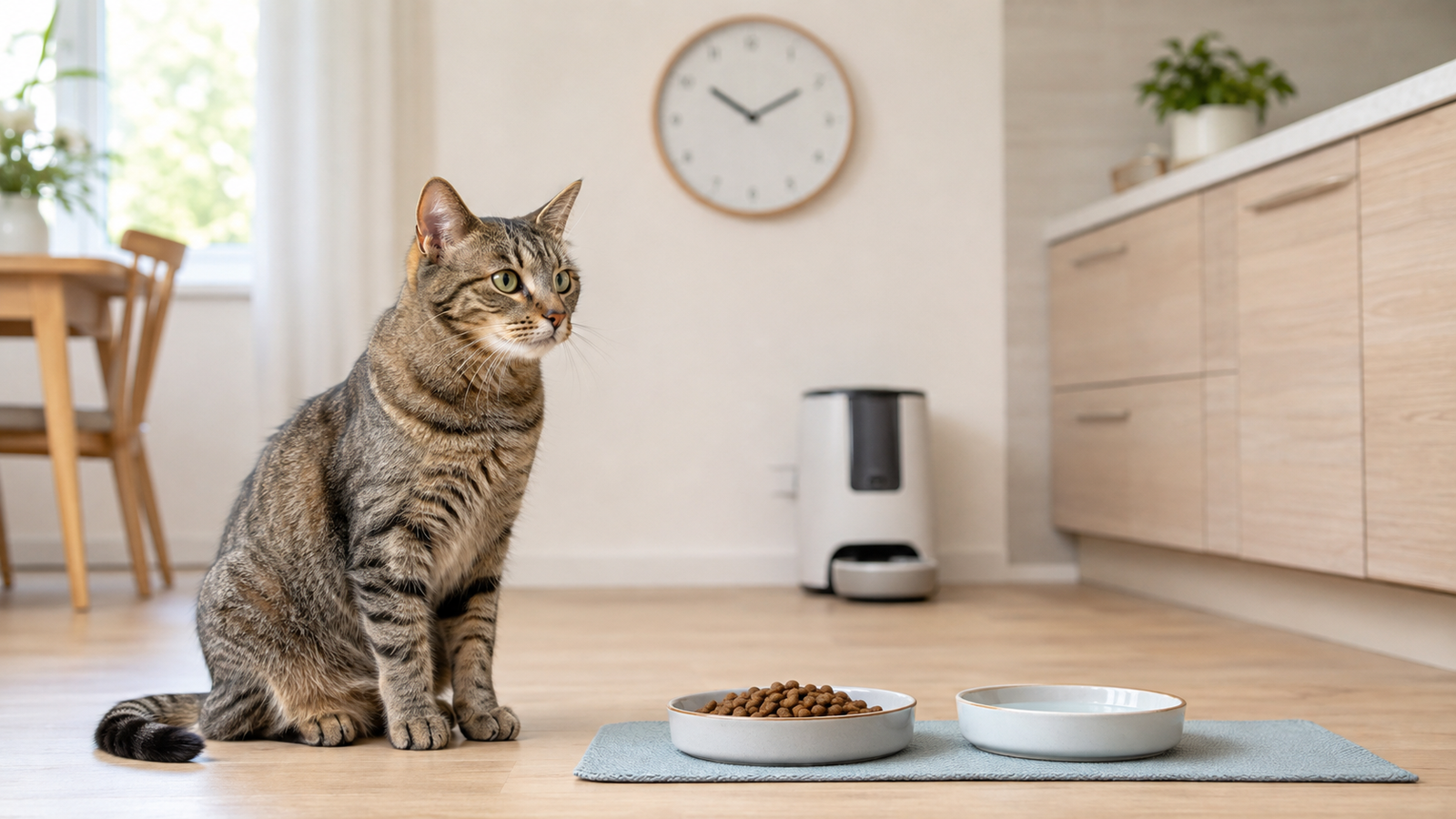
If you have ever stood in the kitchen wondering whether your cat is due for another meal, you are not alone. How often should you feed a cat? There is no single number that fits every cat. A healthy adult might do well with one or two measured meals, while a kitten, a senior cat, or a cat with a medical condition may need something different.
The important distinction is that meal frequency and total daily food are not the same thing. Dividing a cat’s daily allowance into four meals does not mean feeding four times the amount. It means spreading the same allowance across more feeding opportunities.
This guide explains how age, food type, feeding style, household routine, and automatic feeders can shape a practical cat feeding schedule. It provides general educational guidance—not a calorie prescription for an individual cat.
How Often Should You Feed a Cat? Quick Answer
Many healthy adult cats can be fed at least twice daily, although some cats may suit one meal and others may benefit from three or four smaller meals. According to VCA Animal Hospitals, at least two meals per day is a common recommendation, but the ideal frequency depends on the individual cat and household.
Cornell Feline Health Center notes that kittens typically need more frequent feeding than adults. Cornell’s general guidance describes three daily meals for kittens up to about six months, twice-daily feeding between six months and one year, and once- or twice-daily feeding for many adult cats.
These are starting points, not universal rules. Follow the food label and your veterinarian’s advice when deciding the total daily amount, then divide that amount into a practical number of meals.
Key Takeaways
- Many healthy adult cats do well with two measured meals per day, but some benefit from smaller, more frequent meals.
- Kittens generally require more frequent feeding than adult cats because they are growing and have smaller stomachs.
- Senior cats do not automatically need a different feeding frequency, but health, appetite, mobility, and medication can change their needs.
- Meal frequency does not determine the total daily food allowance.
- Free feeding can make intake harder to monitor, particularly in multi-cat homes.
- Wet food, dry food, and mixed feeding require different handling and scheduling considerations.
- Automatic feeders can divide a measured daily allowance into smaller scheduled meals, but they do not determine how much a cat should eat.
- Sudden appetite changes, repeated vomiting, weight changes, or refusal to eat warrant veterinary advice.
Why Feeding Frequency Matters
A predictable routine can make meals easier to manage and help owners notice changes in appetite. If a cat normally finishes breakfast but repeatedly leaves it untouched, that change is easier to spot than it might be when food is continuously available.
Scheduled meals can also help households:
- measure food more consistently;
- divide one daily allowance into manageable portions;
- coordinate wet and dry meals;
- prevent one cat from consuming another cat’s food;
- observe which cat ate and how much;
- plan meals around medication when directed by a veterinarian; and
- reduce dependence on an owner being home at every feeding time.
Cats naturally tend to consume multiple small meals. The 2020 review “Feeding Cats for Optimal Mental and Behavioral Well-Being” explains that domestic cats are commonly free-fed or fed twice daily even though their natural feeding pattern involves several small eating events. That does not mean every household must serve many meals manually. It does suggest that smaller scheduled portions, puzzle feeders, or an appropriately configured automatic feeder may suit some cats.
Cat Feeding Frequency by Life Stage
Age is an important starting point, but it is not the only factor. Body condition, activity, food type, health, and the calorie density of the chosen food also matter.
| Life stage | General starting point | Important considerations |
|---|---|---|
| Young kitten | Several small meals daily | Growth, small stomach capacity, and food formulated for kittens |
| Older kitten | Often two or three meals daily | Gradual transition toward an adult routine |
| Healthy adult | Commonly one or two meals; some suit more | Total daily allowance, activity, and eating behavior |
| Senior cat | Often the established adult routine | Appetite, dental comfort, health, mobility, and medication |
This table is a general planning aid—not an individualized feeding prescription.
How Often Should You Feed a Kitten?
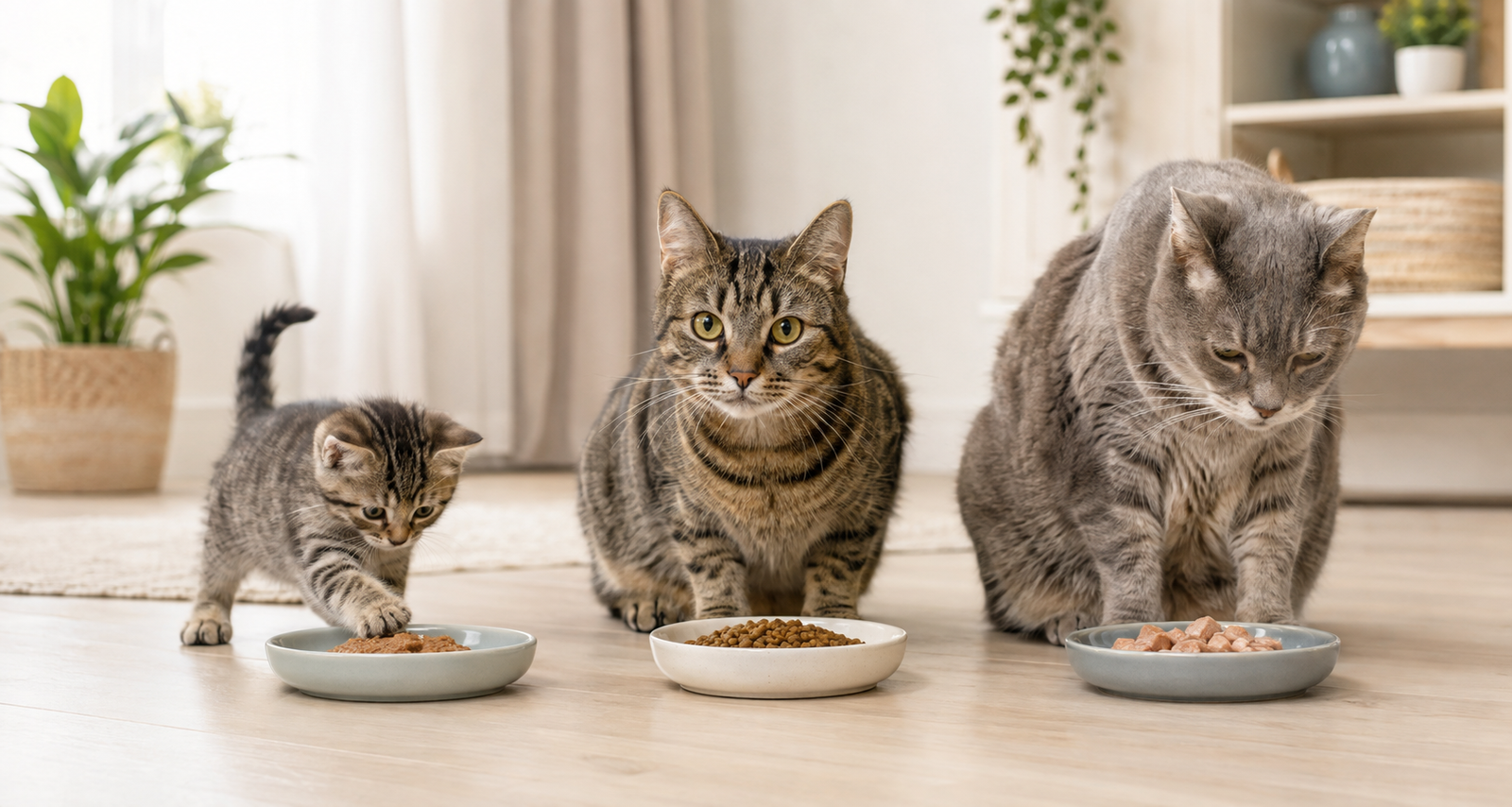
Kittens need more energy and nutrients relative to their size than adult cats, so they usually need smaller meals more frequently. Cornell’s general guidance suggests three meals daily for kittens up to around six months and twice-daily feeding from six months to one year.
Very young, orphaned, underweight, or unwell kittens require professional guidance rather than a generic online schedule. Their needs can change quickly, and inappropriate feeding can be dangerous.
Use a food formulated for the kitten’s life stage, follow its feeding instructions, and ask a veterinarian when you are uncertain about growth or body condition. As the kitten matures, adjust the routine gradually instead of making an abrupt change from frequent meals to a widely spaced adult schedule.
How Often Should You Feed an Adult Cat?
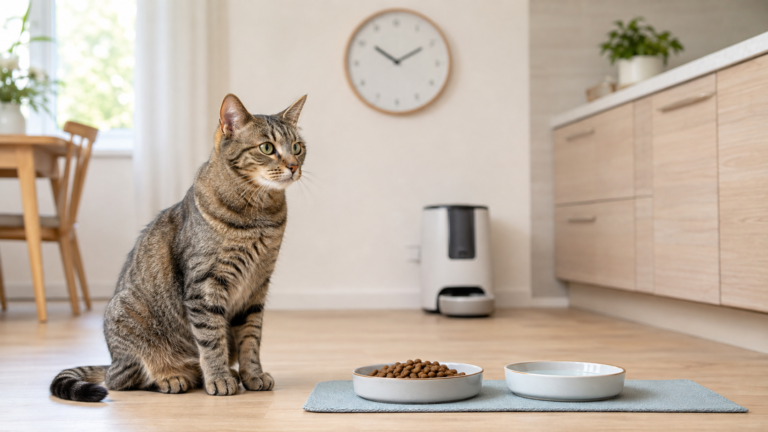
For many healthy adult cats, morning and evening meals create a practical routine. VCA explains that at least two meals per day is a common recommendation, although the appropriate pattern depends on the cat and family schedule.
Some adults appear comfortable with two substantial meals. Others eat only a small quantity at once, beg between meals, or benefit from having the same daily allowance divided into three or four smaller portions. A timed feeder can help provide those extra meals without increasing the daily amount.
Do not judge the schedule only by whether the cat asks for food. Cats may vocalize or seek attention out of habit, anticipation, boredom, or learned behavior. Appetite, weight trend, body condition, stool quality, activity, and veterinary assessment provide more useful information.
How Often Should You Feed a Senior Cat?
Healthy senior cats may continue with the routine that worked during adulthood. Cornell notes that senior cats can often maintain the same schedule unless a veterinarian recommends otherwise.
Age-related changes may nevertheless affect feeding. Dental discomfort can make chewing difficult, arthritis can make a feeding station harder to reach, and medical conditions or medication may require specific timing. Some senior cats eat better when their daily allowance is offered as smaller meals.
Watch for reduced appetite, difficulty chewing, food dropping from the mouth, unexplained weight change, increased thirst, or changes in eating speed. These signs require veterinary attention rather than an automatic schedule adjustment alone.
Scheduled Meals vs. Free Feeding
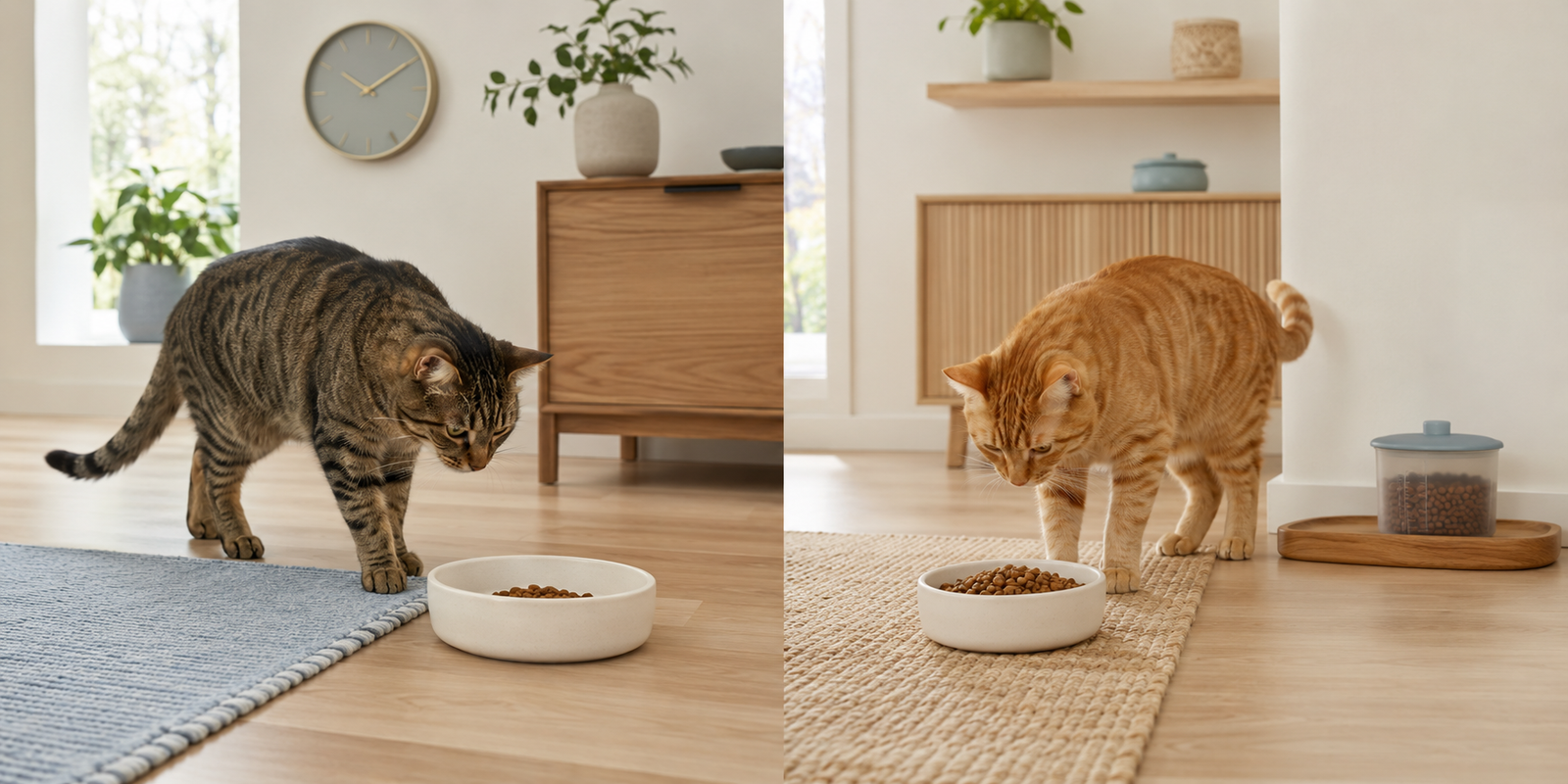
Scheduled meal feeding means offering measured food at planned times. Free feeding generally means leaving food available so the cat can return to it throughout the day.
Neither label tells us whether the correct total amount is being provided. A measured daily portion can be offered for grazing, while an owner can still overfeed through oversized scheduled meals.
Advantages of scheduled meals
- Easier to track whether a cat ate
- Easier to measure the daily allowance
- More practical when cats need separate diets
- Better control over food left exposed
- Creates predictable times for wet food
- Makes appetite changes easier to notice
Limitations of scheduled meals
- Some cats prefer small, frequent eating opportunities
- Widely spaced meals may lead to begging in some cats
- Manual schedules can be difficult for busy households
- Cats may eat too quickly when food appears
Advantages of measured free feeding
- Allows a cat to eat small amounts throughout the day
- May suit cats that naturally regulate their intake
- Requires less attention to exact meal times
Limitations of free feeding
- Harder to know which cat ate in a multi-cat home
- Harder to notice reduced appetite promptly
- Food may become stale or contaminated
- Unmeasured refilling can lead to excess intake
- Wet food cannot safely remain available indefinitely
If free feeding works for a healthy cat, measure the entire daily allowance rather than repeatedly topping up the bowl. Record what remains before adding more food. If weight or body condition changes, discuss the feeding method and daily allowance with a veterinarian.
Does Food Type Change the Feeding Schedule?
Food type affects handling, convenience, and how long a meal can remain available, but it does not create one universal meal frequency.
Wet food
Wet food should be served in portions that can be consumed within an appropriate period and handled according to the manufacturer’s storage instructions. Scheduled wet-food meals make it easier to remove leftovers and monitor consumption.
If you need automated wet-food meals, use a feeder specifically designed for wet food and follow its cooling and time-limit instructions. Our guide to using wet food in an automatic feeder explains the differences between rotating trays, ice-pack models, and refrigerated feeders.
Dry food
Dry food is convenient for timed dispensers and measured grazing, but convenience does not eliminate the need to calculate the total daily allowance. Repeatedly filling a hopper and bowl without tracking the quantity can make intake difficult to assess.
Dry food also varies in calorie density and kibble size. A cup or feeder portion from one recipe may not equal the calories or weight of another. This is why the package instructions and, when necessary, veterinary advice should guide the daily total.
Mixed feeding
When offering both wet and dry food, count both toward the complete daily plan. It is easy to treat the dry feeder as an extra source of food while also serving full wet-food meals.
Decide how much of the daily allowance will come from each food, then distribute those amounts across the chosen schedule. Treats and food used for training also contribute to total intake.
How to Create a Practical Cat Feeding Schedule
1. Confirm the total daily allowance
Start with the feeding guidance for the specific food and your veterinarian’s advice. Do not copy another cat’s cup measurement because foods differ in calorie density, and cats differ in size, age, activity, and body condition.
2. Choose a realistic number of meals
For many adult cats, two daily meals are manageable. If the cat eats too quickly, leaves part of each meal, begs between meals, or seems more comfortable with smaller portions, the same daily allowance may be divided further.
3. Select consistent times
Choose times that the household can maintain. Morning and evening may work for two meals, while a midday timed meal can support a three-meal plan. Exact clock times are less important than a safe, repeatable routine.
4. Divide rather than add
If you increase meal frequency, divide the established daily allowance among the new number of meals. Do not add another full portion unless the total daily plan has been deliberately changed.
5. Include every food source
Account for wet food, dry food, treats, food-dispensing toys, supplements that contain calories, and food offered by other household members.
6. Monitor the result
Observe appetite and eating behavior, and monitor weight and body condition over time. A feeding schedule should be reviewed when the cat’s life stage, food, activity, health, or body condition changes.
Example Cat Feeding Schedules
The examples below show how meals could be distributed. They do not specify the amount of food because that must be determined separately.
| Routine | Example distribution | May suit |
| Two meals | Morning and evening | Many healthy adult cats |
| Three meals | Morning, midday, and evening | Cats that prefer smaller portions or households using a timed midday meal |
| Four small meals | Morning, midday, evening, and later snack | Cats whose established daily allowance is intentionally divided further |
| Mixed feeding | Scheduled wet meals plus measured dry portions | Cats receiving both food types |
For kittens, seniors, and cats with health concerns, use these examples only after confirming an appropriate plan with a veterinarian.
Using an Automatic Feeder for Smaller Scheduled Meals
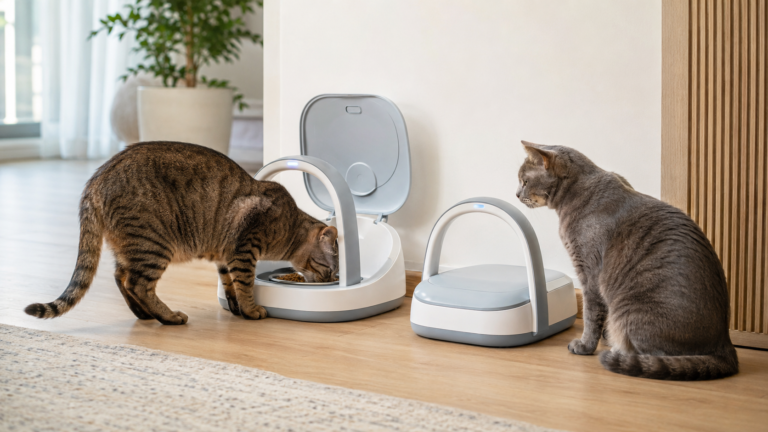
An automatic feeder can make a three- or four-meal routine practical, particularly when owners are working, sleeping, or temporarily away at a mealtime. It can also reduce early-morning feeding demands by serving a measured portion automatically.
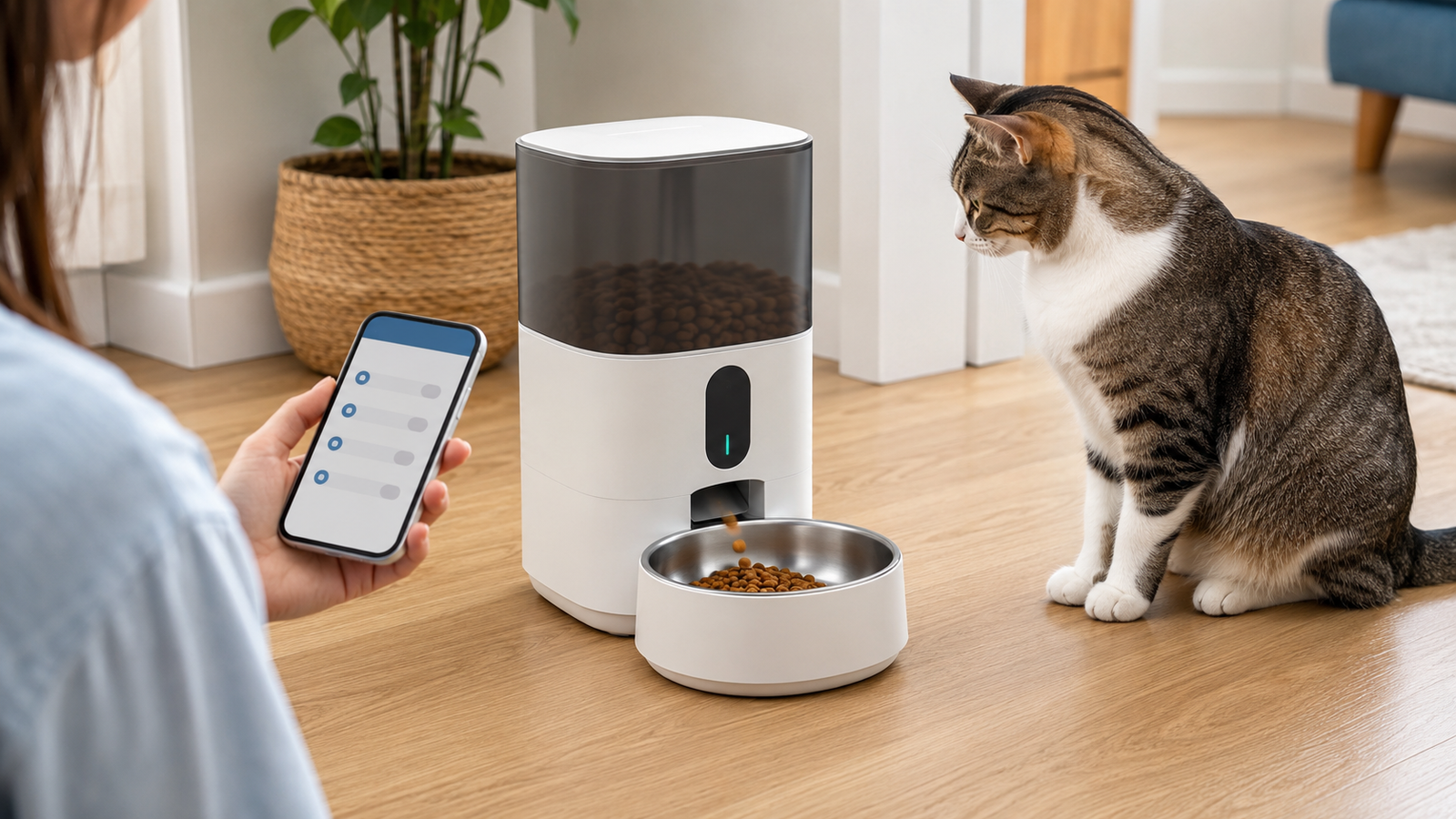
However, a feeder does not decide what a cat needs. Owners must determine the total daily allowance first and then program the device to divide that allowance correctly.
Before relying on a feeder:
- Weigh several test portions.
- Calculate the average amount dispensed.
- Confirm that the programmed daily total matches the intended allowance.
- Supervise complete feeding cycles.
- Recalibrate after changing kibble.
- Continue checking appetite and body condition.
Our automatic pet feeder schedule guide explains the programming and testing process. Because feeder portion labels are not always standard measurements, also see our guide to testing automatic feeder portion accuracy.
Remember that a dispensing notification does not prove that the cat ate. Bowls can be blocked, another pet may steal the food, or the intended cat may be unwell. Daily observation remains necessary.
Feeding Multiple Cats on Different Schedules
Multi-cat homes make feeding frequency harder to monitor. One cat may graze slowly while another finishes quickly and moves to the neighboring bowl. This can make it appear that both cats ate an appropriate amount even when one consumed most of the food.
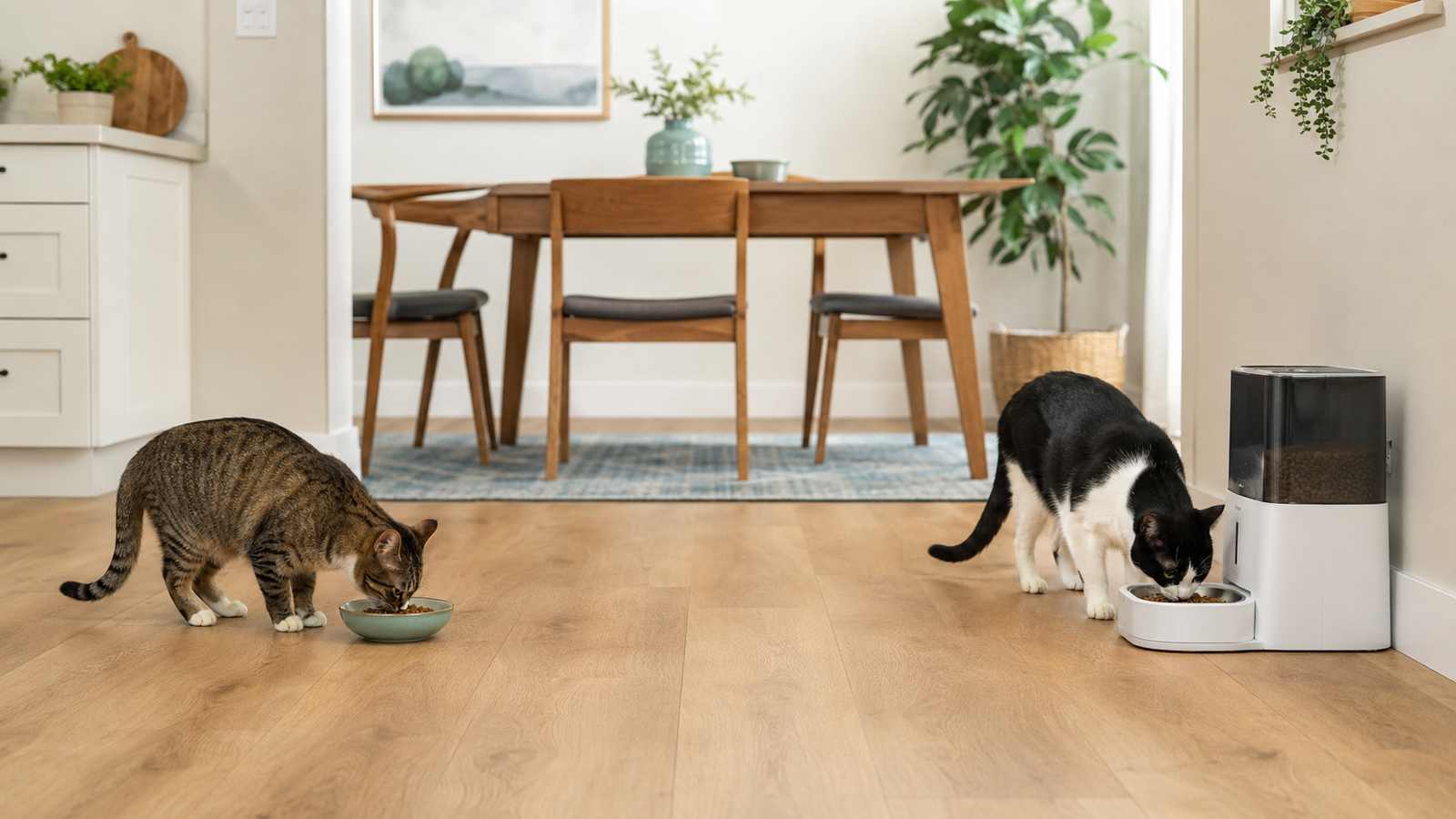
Useful options include:
- separate feeding rooms;
- supervised meals;
- feeding stations placed out of sight of one another;
- timed feeders positioned apart; and
- microchip or RFID-controlled access when cats require separate food.
Our guide to microchip feeders for cats explains how selective access can help protect separate diets. The broader guide to automatic feeders for multiple cats covers station placement, food stealing, and feeder types.
Even with selective feeders, monitor body condition and consumption. Access control can prevent obvious stealing, but it cannot confirm that a cat is eating enough unless the owner continues checking.
When a Standard Schedule May Not Be Appropriate
Generic feeding schedules should not replace veterinary guidance for cats that are:
- very young or not fully weaned;
- pregnant or nursing;
- underweight or overweight;
- diabetic;
- living with kidney, digestive, or dental disease;
- receiving medication that must be given with food;
- recovering from illness or surgery;
- repeatedly vomiting after meals; or
- showing a sudden appetite or weight change.
Do not respond to unexplained appetite loss simply by waiting for the next automatic meal. Cats can become seriously unwell when they stop eating. Contact a veterinarian promptly when a cat refuses food or displays other concerning signs.
Common Feeding-Schedule Mistakes
Changing frequency without recalculating portions
More meals should normally mean smaller portions from the same daily allowance, not extra food.
Treating the food-label chart as a permanent prescription
Package guidance is a starting point. Individual needs and body condition must still be monitored.
Ignoring treats and mixed feeding
Treats, wet meals, and feeder portions all contribute to the daily total.
Refilling bowls without measuring
Continuous topping-up makes it difficult to know how much the cat consumed.
Using one bowl for several cats
A shared bowl prevents reliable individual monitoring and can create competition.
Assuming the feeder guarantees a meal
A feeder may dispense successfully even when the cat does not eat. Check the bowl and observe the cat daily.
Making several changes at once
Changing the food, portion, meal frequency, and feeder simultaneously makes it difficult to identify what caused a problem. Make necessary changes gradually unless a veterinarian advises otherwise.
Frequently Asked Questions
Is feeding a cat twice a day enough?
Two measured meals a day can be suitable for many healthy adult cats. Some cats may do well with one meal, while others benefit from three or four smaller meals. The total daily allowance and the cat’s individual needs matter more than following one universal frequency.
How many times a day should a kitten eat?
Kittens generally need more frequent meals than adults. Cornell describes three meals daily for many kittens up to around six months and twice-daily feeding between six months and one year. Very young, orphaned, or unwell kittens need individualized veterinary guidance.
Should cats have food available all day?
Measured free feeding can work for some healthy cats, but it makes appetite and individual intake harder to monitor. It is particularly difficult in multi-cat homes. Repeatedly topping up an unmeasured bowl can also lead to excess intake.
Is it better to feed a cat three or four small meals?
Some cats prefer smaller, more frequent meals, but increasing meal frequency should normally divide the existing daily allowance. It should not automatically increase total food.
What are the best times to feed a cat?
Choose times that are safe and sustainable for the household. Morning and evening are practical for many adult cats. A timed midday or late-night portion can be added when the established daily allowance is divided into more meals.
Can an automatic feeder replace manual meals?
An automatic feeder can serve measured food at scheduled times, but it does not replace daily observation, cleaning, water provision, or veterinary care. It also cannot prove that the intended cat ate the meal.
Should wet and dry food be served on the same schedule?
They can be included in the same daily plan, but wet food needs more careful time and temperature management. Both food types must be counted toward the complete daily allowance.
When should I ask a veterinarian about feeding frequency?
Seek individualized advice for kittens, pregnancy, nursing, medical conditions, food-dependent medication, weight concerns, or unexplained appetite changes. Promptly contact a veterinarian if a cat stops eating or appears unwell.
Final Thoughts
So, how often should you feed a cat? For many healthy adults, two measured meals per day offer a practical starting point. Kittens usually need more frequent meals, while some adult and senior cats benefit from having the same daily allowance divided into several smaller portions.
The best schedule combines an appropriate total daily allowance with consistent timing, suitable food handling, and regular observation. Scheduled meals can make intake easier to monitor, while measured grazing may work for some cats. Automatic feeders can support smaller, precisely timed meals, but they must be calibrated and checked rather than treated as a substitute for daily care.
Use these general schedules as a framework, then adjust them according to your cat’s life stage, food, behavior, body condition and veterinary guidance.