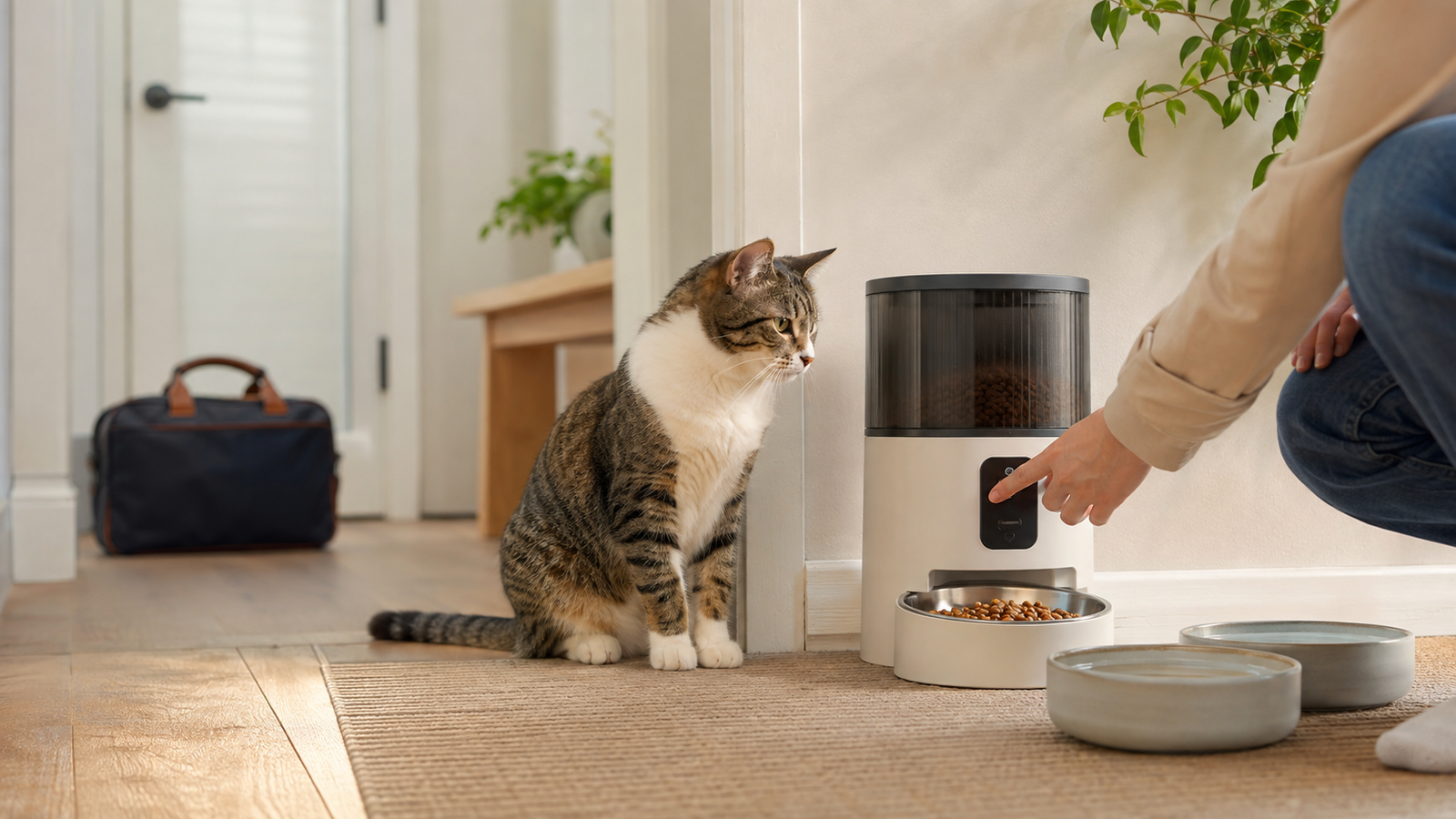
Automatic feeders can make daily cat care more flexible, but they can also create a false sense of security. A feeder may release food on time, yet it cannot refill spilled water, notice vomiting, clean a litter box, respond to an injury, or confirm that your cat actually ate.
So, can you leave a cat alone with an automatic feeder? For a healthy adult cat, a dependable feeder may help cover a normal working day or an occasional overnight absence when the rest of the home is properly prepared. For longer trips, however, automation should support a responsible caregiver—not replace one.
This guide covers practical time limits, the risks feeders can’t manage, which cats need closer supervision, and the checks to run before you leave.
Quick Answer: Can You Leave a Cat Alone With an Automatic Feeder?
You can leave a healthy adult cat alone with a tested automatic feeder for a normal working day and, in some circumstances, an occasional overnight absence. However, if you’ll be away for more than 24 hours, arrange at least daily in-person care. A feeder cannot monitor health, water, litter, safety, or emotional wellbeing.
How long can you leave a cat alone?
For a healthy adult cat, about 8–12 hours may be manageable when the home is properly prepared. An occasional overnight absence requires additional precautions, while any trip lasting more than 24 hours should include at least daily in-person care. An automatic feeder can maintain meal timing, but it does not extend these limits by replacing water checks, litter care, health monitoring, or human supervision.
Key Takeaways
- An automatic feeder handles meal timing; it does not provide complete cat care.
- A healthy adult cat may manage a normal working day when food, water, litter, and the home environment are prepared.
- An occasional overnight absence requires more preparation and a reliable emergency contact.
- For an absence longer than 24 hours, arrange a trusted person or professional pet sitter to check the cat in person at least once daily.
- Kittens, senior cats, cats with health conditions, and cats receiving medication usually need more frequent supervision.
What an Automatic Feeder Can and Cannot Do
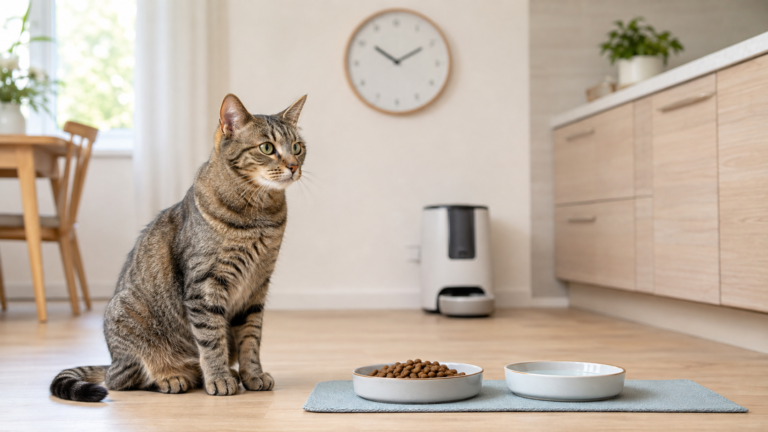
A well-chosen automatic feeder can maintain familiar meal times when you’re at work, delayed getting home, or asleep. Depending on the model, it may dispense measured portions, store a feeding schedule locally, send low-food or jam notifications, run on backup batteries, or show the feeding area through a camera.
These functions are useful, but their scope is narrow:
| An automatic feeder can | An automatic feeder cannot |
|---|---|
| Serve scheduled meals | Confirm that the correct cat ate the meal |
| Dispense programmed portions | Recognize a sudden loss of appetite or illness |
| Reduce disruption to a feeding routine | Refill spilled or contaminated water |
| Provide selected app alerts on supported models | Clean litter, remove vomit, or respond to an accident |
| Continue operating on backup power if supported | Provide companionship, play, or hands-on care |
If you’re still choosing a device, start with How to Choose the Right Automatic Pet Feeder. Reliability, food compatibility, portion control, secure construction, and backup power generally matter more than decorative smart features.
Can You Leave a Cat Alone During the Working Day?
Many healthy adult cats can stay home during a normal working day when they have reliable food, fresh water, a clean litter box, safe resting areas, and an appropriately prepared indoor environment. A PetMD guide written by a licensed veterinarian notes that healthy adult cats can generally be left alone for approximately eight to twelve hours, though age, health, behavior, and the home environment all factor into the individual decision.
An automatic feeder is especially useful if a meal falls within that window—it serves the meal on schedule instead of making the cat wait until you return.
Before leaving for work:
- Confirm the hopper or food compartments contain enough food.
- Check that the correct schedule is active.
- Provide more than one stable source of fresh water.
- Scoop the litter box and make sure your cat can reach it.
- Remove unsafe cords, toxic plants, strings, open windows, and accessible chemicals.
- Keep the indoor temperature comfortable.
- Leave safe enrichment, resting places, and access to familiar areas.
If your cat has only recently started using the device, don’t make your first long absence its first unsupervised trial. Follow our gradual automatic-feeder training guide and confirm that your cat reliably approaches and eats from it.
Can You Leave a Cat Alone Overnight?
Yes, some healthy, settled adult cats can be left alone for an occasional overnight absence, but only when their food, water, litter, home environment, and emergency backup are properly prepared. The key question isn’t simply whether the feeder holds enough meals—you need to consider the full period between your departure and your return, along with your cat’s health, temperament, and usual routine.
Before an overnight absence, confirm that your cat:
- is a healthy adult with no condition requiring close observation;
- is eating, drinking, and using the litter box normally;
- already uses the feeder confidently;
- doesn’t regularly tip water bowls, raid the hopper, or get trapped in cupboards;
- is comfortable spending time alone; and
- has a responsible nearby contact who can enter the home if needed.
Arrange multiple water stations rather than relying solely on an electric fountain. A fountain can lose power, become blocked, or get knocked over—a second, stable bowl provides a simple backup.
If you’re uncertain about your cat’s suitability for an overnight absence, asking a trusted person to visit is the safer choice.
What About a Weekend or Longer Trip?
Don’t treat a large hopper, water fountain, self-cleaning litter box, and pet camera as permission to leave a cat completely unattended for several days. Every automated component introduces another possible point of failure, and a camera can show you a problem without physically solving it.
For any absence lasting more than 24 hours, arrange for a responsible person to visit at least once each day. Some cats need more frequent visits because of age, health, medication, feeding needs, behavior, or social needs.
The RSPCA’s guidance on leaving pets in someone else’s care advises against leaving a pet without a responsible person looking after them, and recommends arranging care through a friend, family member, pet sitter, or boarding establishment. It also advises leaving clear care instructions, veterinary contact details, and emergency information with whoever is looking after your cat.
A daily visit should involve more than refilling the feeder. The caregiver should see the cat where practical, confirm normal behavior, check food consumption, replace water, scoop litter, look for vomit or diarrhea, inspect the home, and spend appropriate time interacting with the cat.
Why a Feeder Cannot Replace a Responsible Caregiver
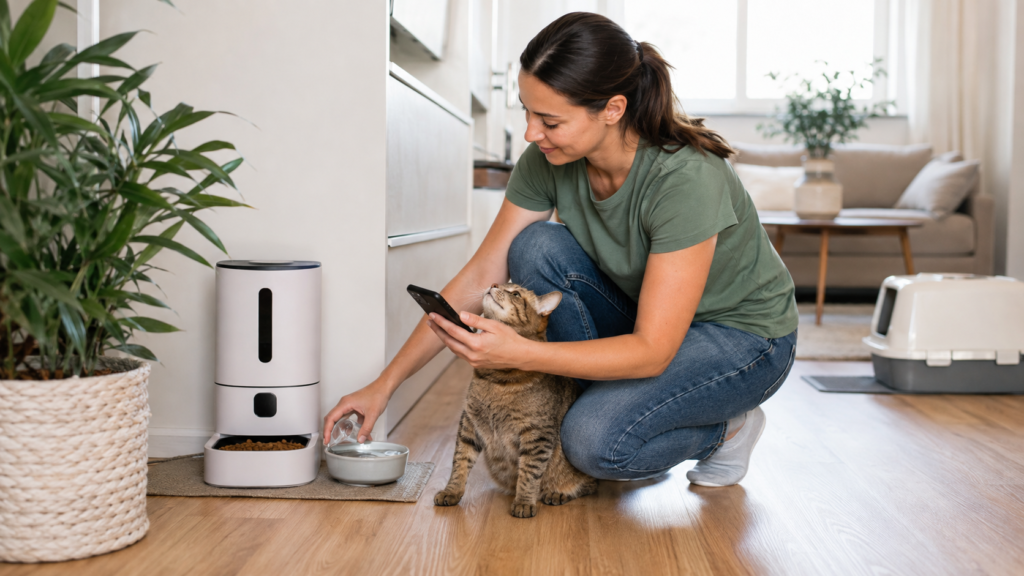
A machine responds to programming and sensors. A caregiver responds to the cat.
Cats can become ill or injured unexpectedly. A caregiver may notice that a usually social cat is hiding, a meal has gone untouched, the water bowl is contaminated, the litter box shows an unusual change, or the cat appears weak or distressed—observations that can prompt timely veterinary advice.
A human visitor can also:
- clear a food jam or restore power;
- confirm that the cat—not another household pet—ate the food;
- refresh water and clean bowls;
- clean the litter box and inspect normal output;
- remove spoiled or uneaten food;
- provide play, attention, and reassurance;
- notice unsafe indoor temperatures, leaks, or other household problems; and
- contact you or a veterinarian during an emergency.
An automatic feeder is best viewed as a scheduling tool that makes the caregiver’s job easier—not a complete care system on its own.
Risks: Jams, Power Failures, Spoiled Food, and Empty Water
Food jams and inaccurate portions
Kibble size, shape, crumbs, moisture, or an incorrectly seated component can interfere with dispensing. Even when the motor runs, the expected amount may not reach the bowl. Test the actual output rather than assuming that one programmed “portion” equals a specific weight.
If you notice inconsistent output, see Why Is My Automatic Pet Feeder Not Dispensing Food? before relying on the device during an absence.
Power, battery, and connection failures
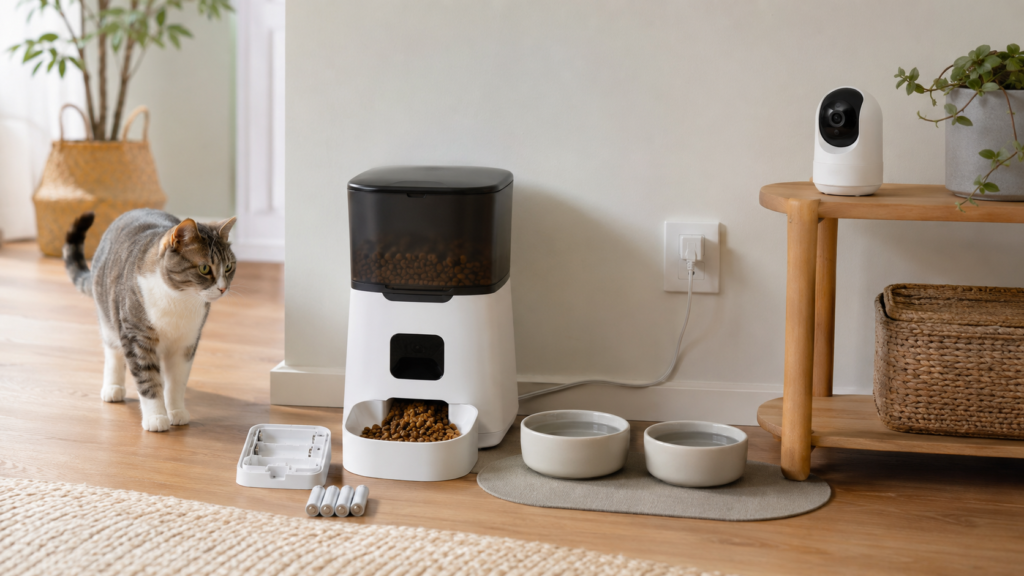
A dual-power feeder can offer useful protection during a short power interruption, but backup behavior varies by model. Some feeders continue scheduled meals on batteries while Wi-Fi, app control, or remote feeding becomes unavailable. Verify the behavior in the manufacturer’s manual rather than assuming every function continues.
Keep in mind that an “offline” alert may reflect a Wi-Fi problem rather than a failed feeding schedule—and the absence of an alert doesn’t prove food reached the bowl.
Likewise, a “meal dispensed” notification confirms a feeder event, not that your cat actually ate the meal. During longer absences, an in-person caregiver should verify both the food and the cat rather than relying only on app records.
Spoiled or dried-out food
Standard dry-food hopper feeders aren’t suitable for wet meals. Wet food requires a compatible covered, chilled, or refrigerated design and must be used within the manufacturer’s stated temperature and time limits. Read Can You Put Wet Food in an Automatic Feeder? before planning unattended wet-food meals.
Even with a compatible feeder, a caregiver should remove leftovers and clean food-contact parts. Cooling features manage food for a limited period—they don’t make perishable food safe indefinitely.
Empty, spilled, or contaminated water
Food automation does nothing to prevent dehydration. Bowls can spill, fountains can stop, and water can become dirty. Provide at least two separate water sources in stable locations and ask the caregiver to replace the water daily.
Hopper break-ins and food stealing
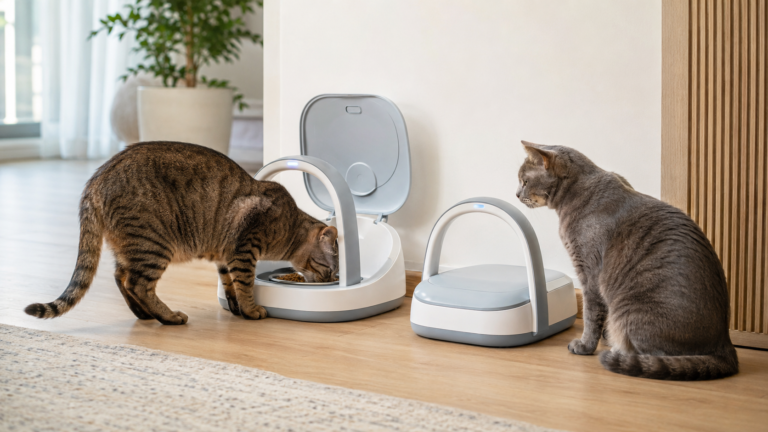
A food-motivated cat may knock over a poorly secured feeder or force a paw into its outlet. In a multi-cat home, one cat may eat another cat’s portion. Test the feeder under supervision and use appropriate selective-access feeding when diets must stay separate.
Cats That Require Closer Supervision
General time estimates for healthy adult cats shouldn’t be applied automatically to every cat. Arrange more frequent, individualized care for:
- Kittens: Young kittens require frequent feeding, monitoring, social contact, and protection from household hazards.
- Senior cats: Older cats may have reduced mobility, changing appetite, cognitive changes, or health conditions that make extended solitude unsuitable.
- Cats with diabetes or other medical conditions: Meal timing, medication, and monitoring may be closely connected—follow your veterinarian’s instructions.
- Cats taking medication: Don’t rely on unattended food to deliver medicine unless a veterinarian has approved the method and a person can confirm the dose was taken.
- Cats with a recent appetite change: Reduced eating can signal illness. Don’t leave until the reason has been properly assessed.
- Cats recovering from surgery or illness: These cats may deteriorate, remove protective equipment, or develop complications.
- Cats with separation-related distress: Cameras and recorded voices don’t replace suitable human contact.
- Multi-cat households with conflict: Competition, blocking, and food stealing can prevent one cat from eating or accessing water and litter.
Ask your veterinarian about an appropriate care plan when a cat has medical, dietary, or behavioral needs.
How to Test the Feeder Before Traveling
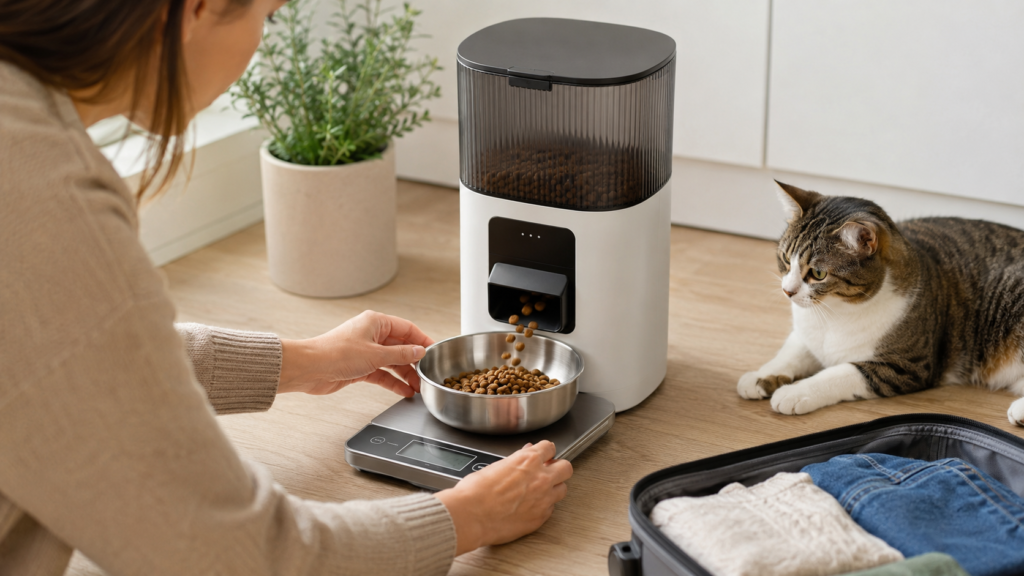
A feeder that worked once isn’t yet travel-ready. Run a realistic home trial while you’re available to observe and resolve problems.
- Clean and assemble it correctly. Wash and dry removable food-contact parts according to the manufacturer’s instructions—see our automatic-feeder cleaning guide for the general process.
- Use the intended food. Confirm that the kibble or wet-food format is compatible with the model.
- Program the real schedule. Set the same meals you plan to use during your absence.
- Weigh several dispensed portions. Check whether output stays reasonably consistent.
- Run a multi-day supervised test. Confirm that each meal releases and that your cat eats it.
- Test backup power. Follow the manual to see what continues when mains power is disconnected.
- Check offline behavior. Determine whether stored schedules continue without Wi-Fi and which app features stop.
- Look for tampering. Watch whether your cat can tip, open, or reach into the feeder.
- Teach the caregiver. Show them how to dispense manually, clear a simple jam, refill food, and recognize an error.
For detailed portion testing and meal programming, see How to Set Up an Automatic Pet Feeder Schedule.
Automatic-Feeder Vacation Checklist
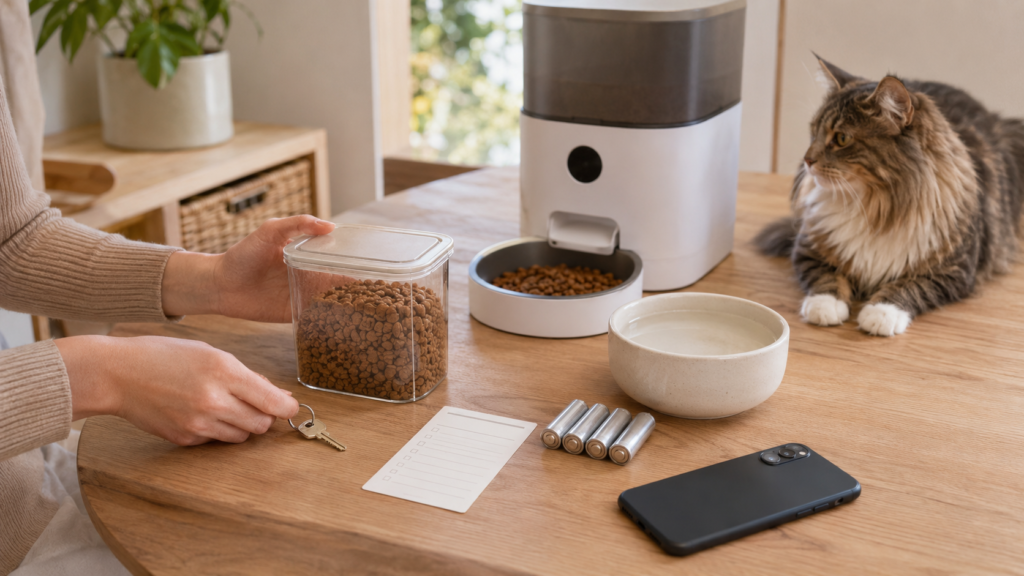
Using an automatic cat feeder for vacation can help maintain your cat’s normal meal schedule, but the feeder should be part of a wider care plan that includes reliable water, litter-box care, daily human checks for longer absences, and a backup feeding method if the device fails.
Complete this checklist before leaving:
- ☐ The feeder has completed a supervised multi-day test.
- ☐ Your cat already eats from it confidently.
- ☐ The schedule, clock, and portion settings are correct.
- ☐ Enough compatible food is loaded without overfilling the unit.
- ☐ Removable parts are clean and completely dry.
- ☐ Fresh backup batteries are installed where supported.
- ☐ At least two stable water sources are available.
- ☐ Litter boxes are clean and accessible.
- ☐ Hazardous plants, foods, medicines, cords, and strings are secured.
- ☐ Doors can’t accidentally close and trap the cat away from resources.
- ☐ Indoor temperature control is dependable.
- ☐ A trusted caregiver has access to the home.
- ☐ Daily visits are arranged for any absence beyond 24 hours.
- ☐ The caregiver has feeding, medication, and emergency instructions.
- ☐ Your veterinarian’s contact and out-of-hours details are available.
- ☐ Spare food, batteries, and cleaning supplies are easy to find.
- ☐ A backup feeding method is ready if the automatic feeder fails.
Instructions to Leave for the Pet Sitter
Written instructions reduce uncertainty and help the caregiver respond consistently. Include:
- your cat’s normal feeding times and daily food allowance;
- how to confirm that food was actually dispensed and eaten;
- where spare food is stored;
- how to use the manual-feed control;
- basic steps for a jam, power loss, or error message;
- which foods and treats are permitted;
- water-refreshing and litter-cleaning instructions;
- medication instructions approved by your veterinarian;
- your cat’s normal behavior, hiding places, and handling preferences;
- your phone number and a second emergency contact;
- your regular veterinarian and nearest out-of-hours veterinary service; and
- clear authorization and payment arrangements for emergency veterinary care.
Ask the sitter to send a brief update after each visit, ideally confirming that the cat was seen, food and water were checked, and the litter box appeared normal.
Warning Signs Requiring Immediate Attention
Ask the caregiver to contact you promptly, and seek veterinary guidance when appropriate if they notice:
- food repeatedly left untouched or an unexplained appetite change;
- repeated vomiting or diarrhea;
- difficulty breathing, collapse, marked weakness, or unusual unresponsiveness;
- straining to urinate, repeated unsuccessful litter-box visits, or no observed urine;
- injury, bleeding, or suspected poisoning;
- the cat trapped, missing inside the home, or unable to reach essential resources;
- unsafe indoor heat or cold;
- an empty or contaminated water supply; or
- feeder failure with no safe backup meal available.
A camera may help you spot an obvious problem, but it should never delay an in-person check or veterinary care.
Frequently Asked Questions
Can I leave my cat alone for 24 hours with an automatic feeder?
Some healthy adult cats may tolerate an occasional period approaching 24 hours when the home is carefully prepared, but this isn’t suitable for every cat. Arrange a responsible nearby contact and avoid extending the absence beyond 24 hours without an in-person caregiver visit.
Can I leave my cat alone for 2 days with an automatic feeder?
Not completely unattended. For a two-day absence, an automatic feeder can maintain meal timing, but arrange at least daily in-person care to check your cat, confirm that food was eaten, refresh water, clean the litter box, and respond if the feeder or another household system fails.
Can I leave my cat alone for three days with an automatic feeder?
No—not completely unattended. An automatic feeder may maintain meal timing, but someone should visit at least daily to see the cat, verify eating, refresh water, clean litter, and respond to illness, injury, or equipment failure.
Can I leave my cat alone for a week if I have smart pet devices?
Don’t leave a cat without human care for a week. A feeder, fountain, camera, and self-cleaning litter box can’t provide health assessment, emergency response, companionship, or dependable backup when something fails. Arrange daily care from a responsible person, a pet sitter, or a suitable boarding service.
Can an automatic feeder replace a cat sitter while I’m on vacation?
No. An automatic feeder can maintain meal timing, but it cannot check your cat’s health, refresh water, clean litter, respond to illness or injury, or fix equipment failures. For trips lasting more than 24 hours, use the feeder to support—not replace—at least daily in-person care.
Is a pet camera enough to monitor my cat?
No. A camera can show part of a room but may not confirm water intake, litter-box use, illness, injury, or whether the feeder delivered the correct portion. It’s a useful supplementary tool, not a replacement for in-person care.
Should I leave extra food out as a backup?
A small, appropriate backup may be useful for some cats, but unrestricted food can lead to overeating and is unsuitable for cats with prescription diets or strict portion requirements. A more dependable plan is a tested feeder plus a caregiver who can serve a backup meal if needed.
Will the automatic feeder work during a power outage?
Only if the model supports battery operation and the batteries are correctly installed and charged. Even then, Wi-Fi and app features may stop working. Check the manual and run a controlled backup-power test before traveling.
Can an automatic feeder be used for wet food while I’m away?
Only in a feeder specifically designed to keep wet food appropriately covered and cooled for its stated operating period—a standard hopper feeder is unsuitable. A caregiver should still inspect the food, remove leftovers, and clean the tray.
How often should a pet sitter visit?
For an absence longer than 24 hours, arrange at least one in-person visit each day. Kittens, seniors, cats with health conditions, cats receiving medication, and cats needing more social contact may require more frequent or longer visits. Follow your veterinarian’s individualized advice.
Final Safety Recap
Leaving a cat alone with an automatic feeder can be practical for a normal working day and may be reasonable for an occasional overnight absence involving a healthy, settled adult cat. The decision depends on far more than food capacity—water, litter, health, household safety, feeder reliability, and your cat’s emotional needs all matter.
For trips lasting more than 24 hours, arrange daily in-person care. Test the feeder in advance, provide backup power and water, leave clear instructions, and make sure someone can respond quickly if the cat or equipment needs attention.
The safest role for an automatic feeder is to preserve your cat’s familiar meal schedule while a responsible person remains accountable for their complete care.