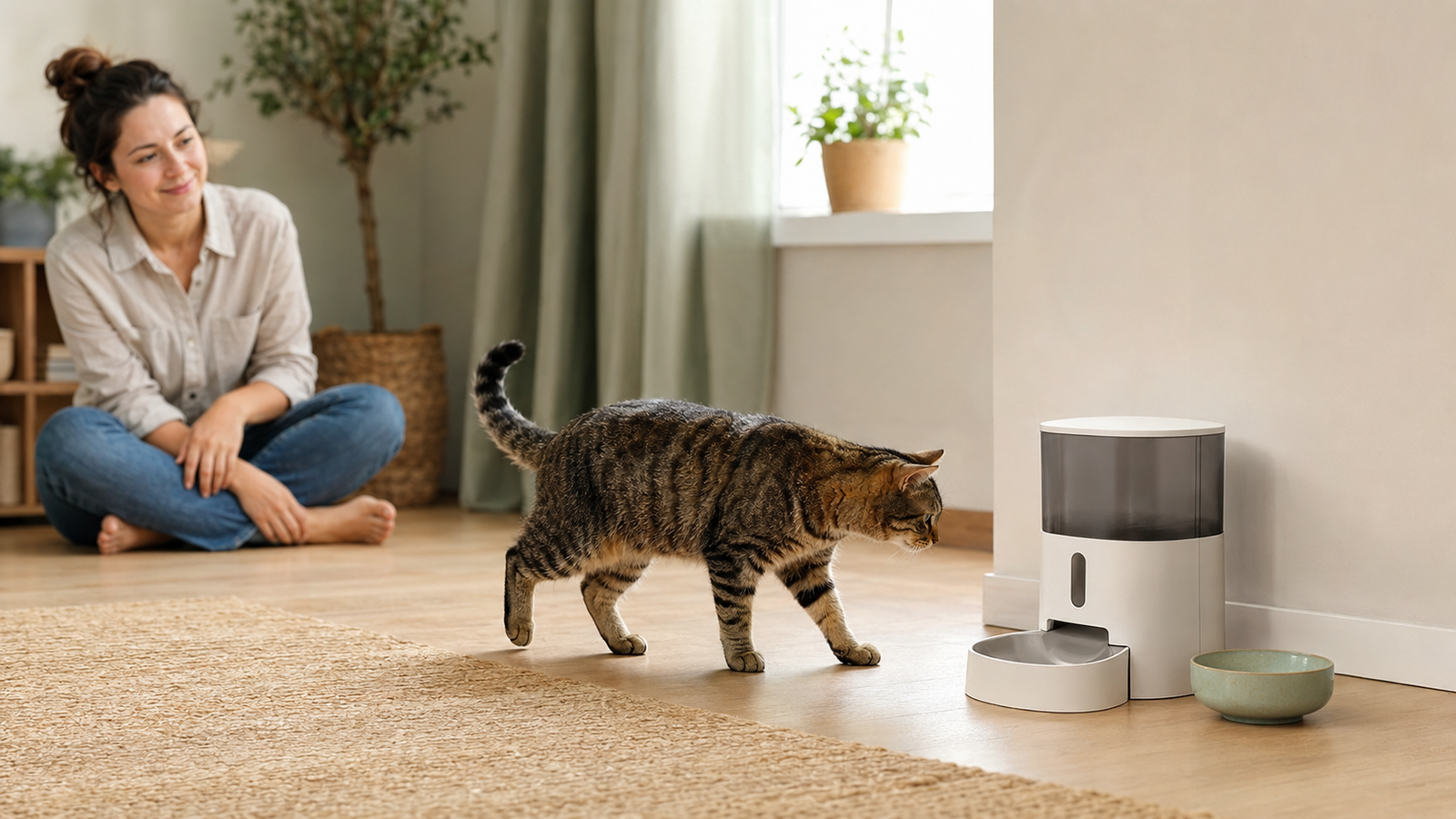
Learning how to train your cat to use an automatic feeder starts with understanding why the device may feel unfamiliar. It can suddenly click, rotate, or drop food without warning. Some cats investigate immediately. Others keep their distance, startle at the dispensing sound, or refuse to eat from the new bowl.
The safest approach is not to force the change. Introduce the feeder gradually, preserve familiar parts of your cat’s routine, and let positive experiences build confidence. This guide explains how to get your cat used to an automatic feeder without turning mealtime into a stressful contest.
Quick Answer
To train your cat to use an automatic feeder, first place the switched-off feeder near the usual feeding area. Let your cat investigate it without pressure. Next, serve familiar food in the feeder’s removable bowl before activating the machine. Introduce its movement or dispensing sound separately, from a comfortable distance, and pair calm behavior with something your cat values. Start with one supervised automatic meal, and increase use only when your cat eats comfortably.
Do not remove all other food access simply to make a frightened cat use the feeder. If your cat refuses food, seems unwell, or begins losing weight, pause the transition and contact your veterinarian.
If your cat will eat from its familiar bowl but not from the automatic feeder, do not assume it is being stubborn. Return to the last comfortable training stage and check whether the bowl, location, dispensing sound, movement, or another pet is causing the hesitation.
Key Takeaways
- Introduce the feeder while it is switched off before asking your cat to eat from it.
- Keep the usual food, feeding location, and meal times familiar during the early stages.
- Let your cat approach voluntarily; never push or hold your cat near the machine.
- Introduce the bowl, feeder sound, and moving parts as separate training steps.
- Use your cat’s preferred reward, which may be food, play, or gentle attention.
- Start with one supervised automatic meal rather than changing every meal at once.
- Move back a step if your cat hides, freezes, flattens its ears, or stops eating.
- Treat prolonged appetite loss as a health concern, not a training problem.
Why Are Some Cats Afraid of Automatic Feeders?
Cats often notice small environmental changes that people overlook. A new feeder can introduce an unfamiliar shape, smell, bowl material, mechanical noise, and movement at the same time. A hopper-style feeder may suddenly release kibble, while a rotating feeder moves the food compartment beneath the cat’s face. A microchip feeder may raise or lower its lid as the cat approaches.
Common reasons for hesitation include:
- Unexpected noise: Motors, gears, and falling kibble can startle a noise-sensitive cat.
- Moving components: A lid or rotating tray may appear unpredictable.
- An unfamiliar bowl: Its depth, shape, smell, or reflective surface may be uncomfortable.
- A changed location: Moving the feeding station at the same time adds another unfamiliar element.
- Previous negative experience: A jam, loud activation, or moving lid may have frightened the cat.
- Competition from another pet: A cautious cat may avoid the new station if another cat guards it.
- Physical discomfort: Dental pain, nausea, reduced appetite, or difficulty bending can look like feeder refusal.
Fear-based behavior is best addressed gradually. VCA Animal Hospitals explains that desensitization starts with controlled exposure at a level mild enough not to trigger fear. Counterconditioning pairs that exposure with something the animal enjoys. In practice, this means introducing the feeder’s sound or movement only at an intensity your cat can tolerate.
If your cat is afraid of the automatic feeder, first identify what triggers the reaction. If the cat avoids the feeder even when it is switched off, work on familiarity with the object and bowl first. If the fear begins only when the feeder activates, keep the machine inactive during meals and introduce the sound or movement separately from a comfortable distance. If your cat was previously comfortable but suddenly becomes reluctant to eat, check the feeder for unusual noise or malfunction and consider whether appetite loss or discomfort could be involved.
Before You Begin: Prepare the Feeder and Feeding Area
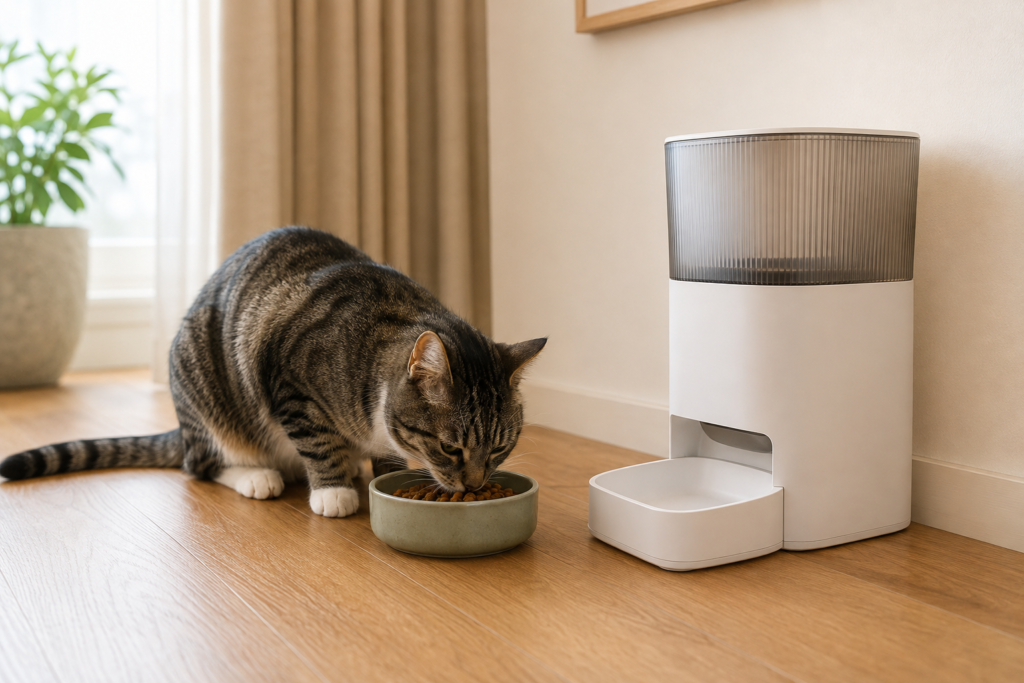
Clean the feeder
Wash all food-contact parts according to the manufacturer’s instructions and dry them completely. New plastic, packaging material, or manufacturing residue may smell unfamiliar. Our guide to cleaning an automatic pet feeder explains how to clean the bowl, hopper, and chute without damaging electronic components.
Test it away from your cat
Program and test the feeder before training begins. Confirm that it dispenses reliably, the bowl is correctly positioned, and the sound is normal. A malfunction during the first introduction can create an avoidable fright. If food does not release consistently, use our automatic feeder troubleshooting guide before continuing.
Keep the location familiar
Place the feeder near your cat’s established feeding area, provided the location is quiet, accessible, and not beside a noisy appliance or litter box. Avoid changing the feeder, food, meal schedule, and feeding room on the same day.
Use familiar food
Training is easier when the food is already accepted. This is not the ideal time to introduce a new diet. If a diet change is necessary, discuss the transition with your veterinarian and avoid combining too many changes at once.
Choose the right reward
Food is useful, but it is not the only reward. The Feline Veterinary Medical Association (FelineVMA, formerly the AAFP) advises choosing a reward that appeals to the individual cat; its positive-reinforcement guidance explains that some cats prefer social interaction or toys. Use something your cat genuinely values, and count edible rewards within its appropriate daily food allowance.
How to Get Your Cat Used to an Automatic Feeder: 7 Steps
Step 1: Place the inactive feeder nearby
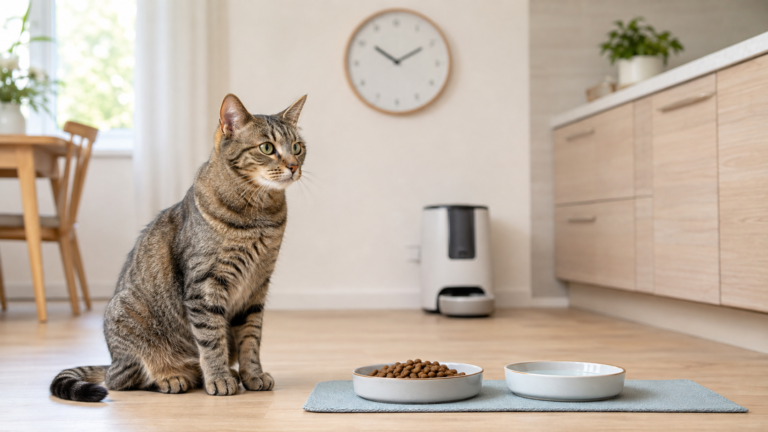
Set the switched-off feeder near the normal bowl. Do not immediately remove the familiar bowl or activate the machine. Allow your cat to look at, smell, and walk around the feeder.
Reward calm investigation, but do not lure your cat so close that it becomes uncomfortable. Some cats may approach within minutes; cautious cats may need several days.
Proceed when your cat can eat from the usual bowl, groom, play, or rest normally while the inactive feeder is present.
Step 2: Introduce the feeder’s bowl separately
If the automatic feeder has a removable bowl or tray, place that part beside the familiar bowl. Add a small amount of the usual food. You can initially put the familiar bowl immediately beside or, if stable and safe, within the feeder’s feeding area.
Gradually serve a larger share of one meal from the feeder bowl. Keep the machine inactive during this stage. The aim is to make the new eating surface familiar before adding sound or movement.
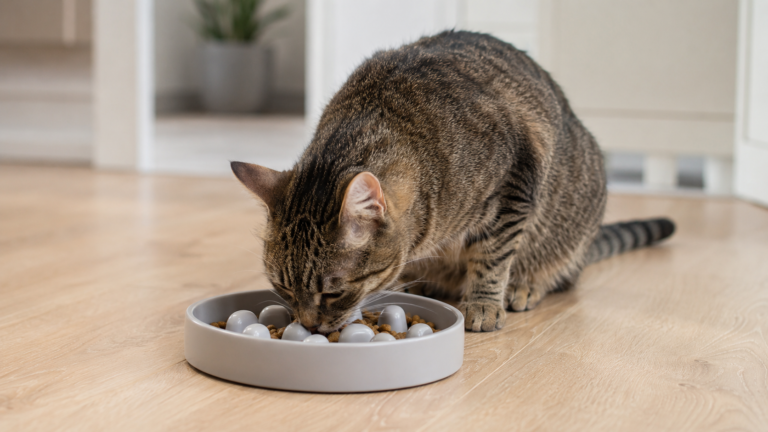
If your cat repeatedly takes food out of the bowl and eats from the floor, check whether the bowl is too deep, narrow, unstable, or reflective.
Step 3: Let the inactive feeder become the regular bowl
Once your cat willingly eats from the feeder bowl, place it back in the inactive feeder. Hand-serve one meal there as you normally would. Repeat until your cat approaches and eats without hesitation.
Do not rush ahead simply because your cat ate a few bites once. Look for relaxed, repeatable behavior over several meals.
Step 4: Introduce the sound at a comfortable distance
Activate a manual dispense or opening cycle while your cat is in the room but not leaning over the feeder. Start far enough away that the sound produces little or no fear response.
Immediately follow the sound with a preferred reward. This helps the noise predict something positive. If your cat startles but quickly recovers, make the next exposure quieter or more distant. If your cat runs away or hides, stop and return to an easier stage later.
Never repeatedly trigger the feeder in the hope that your cat will “get used to it.” Exposure that continues while the cat is frightened can strengthen the negative association.
Step 5: Pair the feeder’s action with food
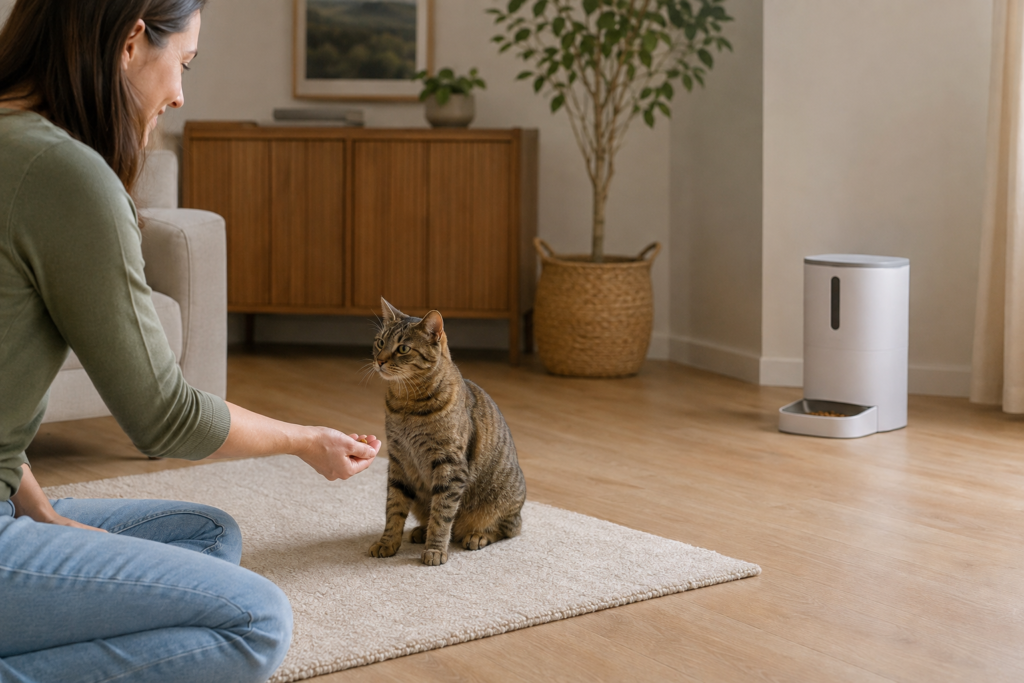
When the sound no longer causes obvious concern, dispense a very small amount of familiar food while your cat watches from a comfortable position. Let your cat decide whether to approach.
For a rotating feeder, begin with the lid or tray already open if the design permits it. Introduce movement only after the cat accepts the bowl. For a microchip feeder, use any manufacturer-provided training mode so the lid movement is introduced gradually.
Step 6: Serve one supervised automatic meal
Program one small meal at a time when you can observe. Confirm that:
- The feeder activates at the intended time.
- The programmed amount reaches the bowl.
- Your cat approaches rather than hiding.
- Your cat actually eats the meal.
- Another pet does not block access or steal the food.
Keep the remaining meals familiar at first. One successful supervised meal provides better information than switching the entire schedule overnight.
Step 7: Gradually increase automatic meals
After several relaxed, successful meals, add another automatic feeding. Maintain consistent times and make sure the total daily food allowance—not the number of feeder portions—remains appropriate.
Our guide to setting an automatic pet feeder schedule explains how to test portion output and divide the daily ration among meals.
Continue checking the feeder and your cat every day. Automation should support attentive care, not replace it.
If Your Cat Previously Free-Fed
If your cat previously had food available throughout the day, switching to an automatic feeder may also introduce a new meal schedule. Avoid changing both the feeding method and food availability abruptly. First help your cat become comfortable eating from the feeder, then gradually establish scheduled meals using an appropriate daily food allowance. If your cat has a medical condition, needs a special diet, or struggles with the schedule change, ask your veterinarian for individualized feeding guidance.
How Do You Know Your Cat Is Ready?
Your cat is ready for regular automatic feeding when it approaches the feeder voluntarily, remains relaxed when it activates, eats the expected meal, and repeats this behavior reliably over several feedings. Before relying on the feeder when you are not nearby, confirm that your cat also eats normally without you standing beside the device.
A Flexible Seven-Day Transition Plan
The following schedule is an example, not a deadline. Remain at any stage longer if your cat is uncertain. If fear increases, return to the last comfortable step.
Seven days is not a required training period. Some cats may progress faster, while cautious or noise-sensitive cats may need several weeks. Move forward based on your cat’s behavior and reliable eating, not the calendar.
| Approximate stage | What to do | Progress sign |
|---|---|---|
| Days 1–2 | Place the inactive feeder beside the normal feeding area. | The cat eats and behaves normally near it. |
| Days 2–3 | Offer familiar food from the removable feeder bowl. | The cat eats from the new bowl without repeatedly retreating. |
| Days 3–4 | Serve a meal from the bowl while it sits in the inactive feeder. | The cat approaches and eats comfortably. |
| Days 4–5 | Introduce one quiet activation at a distance and reward calm behavior. | Cat notices but does not flee or hide. |
| Days 5–6 | Dispense a small amount while you supervise. | The cat approaches and eats after activation. |
| Day 7 onward | Automate one meal, then gradually add others. | The cat reliably eats and maintains normal behavior. |
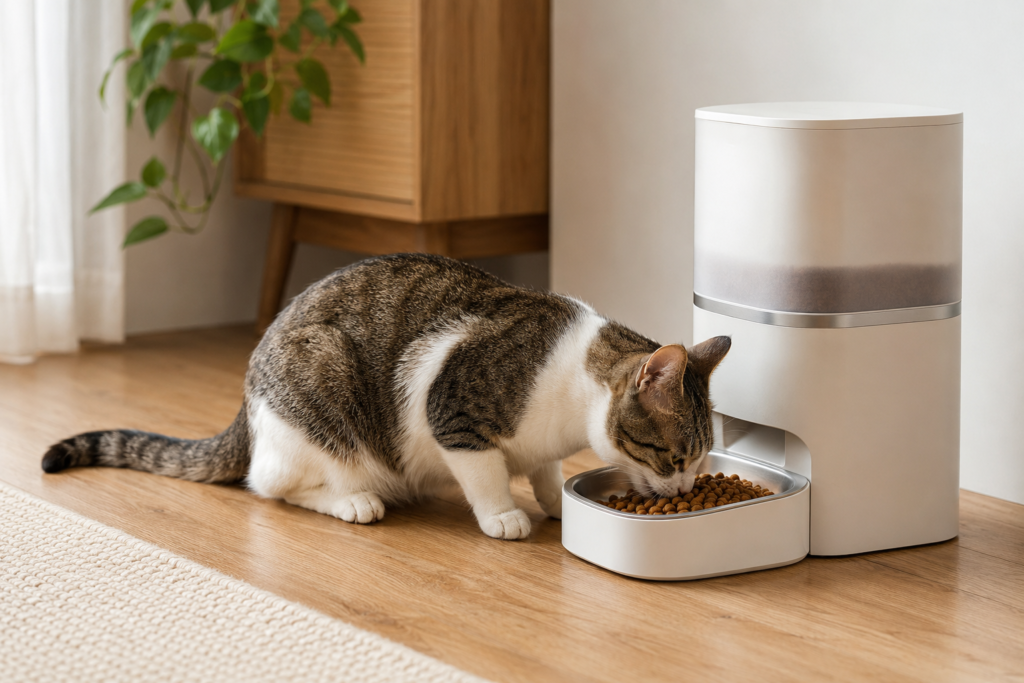
Adjusting Training for Different Feeder Types
Hopper-style dry-food feeders
The falling kibble may be louder than the motor. Begin with a very small manual portion and, where practical, increase the distance between the cat and the feeder during the first activation. Make sure the kibble size is compatible so an early jam does not produce unusual noises.
Rotating tray feeders
Movement close to the face can worry some cats. Let your cat eat from an open, stationary compartment before introducing rotation. Keep paws and whiskers clear when testing the mechanism.
Microchip or RFID feeders
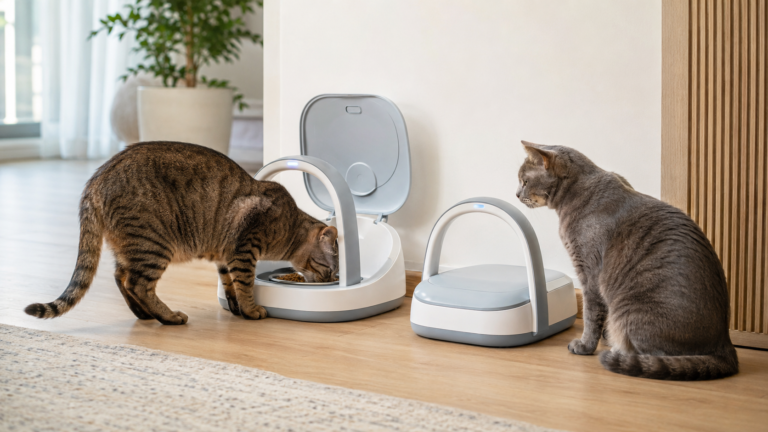
These require the cat to approach closely before a lid moves. Follow the manufacturer’s training mode rather than immediately using full lid movement. In a multi-cat household, supervise until each cat understands which station provides access.
Wet-food automatic feeders
Cold food can smell less noticeable to a cat, and rotating lids or refrigerated models may produce different sounds. Only use a model designed for the food type and follow its temperature and storage instructions. See our guide, Can You Put Wet Food in an Automatic Feeder?, for food safety and setup considerations.
Quick Guide: Why Your Cat Won’t Use the Automatic Feeder
| What you notice | What to do first |
|---|---|
| Cat avoids the feeder even when it is off | Keep it inactive and allow more time for familiarization. |
| Cat eats from the bowl but runs when the feeder activates | Introduce the sound or movement separately from a comfortable distance. |
| Cat approaches the feeder but does not eat | Check the food, bowl, smell, location, accessibility, and competition from other pets. |
| Cat used the feeder before but suddenly refuses it | Check for jams, unusual noises, food changes, and possible appetite or health problems. |
| Cat eats when supervised but not alone | Continue supervised automatic meals before increasing independent use. |
What If Your Cat Eats From the Feeder Only When You Are Nearby?
Reduce your presence gradually rather than moving straight from supervised meals to leaving the cat alone. Start beside the feeding area, then sit progressively farther away during successful meals. Once your cat continues eating comfortably while you are elsewhere in the room, briefly step out and return. Increase the time away only while your cat continues approaching and eating normally.
What If Your Cat Is Afraid of the Feeder’s Noise?
Move back to the inactive feeder stage. Test the mechanism away from your cat to rule out grinding, obstruction, or another abnormal sound. Then reintroduce the normal sound from farther away, at a low frequency, paired with a valued reward.
Keep sessions short and end while your cat is still calm. Signs that the exposure is too intense include:
- Running away or hiding
- Crouching or freezing
- Flattened ears
- Dilated pupils
- Tail tucked tightly or lashing
- Refusal to approach the feeding area
- Reduced eating after the session
Do not punish your cat for showing fear, carry it to the feeder, or restrain it beside the machine. If the normal operating sound remains intolerable despite a slow introduction, that feeder may not suit your cat.
What If Your Cat Is Not Eating From the Automatic Feeder?
Check the complete feeding setup rather than assuming stubbornness:
- Confirm that the correct food was dispensed and is fresh.
- Check whether the bowl moves, reflects light, or retains an unfamiliar smell.
- Make sure the bowl is easy to reach and comfortable for your cat’s body size and mobility.
- Observe whether another pet is guarding the route or feeding station.
- Confirm that portions have not become too large, too small, or too frequent.
- Offer the same food in the familiar bowl to help distinguish feeder avoidance from appetite loss.
If your cat refuses both the feeder and its familiar bowl, consider this a possible health problem rather than a training setback.
If your cat eats normally from the familiar bowl but not from the automatic feeder, the problem is more likely related to the feeder setup or transition. Return to the last stage where your cat ate comfortably, then reintroduce the bowl, sound, or movement gradually rather than withholding the familiar feeding option.
Introducing Automatic Feeders in a Multi-Cat Home
Train each cat at its own pace. A confident cat can crowd the feeder and make a cautious cat appear unwilling to use it. Where possible:
- Provide separated feeding stations.
- Introduce one feeder or one cat at a time.
- Prevent food stealing during supervised practice.
- Ensure every cat has an unobstructed route to and from its feeding area.
- Watch for guarding, staring, chasing, or blocking.
If cats need different foods, portions, or prescription diets, a selective-access design may be more appropriate than an open bowl. Our guide to automatic cat feeders for multiple cats discusses microchip, RFID, and separate-station options.
Common Automatic-Feeder Training Mistakes
Removing the old bowl immediately
This can turn the transition into an all-or-nothing situation. Keep a safe, familiar feeding option while the cat learns.
Forcing the cat to approach
Holding, pushing, or trapping a cat near a feared feeder can worsen the association and reduce trust.
Changing the food at the same time
If the cat refuses the meal, you will not know whether the feeder or the new food is responsible.
Activating the feeder beside the cat without preparation
A sudden first activation may be especially frightening with rotating lids, mechanical trays, or noisy kibble delivery.
Advancing according to the calendar
The cat’s behavior—not the day number—determines when to proceed.
Assuming food in the bowl means the cat ate
Measure or visually check leftovers. In a multi-cat home, identify which animal actually consumed the food.
Using hunger as pressure
Do not withhold an appropriate alternative simply to force acceptance. A cat that is frightened enough to avoid food needs a slower plan, and a cat with poor appetite may need veterinary care.
When Should You Pause Training and Contact a Veterinarian?
Pause the transition if your cat’s food intake drops substantially, it refuses familiar food, loses weight, vomits repeatedly, appears lethargic, or shows signs of pain.
The Cornell Feline Health Center explains that appetite loss can accompany many medical problems and may seriously affect a mature cat’s health if it persists for as little as 24 hours. Food avoidance can also have behavioral causes, but those should not be assumed before health concerns are considered.
Cats with diabetes, kidney disease, gastrointestinal illness, prescribed diets, or medication tied to meals require an individualized feeding plan. Consult the veterinarian responsible for their care before making substantial changes to meal timing or food access.
Frequently Asked Questions
How long does it take for cats to get used to an automatic feeder?
Some cats accept a feeder within a day or two, while cautious or noise-sensitive cats may need several weeks. Progress should be based on relaxed behavior and reliable eating, not a fixed deadline.
Should I leave the automatic feeder switched off at first?
Yes. Allowing your cat to investigate and eat from the bowl while the feeder is inactive separates familiarity with the object from its sound and movement.
What should I do if my cat runs away when food dispenses?
Stop activating it close to the cat. Return to the last comfortable stage, test for abnormal noise, and reintroduce the sound from farther away while pairing calm behavior with a preferred reward.
Can I put treats in the automatic feeder during training?
If the treats are compatible with the feeder and appropriate for your cat, a small amount can create a positive association. Count treats within the daily food allowance. Play or gentle attention may work better for cats that are not food-motivated.
Should I remove my cat’s normal bowl?
Not at the beginning. Gradually reduce reliance on the familiar bowl after your cat repeatedly eats from the inactive feeder and tolerates its operation.
Can an older cat learn to use an automatic feeder?
Yes, but consider hearing, vision, dental health, mobility, and sensitivity to change. The bowl and feeding position must be comfortable and accessible. A slower introduction may be appropriate.
Why does my cat stare at the automatic feeder all day?
The cat may have learned that the feeder predicts food, but persistent fixation can also reflect hunger, boredom, an unsuitable schedule, or an inadequate ration. Confirm the daily amount with your veterinarian, preserve play and social interaction, and do not use the feeder as a substitute for enrichment.
Can I rely on an automatic feeder while I am away?
Do not assume successful training eliminates the need for daily human checks. Feeders can jam, lose power, or be tipped over, and cats can become ill. Arrange responsible care and monitoring appropriate to the length of your absence.
Before relying on scheduled feeding, also understand what your feeder will do if Wi-Fi, internet service, or household power fails. Our guide explains how automatic feeders behave offline and which backup checks matter.
Final Recap
The best way to get your cat used to an automatic feeder is to make the transition gradually and divide training into manageable steps. First, make the inactive feeder familiar. Then introduce its bowl, sound, and movement separately. Pair calm exploration with something your cat values and automate only one supervised meal at first.
Patience is more effective than pressure. If your cat becomes frightened, return to an easier step. If it stops eating familiar food or appears unwell, treat the situation as a potential health concern and contact your veterinarian.
Once your cat is comfortable, verify portion output and build a consistent routine using our automatic pet feeder schedule guide. A properly introduced feeder should make meals more predictable without making your cat feel unsafe.