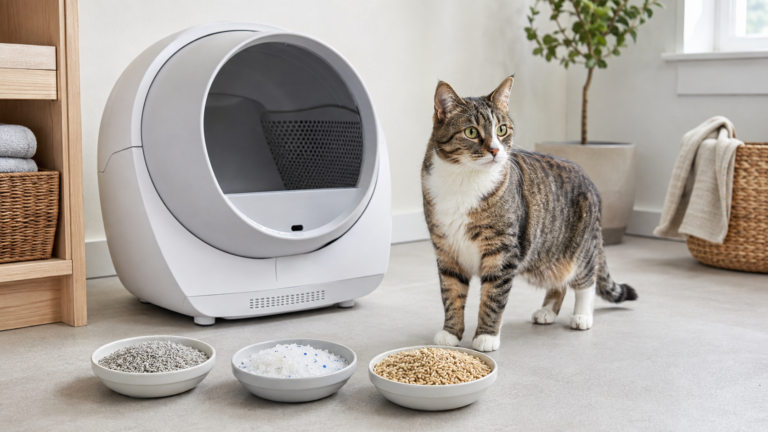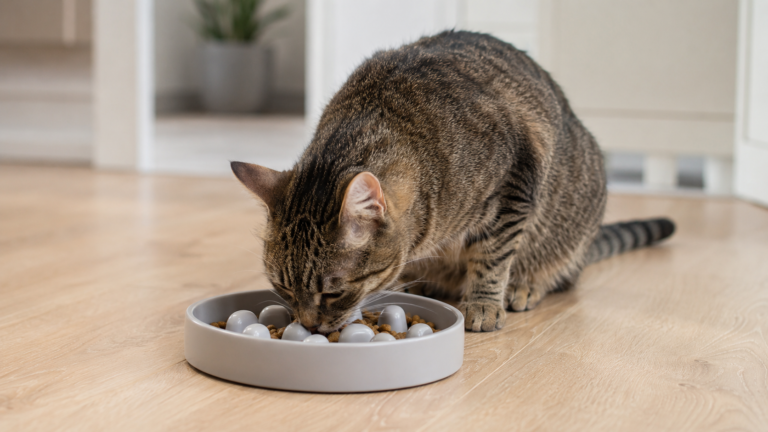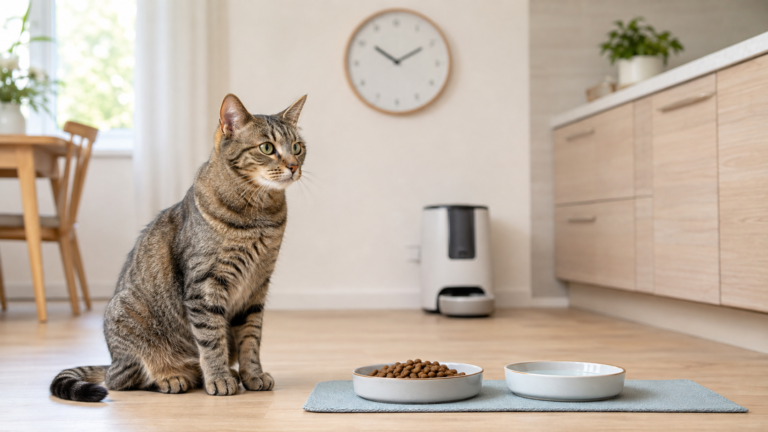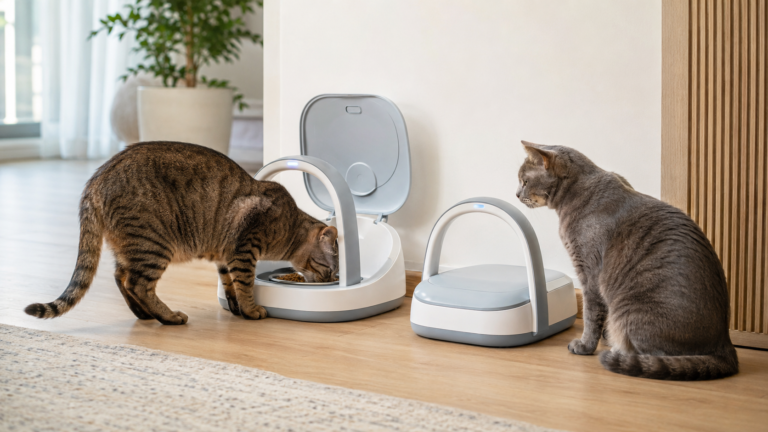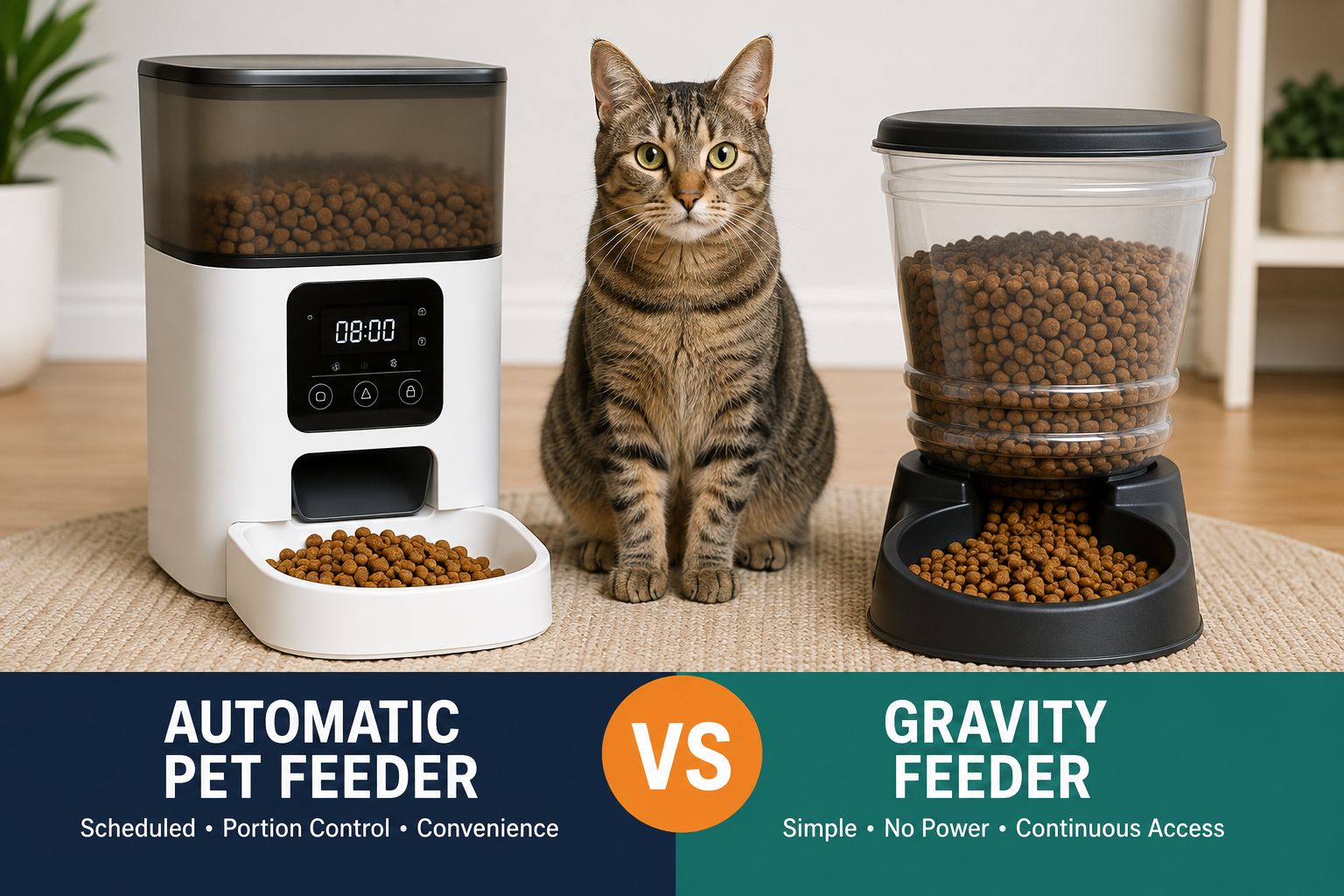
Choosing between an automatic pet feeder vs gravity feeder comes down to more than convenience. Both can reduce the need to manually fill your cat’s bowl at every mealtime, but they manage food in very different ways.
A gravity feeder continually replenishes the bowl as your cat eats. A programmable automatic feeder dispenses food at scheduled times, usually in measured portions. That difference can affect portion control, feeding routines, reliability, food freshness, multi-cat households, and how easily you can monitor your cat’s food intake.
So, which is better?
Neither feeder is universally better for every cat. The right choice depends on whether your cat benefits from scheduled, measured meals or can appropriately self-regulate when dry food remains continuously available.
This guide compares automatic pet feeders vs gravity feeders so you can choose the feeding system that best fits your cat’s needs and your household routine.
Quick Answer: Automatic Feeder vs Gravity Feeder
An automatic feeder is generally more suitable when you want scheduled meals, measured portions, or greater control over when food is dispensed.
A gravity feeder prioritizes simplicity. It continually replenishes dry food without requiring electricity, batteries, Wi-Fi, or programming.
The real question isn’t which feeder has more technology. It is which feeding method appropriately supports your cat’s needs.
Key Takeaways
- Programmable automatic feeders can control when and approximately how much food is dispensed; gravity feeders generally keep the bowl replenished.
- Gravity feeders have fewer electronic or mechanical components, but they can still develop food-flow problems and usually don’t provide portion control or scheduled meals.
- Automatic feeders can make structured feeding plans easier to follow, but their actual portion output should be tested.
- Neither a standard automatic feeder nor a gravity feeder necessarily prevents one cat from eating another cat’s food in a multi-cat home.
- Your cat’s health, eating behavior, feeding plan, and household routine should determine the choice—not the amount of technology in the feeder.
What Is an Automatic Pet Feeder?
An automatic pet feeder releases food without requiring you to manually serve every meal.
Many dry-food models use a hopper to store kibble and an electronic dispensing mechanism. You set feeding times and portion settings, and the feeder dispenses food according to that schedule.
Depending on the model, an automatic feeder may offer:
- Multiple scheduled meals per day
- Adjustable portion settings
- Digital controls
- Battery backup
- Wi-Fi connectivity
- Smartphone app controls
- Feeding notifications
- Low-food alerts
- Feeding history
- Cameras or other monitoring features
Not every automatic feeder includes these features. A simple timed feeder can be very different from a Wi-Fi-connected smart feeder.
The defining characteristic is that food is released according to a controlled mechanism or schedule instead of simply remaining continuously available.
What Is a Gravity Feeder?
A gravity feeder is considerably simpler.
It typically consists of a food reservoir positioned above a feeding bowl. As your cat eats and the level in the bowl drops, gravity allows more kibble to move from the reservoir into the bowl.
A basic gravity feeder usually requires:
- No motor
- No timer
- No app
- No Wi-Fi
- No electrical outlet
- No batteries
That simplicity is one of its main advantages.
However, it also creates an important limitation: a gravity feeder normally replenishes the bowl rather than measuring individual meals.
As a result, your cat may have access to dry food throughout the day.
Automatic Pet Feeder vs Gravity Feeder: Key Differences
| Feature | Automatic Feeder | Gravity Feeder |
|---|---|---|
| Feeding method | Scheduled dispensing | Continuous replenishment |
| Food access | Available according to the programmed schedule | Generally remains continuously available |
| Portion control | Usually available | Generally not available |
| Scheduled meals | Yes | No |
| Power required | Usually electricity and/or batteries | No |
| Wi-Fi required | Only for connected models/features | No |
| App control | Available on some models | No |
| Complexity | Moderate to high | Very low |
| Electronic failure points | Possible | None on basic models |
| Best suited to | Structured feeding | Appropriate free-feeding situations |
| Typical maintenance | Bowl, hopper and dispensing components | Bowl and reservoir |
In simple terms:
Gravity feeders prioritize simplicity and continuous food availability, while automatic feeders prioritize timing and control.
It helps to separate three kinds of feeding control: when food becomes available, how much food is provided, and which cat can access it. A programmable automatic feeder can usually control the first two, while a standard gravity feeder generally controls neither. Neither standard design normally controls which cat eats the food; that requires separate feeding arrangements or an individual-access feeder such as a microchip- or RFID-controlled model.
Portion Control
Portion control is one of the biggest differences between these feeding systems.
With a typical gravity feeder, the bowl refills as food is eaten. The feeder doesn’t normally measure how much your cat consumes.
A programmable automatic feeder can instead release a selected amount at specific times, making it easier to divide a cat’s daily food allowance into several meals.
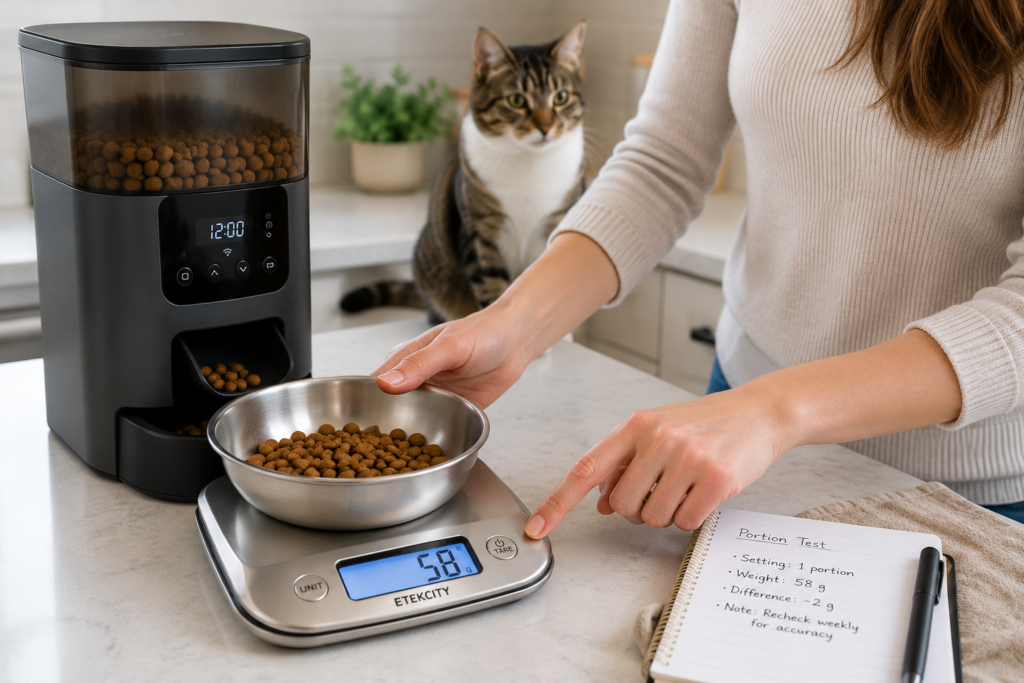
However, don’t assume that every automatic feeder dispenses perfectly precise portions.
Actual output can vary because of the following:
- Kibble size
- Kibble shape
- Dispensing mechanism
- Portion-setting increments
- How food settles inside the hopper
When setting up a new automatic feeder, dispense several test portions and weigh the actual output on a digital kitchen scale.
This gives you a much better idea of what the feeder’s portion setting means with your cat’s particular food.
If you want to verify dispensing accuracy more precisely, see our guide to how accurate automatic pet feeders are and how to test portion sizes.
For a more detailed approach to meal timing and portion setup, see our guide on how to set up an automatic pet feeder schedule.
Scheduled Feeding vs Free Feeding
This is the fundamental difference between the two feeder types.
A gravity feeder and free feeding are related, but they are not exactly the same thing. A gravity feeder is the device that replenishes the bowl, while free feeding is the feeding method in which food remains available for the cat to eat throughout the day. Gravity feeders commonly support free feeding because they continuously replace food as the bowl empties.
Gravity Feeder
Food generally remains available, and your cat decides when and how much to eat from the available supply.
Automatic Feeder
You determine when food becomes available and approximately how much is dispensed at each scheduled meal.
Neither approach is automatically appropriate for every cat.
Some cats may maintain an appropriate intake when food is continuously available, while others may consume more than intended.
Continuous access can also make changes in appetite harder to notice because food is replenished rather than presented as clearly separated meals. With scheduled feeding, it may be easier to observe whether a cat approaches a meal and how much food remains afterward, although an automatic feeder still cannot confirm that the cat actually ate unless you check.
If your cat tends to overeat, follows a weight-management program, or needs carefully measured food, unrestricted access may not be appropriate.
When feeding is part of managing a health condition or body weight, veterinary guidance should take priority over the feeder’s default settings.
If your cat currently free-feeds from a gravity feeder and you want to switch to scheduled automatic feeding, avoid treating the change as simply replacing one device with another. The cat is also moving from continuous food access to defined mealtimes. Introduce the new routine gradually where appropriate, monitor whether your cat eats the scheduled portions normally, and seek veterinary guidance if meal timing or food availability is important to a medical or weight-management plan.
The Feline Veterinary Medical Association’s feline feeding guidance also encourages feeding approaches that support cats’ natural behavior, including multiple small meals and appropriate individual feeding arrangements.
Which Is Better for Weight Management?
An automatic feeder has a practical advantage when a feeding plan requires measured portions at predetermined times.
That doesn’t mean an automatic feeder causes weight loss.
Weight management depends on factors including overall calorie intake, diet, activity level, health, and an appropriate feeding plan.
The feeder is simply a tool that may make a structured plan easier to follow. The Cornell Feline Health Center similarly recommends working with your veterinarian to determine an appropriate body weight and adjust your cat’s diet to reach and maintain that weight.
For example, instead of leaving an entire day’s food accessible at once, an appropriate daily allowance can be divided into several scheduled meals.
A standard gravity feeder generally cannot provide the same degree of portion control because the bowl is replenished as food is eaten.
When to Ask Your Veterinarian
If your cat is overweight, underweight, diabetic, has urinary or digestive problems, requires a therapeutic diet, or has another condition affecting feeding, don’t determine portions solely from an automatic feeder’s instructions.
Ask your veterinarian how much and how often your cat should eat, then configure the feeder to support that plan.
Reliability: Gravity Feeder vs Automatic Feeder
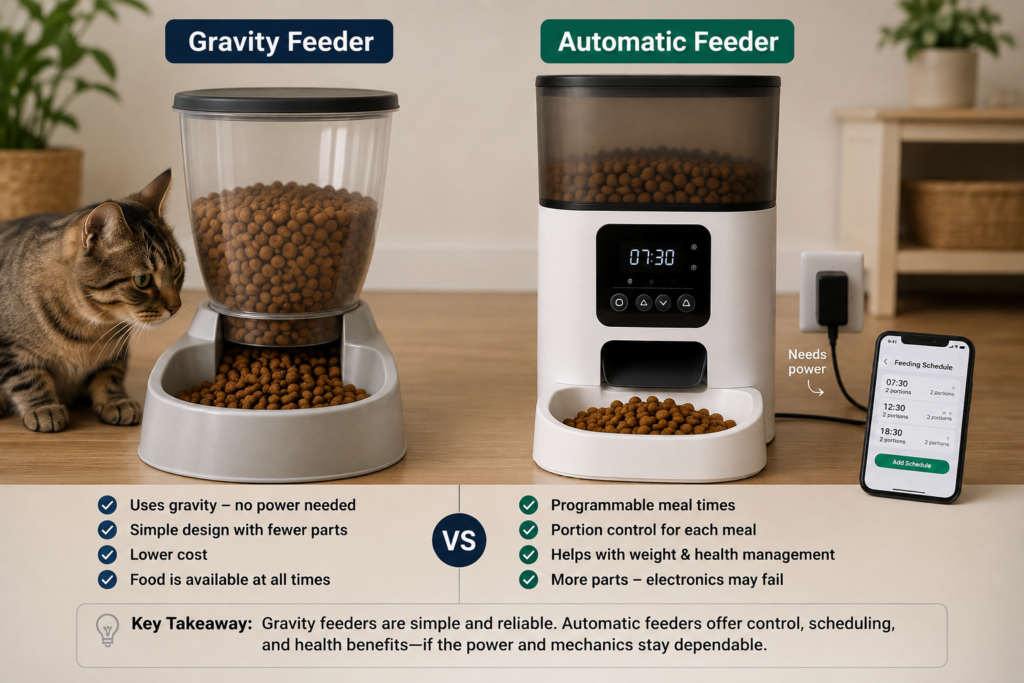
Reliability is more complicated than simply saying one feeder is better.
Gravity Feeder Reliability
A basic gravity feeder has very few components that can fail.
There is normally no:
- Software
- Wi-Fi connection
- Motor
- Electronic timer
- Firmware
- Power supply
That simplicity can be an advantage.
However, gravity feeders aren’t completely failure-proof. Depending on the food and feeder design, kibble can occasionally bridge, become stuck, or fail to flow smoothly.
The bowl or dispensing opening can also become dirty or obstructed. So, while a gravity feeder eliminates electronic failure points, it does not eliminate food-flow problems. Kibble size and shape, crumbs, an obstructed outlet, or the way food settles in the reservoir can affect whether dry food moves freely into the bowl.
Automatic Feeder Reliability
Automatic feeders have more potential points of failure, including:
- Kibble jams
- Incorrect portion settings
- Motor problems
- Power loss
- Depleted batteries
- Incorrect clock or schedule settings
- App, Wi-Fi, internet, or manufacturer online-service problems on connected models
A well-designed automatic feeder can still be reliable, but it requires regular checking rather than a “set it and forget it” approach.
If your feeder stops releasing food, our automatic pet feeder troubleshooting guide explains the most common causes and practical checks.
What Happens During a Power Outage?
A basic gravity feeder is unaffected by a household power outage because it doesn’t require electricity.
An electronic automatic feeder is different.
Some models can operate from an AC adapter with backup batteries, while others use different power arrangements. For example, PetSafe’s Smart Feed documentation describes an optional battery-backup system designed to maintain regularly scheduled feedings if household power is lost.
If power-outage reliability matters to you, check the manufacturer’s documentation for your particular feeder rather than assuming it will continue operating.
Useful precautions include:
- Install fresh backup batteries if supported
- Test battery operation before relying on it
- Confirm whether feeding schedules remain stored after a power interruption
- Check the feeder after an outage
- Understand what happens if both electricity and internet connectivity are unavailable
The exact behavior varies by model.
For a deeper look at offline feeding, backup power, and internet outages, see our guide to how automatic pet feeders work without Wi-Fi.
Does a Smart Feeder Stop Working Without Wi-Fi?
Not necessarily.
This is an important distinction between power dependency and internet dependency.
Some Wi-Fi-enabled automatic feeders store feeding schedules locally and may continue scheduled dispensing during a temporary internet outage.
For example, PetSafe’s Smart Feed support guidance states that its feeder continues previously scheduled feedings while offline as long as the feeder still has power.
However, internet-dependent features such as remote commands, notifications, feeding-history synchronization, camera access, or app-based schedule changes may become unavailable.
Other models may behave differently.
Never assume that every smart feeder handles a Wi-Fi outage in the same way. Check the manufacturer’s documentation for your specific model.
Food Freshness
Neither feeder type automatically guarantees fresh food. A large food reservoir can reduce how often you refill either feeder, but capacity should not be confused with freshness. Storing more kibble in a feeder for longer periods can increase the importance of moisture control, regular inspection, cleaning, and following the food manufacturer’s storage instructions.
A large gravity feeder may hold kibble for an extended period, while food sitting exposed in the bowl remains in contact with the surrounding air.
Automatic feeders also store food in a hopper. Some models use seals, lids, or desiccant systems intended to help reduce exposure to air and moisture, but these features don’t eliminate the need for proper storage and cleaning.
Regardless of feeder type:
- Don’t overfill the feeder unnecessarily
- Keep kibble dry
- Store the main food supply according to the pet-food manufacturer’s instructions
- Wash food-contact surfaces regularly
- Discard food that smells unusual, appears damp, or shows signs of contamination
- Check stored food regularly rather than assuming it remains fresh because it is inside a feeder
A feeder is a dispensing device—not a substitute for proper pet-food storage.
Cleaning and Maintenance
Both types of feeders need regular cleaning.
Gravity Feeders
Cleaning is generally straightforward because there are fewer components.
Typical maintenance involves:
- Emptying the reservoir
- Washing the food bowl
- Cleaning the food container
- Removing food residue
- Drying all food-contact parts thoroughly before refilling
Automatic Feeders
Automatic feeders can require more attention because crumbs and food oils may accumulate around the dispensing mechanism.
Depending on the model, cleaning may involve:
- Food bowl
- Hopper
- Hopper lid
- Dispensing rotor
- Food chute
- Removable internal components
Never immerse an electronic base unless the manufacturer specifically states that it is washable.
Always follow the cleaning instructions supplied with your particular feeder. The FDA’s pet-food storage guidance also recommends washing and drying pet-food bowls and scooping utensils after each use, which helps reinforce the importance of keeping food-contact surfaces clean.
For a complete cleaning routine, see our step-by-step guide to cleaning an automatic pet feeder.
Which Is Better for Busy Cat Owners?
Both feeder types can reduce manual feeding work, but they solve different problems.
A gravity feeder reduces refilling frequency.
An automatic feeder reduces meal-timing dependence.
For example, if your cat normally eats breakfast at 6:00 a.m. but your daily schedule varies, a programmable feeder can dispense the meal at the scheduled time without requiring you to be standing beside the bowl.
An automatic feeder can also divide an appropriate daily allowance into several smaller meals.
A gravity feeder cannot reproduce the same meal schedule because food generally remains accessible.
Can an Automatic Feeder Help With Early-Morning Meowing?
It may help in some households.
If your cat strongly associates you waking up with receiving breakfast, an automatic feeder may help shift that association because the food is dispensed by the feeder rather than directly by you.
A scheduled early-morning meal may therefore form part of a consistent feeding routine. The Feline Veterinary Medical Association’s behavior guidance similarly suggests using a timed automatic feeder that opens before a cat would normally wake its caregiver, helping remove the caregiver from the feeding routine.
However, persistent or sudden vocalization can have many causes.
If your cat suddenly develops unusual hunger, persistent meowing, or significant behavioral changes, don’t assume the feeder is the solution. Consider discussing the change with your veterinarian.
Automatic vs Gravity Feeders in Multi-Cat Homes
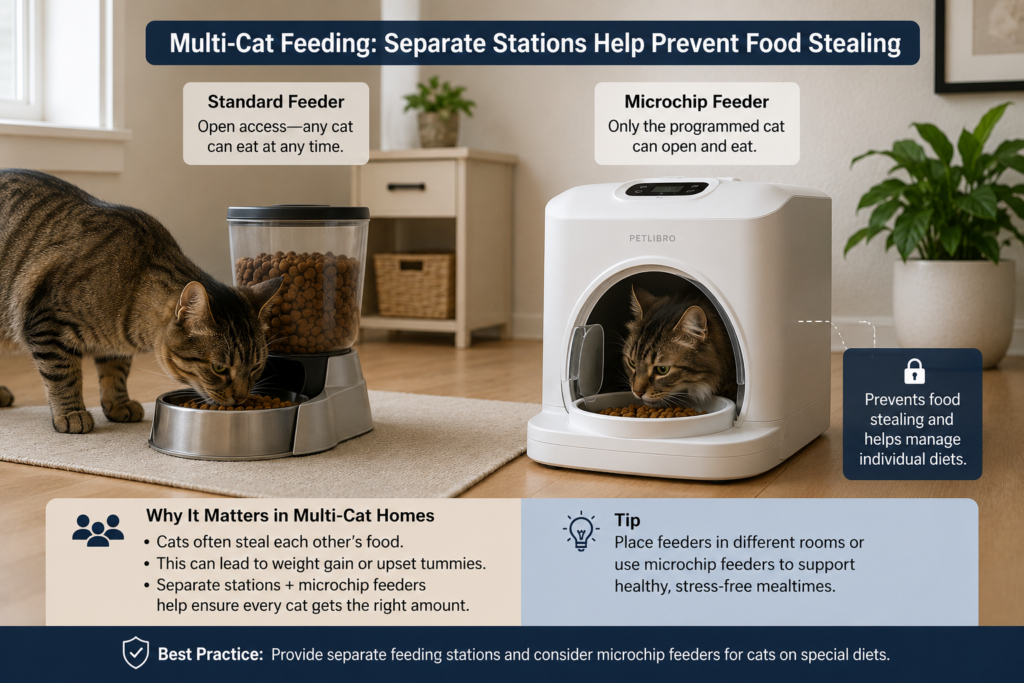
Multi-cat households require special consideration.
Imagine two cats:
Cat A eats slowly.
Cat B finishes quickly and then moves to Cat A’s bowl.
A standard gravity feeder cannot identify which cat is eating.
A standard automatic feeder usually cannot either.
Simply changing from a gravity feeder to a timed automatic feeder, therefore, doesn’t necessarily solve food stealing.
Some specialized feeders use a pet’s implanted microchip or a compatible RFID tag to control access. Individual-access feeders can be useful when cats:
- Eat different foods
- Require different portions
- Follow different feeding plans
- Need therapeutic diets
- Regularly steal food from one another
Research involving an individualized automatic feeding system in multi-cat households with overweight cats has also examined how controlled individual access can support structured weight-management programs.
However, that finding should not be generalized to every automatic feeder. Standard timed feeders and individual-access feeding systems solve different problems. For more practical options, see our guide to automatic pet feeders for multiple cats.
Ease of Use
Gravity Feeders
A gravity feeder is usually the easier option.
Fill the reservoir, position it correctly, keep it clean, and regularly monitor the food supply and your cat’s eating habits.
That simplicity reduces setup requirements, but it does not make the feeder maintenance-free. You still need to check that food is flowing freely, the bowl and outlet remain clean, and your cat is eating normally.
Automatic Feeders
An automatic feeder requires more initial setup.
Depending on the model, you may need to:
- Assemble the feeder.
- Install batteries or connect the power adapter.
- Set the clock.
- Program feeding times.
- Configure portion settings.
- Test several dispensing cycles.
- Connect the feeder to an app if applicable.
- Weigh the actual food output.
- Test backup power if available.
Once properly configured, daily operation can become very convenient.
Cost Considerations
Gravity feeders are generally simpler products and often cost less than electronic automatic feeders.
Automatic feeders range from basic timed devices to more sophisticated connected systems with cameras, app controls, RFID or microchip access, and other smart features.
But cost alone shouldn’t determine your decision. The better value is the feeder that reliably solves your actual feeding problem without adding features you do not need.
Ask yourself:
Which features will I genuinely use?
There is little value in paying extra for a camera, voice recording, detailed app analytics, or other connected features if all you need is reliable scheduled dispensing.
Conversely, choosing a basic gravity feeder solely because it is inexpensive may not be appropriate if your cat needs measured meals.
Pros and Cons of Automatic Pet Feeders
Pros
- Scheduled meals
- Greater control over portions
- Useful for dividing food into multiple smaller meals
- Helpful when owner schedules vary
- Some models provide battery backup
- Smart models may offer remote controls and notifications
- Can support a structured feeding routine
Cons
- Generally more expensive than basic gravity feeders
- Requires initial setup
- Electronic or mechanical components can fail
- Kibble can jam
- Actual portion output should be tested
- Some smart features depend on Wi-Fi, internet access, or the manufacturer’s online service
- Cleaning can be more involved
- Advanced features may be unnecessary for some households
Pros and Cons of Gravity Feeders
Pros
- Simple operation
- No electricity required
- No batteries
- No Wi-Fi
- Few components
- Usually inexpensive
- Straightforward cleaning
- Keeps dry food continuously available
Cons
- Little or no portion control
- Cannot schedule individual meals
- May not suit cats that overeat
- Makes individual intake difficult to monitor
- Doesn’t prevent food stealing in multi-cat households
- Food remains continuously accessible
- Kibble can bridge, stick, or become obstructed at the outlet
- No remote monitoring or feeding history
Still deciding whether automated feeding makes sense for your household? Our guide to whether automatic pet feeders are worth it looks more broadly at their advantages, limitations, and everyday use.
Which Feeder Fits Your Household?
Rather than asking which feeder is universally “best,” consider the feeding problem you actually need to solve.
You Might Prefer an Automatic Feeder If:
- Your cat eats scheduled meals
- You want to divide the daily food allowance into several portions
- Your schedule makes consistent manual feeding difficult
- You want scheduled feeding but don’t necessarily need Wi-Fi or app-based controls
- Controlled food access is important
- Your veterinarian has recommended measured feeding
- You want feeding notifications or remote features
- Early-morning feeding is disrupting your routine
Choose the functions you actually need rather than automatically selecting the feeder with the most technology.
You Might Prefer a Gravity Feeder If:
- Your cat appropriately self-regulates food intake
- Continuous access to dry food is intentional
- Portion control isn’t currently required
- You prefer maximum simplicity
- You don’t want electronic components
- You want a feeder unaffected by electricity or internet outages
Even then, continue monitoring your cat’s weight and eating habits rather than assuming that an always-full bowl will remain appropriate indefinitely.
Feeding requirements can change with age, activity level, body condition, and health.
Consider an Individual-Access Feeder If:
Your main concern isn’t when food is served but which pet can access it.
A microchip- or RFID-controlled feeder may be worth considering when cats require different diets or one repeatedly steals another’s food. To understand how selective access works, including the difference between implanted microchip and RFID-tag systems, see our guide to microchip feeders for cats.
When Neither Feeder Should Make the Decision for You
Technology should support a feeding plan—not create one.
If your cat has:
- Significant unexplained weight gain or loss
- Diabetes
- Kidney disease
- Urinary disease
- Digestive problems
- Food allergies
- A prescription or therapeutic diet
- Unexplained increased hunger
- Reduced appetite
- Difficulty eating
The first question shouldn’t be:
“Which feeder should I buy?”
It should be:
“What feeding plan does my cat need?”
Once an appropriate plan has been established with veterinary guidance, choose a feeder that helps you implement it consistently.
Common Mistakes When Choosing a Pet Feeder
- Assuming “automatic” means “smart.” Not every automatic feeder needs Wi-Fi or an app. A basic timed model may provide everything you need.
- Assuming gravity feeding provides portion control. Most basic gravity feeders replenish the bowl rather than dispense measured meals.
- Trusting automatic portion settings without testing them. Weigh several actual portions before relying on the feeder’s settings.
- Ignoring backup power. If you depend on an electronic feeder, understand what happens during a power failure.
- Assuming an automatic feeder solves multi-cat food stealing. Most standard automatic feeders cannot identify individual cats.
- Filling the hopper and forgetting about it. Every feeder needs regular inspection, cleaning, and food-freshness checks.
- Treating a feeder as a substitute for attentive care. Feeding technology adds convenience, but you still need to monitor appetite, eating behavior, water intake, body condition, and overall health.
Automatic Feeder vs Gravity Feeder: Simple Decision Guide
Choose based on CONTROL:
Consider an automatic feeder when you need scheduled meals, measured portions, or greater control over when food is dispensed.
Choose based on SIMPLICITY:
Consider a gravity feeder when continuous access to dry food is appropriate for your cat, and you don’t need scheduled or measured dispensing.
Choose based on RELIABILITY NEEDS:
If avoiding electronic, power, and connectivity dependencies is the priority, a basic gravity feeder has fewer failure points. If scheduled feeding is necessary, compare automatic feeders by dispensing reliability, backup power, offline behavior, and how easily you can verify that meals were dispensed.
Choose based on INDIVIDUAL ACCESS:
Consider a microchip- or RFID-controlled feeder when the main problem is determining which cat can access the food.
The right feeder is the one that supports the feeding approach your cat actually needs.
Frequently Asked Questions
Is an automatic feeder better than a gravity feeder for cats?
Not universally. Automatic feeders provide greater control over meal timing and portions, while gravity feeders provide simplicity and continuous food access. The appropriate choice depends on your cat’s feeding needs, eating behavior, and household routine.
Are gravity feeders safe for cats?
A gravity feeder can be used safely when it is appropriate for the individual cat, kept clean, filled with properly stored dry food, and checked regularly to make sure food is flowing freely. Safety also depends on whether unrestricted food access is appropriate for that cat’s feeding and health needs.
Is a Gravity Feeder Good for Cats?
A gravity feeder can be a good option for some cats when continuous access to dry food is intentional and the cat appropriately self-regulates its intake. It may be a poor fit when a cat overeats, requires measured meals, follows a weight-management or therapeutic feeding plan, or lives with another pet that steals food.
The key question is not whether gravity feeders are universally good or bad for cats, but whether continuous food access is appropriate for the individual cat.
Can cats overeat from a gravity feeder?
Some cats may consume more food than intended when food is continuously available. If your cat doesn’t appropriately self-regulate its intake, a measured feeding approach may be more suitable.
Do automatic feeders work if Wi-Fi goes out?
Some smart feeders can continue a feeding schedule stored locally on the device even when Wi-Fi is unavailable, while internet-dependent features may stop working. This varies by model, so check the manufacturer’s documentation.
Do automatic feeders work during a power outage?
Some models support backup batteries or another secondary power source, but this varies. Test the backup system rather than assuming it will work when needed.
Can automatic feeders dispense wet food?
Some automatic feeders are specifically designed for wet food, typically using covered compartments and, in some designs, cooling features. Traditional hopper-style dry-food feeders shouldn’t be used for wet food unless the manufacturer specifically states that the model supports it.
For more details on food safety, feeder types, and practical limitations, see our guide to using wet food in an automatic pet feeder.
Can an automatic feeder help with weight control?
It can help consistently dispense measured meals, but the feeder itself isn’t a weight-loss treatment. Appropriate calorie intake and feeding frequency should be determined according to your cat’s individual needs, with veterinary guidance when weight management or a health condition is involved.
Are gravity feeders suitable for multiple cats?
They can make food available to multiple cats, but they generally cannot control which cat eats or how much each cat consumes. If individual food access matters, separate feeding arrangements or an individual-access feeder may be more appropriate.
Is a gravity feeder cheaper than an automatic feeder?
Gravity feeders are generally simpler and often less expensive than electronic automatic feeders. However, price varies by design and features, and the lowest-cost option isn’t necessarily the most appropriate one for your cat’s feeding needs.
Can I leave my cat alone because I have an automatic feeder?
An automatic feeder can make scheduled feeding more convenient, but it shouldn’t be treated as a replacement for appropriate human supervision and care. Cats still need fresh water, a clean environment, health monitoring, social interaction, and someone able to respond if the feeder fails or the cat becomes unwell.
For a more detailed look at supervision, time limits, feeder reliability, and vacation planning, see our guide to leaving a cat alone with an automatic feeder.
Final Thoughts
The choice between an automatic pet feeder and a gravity feeder isn’t simply about high-tech versus low-tech.
It is primarily about control versus continuous access.
A gravity feeder offers simplicity. It requires no programming, electricity, Wi-Fi, or batteries and can keep dry food available when continuous access is appropriate for your cat.
An automatic feeder adds structure. It can dispense food at scheduled times, divide an appropriate daily allowance into several meals, and reduce your dependence on being physically present at every feeding time.
Neither feeder is automatically right for every cat.
Start with your cat’s feeding requirements, eating behavior, body condition, and health. Then consider your household routine and choose the feeder—and level of technology—that genuinely supports those needs.
Most importantly, continue monitoring how your cat actually eats after introducing either system.
A feeder can dispense food, but it can’t replace your attention to your cat’s health, appetite, and overall well-being.