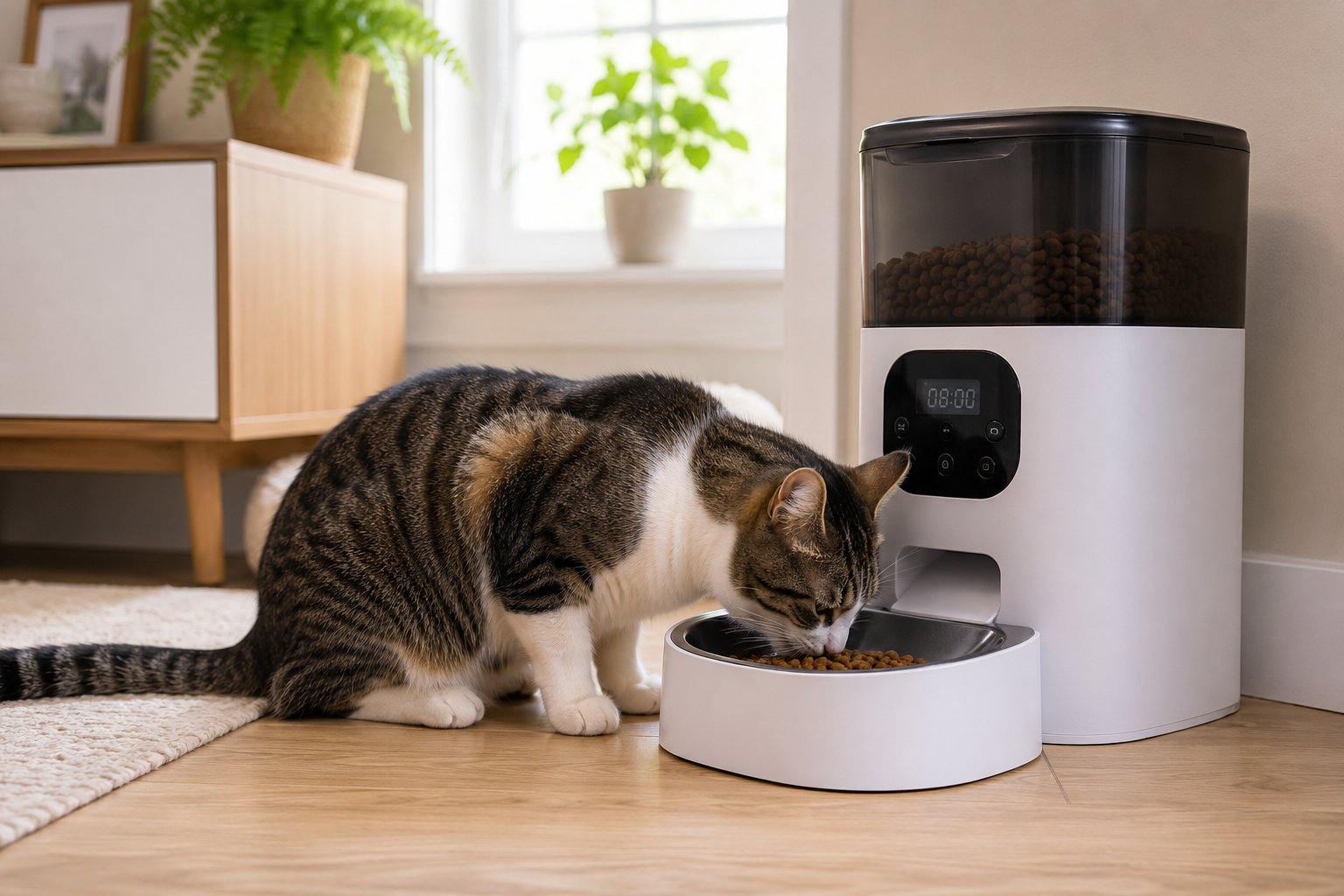
If you have ever come home late to a hungry cat—or been woken at 5 a.m. by one demanding breakfast—you may have wondered: are automatic pet feeders worth it?
For many cat owners, they can be. Automatic pet feeders can provide more consistent meal times, help manage measured portions, and make it easier to divide a cat’s daily food allowance into several scheduled meals. They can also be useful when work, sleep, or other commitments make manual feeding at exactly the same time every day difficult.
But convenience has limits. Automatic feeders can jam, lose power, dispense inconsistent portions, require regular cleaning, and may not work equally well with every type of cat food. In multi-cat households, a standard feeder may also fail to prevent one cat from eating another’s meal.
Most importantly, an automatic feeder does not replace appropriate nutrition, fresh water, daily observation, litter-box care, veterinary guidance when needed, or human interaction.
So the real question is not whether automatic feeders are better than traditional bowls. It is whether a feeder solves a genuine problem for your cat and your household without creating unnecessary complications.
In this guide, we examine the pros and cons of automatic pet feeders, portion control, feeding schedules, wet- and dry-food compatibility, multi-cat challenges, reliability, cleaning, smart features, and what cat owners should consider before buying one.
Quick Answer: Are Automatic Pet Feeders Worth It?
Automatic pet feeders can be worth it when they solve a specific feeding problem, such as inconsistent meal times, early-morning feeding, portion scheduling, or providing several small meals throughout the day.
However, they are not completely hands-off. Feeders can jam, lose power, or experience connectivity problems, so they still need regular cleaning, refilling, testing, and monitoring. Their suitability depends on your cat, food type, household setup, feeding plan, and how reliably the particular feeder performs.
Think of an automatic feeder as a scheduling and portioning tool—not a replacement for responsible daily care.
Is an Automatic Feeder Worth It for Your Cat?
An automatic feeder is worth considering when it solves a specific feeding problem. Use this quick comparison to decide whether automation is likely to benefit your cat and household.
Your situation Recommended approach Is an automatic feeder worth it? Your cat wakes you early for breakfast A programmable timed feeder can provide an early meal. Yes, often Your work schedule makes regular feeding difficult A reliable feeder can deliver planned meals at consistent times. Yes, often Your cat needs several small meals daily A portion-controlled feeder can divide the daily food allowance into scheduled meals. Yes, often You have multiple cats that steal each other’s food Consider separate feeding areas or a microchip/RFID access-controlled feeder. Yes, with the right design Your cat primarily eats wet food Choose a suitable wet-food feeder with appropriate temperature management, or continue manual feeding. Depends on the model Your cat has a medical condition or needs close appetite monitoring Follow a veterinarian-approved feeding plan and maintain appropriate supervision. Depends on veterinary guidance Your cat is frightened by mechanical sounds Introduce the feeder gradually, or continue using a traditional bowl. Possibly not You already provide measured meals consistently Continue manual feeding unless automation solves another genuine problem. Usually unnecessary Bottom line: An automatic feeder is most valuable when it improves meal timing, portion consistency, or food access. It is not automatically better than traditional feeding, and it never replaces daily care and monitoring.
Key Takeaways
- Automatic feeders can improve feeding consistency by providing meals on a predictable schedule when your own routine changes.
- Portion control depends on accuracy. A programmable feeder is useful only when the amount it dispenses matches your cat’s intended daily food allowance.
- Dry food is generally easier to automate. Wet food requires a feeder designed for appropriate storage and temperature management.
- Multi-cat households need extra planning. Separate feeding areas or microchip/RFID access-controlled feeders may be necessary when cats require different foods or portions.
- Reliability matters more than smart features. Dependable dispensing, backup power, secure food storage, easy cleaning, and predictable offline behavior should usually take priority over cameras or app controls.
- Automatic does not mean unattended. Regular checks are still necessary to confirm that the feeder is working and your cat is actually eating.
What Is an Automatic Pet Feeder?
An automatic pet feeder is a device designed to make food available at scheduled times or under specific access conditions.
Depending on the design, a feeder may release a measured amount of dry food, uncover a pre-portioned meal, or allow only an authorized cat to access the food.
Common features include:
- Programmable meal schedules
- Adjustable portion settings
- Multiple meals per day
- Battery backup
- App-based controls
- Feeding notifications
- Low-food alerts
- Cameras or microphones
- Microchip or RFID-tag recognition
- Feeding histories or activity records
Despite these features, the basic purpose remains straightforward: controlling when—and sometimes how much—food becomes available.
An automatic feeder cannot determine what your cat should eat or how many calories your cat needs. Feeding requirements vary according to factors such as age, health, body condition, activity, and individual needs.
How Do Automatic Cat Feeders Work?
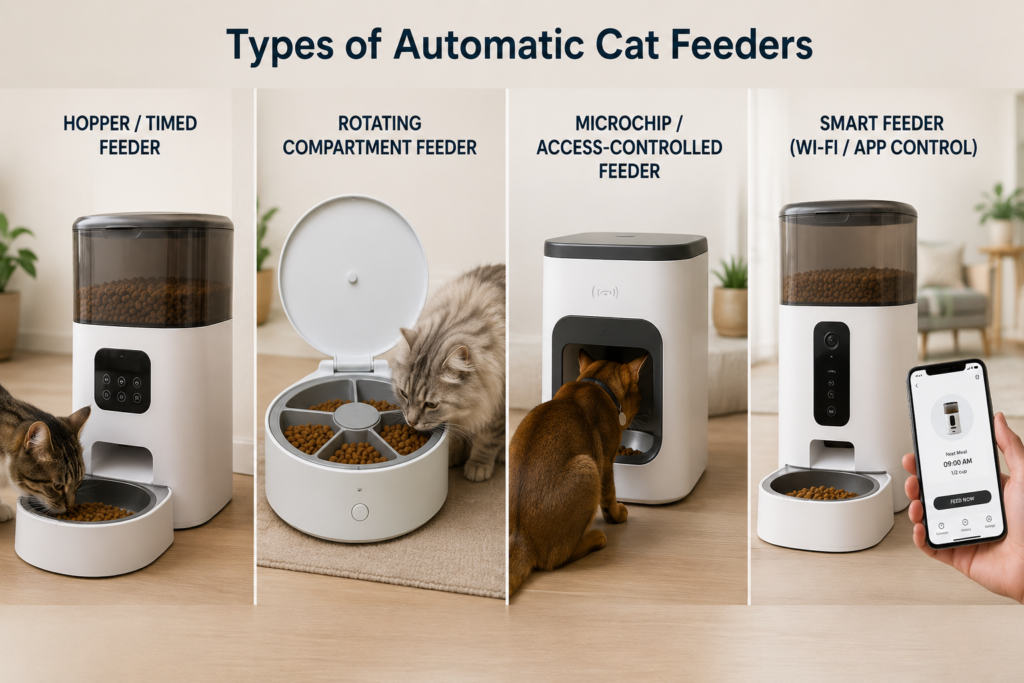
The way an automatic cat feeder works depends on its design. Understanding the main types is important because they solve different feeding problems.
Gravity Feeders
A gravity feeder uses a food reservoir positioned above a bowl. As your cat eats, additional dry food falls into the bowl.
Gravity feeders are simple and generally require no programming, but they do not provide true scheduled feeding or portion control because food remains continuously available.
That can work for some cats, but it may be unsuitable for cats that tend to overeat when food is freely available. Cornell notes that free feeding may contribute to overeating and inappropriate weight gain in some cats.
If you’re deciding between these two feeding systems, see our automatic pet feeder vs gravity feeder comparison for a closer look at how they differ in portion control, scheduling, reliability, and everyday use.
Programmable Dry-Food Feeders
These feeders typically use a hopper and motorized dispensing mechanism.
You program feeding times and portion settings, and the feeder releases dry food according to that schedule.
This is one of the most common types of automatic pet feeders and can be particularly useful when you want to provide several scheduled meals without manually serving every one.
However, the amount actually dispensed can vary depending on the feeder mechanism and the size and shape of the kibble. We will discuss portion accuracy in more detail later in the article.
Rotating or Compartment Feeders
These feeders contain individual food compartments. At scheduled times, a lid or tray rotates or opens to expose the next meal.
Because you place the food into each compartment beforehand, this design gives you direct control over the amount placed in each meal compartment.
Depending on the model, compartment feeders may be designed for dry food, wet food, or both. Models intended for wet food may use ice packs, insulated compartments, or other cooling systems.
For wet food, always follow the feeder manufacturer’s storage, temperature, and cleaning instructions rather than assuming food will remain safe simply because it is inside the feeder.
Microchip or Access-Controlled Feeders
Access-controlled feeders solve a somewhat different problem.
Instead of simply releasing food at a particular time, they restrict access to an authorized pet. Depending on the model, identification may use a compatible implanted microchip or an RFID collar tag.
They can be particularly useful when:
- Cats require different diets.
- One cat regularly steals another cat’s food.
- One cat requires controlled portions.
- A cat needs veterinarian-prescribed food.
- Cats eat at substantially different speeds.
VCA Animal Hospitals notes that some microchip-controlled automatic feeders can restrict food access to a registered pet, which can help prevent pets from stealing each other’s food. FelineVMA recommends feeding programs that account for individual cats in multi-pet households, including separate feeding resources and, in some situations, automatic feeders.
However, technology is not always necessary. Feeding cats separately or in different parts of the home can also be an effective solution. Cornell specifically recommends separate feeding areas as an option in multi-cat households.
Smart or App-Connected Feeders
Smart pet feeders add remote controls and monitoring to the basic automatic-feeding function.
Depending on the model, an app may allow you to:
- Change feeding schedules
- Trigger a meal remotely
- Receive dispensing notifications
- Receive low-food or error alerts
- Review feeding history
- Monitor the feeding area through a built-in camera
These features can be useful, particularly for owners who want remote monitoring or schedule adjustments.
But smart technology also introduces additional dependencies, including Wi-Fi, software, and app support. A notification that a meal was scheduled or dispensed does not necessarily prove that your cat actually ate it.
For that reason, reliable dispensing, appropriate portioning, food compatibility, and easy cleaning should generally take priority over app features.
Benefits and Pros of Automatic Pet Feeders for Cats
Automatic feeders are most useful when they solve a specific feeding or scheduling problem. Their main benefits are consistency, portion management, flexibility, and the ability to provide multiple planned meals without requiring someone to be beside the food bowl every time.
More Consistent Feeding Times
Cats generally benefit from a predictable feeding routine. An automatic feeder can provide meals at scheduled times even when your work, sleep, or household routine changes.
This consistency can be particularly useful when feeding times would otherwise vary considerably from one day to another.
Cornell Feline Health Center recommends establishing a regular feeding routine and notes that owners should find a feeding schedule that works for both themselves and their cat and then keep it consistent.
Easier Portion Management
A programmable automatic cat feeder can divide a measured daily food allowance into several planned portions.
This may be helpful when:
- Several household members share feeding responsibilities.
- A cat tends to overeat when food is continuously available.
- You want to divide the daily ration into several smaller meals.
- Consistent portioning is difficult to manage manually.
However, the feeder cannot determine the correct amount of food for your cat. The appropriate daily intake depends on factors such as diet, age, body condition, activity, and health.
Several Small Meals Throughout the Day
One practical advantage of automatic pet feeders is the ability to divide a cat’s daily food allowance into several smaller meals without requiring someone to serve every meal manually.
This can be useful when nobody is home throughout the day.
FelineVMA’s feline feeding guidance recognizes frequent small meals as one strategy for addressing normal feline feeding behavior and notes that appropriate feeding programs may include puzzle feeders, forage feeding, multiple feeding stations, and, in some situations, automatic feeders.
The key is not to increase the total daily food simply because you increase the number of meals. The intended daily amount should be divided among those meals.
Help With Early-Morning Feeding
This is one of the most practical reasons some cat owners consider a timed feeder.
If your cat regularly wakes you at 5 a.m. expecting breakfast, scheduling the feeder to provide an early meal may help shift the food expectation away from you.
VCA specifically notes that timed feeders can be useful for cats that wake their owners in the morning because the feeder can be programmed to provide an early meal.
It may not eliminate every early-morning behavior, but it can reduce the direct association between “wake the owner” and “food appears.”
More Flexibility When Your Schedule Changes
Work, appointments, travel delays, traffic, and other commitments do not always cooperate with your cat’s normal mealtime.
A programmable feeder can provide some flexibility by delivering a planned meal even when you cannot serve it personally at the usual time.
But this convenience has an important limit:
Automating food delivery does not make an automatic feeder a substitute for appropriate supervision and daily care.
Your cat still needs fresh water, litter-box care, observation, interaction, and someone able to respond if something goes wrong.
Potential Benefits in Multi-Cat Homes
Automatic feeding can also be useful in multi-cat households—but only when the feeding setup addresses competition and food stealing.
For example, an access-controlled feeder may help when:
- One cat eats much faster than another.
- Cats require different portion sizes.
- One cat needs a different diet.
- One cat repeatedly steals another cat’s food.
A conventional open automatic feeder may not solve these problems because any cat may still be able to eat the dispensed food.
Cornell notes that in multi-cat households, feeding cats separately or in different areas of the home may sometimes be helpful.
We will cover this issue in greater detail in the dedicated Automatic Feeders in Multi-Cat Households section later in the article.
The Cons of Automatic Pet Feeders
Automatic feeders can make feeding more convenient, but they introduce mechanical and electronic components that ordinary food bowls do not have. Before buying one, it is worth considering where automation can fail and how much maintenance the feeder will require.
Mechanical Failure and Food Jams
Automatic feeders depend on moving parts. Food can jam in the dispensing mechanism, trays may fail to rotate correctly, and motors or sensors can malfunction.
Kibble size and shape can also affect how consistently some hopper-style feeders dispense food.
A feeder that works correctly during testing can still develop a problem later, so it should never be treated as completely hands-off.
Before relying on a new feeder, run it through multiple feeding cycles while you are home and periodically confirm that food is still dispensing correctly.
If your feeder stops releasing food, our automatic pet feeder not dispensing food troubleshooting guide explains the common causes and checks to try.
Power and Battery Problems
Depending on the model, an automatic feeder may use wall power, batteries, or both.
A power outage, disconnected cable, depleted battery, or other power problem can interrupt scheduled feeding. VCA specifically identifies drained batteries as a potential cause of missed meals in automatic feeders.
For owners who depend on scheduled meals, battery backup and low-battery alerts can be more practically valuable than some smart features.
Even with backup power, test the feeder periodically rather than assuming the backup system works.
Portion Sizes May Not Be Perfectly Accurate
A feeder’s “portion” setting should not automatically be treated as a precise nutritional measurement.
The actual amount dispensed can depend on factors such as:
- Kibble size
- Kibble shape
- Food density
- The dispensing mechanism
- The feeder’s portion settings
VCA cautions that some automatic feeders may dispense more food than intended and that even small amounts can accumulate over time, particularly when accurate calorie control matters.
After setting up a feeder, dispense several normal meals into an empty bowl and weigh them using a kitchen scale. Repeating the test several times can help you determine how consistently the machine delivers the intended amount.
For a step-by-step method, see our guide to testing and adjusting automatic pet feeder portion accuracy
This is one of the most important practical checks before relying on an automatic feeder.
Cleaning Is More Involved Than Washing a Bowl
An ordinary bowl is relatively simple to clean.
An automatic feeder may include a hopper, lid, food chute, rotor, tray, seals, and other food-contact surfaces where crumbs, food oils, and moisture can accumulate.
VCA notes that more complicated automatic feeders can be difficult to clean and may need to be disassembled for thorough cleaning.
FDA guidance also recommends washing and drying pet food bowls and food-measuring utensils after use, and cleaning and drying food-storage containers between bags of dry food.
When comparing feeders, therefore, consider how easily the food-contact components can actually be removed and cleaned, not simply whether the feeder looks easy to maintain.
For practical maintenance instructions, see our step-by-step guide to cleaning an automatic pet feeder.
Many Automatic Feeders Are Better Suited to Dry Food
Most hopper-style automatic feeders are designed primarily for dry kibble. VCA similarly identifies wet-food compatibility as a limitation of many automatic feeders.
Wet food requires more careful handling because opened canned and pouched foods are perishable.
Some compartment-style feeders are specifically designed for wet food and may use ice packs, insulation, refrigeration, or other temperature-management systems. However, you should follow the manufacturer’s food-storage instructions rather than assuming that wet food remains safe simply because it is inside a feeder.
The FDA recommends promptly refrigerating or discarding unused or leftover canned and pouched pet food.
We will examine wet-food feeders in more detail later in the Dry Food vs. Wet Food section.
Some Cats May Be Frightened by the Feeder
Not every cat immediately accepts an automatic feeder.
Motor noise, a rotating tray, or kibble suddenly dropping into a bowl can startle a noise-sensitive cat. VCA specifically identifies this as a possible drawback of automatic feeders.
A frightened cat may avoid approaching the feeder even when hungry.
For this reason, introduce the device gradually and supervise the first several feeding cycles rather than immediately replacing your cat’s familiar feeding setup.
Determined Cats May Try to Get Extra Food
Food-motivated cats may investigate the feeder far more enthusiastically than the manufacturer intended.
Some cats may:
- Paw at the dispensing chute
- Push or tip the feeder
- Attempt to lift the lid
- Reach into the food opening
- Interfere with rotating components
This makes stability, a secure lid, and a protected dispensing mechanism meaningful buying considerations—not merely design details.
Reliability Has More Than One Failure Point
An automatic feeder can fail in different ways, and these problems should not all be treated as the same type of outage.
Before depending on a feeder, consider four separate failure points:
- Mechanical failure: Food can jam, a tray may fail to rotate, or a motor or sensor may malfunction.
- Power failure: A power outage, loose cable, depleted battery, or failed backup system can interrupt operation.
- Wi-Fi or internet failure: A smart feeder may lose remote controls, notifications, cameras, or app access when the home network or internet connection goes down.
- App or cloud-service failure: Some connected features may also depend on the manufacturer’s software or online services, even when your home Wi-Fi is working normally.
What happens next depends on the particular feeder. Some models store feeding schedules locally and may continue scheduled dispensing when internet access is unavailable, while remote features stop working. Other models may behave differently.
Do not assume that “battery backup,” “offline feeding,” or “stored schedule” means every function will continue during every type of failure. If dispensing itself fails, see our automatic pet feeder troubleshooting guide. For Wi-Fi, offline schedules, power interruptions, and backup behavior, see our guide to automatic pet feeders without Wi-Fi. Check the manufacturer’s documentation and test the behavior you actually depend on before trusting the feeder.
Smart Features Can Add Complexity
Wi-Fi, cameras, apps, and feeding notifications can be genuinely useful, but they also add another layer of technology.
An app may confirm that a feeding command was sent or that the feeder operated, but that does not necessarily prove that your cat ate the meal.
Likewise, an app status or feeding record should not be treated as a perfect substitute for checking the feeder itself. During connectivity or service problems, remote records and notifications may not always reflect what physically happened at the bowl.
Connectivity problems can also affect remote functions even when the feeder’s basic scheduled dispensing continues to work.
For essential feeding, prioritize:
- Reliable dispensing
- Portion consistency
- Appropriate food storage
- Backup power
- Ease of cleaning
- Stable, secure construction
Only after those fundamentals are satisfactory should features such as cameras, voice recording, or remote app controls become deciding factors.
The best automatic feeder is not necessarily the one with the most technology—it is the one that reliably solves your particular feeding problem.
Can an Automatic Feeder Help With Weight Management?
Potentially—but an automatic feeder should be viewed as a portioning and scheduling tool, not a weight-loss treatment.
A programmable feeder can help deliver predetermined amounts of food at scheduled times. This may be useful when a cat tends to overeat from a continuously available bowl or when several household members sometimes feed the same cat without realizing someone else has already done so.
VCA notes that automatic feeders can be used to control how much food is released per serving as part of a weight-management plan. However, the feeder itself cannot determine:
- Your cat’s ideal body weight
- How many calories your cat should receive
- Whether weight loss is medically appropriate
- How quickly weight should occur
- Whether an underlying health condition is affecting weight
Cornell Feline Health Center emphasizes that cats vary considerably in how much food they need and recommends working with a veterinarian to determine an appropriate weight and feeding plan.
Once an appropriate daily food allowance has been established, an automatic feeder may make that plan easier to follow consistently by dividing the total amount into scheduled portions.
The important principle is:
Use the feeder to follow the feeding plan—not to create the feeding plan.
If your cat is overweight, underweight, or experiencing unexplained weight changes, consult your veterinarian before making significant changes to food intake.
Are Automatic Feeders Good for Cats That Eat Too Fast?
Sometimes—but an automatic feeder is not necessarily the best solution for fast eating.
A programmable feeder can divide the daily food allowance into several smaller portions, reducing how much food is available at one time. However, a fast eater may simply consume each smaller portion immediately.
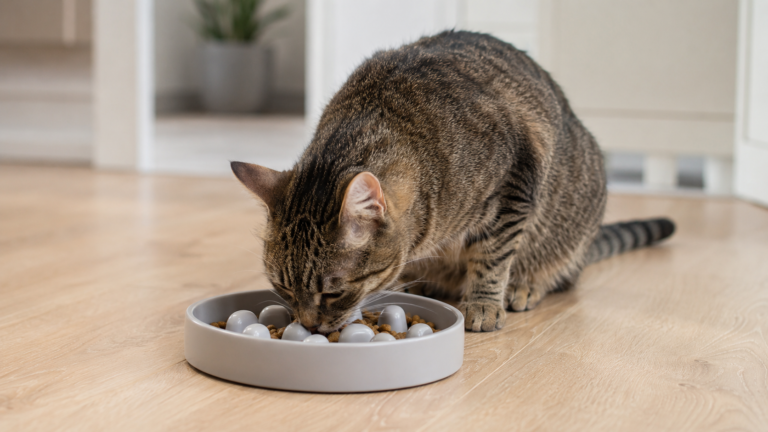
If the main goal is to slow down how quickly a cat eats, a puzzle or interactive feeder may be more appropriate because it requires the cat to work for the food rather than simply waiting for it to appear.
VCA notes that food puzzles can keep pets engaged while slowing the pace of eating. Feline veterinary feeding guidance also recognizes puzzle feeding and multiple small meals as ways to encourage more natural feeding behavior.
In some households, the two approaches can complement each other:
| Feeding tool | Main purpose |
|---|---|
| Automatic feeder | Controls when and how much food becomes available |
| Puzzle/interactive feeder | Influences how the cat obtains and eats the food |
For example, an automatic feeder could provide scheduled meals while part of the cat’s measured daily dry-food allowance is provided through an appropriate puzzle feeder.
The important point is that adding a puzzle feeder should not mean adding extra food. Any food used for enrichment should generally be accounted for within the cat’s intended daily allowance.
Automatic Feeders in Multi-Cat Households
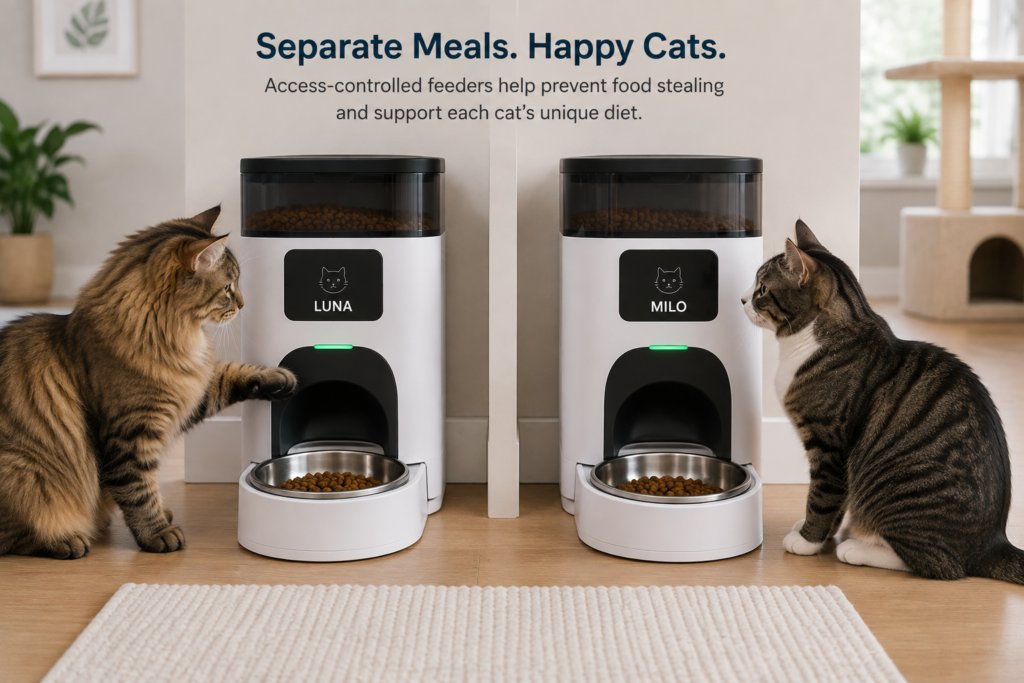
Automatic feeders can be useful in a multi-cat household, but one feeder does not automatically solve multi-cat feeding problems.
Consider two cats:
- One eats quickly and tends to gain weight.
- The other eats slowly and requires a different diet or portion size.
If both cats can access the same open automatic feeder, the faster cat may simply eat food intended for the other cat.
This is why multi-cat feeding requires more than scheduling meals. The goal is to make sure the right cat receives the right food in the intended amount.
Practical options include:
- Feeding cats in separate rooms or feeding areas
- Providing a separate bowl for each cat
- Supervising scheduled meals when practical
- Using separate automatic feeders
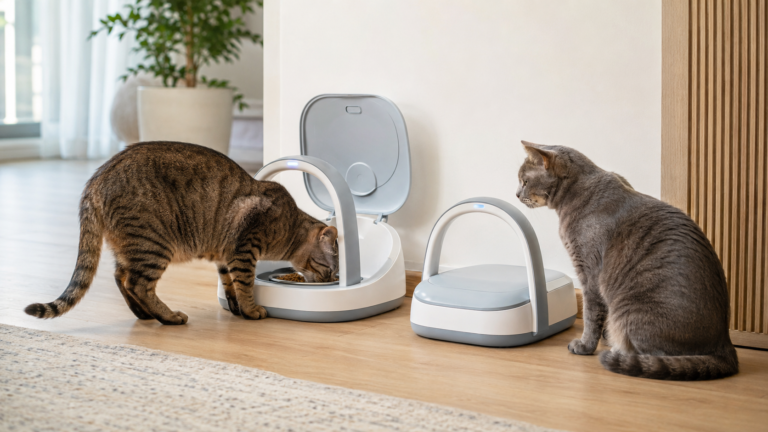
- Using microchip or RFID access-controlled feeders
- Removing uneaten food after meals when appropriate
VCA recommends separate bowls for individual pets and identifies separate feeding areas as a simple way to prevent one pet from accessing another’s diet. It also notes that some automatic feeders can recognize an individual pet’s microchip.
Why Separate Feeding Areas Can Matter
Food stealing is not the only consideration.
Cats may eat near one another without obvious fighting while still experiencing competition or stress around feeding resources.
FelineVMA guidance recommends separate feeding stations with distance and visual separation between cats in multi-cat households, helping individual cats access food without unnecessary competition.
Therefore, a high-tech feeder is not always necessary. Sometimes separate feeding locations provide a simpler solution.
When Access-Controlled Feeders Make More Sense
A microchip or RFID feeder may be particularly useful when:
- Cats require different diets.
- One cat regularly steals another’s food.
- One cat needs carefully controlled portions.
- Cats eat at substantially different speeds.
- One cat requires veterinarian-prescribed food.
However, check exactly how a particular feeder controls access before buying. A timed automatic feeder and an access-controlled feeder solve different problems.
A timed feeder controls when food appears.
An access-controlled feeder controls which pet can reach the food.
Some products combine functions, but owners should not assume that every automatic feeder provides both.
If food stealing or different diets are your main concern, see our Best Automatic Cat Feeders for Multiple Cats guide for feeder options designed around multi-cat feeding challenges.
Dry Food vs. Wet Food: Which Works Better?
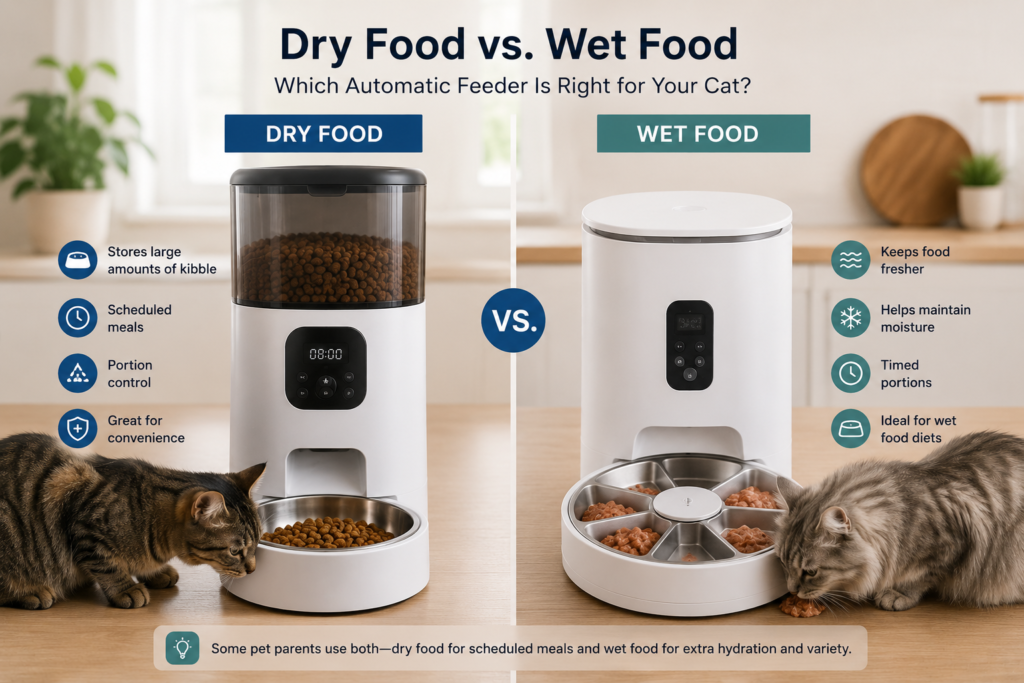
Food type is one of the most important considerations when choosing an automatic cat feeder.
In general, dry food is easier to automate, while wet food requires more careful storage and temperature management.
Automatic Feeders for Dry Food
Dry kibble works well with many hopper-style automatic feeders because it can be stored in a reservoir and released through a dispensing mechanism.
Before choosing a dry-food feeder, check:
- Recommended kibble size and shape
- Hopper capacity
- Portion adjustment range
- Dispensing mechanism
- Food-storage design
- Ease of cleaning
- Whether the hopper closes securely
Do not assume that every type of kibble will dispense equally well. Very large, very small, flat, or irregularly shaped pieces may behave differently depending on the feeder mechanism.
Also remember that a large hopper is not automatically an advantage. Food should still be stored appropriately, and the feeder should be cleaned according to the manufacturer’s instructions.
Automatic Feeders for Wet Food
Wet food requires greater care because opened canned and pouched pet foods are perishable.
Some compartment-style automatic feeders are designed specifically for wet food and may use:
- Ice packs
- Insulated compartments
- Active cooling or refrigeration
- Covered individual meal compartments
However, a closed compartment does not automatically make wet food safe for an unlimited period.
Follow the feeder manufacturer’s instructions regarding food storage, cooling, cleaning, and how long food can remain inside the unit.
The FDA recommends promptly refrigerating or discarding unused or leftover canned and pouched pet food and keeping refrigerated pet food at 40°F (4°C) or below. Because automatic wet-food feeders differ in their cooling and storage systems, always follow the feeder manufacturer’s instructions for food storage, temperature management, and holding times.
What Should Wet-Food Cat Owners Prioritize?
If wet food comprises a substantial part of your cat’s diet, consider these factors before smart features such as cameras or voice recording:
- Temperature management
- Food-safe storage
- Easy-to-clean meal compartments
- Reliable opening or rotation
- Appropriate meal capacity
- Manufacturer guidance for wet-food holding times
A feeder designed primarily for dry kibble should not be adapted for wet food unless the manufacturer specifically states that it is suitable for that purpose.
If you feed canned or fresh food, see our guide to using wet food in an automatic pet feeder for the key food-safety, cooling, and feeder-design considerations.
What About Cats With Medical Conditions?
For cats with medical conditions, veterinary guidance should take priority over feeding convenience.
Conditions such as diabetes, chronic kidney disease, gastrointestinal disorders, food allergies, obesity, and other health problems may affect the type of food a cat needs, the amount offered, or how feeding should be managed.
Cornell Feline Health Center notes that a cat’s health affects feeding requirements. For example, dietary modification may form part of the management of conditions such as diabetes and chronic kidney disease.
An automatic feeder may sometimes help carry out an established feeding plan—for example, by providing measured portions or scheduled meals—but it should not be used to create or modify a medical feeding plan without veterinary guidance.
Diabetes Requires Particular Care
Owners of diabetic cats should not assume that a standard automatic-feeding schedule is appropriate simply because the feeder can provide meals at fixed times.
Management of feline diabetes can involve diet, medication or insulin, monitoring, and individualized veterinary decisions. Cornell advises owners of diabetic cats to work closely with their veterinarian and monitor factors including appetite, body weight, water intake, and medication or insulin administration.
Therefore, if a cat has diabetes, use an automatic feeder only as part of the feeding and treatment approach recommended by the veterinarian.
Cats With Chronic Kidney Disease May Have Specific Dietary Needs
Chronic kidney disease (CKD) is another example where the food itself can be part of medical management.
Cornell explains that dietary modification is an important part of CKD treatment and that therapeutic diets may differ from standard cat foods in nutrients such as protein, phosphorus, and sodium. Cornell also emphasizes maintaining adequate nutrition and hydration and working with a veterinarian to find an appropriate diet the cat will actually eat.
An automatic feeder may help deliver appropriate food at planned times, but the feeder should accommodate the veterinarian-recommended diet—not determine which diet the cat receives.
If the prescribed diet is wet food, the wet-food storage and temperature considerations discussed earlier in this article become especially important.
Appetite Monitoring Still Matters
One limitation of automatic feeding is particularly important when a cat has a medical condition:
Food being dispensed does not mean the cat actually ate it.
Changes in appetite can be medically significant. Cornell notes that loss of appetite can occur with conditions including diabetes, kidney disease, hyperthyroidism, pancreatitis, and other health problems, and warns that sustained loss of appetite can seriously affect a cat’s health.
That means owners should continue checking:
- Whether food was actually eaten
- Changes in appetite
- Unexpected weight loss or gain
- Changes in drinking or urination
- Vomiting or gastrointestinal changes
- Changes in behavior or activity
An automatic feeder should therefore support observation, not replace it.
If your cat suddenly stops eating, eats substantially less than usual, loses weight unexpectedly, or otherwise appears unwell, contact your veterinarian rather than assuming the feeder is responsible.
Is an Automatic Pet Feeder Worth the Cost?
An automatic pet feeder is worth the expense when its practical benefits justify the purchase price, maintenance, and any ongoing costs. A more expensive feeder is not necessarily a better investment, especially if a basic timed model already meets your cat’s needs.
Before buying, consider the following costs and benefits.
| Cost or consideration | What to evaluate |
|---|---|
| Initial purchase price | Does a basic timed feeder meet your needs, or do you genuinely require advanced features? |
| Batteries and electricity | Does the feeder require replacement batteries, backup batteries, or continuous electrical power? |
| Optional subscriptions | Are features such as cloud video storage or advanced app services subject to recurring fees? Check the specific model. |
| Replacement parts | Are bowls, trays, lids, adapters, and other components available and reasonably priced? |
| Cleaning and maintenance | How much time and effort will regular cleaning, refilling, and testing require? |
| Practical benefits | Will the feeder meaningfully improve meal timing, portion consistency, or food access in your household? |
When is the extra cost justified?
An automatic feeder may provide worthwhile value if it reliably solves a recurring problem, such as early-morning feeding, irregular work schedules, or the need to provide several measured meals throughout the day.
However, if you already serve appropriate portions consistently and your cat’s feeding routine works well, a traditional bowl may be the more economical choice.
For households with multiple cats, an access-controlled feeder may justify a higher initial expense when separate feeding arrangements are difficult and food stealing is a persistent problem.
The key consideration is long-term usefulness, not the number of smart features. Choose a feeder that solves your actual feeding problem without introducing unnecessary costs or maintenance. An automatic feeder should complement daily care, not replace it.
Automatic Feeders vs. Traditional Feeding
Automatic feeders and traditional bowls can both be appropriate ways to feed a cat. The better choice depends on your cat’s diet, feeding plan, household routine, and whether automation solves a genuine problem.
| Factor | Automatic Feeder | Traditional Bowl |
|---|---|---|
| Scheduled meals | Can dispense food automatically at programmed times | Requires a caregiver to serve scheduled meals |
| Portion control | Can provide programmed portions, but dispensing accuracy should be checked | Portions can be measured directly by the caregiver |
| Several meals during the day | Easier to provide when nobody is available at every mealtime | Requires someone to serve each meal |
| Initial cost | Generally higher | Generally lower |
| Mechanical components | Motors, trays, sensors, or dispensing mechanisms may be present | Usually none |
| Power or batteries | Required by many models | Not required |
| Cleaning | May involve several removable food-contact components | Usually simpler |
| Dry-food use | Well suited to many hopper-style models | Straightforward |
| Wet-food use | Requires a model specifically suitable for wet food and appropriate storage | Straightforward when food is served fresh at mealtime |
| Multi-cat access control | Available with some microchip/RFID-controlled models | Usually requires separation or supervision |
| Food-stealing prevention | Possible with access-controlled models; not with every automatic feeder | Usually managed through separate feeding areas or supervision |
| Failure risk | Mechanical, battery, power, connectivity, or service problems are possible | Very low mechanical failure risk |
| Remote/app features | Available on some smart feeders | Not applicable |
| Human observation at mealtime | May be reduced if meals occur automatically | Usually provides more opportunity to observe eating directly |
| Ongoing monitoring | Still required | Still required |
VCA confirms several of these distinctions: automatic feeders can provide scheduled and portioned meals, and some models use microchip-controlled access, but drained batteries, cleaning difficulty, and inaccurate dispensing can also be drawbacks.
Which Is Better?
There is no universal winner.
A traditional bowl has several practical advantages: it is inexpensive, mechanically simple, easy to clean, and allows the caregiver to directly observe feeding when present.
An automatic feeder adds capabilities a bowl cannot provide by itself, particularly scheduled food delivery, automated portioning, multiple planned meals, and—in certain models—individual-pet access control.
However, those benefits come with additional responsibilities, including cleaning, refilling, checking portion accuracy, maintaining batteries or power, and confirming that the feeder actually operated as expected.
Cornell also emphasizes consistency in feeding schedules while noting that feeding arrangements should suit the individual cat and household.
The most useful question is therefore not:
“Which feeding method is better?”
It is:
“Does an automatic feeder solve a feeding problem that my current routine does not?”
If your cat already receives appropriately measured meals reliably from a traditional bowl, automation may provide little additional benefit.
If your difficulty is meal timing, providing several planned meals while you are away, portion consistency, or controlling food access between cats, an appropriate automatic feeder may offer a practical advantage.
What to Check Before Buying an Automatic Cat Feeder
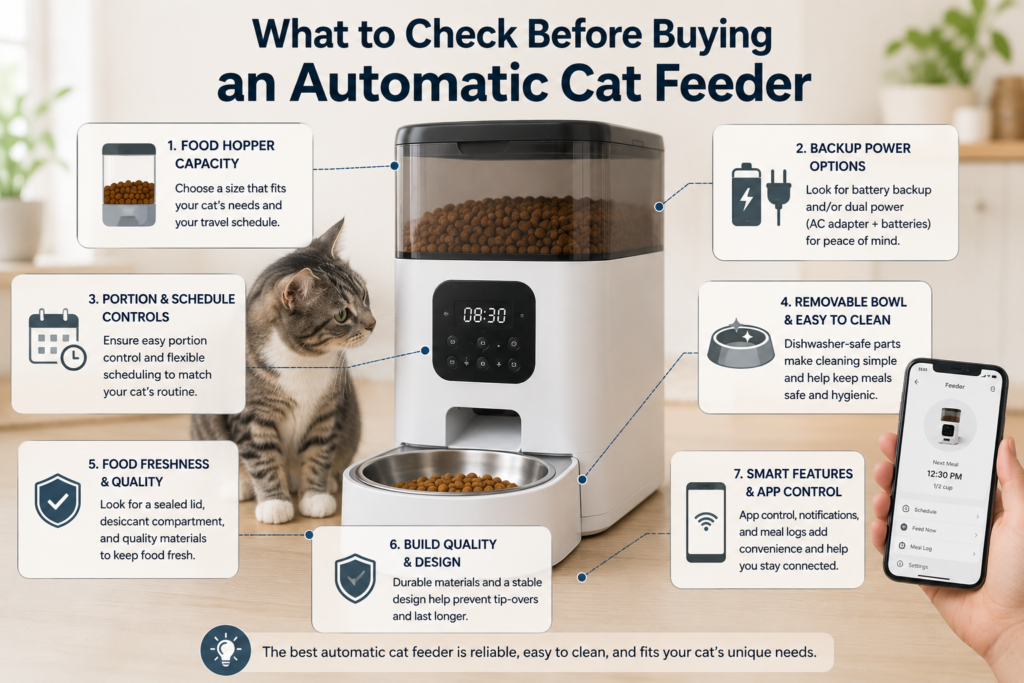
Not every automatic feeder solves the same problem. Before comparing cameras, apps, or other smart features, start with your cat’s food, feeding schedule, and household needs.
If you’re already considering a feeder and want a more detailed selection checklist, our How to Choose the Right Automatic Pet Feeder guide explains the key buying factors in more depth.
1. Food Compatibility
Start with what your cat actually eats.
Many hopper-style automatic feeders are designed primarily for dry kibble. VCA notes that kibble works particularly well in automatic feeders, while wet-food feeding requires different considerations.
Check the manufacturer’s specifications for:
- Dry- or wet-food compatibility
- Recommended kibble size and shape
- Whether mixed kibble shapes dispense reliably
- Wet-food cooling or refrigeration system, where applicable
- Food-contact materials and cleaning instructions
A feeder with excellent smart features is of little value if it cannot safely and consistently handle your cat’s normal food.
2. Portion Accuracy and Portion Range
Do not assume that one feeder “portion” equals one nutritionally appropriate serving.
Different dispensing mechanisms and kibble shapes can affect the amount released. VCA specifically cautions that some automatic feeders can dispense more food than intended and that small inaccuracies can accumulate over time.
Before relying on a new feeder:
- Program the amount you expect to use.
- Dispense it into an empty bowl.
- Weigh the food on a kitchen scale.
- Repeat the test several times.
- Compare the results for consistency.
VCA also notes that weighing kibble in grams is the most accurate way to measure a consistent amount.
3. Meal-Scheduling Flexibility
Check whether the feeder’s schedule matches the way you actually intend to feed your cat.
Consider:
- Number of programmable meals per day
- Minimum and maximum portion sizes
- Whether different meals can have different portion sizes
- Whether schedules can be changed directly on the feeder
- Whether the stored schedule survives loss of power
- Whether manual feeding can be triggered when needed
FelineVMA guidance recognizes multiple small meals as compatible with normal feline feeding behavior and notes that automatic feeders can sometimes help provide them.
If you need help planning meal times and portions, see our automatic pet feeder schedule setup guide.
4. Power Supply and Battery Backup
If your cat will depend on the feeder for scheduled meals, consider what happens during a power interruption.
Look for:
- Battery backup
- Low-battery warning
- Clear power-status indicators
- Whether programmed schedules remain stored after power loss
- Whether normal scheduled feeding resumes automatically after power is restored
VCA specifically identifies drained batteries as a possible cause of missed meals.
Battery backup does not make a feeder failure-proof, but it provides another layer of protection.
5. Food Capacity and Storage
A larger hopper can reduce how often you refill the feeder, but bigger is not automatically better.
Consider:
- How much food your cat actually consumes
- How long food will remain in the hopper
- How securely the lid closes
- Whether the storage compartment helps protect food from moisture and pests
- How easy the hopper is to empty and clean
Choose capacity according to your feeding needs rather than simply selecting the largest available reservoir.
6. Ease of Cleaning
Automatic feeders contain more components than ordinary bowls, so cleaning deserves serious consideration.
Check whether the:
- Bowl is removable
- Hopper can be emptied easily
- Food chute is accessible
- Food-contact parts can be washed thoroughly
- Manufacturer clearly identifies dishwasher-safe components
VCA identifies cleaning complexity as a genuine drawback of some automatic feeders because thorough cleaning may require disassembly.
Do not assume that “dishwasher-safe” applies to every part of the feeder.
7. Stability and Food Security
A food-motivated cat may regard an automatic feeder as a puzzle that needs solving.
Look for:
- A stable base
- Secure hopper lid
- Protected dispensing opening
- Construction that resists tipping
- A design that makes it difficult to reach food inside the chute
For some households, cat-proof construction may matter more than app connectivity.
8. Multi-Cat Suitability
If you have multiple cats, ask:
What actually prevents one cat from eating another cat’s food?
A standard timed feeder may control when food appears without controlling which cat eats it.
Microchip- or RFID-controlled feeders may provide individualized access. VCA notes that registered-pet access can help prevent pets from stealing one another’s food and can help ensure that prescription or restricted diets reach the intended pet.
FelineVMA also emphasizes separate feeding resources and reducing competition in multi-cat homes.
9. Noise and Your Cat’s Temperament
A feeder can perform perfectly from a technical standpoint and still fail if your cat is frightened to approach it.
Consider the noise produced by:
- Motors
- Rotating trays
- Kibble dropping into the bowl
- Notification sounds
VCA specifically notes that automatic feeders can startle sensitive pets.
For a nervous cat, quieter operation may be substantially more valuable than cameras, microphones, or voice-recording features.
10. Replacement Parts, Warranty, and Manufacturer Support
Before buying, check whether commonly needed components can be replaced, such as:
- Food bowls
- Lids
- Power adapters
- Ice packs
- Trays
- Other removable food-contact parts
Also check the manufacturer’s warranty and support arrangements.
This is especially important for a device that you expect to use every day.
11. Smart Features You Will Actually Use
Smart automatic pet feeders may offer:
- Wi-Fi connectivity
- Remote feeding
- Feeding notifications
- Low-food alerts
- Feeding history
- Cameras
- Two-way audio or voice recording
These features can be convenient, but they should come after the fundamentals.
Prioritize:
Reliable dispensing → appropriate food compatibility → portion consistency → safe storage → backup power → easy cleaning → secure construction
Then decide whether smart features provide enough additional value for your particular situation.
An app cannot compensate for a feeder that does not reliably perform its basic job. For a smart feeder, also check whether scheduled meals are stored locally on the device, what happens if the manufacturer’s online service is unavailable, and which functions continue without an internet connection.
12. Test Before You Depend on It
This deserves its own final buying criterion.
Before relying on the feeder, test:
- Several scheduled feeding cycles
- Portion consistency
- Battery backup
- Offline scheduled feeding, if the feeder normally connects to Wi-Fi
- Power recovery
- Your cat’s reaction to the sound
- Whether another pet can access the food
- App notifications, if applicable
A feeder should prove that it works reliably in your household before you depend on it. If a missed meal could create a significant problem—especially when you will be away from home—have a practical human backup plan rather than relying on the feeder, app, or internet connection as the only safeguard.
Who Is Most Likely to Benefit From an Automatic Feeder?
An automatic feeder is most useful when it solves a specific, recurring feeding problem rather than simply adding technology to a routine that already works well.
You may benefit from one if:
- Your schedule makes consistent meal times difficult. A programmable feeder can provide planned meals even when work, appointments, or other commitments delay you.
- Your cat expects very early meals. A timed feeder can provide an early-morning portion without requiring you to get out of bed specifically to serve it. VCA identifies timed feeders as particularly useful for cats that wake their owners for food.
- You want to provide several smaller meals. An automatic feeder can divide a measured daily allowance into multiple scheduled portions. FelineVMA recognizes frequent small meals as part of feeding strategies that better accommodate normal feline feeding behavior.
- Household members sometimes double-feed the cat. A programmed feeding schedule may make it easier to maintain a consistent daily amount.
- You need controlled food access in a multi-cat home. Microchip or RFID access-controlled feeders may help when cats require different diets or one cat steals another’s food.
- You are following a veterinarian-approved feeding plan. Once the appropriate food, daily amount, and feeding approach have been established, automation may make that plan easier to implement consistently.
An automatic feeder is therefore most valuable when consistency, timing, portioning, or food access is genuinely difficult to manage manually.
Who Might Do Better With Traditional Feeding?
Automatic feeding is not automatically an upgrade.
A traditional bowl and manually served meals may be the better choice if:
- You are normally available to serve meals consistently.
- Your cat is highly sensitive to mechanical noises or moving equipment.
- Your cat’s normal food is unsuitable for the available feeder.
- You need to closely observe appetite at each meal.
- Your cat repeatedly tips, opens, or otherwise defeats automatic dispensers.
- The feeding plan changes frequently because of a medical condition.
- Cleaning or maintaining an automatic feeder would create more inconvenience than it solves.
- Your existing measured-meal routine already works reliably.
Traditional feeding also provides a simple opportunity to observe whether your cat approaches the meal normally and how much is actually eaten.
This can be particularly important when appetite needs close monitoring.
There is nothing outdated about using an ordinary food bowl.
The better feeding system is the one that safely, reliably, and consistently meets the individual cat’s needs.
Common Mistakes to Avoid With Automatic Pet Feeders
Even a good automatic feeder can perform poorly if it is set up or used incorrectly.
1. Filling It and Forgetting About It
An automatic feeder should not be treated as completely hands-off.
Check regularly that:
- Food is actually dispensing.
- Your cat is eating.
- The hopper contains enough food.
- Batteries or power are functioning.
- Food-contact components remain clean.
VCA specifically identifies drained batteries, dispensing inaccuracies, and cleaning complexity among potential drawbacks of automatic feeders.
2. Assuming “One Portion” Means One Correct Serving
A manufacturer’s portion setting does not determine your cat’s nutritional requirements.
As discussed earlier, test the amount the feeder actually dispenses and compare it with the intended feeding plan.
This is particularly important when accurate calorie control matters.
3. Adding More Meals Without Adjusting the Daily Total
Providing several smaller meals should not automatically mean providing more food overall.
If your cat’s daily allowance is divided among additional meals, those portions should still fit within the intended total daily amount.
FelineVMA recommends dividing a cat’s daily food allowance into multiple small meals rather than simply adding extra feeding events.
4. Using Automation to Replace Human Care
An automatic feeder performs one main function: food delivery.
It cannot:
- Monitor your cat’s overall health
- Provide fresh water
- Maintain the litter box
- Confirm that your cat actually swallowed the food
- Notice subtle changes in behavior
- Provide social interaction
- Respond appropriately to illness or an emergency
VCA explicitly cautions that automatic food dispensers are not substitutes for human interaction.
5. Neglecting Cleaning
Food-contact surfaces require routine cleaning even when they look reasonably clean.
Pay particular attention to bowls, food chutes, trays, hoppers, seals, and wet-food compartments.
Follow the manufacturer’s cleaning instructions and the food-safety principles discussed earlier in this guide.
6. Introducing the Feeder Only When You Suddenly Need It
Do not wait until immediately before a trip, long workday, or other situation to introduce a new feeder.
Your cat needs time to become comfortable with the device, and you need time to discover whether the feeder actually works reliably.
Test several feeding cycles while you are present.
7. Assuming Every Cat Will Accept the Feeder
Some cats may initially be frightened by motors, rotating trays, or the sound of kibble dropping.
Introduce the feeder gradually rather than immediately removing the familiar feeding setup.
8. Assuming Cats Will Respect Assigned Bowls
In a multi-cat household, one cat may eat another’s meal even when separate portions are provided.
If food stealing is a problem, consider physical separation or an appropriate access-controlled feeder rather than assuming each cat will stay with an assigned bowl.
FelineVMA recommends separate food and water resources and visual separation where appropriate in multi-cat households.
9. Choosing Smart Features Before Basic Reliability
Cameras, apps, voice recording, and remote feeding can be useful, but they should not outweigh the fundamentals.
Prioritize:
reliable dispensing → correct portions → food compatibility → safe storage → backup power → easy cleaning → secure construction
Only then consider which smart features genuinely improve your particular feeding routine.
10. Assuming an Automatic Feeder Means a Cat Can Be Left Unattended
This is perhaps the most important mistake to avoid.
An automatic feeder reduces the need to be physically present at the exact moment a meal is served. It does not automate all the other aspects of caring for a cat.
Food delivery should never be confused with complete pet care.
How to Introduce an Automatic Feeder to Your Cat
Even the best automatic feeder will not help if your cat is afraid to approach it. Motors, rotating trays, and the sudden sound of kibble dropping can be unfamiliar, particularly for noise-sensitive cats.
Rather than replacing the familiar bowl immediately, introduce the new feeder gradually.
1. Place It Near the Existing Feeding Area
Start by positioning the automatic feeder near your cat’s normal feeding location without immediately removing the familiar bowl.
Allow your cat to investigate the feeder at their own pace.
FelineVMA guidance recommends gradually introducing unfamiliar sounds, sights, smells, and other stimuli when they cannot be avoided, particularly when they may cause fear or anxiety.
2. Let Your Cat Become Familiar With the Feeder
Before depending on automatic dispensing, allow your cat to see and smell the feeder while it is inactive.
You can place familiar food in its bowl or feeding compartment so that the device begins to become associated with a normal feeding experience.
Avoid forcing a nervous cat toward the feeder.
3. Introduce the Dispensing Sound While You Are Present
Activate the feeder while you are nearby and observe your cat’s reaction.
VCA notes that automatic feeders can startle sensitive pets and may even discourage them from eating.
If your cat retreats or appears frightened, give them more time rather than repeatedly activating the mechanism in quick succession.
4. Use Familiar Food
When possible, avoid introducing both a new food and a new feeding device at the same time.
Using your cat’s familiar food makes it easier to determine whether any reluctance is related to the feeder rather than the food itself.
5. Supervise Several Automatic Feeding Cycles
Before relying on the feeder when you are away, watch it complete several normal feeding cycles.
Confirm that:
- Food dispenses at the programmed time.
- The intended amount is released.
- Your cat approaches and eats comfortably.
- Food does not jam in the mechanism.
- Other pets do not steal the meal.
- The feeder remains stable while your cat eats.
This tests both sides of the system: whether the feeder works and whether your cat accepts it.
6. Test the Backup Power
If the feeder offers battery backup, test it.
Disconnect the main power supply and confirm that the feeder continues to operate as the manufacturer describes.
Also check whether the programmed feeding schedule remains stored.
This matters because VCA identifies depleted batteries as one potential cause of missed automatic meals.
7. Test Smart Features Separately
If you have a Wi-Fi or app-connected feeder, check:
- Remote feeding commands
- Feeding notifications
- Low-food alerts
- Error notifications
- Camera functions, if included
But remember that receiving an app notification is not the same as confirming that your cat actually ate the meal.
8. Keep Monitoring After the Transition
Once your cat is comfortable with the feeder, continue checking it regularly.
Periodically confirm:
- Portion consistency
- Food freshness
- Battery status
- Cleanliness
- Dispensing reliability
- Your cat’s normal appetite and eating behavior
An automatic feeder should eventually become part of the normal feeding routine—but not something you stop checking altogether.
For a more detailed introduction process, see our step-by-step guide to training a cat to use an automatic feeder.
Frequently Asked Questions About Automatic Pet Feeders
Are automatic pet feeders worth it?
They can be worth it when they solve a genuine feeding problem, such as inconsistent meal times, early-morning feeding, portion scheduling, or providing several planned meals during the day.
However, an automatic feeder still requires cleaning, refilling, testing, and monitoring. Its value depends on your cat’s diet, feeding needs, household setup, and how reliably the particular feeder performs.
Are automatic pet feeders good for cats?
They can be. Automatic feeders can provide scheduled meals and measured portions and may make it easier to divide a cat’s daily food allowance into several planned meals.
They are not equally suitable for every cat. Food type, temperament, medical needs, multi-cat competition, and the feeder’s reliability all matter.
Can I leave my cat alone because I have an automatic feeder?
An automatic feeder should not be treated as a substitute for appropriate supervision and daily care.
It automates food delivery—not fresh water, litter-box maintenance, health observation, interaction, or emergency care.
VCA similarly cautions that automatic food dispensers are not substitutes for human interaction.
If you’re planning time away from home, see our guide to leaving a cat alone with an automatic feeder for safety considerations, time limits, and a practical vacation checklist.
Can automatic feeders help prevent overeating?
A portion-controlled feeder may help limit unrestricted access to food and deliver predetermined portions at scheduled times.
However, it only helps when the feeder dispenses consistently and is programmed according to an appropriate feeding plan. It cannot determine your cat’s calorie requirements or ideal body weight by itself.
As discussed earlier, weight-management plans should be developed with veterinary guidance when appropriate.
Are automatic feeders suitable for wet cat food?
Some are, but many hopper-style automatic feeders are primarily designed for dry kibble. VCA also notes that canned food is not compatible with most automatic feeders.
For wet food, choose a feeder specifically designed for it and follow the manufacturer’s instructions for cooling, food storage, holding times, and cleaning.
Do not assume that an enclosed compartment or ice pack keeps wet food safe indefinitely.
Can two cats share one automatic feeder?
Sometimes—but it depends on the cats.
If both cats eat similar food and portions without competition, sharing may be workable. But if one cat eats faster, steals food, requires a different diet, or needs controlled portions, one open automatic feeder may not solve the problem.
In those situations, separate feeding areas, separate feeders, or microchip/RFID access-controlled feeders may be more appropriate.
What happens to an automatic feeder if the power goes out?
It depends on the model.
Some automatic feeders have battery backup and can continue following a stored feeding schedule during a power outage. Others may stop operating when mains power is unavailable.
Before relying on a feeder, check:
- Whether it has battery backup
- Whether schedules remain stored
- How low-battery warnings work
- What functions remain available without Wi-Fi
VCA specifically identifies depleted batteries as one potential cause of missed meals.
Do automatic pet feeders need Wi-Fi?
No—not all automatic feeders require Wi-Fi.
Many basic programmable feeders store feeding schedules directly on the device and operate without an internet connection.
Wi-Fi is generally associated with additional smart features such as:
- Remote feeding
- Schedule changes through an app
- Feeding notifications
- Low-food alerts
- Cameras
- Feeding histories
If reliable scheduled feeding is your main goal, Wi-Fi may not be necessary.
For a closer look at offline schedules, Wi-Fi and internet outages, power failures, battery backup, and what smart features may stop working, see our guide to using automatic pet feeders without Wi-Fi.
Will an automatic feeder still work if Wi-Fi goes down?
It depends on the feeder’s design.
Some smart feeders store the programmed schedule locally and continue scheduled dispensing even if the internet connection is temporarily unavailable, while remote app functions may stop working. Other models may behave differently.
Check the manufacturer’s specifications for the particular feeder rather than assuming that Wi-Fi failure either stops—or does not stop—feeding.
For essential feeding, the ability to maintain the basic programmed schedule independently of an internet connection can be more important than advanced smart features.
Are smart automatic feeders better than basic timed feeders?
Not necessarily.
Smart feeders can add useful features such as remote controls, cameras, alerts, and feeding histories. But those features do not automatically make a feeder safer, more accurate, or more reliable.
For most buyers, the priorities should remain:
food compatibility → reliable dispensing → portion consistency → easy cleaning → secure construction → backup power
Smart features should come after those fundamentals.
Final Verdict: Are Automatic Pet Feeders Worth It?
For many cat owners, automatic pet feeders can be worth it when they solve a specific feeding problem.
Their strongest advantages are consistency, scheduling flexibility, and the ability to divide a measured daily food allowance into planned meals. Depending on the feeder, automation may also help with early-morning feeding, portion management, changing schedules, or controlling food access in a multi-cat household.
But an automatic feeder is not automatically a better or healthier way to feed a cat.
Feeders can jam, lose power, dispense inconsistent portions, require more cleaning than an ordinary bowl, frighten sensitive cats, or allow the wrong cat to access food. Wet-food models also require particular attention to safe food storage and temperature management.
Smart features do not remove those limitations. Wi-Fi, cameras, feeding histories, and app controls can add convenience, but they also introduce connectivity, software, and online-service dependencies. They cannot compensate for unreliable dispensing, inappropriate portions, poor food compatibility, inadequate cleaning, or weak backup arrangements.
The Best Approach: Feeding Plan First, Technology Second
Before buying an automatic feeder, start with three questions:
- What feeding problem am I trying to solve?
- What food and feeding schedule does my cat actually need?
- Can this particular feeder deliver that plan safely and reliably?
If measured meals served in a traditional bowl already work well for you and your cat, automation may provide little additional benefit.
If meal timing, several planned meals, portion consistency, or food access between cats is a recurring challenge, a suitable automatic feeder may make the routine considerably easier.
For cats with medical conditions, specialized diets, unexplained appetite or weight changes, or veterinarian-directed feeding requirements, establish the feeding plan with your veterinarian before building automation around it.
Ultimately, the answer to “Are automatic pet feeders worth it?” depends less on how many features a feeder has and more on whether it reliably solves a genuine need for your cat and household.
A good automatic feeder should support responsible cat care—not replace it.
For hands-on recommendations, see our Best Automatic Pet Feeders buying guide. If you’re feeding more than one cat, our automatic cat feeders for multiple cats article covers access-controlled options in more depth.